July 29, 2026
When Mine Sequencing Moves Markets: Reading the Antamina Signal Correctly
The global copper concentrate market has entered territory that seasoned traders describe as structurally unprecedented. Treatment charges, the fees miners traditionally pay smelters to process raw concentrate into refined metal, have not just declined. They have inverted entirely, turning negative and pushing smelters into the unusual position of effectively paying a premium to secure raw material. Against this backdrop, the news that Antamina shifts to copper-only ore in its Q2 2026 mill feed reads, at first glance, like a decisive strategic pivot. The reality is considerably more nuanced, and understanding the difference matters enormously for how investors, traders, and commodity analysts interpret both copper and zinc supply signals through the remainder of 2026.
When big ASX news breaks, our subscribers know first
Understanding What Antamina Actually Is: A Polymetallic Orebody, Not a Single-Metal Mine
Antamina sits at approximately 4,300 metres above sea level in the Peruvian Andes and ranks among the largest polymetallic mines operating anywhere in the world. The joint venture structure brings together four major mining entities: BHP and Glencore each hold 33.75%, Teck Resources holds 22.5%, and Mitsubishi Corporation holds the remaining 10%.
What makes Antamina geologically distinctive is that its orebody is not homogenous. The deposit contains mineralised zones with materially different metal compositions:
- Copper-only ore zones, where mineralisation is dominated by copper sulphides with negligible zinc content
- Copper-zinc ore zones, where both metals are present at commercially recoverable grades
- Zinc-dominant ore zones, where zinc mineralisation takes precedence over copper
The mill at Antamina processes whichever ore type is being extracted from the active mining zone. This means the proportional split of copper-only versus copper-zinc feed through the mill shifts quarter by quarter, governed entirely by where the mine plan is tracking through the deposit at any given time.
This is not an uncommon operational characteristic. Large skarn-type deposits, which is the geological classification that best describes Antamina's mineralisation style, frequently exhibit sharp lateral and vertical zonation between copper and zinc mineralisation. Mine planners at operations of this type spend considerable effort modelling ore zone boundaries to optimise metallurgical recovery, as mixing incompatible ore types can reduce concentrate grades and complicate downstream processing.
Why the Term "Copper-Only Ore" Creates Market Misreading
The phrase itself is a mill feed classification used in operational reporting. It does not describe a permanent strategic realignment of the mine. When the mine plan sequences into copper-only zones, the zinc circuit in the concentrator plant receives no compatible ore to process. Zinc output consequently falls not because the mine has abandoned zinc, but because the zinc-bearing rock simply is not being fed through the mill during that window.
Understanding zone sequencing is foundational to interpreting polymetallic mine production data. A quarter of suppressed zinc output from a copper-only phase tells you about where the mine shovel is working today, not where the deposit's long-term value sits.
Antamina's life extension from the previously anticipated 2028 closure to 2036, approved by Peru's environmental regulator, reinforces this point directly. That extension was not granted on the basis of copper production alone. The full orebody, including zinc-rich zones that will be accessed in future mining phases, underpins the multi-decade operational plan. Furthermore, understanding the broader copper supply crunch helps contextualise why individual mine decisions carry such outsized market significance.
Q2 2026 Production Data: What the Numbers Actually Show
The scale of the ore mix shift in Q2 2026 was significant by any measure. The following table captures the core production changes:
| Metric | Q2 2025 | Q2 2026 | Change |
|---|---|---|---|
| Copper-only ore in mill feed | 23% | 67% | +44 percentage points |
| Copper-zinc ore in mill feed | 77% | 33% | -44 percentage points |
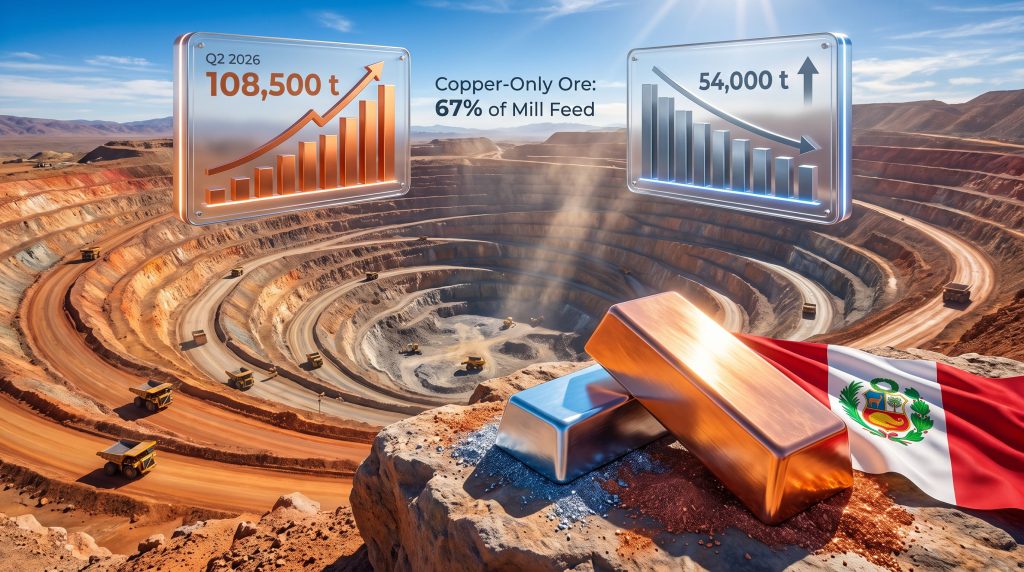
| Copper production (100% basis) | ~65,000 t | 108,500 t | +43,500 t (~+67%) |
| Zinc production (100% basis) | 142,000 t | 54,000 t | -88,000 t (~-62%) |
| Teck's attributable copper (22.5%) | ~14,600 t | ~24,400 t | +~9,800 t |
Three distinct factors converged to produce the headline year-on-year copper surge and zinc decline:
- Planned ore zone sequencing into higher-copper, lower-zinc zones as dictated by the mine schedule
- A depressed comparative base for copper in Q2 2025, when the mine suspended operations following a workplace fatality on April 22, 2025
- A temporary shutdown of the 302-kilometre slurry pipeline, which transports both copper and zinc concentrates from the mine site in the Andes down to the port for shipment, further suppressing zinc concentrate sales volumes beyond what the ore mix shift alone would have produced
Teck's chief executive confirmed during the July 23 earnings call that the pipeline had been repaired and returned to service. The pipeline disruption is therefore a one-off volume event, not a structural impediment to future zinc concentrate shipments.
The Pipeline: An Underappreciated Logistical Chokepoint
The Antamina slurry pipeline is one of the longest of its kind in South America. Concentrate slurry, a mixture of finely ground ore particles and water, is pumped under pressure across challenging Andean terrain to reach the coastal port facility. Any shutdown of this system, even temporary, has an outsized effect on the mine's ability to convert in-situ production into shipped, marketable product.
This logistical dependency is a risk factor that is often underweighted in analyses focused solely on mine-site production data. An operation can be producing concentrate at full capacity and still show a decline in concentrate sales if the transport mechanism is offline. For zinc, where Q2 2026 output was already suppressed by the ore mix shift, the pipeline outage compounded the sales volume reduction in a way that overstates any longer-term structural signal.
Copper Concentrate Treatment Charges: Understanding Negative TC Territory
The copper concentrate market context around Antamina shifts to copper-only ore is arguably as significant as the production data itself. In addition, the copper price drivers shaping 2025 and 2026 are directly influencing how smelters and miners negotiate these terms.
What Are Treatment and Refining Charges?
Treatment charges (TCs) and refining charges (RCs) are fees paid by mining companies to smelters to process copper concentrate, which typically contains between 25% and 35% copper, into refined metal. The TC/RC structure has historically represented compensation to the smelter for the capital and operating costs of running the processing facility.
When TC/RCs turn negative, the economic logic inverts. The smelter is no longer being compensated by the miner. Instead, the smelter is effectively paying a premium on top of the value of the contained metal to secure raw material supply. This only occurs when concentrate supply is materially insufficient relative to installed smelting capacity.
Fastmarkets assessed its weekly copper concentrates TC index (CIF Asia Pacific) at $(193.20) per tonne as of late July 2026, a decline of $14.00 per tonne from $(179.20) per tonne the prior week. To contextualise that figure: as recently as 2023, benchmark TC/RCs were being negotiated at positive levels above $80 per tonne. The move from positive $80 to negative $193 in roughly three years represents a shift of approximately $273 per tonne in the commercial terms governing a significant portion of global copper concentrate trade.
Why Sulfuric Acid Dynamics Are Quietly Reshaping Smelter Economics
A less widely understood factor amplifying smelter willingness to accept negative TCs is the sulfuric acid by-product dynamic. Copper smelters generate large volumes of sulfuric acid as a process by-product when sulfur dioxide off-gases are captured and converted. Under normal market conditions, this acid is sold to the fertiliser and chemicals industries at relatively modest prices.
Disruptions to Middle East sulfur supply during Q2 2026 elevated sulfuric acid prices, improving the net revenue position of smelters even as TC/RCs moved further into negative territory. In practical terms, a smelter earning elevated acid revenues can tolerate paying more to secure concentrate, because the overall economics of running the smelter at high utilisation remain commercially viable. This dynamic has become an increasingly important variable in concentrate market modelling, particularly for smelters with strong acid offtake arrangements. Furthermore, copper smelting expansion trends in 2025 have added further complexity to regional supply-demand balances.
Zinc Concentrate Treatment Charges: A Structural Collapse Hiding in Plain Sight
While copper TC/RC dynamics have attracted significant market attention, the parallel collapse in zinc concentrate treatment charges has been equally dramatic.
| Assessment | January 9, 2026 | July 10, 2026 | Change |
|---|---|---|---|
| Zinc concentrate spot TC, CIF China | $40-$60/t | $(70)-$(120)/t | ~-$145/t midpoint swing |
The midpoint swing of approximately $145 per tonne represents a decline exceeding 250% from the January 2026 level, as assessed by Fastmarkets. This is not a minor softening. Zinc TCs entering deeply negative territory alongside copper TCs suggests that the concentrate supply tightness narrative in base metals is not copper-specific. Both markets are reflecting the same underlying structural dynamic: global mine supply growth has not kept pace with installed smelter capacity.
Several factors are simultaneously shaping the zinc concentrate picture:
- Record-level copper and zinc output from Kipushi in the Democratic Republic of Congo is emerging as a new supply source, but volumes remain modest relative to global market size
- A smelter fire in South Korea temporarily reduced available zinc processing capacity, tightening the supply-demand balance further
- Chinese zinc exporters have remained cautious, with thin margins on refined metal limiting appetite for large-scale cargo movements
- By-product payables, including credits for lead, silver, and other metals recovered from zinc concentrate, have gained commercial importance in negotiations since the second half of 2025, complicating straightforward TC comparisons across deals
Zinc TCs have now moved through a structural inflection point that extends well beyond seasonal fluctuations. The January-to-July 2026 swing represents a fundamental revaluation of raw material scarcity in the zinc processing chain, not a temporary pricing anomaly.
Teck's Group Performance: A Copper Transformation Thesis Playing Out in Real Time
The Antamina production shift sits within a broader group-level copper production trajectory that Teck has been executing since divesting its steelmaking coal business and repositioning as a focused copper producer. Consequently, understanding how a major copper project like Antamina fits within global supply planning becomes essential context for interpreting these results.
Q2 2026 group results at a glance:
- Total group copper production: 135,900 tonnes, up 25% year on year
- Production growth recorded across all four of Teck's copper operations
- Full-year 2026 copper production guidance maintained at 455,000 to 530,000 tonnes
- Group adjusted EBITDA: C$2.2 billion (~US$1.6 billion), described by management as more than triple the comparable prior period
- Teck cited a record quarterly average copper price as a key earnings driver during the July 23 results call
Antamina's attributable contribution to Teck's copper output nearly doubled year on year, from approximately 14,600 tonnes to approximately 24,400 tonnes, demonstrating how consequential the single-asset ore zone sequencing decision is at the group reporting level. For investors tracking Teck's copper production growth thesis, Antamina's 2026 copper phase is not incidental. It is central to the earnings uplift story.
The next major ASX story will hit our subscribers first
Forward Trajectory: What Happens When Antamina Returns to Zinc-Rich Zones?
Based on publicly available production guidance and operational commentary, Antamina forecasts copper output to peak at approximately 450,000 tonnes in 2026, up from approximately 380,000 tonnes in 2025. Post-peak copper output is projected to stabilise at around 400,000 tonnes annually in subsequent years as the mine sequences back through mixed and zinc-bearing ore zones.
The table below models the market implications of each phase transition:
| Mining Phase | Copper Output | Zinc Output | Concentrate Market Effect |
|---|---|---|---|
| Current (2026 copper peak) | ~450,000 t/yr | Suppressed ~200,000 t/yr | Adds copper concentrate supply to tight market |
| Transition to copper-zinc zones | Moderate decline | Recovery toward ~450,000 t/yr | Eases zinc TC pressure; copper TC remains tight |
| Future zinc-dominant sequencing | Reduced | Elevated | Copper concentrate tightness persists |
This cyclical pattern carries a critical implication for market modellers. Antamina cannot be treated as a fixed annual contributor to either copper or zinc supply. Its output profile is dynamic by geological design. Projections that assume current copper-heavy output ratios will persist materially overstate near-term copper concentrate supply and understate the zinc concentrate recovery already embedded in the mine's future sequencing plan. Additionally, copper processing economics will increasingly influence how concentrate from these transitioning ore zones is valued and processed downstream.
Key Takeaways for Investors and Market Participants
Reading the Antamina ore mix shift accurately requires separating three distinct signals that are currently being conflated in market commentary:
- The ore zone sequencing signal confirms that Antamina shifts to copper-only ore at its planned 2026 peak, consistent with a pre-scheduled geological phase, not a strategic pivot away from zinc
- The pipeline disruption signal added a temporary, non-recurring constraint on zinc concentrate sales that exaggerated the apparent structural decline in zinc output
- The concentrate market tightness signal is real, structural, and extends well beyond Antamina's individual production decisions, reflecting a global supply-demand imbalance across both copper and zinc processing chains
For those monitoring Peru's role in global copper supply, Antamina's trajectory toward approximately 450,000 tonnes of copper in 2026 is a meaningful contributor to the country's production outlook. However, the mine's life extension to 2036 means its long-term value to all four joint venture partners, particularly in zinc-bearing zones that will be reactivated in future sequencing phases, remains firmly intact.
Disclaimer: This article contains forward-looking statements and production projections sourced from publicly available company guidance and market assessments. These figures are subject to change based on operational, geological, and market conditions. Nothing in this article constitutes financial or investment advice. Readers should conduct independent due diligence before making investment decisions. Treatment charge data referenced in this article is sourced from Fastmarkets price assessments.
Want to Position Yourself Ahead of the Next Major Mineral Discovery?
Discovery Alert's proprietary Discovery IQ model delivers real-time alerts on significant ASX mineral discoveries, instantly translating complex mineral data into actionable investment insights for both short-term traders and long-term investors — explore historic discoveries and the returns they generated to understand what early positioning can mean, then begin your 14-day free trial at Discovery Alert to secure your market-leading edge.