June 20, 2026
The Brownfield Blueprint: Why Antamina's US$2 Billion Expansion Redefines Latin American Copper Strategy
When mining analysts debate the future of global copper supply, the conversation almost always gravitates toward undiscovered greenfield deposits, frontier exploration jurisdictions, and the speculative timelines of projects yet to break ground. Yet some of the most consequential copper supply decisions of this decade are happening not in unexplored territories, but deep within existing operations that already possess the geology, infrastructure, and regulatory relationships to deliver metal at scale. The Antamina expansion is precisely that kind of decision, and its implications extend far beyond a single Peruvian mine.
When big ASX news breaks, our subscribers know first
Antamina's Position in the Global Copper Landscape
Situated in Peru's Ancash region at elevations exceeding 4,300 metres above sea level, Antamina ranks among the world's largest and most strategically significant polymetallic open-pit operations. Unlike pure copper mines, Antamina produces a multi-commodity suite that includes copper, zinc, molybdenum, and silver, a combination that provides revenue resilience across commodity price cycles that single-metal operations fundamentally cannot replicate.
Peru holds its position as the world's second-largest copper producer, contributing approximately 11 to 13 percent of global copper mine production annually, according to the U.S. Geological Survey Mineral Commodity Summaries. Antamina anchors that position, historically accounting for between 7 and 9 percent of Peru's total national copper output. That geological and operational relevance explains why decisions made at this one mine carry outsized consequences for global supply models.
What is less commonly appreciated is how the mine's altitude shapes both its operational complexity and its competitive distinctiveness. At 4,300 metres, reduced air density affects combustion engine efficiency, worker physiology, and the performance parameters of heavy earthmoving equipment. These constraints raise operating costs relative to lower-altitude operations in Chile and Argentina, yet Antamina compensates through scale, ore body richness, and the economic buffer provided by its multi-metal output.
Ownership, Governance, and Capital Allocation
The Antamina expansion reflects a joint commitment from one of mining's most institutionally credible ownership consortiums. The four-partner structure comprises Glencore, BHP, Teck Resources, and Mitsubishi, each bringing distinct strategic priorities, commodity exposure preferences, and balance sheet characteristics to the decision-making table.
Multi-partner mining governance structures carry inherent complexity. Capital approval thresholds, environmental policy alignment, dividend distribution arrangements, and operational authority delegations all require negotiated consensus. In practice, this means major expansion decisions at Antamina must satisfy diverse institutional criteria simultaneously, a governance filter that ultimately strengthens project quality by subjecting proposals to multiple independent assessments before capital is committed.
The participation of risk-mitigation instruments from the World Bank Group's Multilateral Investment Guarantee Agency (MIGA) adds an institutional confidence signal for the project's financial viability and its environmental and social governance standards. MIGA instruments typically provide coverage against political risks including expropriation and breach of contract, reducing the risk premium demanded by institutional capital and enabling more competitive financing structures for large-scale infrastructure programs.
The US$2 Billion Capital Program: Scale, Scope, and Engineering Ambition
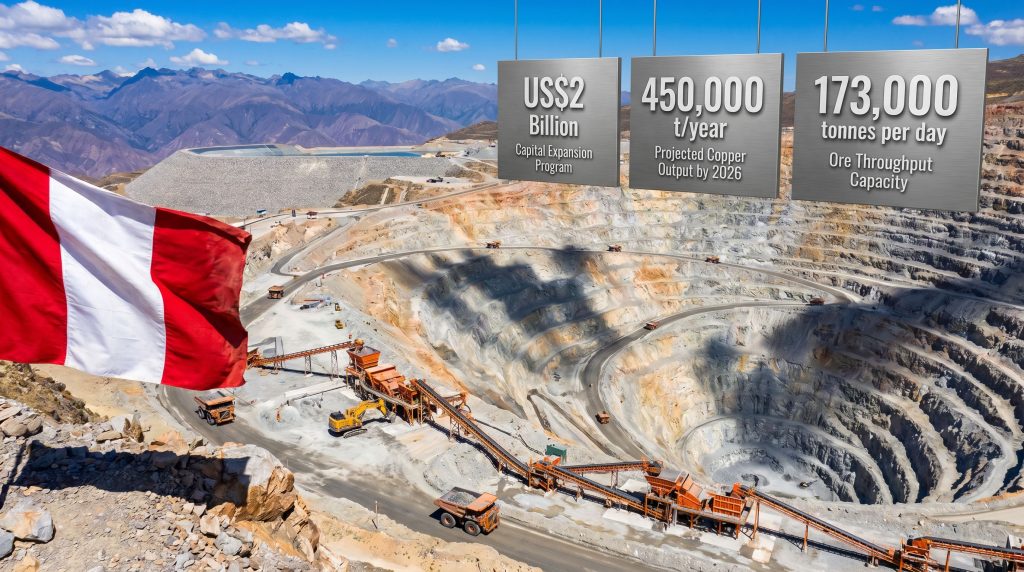
The Antamina expansion represents a US$2 billion capital commitment directed across four primary areas: open pit enlargement, tailings infrastructure, crushing and conveyor systems, and mining fleet upgrades. The physical scope of the program is substantial by any measure.
| Metric | Pre-Expansion | Post-Expansion |
|---|---|---|
| Mine Area Growth | Baseline | ~25% increase |
| Open Pit Depth | Baseline | +150 metres deeper |
| Ore Throughput Capacity | Below 173,000 t/day | Up to 173,000 t/day |
| Tailings Storage Capacity | ~1,100 million tonnes | ~1,572 million tonnes |
The ore throughput target of 173,000 tonnes per day places Antamina among the highest-capacity polymetallic operations globally. To contextualise that figure, most operating copper mines process between 50,000 and 150,000 tonnes of ore daily. Achieving 173,000 tonnes requires not just pit expansion but a fundamental upgrade of the ore handling and processing chain from the face of the pit through to concentrate production.
One of the more analytically interesting infrastructure decisions embedded in this program is the shift toward in-pit crushing and conveyor systems to reduce truck haulage dependency. This transition typically delivers per-tonne haulage cost reductions of 30 to 50 percent compared with purely truck-dependent operations, while simultaneously lowering diesel consumption and associated emissions. As open pit mines deepen, truck cycle times extend and per-tonne costs rise steeply; conveyor infrastructure breaks this cost curve. These copper processing benefits extend across the broader industry as operations seek greater efficiency at depth.
The waste movement capacity scaling to approximately 742,000 tonnes per day implies a waste-to-ore ratio of roughly 4.3:1, a figure that reflects the geological reality of mining deeper into the ore body where ore grades typically decline and proportionally more surrounding rock must be moved per tonne of recoverable copper.
Tailings Dam Engineering: The Project's Most Technically Demanding Component
The tailings infrastructure program involves two distinct engineering challenges. The first is a 30-metre raise to the existing tailings dam structure. The second, and considerably more complex, is the construction of a new 230-metre-high rockfill tailings structure at altitude. Together, these works expand total tailings storage capacity from approximately 1,100 million tonnes to 1,572 million tonnes, an increase of roughly 43 percent.
A 230-metre rockfill structure at 4,300-plus metres elevation is, by any geotechnical standard, among the most demanding tailings engineering challenges in active Latin American mining. The design must account for:
- Seismic loading from Peru's active tectonic zone along the Pacific margin
- Hydrostatic pressure management at altitude where atmospheric pressure differentials affect pore water behaviour
- Freeze-thaw cycling and high-altitude precipitation patterns affecting structural integrity
- Limited construction season windows due to weather constraints at extreme elevation
- Reduced equipment performance from lower air density, extending construction timelines
Global engineering firms specialising in mine waste management infrastructure, including Stantec and Klohn Crippen Berger, have established capabilities in high-altitude tailings design relevant to projects of this complexity. Independent tailings review boards, now standard practice at large operations, provide quarterly technical oversight to ensure design and construction quality throughout the build program.
The global shift toward stricter tailings dam governance standards, catalysed by high-profile dam failures in Brazil, has fundamentally changed what large-scale tailings projects must demonstrate before receiving regulatory approval. Antamina's expansion design reflects these evolved standards, incorporating advanced geotechnical monitoring, independent technical review, and real-time instrumentation systems.
Regulatory Pathway: Peru's Environmental Approval Framework
Peru's environmental permitting framework for large-scale mining operates through the Ministry of Environment (MINAM), which administers Environmental Impact Studies and their subsequent modification approvals. The Antamina expansion received regulatory authorisation through a Modification to the Environmental Impact Study (MEIA) in early 2024, covering the open pit enlargement, expanded waste dump footprints, and the tailings dam raise.
MEIA modifications are procedurally distinct from initial EIA approvals. Rather than requiring comprehensive baseline assessment across a new project footprint, modifications review incremental changes to an already-approved operational envelope. This procedural distinction typically produces shorter regulatory timelines, though community consultation requirements remain meaningful when the modified scope affects previously unimpacted areas or communities.
The 2024 MEIA approval functions as the critical regulatory gateway enabling the construction program's 2028 commencement. Without this authorisation, no construction mobilisation would be legally permissible under Peru's environmental law framework, underscoring why securing this approval was a foundational prerequisite for the entire investment program.
Community engagement in the Ancash region carries particular weight. The mine's extended operational life through 2036, and potentially 2049, creates sustained socio-economic dependencies that make social licence management an ongoing operational priority rather than a one-time approval milestone. Environmental monitoring commitments embedded in the MEIA, covering water quality, air quality, and biodiversity indicators, bind the operation to long-term performance obligations enforceable by both regulators and local stakeholders.
Production Profile: Copper Output Through 2036 and Beyond
The production economics of the Antamina expansion are anchored by a clearly modelled output trajectory. According to mining.com, copper production is projected to reach approximately 450,000 tonnes per year by 2026 during the ramp-up phase, representing roughly a 20 percent increase over the pre-expansion baseline of around 380,000 tonnes annually.
| Production Period | Estimated Annual Copper Output |
|---|---|
| Pre-Expansion Baseline | ~380,000 tonnes/year |
| 2026 Ramp-Up Phase | ~450,000 tonnes/year |
| 2027-2036 Steady State | ~400,000-430,000 tonnes/year |
The stabilisation of output at 400,000 to 430,000 tonnes annually from 2027 through 2036 reflects the operational reality of mining at depth: new pit zones, refreshed crushing infrastructure, and conveyor integration all contribute to production capacity, but deeper ore bodies typically carry somewhat lower grades than shallower historical mining zones. The combination of higher throughput volume with potentially declining grades produces a net output profile that is stable rather than continually ascending.
The mine life extension scenario to 2049 deserves particular analytical attention. A 13-year extension beyond the current 2036 horizon represents enormous economic value at any reasonable long-run copper price assumption. Extension feasibility depends on ore body geometry at depth, confirmation of economically recoverable mineral inventory through resource definition drilling, and capital recovery modelling that justifies the next capital cycle. Engineering studies exploring the 2049 scenario are already underway, suggesting the geological case is sufficiently compelling to warrant formal evaluation.
Antamina's polymetallic character provides a revenue smoothing mechanism that pure copper operations cannot replicate. When copper prices soften, zinc and molybdenum may strengthen on their own supply-demand dynamics. Silver by-product credits enhance overall project economics at scale. This multi-commodity cash flow architecture reduces the earnings volatility that would otherwise accompany a single-metal reliance on copper price cycles, making Antamina's long-run economics more predictable and its investment case more robust across a range of price scenarios.
The next major ASX story will hit our subscribers first
Strategic Timing: Energy Transition Demand and the Copper Supply Gap
The timing of the Antamina expansion is not incidental. It intersects precisely with structural demand shifts in global copper markets driven by electrification, renewable energy infrastructure deployment, and grid modernisation programs across major economies. Understanding the copper supply gap is essential context for appreciating why this expansion carries such strategic weight.
Electric vehicles consume between three and four times more copper than internal combustion engine vehicles. Offshore wind turbines require approximately 8 to 10 tonnes of copper per megawatt of installed capacity, according to the Copper Development Association. Grid-scale battery storage, transmission line upgrades, and EV charging infrastructure each add incremental demand layers. These structural accelerators are widely projected to produce copper supply deficits through the 2030s as demand growth outpaces the capacity of existing mines and currently permitted new projects.
This is precisely where the brownfield advantage becomes strategically decisive.
| Factor | Brownfield Expansion (Antamina) | Greenfield Development |
|---|---|---|
| Permitting Timeline | Shorter (MEIA modification) | Longer (full EIA required) |
| Infrastructure Cost | Lower (existing assets leveraged) | Higher (built from scratch) |
| Community Relations | Established relationships | New engagement required |
| Execution Risk | Lower | Higher |
| Lead Time to Production | Faster | 7-15+ years typical |
New greenfield copper projects typically require 7 to 15 years from discovery to first production, incorporating exploration, feasibility, permitting, financing, and construction phases. Furthermore, brownfield expansions like Antamina's compress this timeline significantly because existing infrastructure, established community relationships, and prior regulatory approvals reduce the time and capital required to achieve incremental production growth. The copper supply crunch facing global markets makes every tonne of copper produced earlier carry premium strategic value.
Socio-Economic Dimensions: Ancash Region and Peru's National Accounts
The extended mine life through 2036, with potential continuation to 2049, locks in multi-decade employment, procurement, and fiscal contribution streams for both the Ancash region and Peru's national economy. Antamina has historically ranked among Peru's largest individual sources of mining tax revenue and royalty contributions, with these fiscal flows funding regional infrastructure, social programs, and national budget priorities.
The construction phase commencing in 2028 generates additional economic activity through direct employment, contractor procurement, equipment supply, and professional services engagement. Peruvian contractors, logistics providers, and technical services firms are positioned to capture a meaningful share of the capital deployment cycle across the construction period.
Water resource management at 4,300-metre elevation presents the most technically complex environmental obligation attached to this expansion. High-altitude hydrological systems are sensitive to both operational footprint changes and broader climate dynamics. Robust water balance monitoring, drainage management, and tailings seepage control systems are central environmental performance indicators for the expanded operation, with compliance obligations embedded in the MEIA approval conditions.
Frequently Asked Questions About the Antamina Expansion
What is the total investment value of the Antamina expansion?
The expansion program represents a capital commitment of approximately US$2 billion, allocated across open pit enlargement, tailings infrastructure upgrades, new crushing and conveyor systems, and fleet expansion.
When will the Antamina expansion be completed?
Major construction activity is scheduled to commence from 2028, with the expanded operation designed to sustain production through at least 2036. Engineering studies are simultaneously evaluating scenarios to extend operational life through to 2049.
Who owns Antamina mine?
Antamina is jointly owned by Glencore, BHP, Teck Resources, and Mitsubishi, representing a consortium of major global mining and resources companies.
How much copper will Antamina produce after the expansion?
Copper output is projected to reach approximately 450,000 tonnes per year by 2026, stabilising at 400,000 to 430,000 tonnes annually through the 2027 to 2036 steady-state production period.
What environmental approvals were required for the expansion?
Peru's environmental authority approved a modification to Antamina's Environmental Impact Study (MEIA) in early 2024, authorising the expansion of the open pit, waste dump enlargement, and the tailings dam raise.
What metals does Antamina produce besides copper?
Antamina is a polymetallic operation producing copper, zinc, molybdenum, and silver, with the multi-commodity output delivering revenue diversification advantages across commodity price cycles.
What the Antamina Expansion Signals for Latin American Mining
The Antamina expansion crystallises a broader strategic trend reshaping how the global mining industry approaches capital allocation. In an environment characterised by constrained project pipelines, lengthening permitting timelines, and rising greenfield development costs, brownfield reinvestment at proven operations with established geological depth is becoming the primary mechanism for incremental copper supply growth.
For investors, understanding the key copper price drivers alongside the combination of institutional consortium ownership, multilateral risk-mitigation instruments, a secured regulatory pathway through the 2024 MEIA approval, polymetallic revenue diversification, and alignment with structural copper demand growth creates a project profile that is difficult to replicate through greenfield alternatives at comparable risk-adjusted returns. Indeed, a major copper-gold project such as Reko Diq illustrates, by contrast, the considerably longer timelines associated with greenfield development in frontier jurisdictions.
For the global copper supply chain, Antamina's expansion delivers something genuinely scarce: large-scale, brownfield, permitted copper production capacity that can realistically enter service within the critical supply window of the late 2020s to mid-2030s, precisely when demand models indicate the most acute supply pressure.
The Antamina expansion is not simply the story of one mine getting larger. It is a case study in how geological resource depth, operational track records, and multi-decade institutional commitment unlock investment cycles that sustain copper supply through the energy transition era and beyond.
This article contains forward-looking statements and production estimates based on publicly available project information and industry analysis. Actual production outcomes, timelines, and capital costs may differ materially from projections. Readers are encouraged to consult independent financial and technical advice before making investment decisions.
Want to Track the Next Major Copper Discovery Before the Market Does?
Discovery Alert's proprietary Discovery IQ model delivers real-time alerts the moment significant mineral discoveries — including copper — are announced on the ASX, transforming complex geological data into actionable investment insights for both short-term traders and long-term investors. Explore how historic discoveries have generated extraordinary returns on Discovery Alert's dedicated discoveries page, and begin your 14-day free trial today to position yourself ahead of the broader market.