
June 20, 2026
Mining Compliance Under Political Pressure: What Structured Audits Actually Measure
When a large-scale mining operation is suspended under politically charged circumstances, the question of what happens next rarely has a clean answer. Operations freeze, workforces disperse, environmental systems enter care-and-maintenance mode, and legal teams mobilise across multiple jurisdictions simultaneously. The infrastructure remains, but the obligations tied to it do not disappear. In fact, they intensify. It is precisely in these suspended-state scenarios that compliance architecture is tested most severely, and where structured third-party audits become the most consequential instruments available to regulatory authorities.
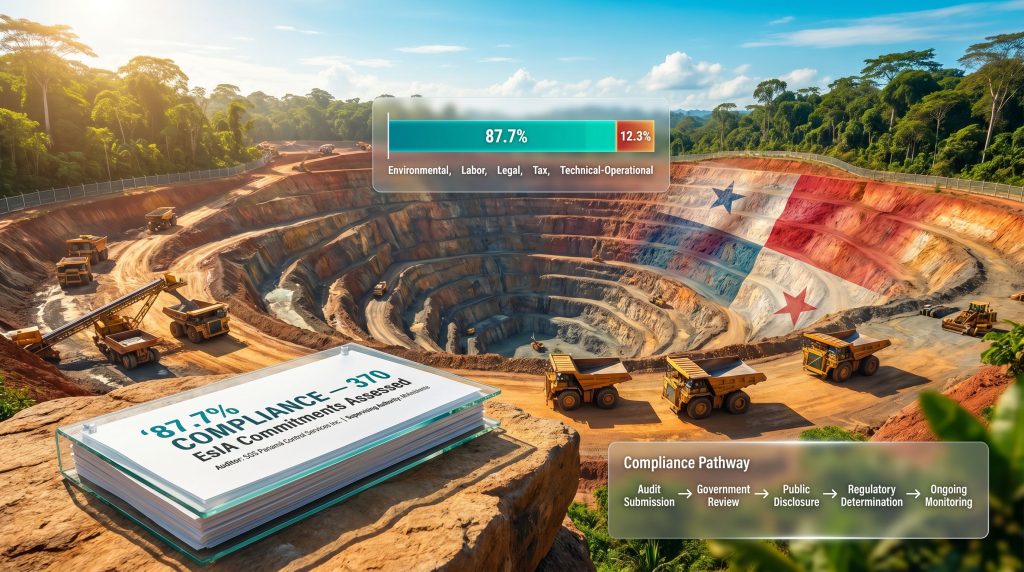
The Cobre Panamá compliance audit, conducted by SGS Panamá Control Services Inc. under the supervision of Panama's Ministry of Environment (MiAmbiente), offers a detailed case study in how modern mining governance attempts to manage this exact problem. With an interim compliance finding of 87.7% across 370 legally binding Environmental Impact Study (EsIA) commitments, the review has become one of the most closely watched regulatory events in Latin American mining since the mine's politically driven closure.
When big ASX news breaks, our subscribers know first
Understanding Panama's EsIA Compliance Framework
Panama's Environmental Impact Study system is the foundational legal instrument governing large-scale resource extraction in the country. When a project like Cobre Panamá receives its environmental impact approval, it does so against a detailed matrix of commitments spanning environmental protection, labour standards, community relations, tax obligations, and technical site management. These are not aspirational targets; they are legally binding obligations with defined measurement criteria.
The 370 EsIA commitments assessed in this audit represent the full operational compliance universe of the project. Understanding what that number actually captures requires appreciating how the categories interact:
| Audit Domain | Key Areas Assessed |
|---|---|
| Environmental | Air quality, water management, GHG emissions, biodiversity monitoring, waste disposal |
| Social and Community | Community relations protocols, cultural heritage protection |
| Labour | Workforce safety standards, employment obligations |
| Legal and Tax | Contractual compliance, fiscal reporting obligations |
| Technical-Operational | Site management standards under suspended-operations conditions |
What distinguishes Panama's EsIA framework from simpler permit systems used elsewhere in the region is its holistic scope. Rather than treating environmental compliance as a standalone domain, the EsIA system integrates social, fiscal, and operational obligations into a single auditable structure. This creates a compliance scorecard broad enough to capture the full footprint of a project's impact, but also complex enough to produce nuanced findings rather than binary pass-or-fail determinations.
Furthermore, by comparison, Peru's environmental compliance system, administered through the Servicio Nacional de Certificación Ambiental (SENACE), tends to separate environmental from social licensing obligations into parallel tracks. Chile operates a similarly segmented framework through its Sistema de Evaluación de Impacto Ambiental (SEIA). Panama's integrated EsIA approach arguably enables more comprehensive compliance measurement, though it also creates greater surface area for partial non-compliance to emerge, particularly during extended operational suspensions. This integrated model also has notable parallels with the mining claims framework developed in British Columbia, where multi-domain obligations are similarly woven into a single regulatory structure.
Why Independent Auditor Credentials Matter in Government-Supervised Reviews
SGS Panamá Control Services Inc. operates as part of SGS S.A., a Geneva-headquartered inspection, verification, testing, and certification company widely regarded as one of the world's largest in its sector. SGS has operational presence in over 115 countries and conducts compliance assessments across mining, oil and gas, agriculture, and industrial sectors globally.
The structural distinction between a government-supervised third-party audit and an operator-commissioned review is not merely procedural; it is substantive. When a mining company commissions its own compliance assessment, the auditor's scope, access, and reporting obligations are shaped by the contractual relationship with the client. When MiAmbiente commissions or supervises the audit, however, the auditor's obligations run directly to the regulatory authority, not to the operator. This structural independence is what gives the SGS findings their evidentiary weight in any subsequent regulatory, arbitral, or political process.
Key consideration: In investor-state dispute contexts, the independence of an audit's commissioning authority can determine whether findings are accepted as neutral evidence or challenged as operator-biased assessments. Government-supervised audits occupy a fundamentally different evidentiary tier.
Interpreting the 87.7% Score: What It Means and What It Does Not
The 87.7% compliance rating indicates that approximately 325 of the 370 EsIA commitments assessed were found to be met at the time of the audit review. The remaining ~12.3%, representing roughly 45 commitments, were assessed as requiring corrective action or remained outstanding. It is critical to note that this figure represents an advance or interim finding, not a final official determination by MiAmbiente. Readers and investors should treat it as directional evidence of compliance posture rather than a conclusive regulatory certification.
Within the audit methodology itself, compliance determinations typically fall across a spectrum:
- Fully compliant: The commitment has been met in full accordance with EsIA specifications
- Partially compliant: The obligation is being addressed but has not yet reached the required standard
- Non-compliant: The commitment has not been met and requires immediate corrective action
- Not applicable: The commitment is contextually inapplicable given the project's suspended operational status
The last category is particularly relevant for Cobre Panamá. Some EsIA commitments are inherently linked to active production, such as process water management targets or ore throughput-related environmental controls. When a project is in care-and-maintenance mode, the methodology for evaluating these commitments requires adaptation, and auditors must distinguish between obligations that are genuinely breached and those that are simply dormant due to suspension.
Important caveat: The 87.7% figure is derived from an interim advance report as of June 2026. Final official audit determinations from MiAmbiente have not yet been published. All analysis should be understood within this context.
How Does 87.7% Benchmark Against Industry Norms?
For context, comprehensive third-party compliance audits of large open-pit copper operations during extended suspensions typically encounter meaningful non-compliance rates in the 10–20% range, primarily because prolonged care-and-maintenance conditions create operational drift in environmental monitoring systems, labour retention obligations, and community engagement requirements. An 87.7% rate against 370 discrete commitments therefore represents a materially strong interim outcome, though the quality of what sits within that 12.3% gap matters considerably more than the headline figure alone.
Non-compliance concentrated in peripheral administrative obligations carries very different regulatory and legal weight than non-compliance in core environmental or labour domains. Until MiAmbiente publishes its detailed domain-by-domain breakdown, the distribution of that 12.3% gap remains a critical unknown for any analyst assessing the mine's restart prospects. Indeed, the importance of mine reclamation importance and environmental stewardship during suspension periods cannot be overstated in this regard.
The Political Economy Surrounding the Audit
Cobre Panamá was, at the time of its suspension, one of the largest copper mines in Latin America by production capacity. The First Quantum Minerals-operated facility had a designed throughput capacity of approximately 100 million tonnes of ore per year and had reached copper production rates exceeding 350,000 tonnes annually before operations were halted following large-scale public protests in late 2023 and a subsequent Supreme Court ruling that declared its operating contract unconstitutional.
The economic consequences for Panama have been significant. Prior to suspension, the mine contributed an estimated 3–5% of Panama's GDP and represented the country's largest single private investment. Its closure removed a substantial fiscal revenue stream at a time when Panama was already managing fiscal pressures, and the International Monetary Fund flagged the mine's shutdown as a meaningful drag on the country's near-term growth trajectory.
This economic backdrop transforms the Cobre Panamá compliance audit from a purely technical exercise into a politically charged process. A favourable audit outcome strengthens the case for any future restart discussion, while significant non-compliance findings would provide ammunition for those advocating permanent closure or contract termination. The Cobre Panamá arbitration impacts further complicate this picture, as MiAmbiente's transparency mandate means whatever SGS ultimately reports will enter the political arena as a direct input to public debate.
Macro perspective: Copper's centrality to the global clean energy transition adds a geopolitical dimension to Cobre Panamá's status that extends well beyond Panama's borders. The International Energy Agency projects that copper demand could nearly double by 2040 under accelerated energy transition scenarios, making the resolution of major suspended copper projects a matter of supply chain interest for energy importers worldwide.
Regulatory Pathways After the Audit: Three Scenarios
Once the final audit report is delivered to MiAmbiente and the government review process is complete, three broad regulatory trajectories are possible:
Scenario 1: Conditional restart authorisation. If the final compliance determination supports the interim 87.7% finding and the outstanding obligations are assessed as remediable within defined timeframes, MiAmbiente could structure a conditional restart framework requiring the operator to fulfil specific milestones before production resumes. This pathway would likely require ongoing third-party monitoring verification.
Scenario 2: Mandatory remediation without restart approval. MiAmbiente may determine that outstanding compliance gaps must be fully resolved before any restart consideration, effectively establishing a sequenced remediation programme with defined timelines and enforcement mechanisms. This scenario could extend the suspension period by months to years depending on the complexity of required corrective actions.
Scenario 3: Audit findings as leverage in contract renegotiation or termination. Non-compliance findings, particularly in legally sensitive domains, could become instruments in Panama's broader contractual and arbitral strategy. The First Quantum arbitration case has already generated significant international attention, and the compliance audit findings will form part of the evidentiary record that both parties draw upon.
Step-by-Step: How Audit Findings Move Through the Regulatory System
- Submission – SGS delivers the final comprehensive audit report to MiAmbiente
- Government review – MiAmbiente assesses findings against statutory compliance thresholds and legal requirements
- Public disclosure – Transparency obligations require the publication of key findings accessible to public stakeholders
- Formal determination – MiAmbiente issues an official regulatory decision: remediation order, conditional approval, or further review
- Compliance timeline – Enforceable deadlines are established for any outstanding obligations
- Ongoing verification – Continued third-party monitoring confirms that corrective actions are being implemented as required
The next major ASX story will hit our subscribers first
What This Audit Signals for Latin American Mining Governance More Broadly
The Cobre Panamá compliance audit is being watched across the region not just for its specific findings, but for the procedural model it represents. Several dynamics make it particularly instructive:
- The use of a multi-domain EsIA compliance matrix rather than a narrowly defined environmental checklist establishes a precedent for holistic suspended-project assessment
- The assignment of an internationally accredited third-party auditor under direct government supervision demonstrates a governance model that can command credibility across investor, community, and arbitral audiences simultaneously
- The public transparency commitment embedded in the process reflects a broader shift in Latin American mining governance toward participatory regulatory models that integrate community accountability alongside technical compliance
- The audit's interim nature, with findings being disclosed progressively rather than in a single final report, raises questions about how partial disclosure affects market behaviour, political dynamics, and community trust during the review period
One underappreciated dynamic in suspended-project audits of this scale is the challenge of assessing prospective environmental liabilities versus historical compliance. Auditors must evaluate not just whether past obligations were met, but whether the current care-and-maintenance configuration creates foreseeable future risks — such as tailings stability under prolonged non-operational conditions, groundwater management without active pumping systems, and biodiversity monitoring in the absence of operational site staff. These prospective liability assessments are methodologically distinct from backward-looking compliance scoring and often carry greater long-term regulatory weight. Consequently, the broader mining geopolitical landscape in 2025 has intensified scrutiny of precisely these kinds of assessments across jurisdictions.
Furthermore, First Quantum's own published position on the mine's operational status and commitments provides useful context when evaluating the scope of what the audit assesses against what the operator has publicly stated.
Key Metrics: At a Glance
| Metric | Detail |
|---|---|
| Reported Compliance Rate | 87.7% (interim advance finding) |
| Total EsIA Commitments Assessed | 370 |
| Estimated Compliant Commitments | ~325 |
| Non-Compliance Gap | |
| Auditor | SGS Panamá Control Services Inc. |
| Supervising Authority | MiAmbiente (Panama's Ministry of Environment) |
| Audit Domains | Environmental, Labour, Legal, Tax, Technical-Operational |
| Audit Status | Advance/in-progress report as of June 2026 |
Frequently Asked Questions
What is the Cobre Panamá compliance audit?
The Cobre Panamá compliance audit is an independent, government-supervised review assessing the mine's adherence to 370 legally binding obligations established under its Environmental Impact Study. It covers environmental, labour, legal, tax, and operational domains, and is conducted by SGS Panamá Control Services Inc. under MiAmbiente oversight.
Does an 87.7% compliance score mean the mine can reopen?
Not automatically. A favourable audit outcome is one necessary input into any restart consideration, but it does not constitute a restart authorisation. Political, contractual, social, and arbitral factors will all bear on whether and how operations could resume.
How do audit findings interact with international arbitration?
Audit findings provide an independent evidentiary record of the mine's compliance status during the suspension period. This documentation may be relevant to investor-state arbitration proceedings, as it speaks to operational and environmental conduct throughout the shutdown.
Why does the audit cover labour and tax obligations alongside environmental ones?
Panama's EsIA framework integrates social, fiscal, and operational commitments alongside environmental ones as a unified compliance structure. This holistic approach distinguishes Panama's regulatory model from more narrowly defined environmental permit systems used in other jurisdictions.
Disclaimer: This article is for informational purposes only and does not constitute investment advice. The compliance figures cited are based on interim advance audit findings and are subject to revision upon the release of MiAmbiente's final official determination. Investors and stakeholders should conduct their own due diligence and consult qualified advisers before making any decisions based on the information presented here.
Want to Capitalise on the Next Major ASX Mineral Discovery Before the Market Does?
Discovery Alert's proprietary Discovery IQ model delivers real-time alerts on significant ASX mineral discoveries, transforming complex mineral data into clear, actionable insights for both short-term traders and long-term investors — start your 14-day free trial today and discover why historic mineral discoveries have generated some of the most extraordinary returns in the resources sector.