June 19, 2026
The Hidden Cost of Copper: Why Groundwater Has Become the Critical Path Item for Mine Expansion in Arid Chile
Every major copper expansion project carries a visible price tag and a less visible one. The visible cost sits in capital expenditure estimates, contractor agreements, and equipment procurement schedules. The less visible cost is embedded in aquifers, regulatory submissions, and the multi-decade environmental liabilities that water-scarce mining jurisdictions are increasingly demanding producers account for before a single additional tonne of ore is processed. Capstone Mantos Blancos groundwater issues in Chile illustrate precisely this dynamic in one of the world's most consequential copper-producing corridors.
The situation developing at Capstone Copper's Mantos Blancos operation offers one of the most instructive case studies currently available in the global copper industry. It is not simply a story about one company's compliance challenges. It is a window into a structural shift in how environmental governance frameworks are being applied to copper mining in water-stressed regions, and what that shift means for project economics, permitting timelines, and the long-term supply outlook for a metal that sits at the centre of the global energy transition.
When big ASX news breaks, our subscribers know first
Why Groundwater Is Northern Chile's Most Contested Resource
Chile's northern provinces occupy one of the harshest hydrological environments on Earth. The Atacama and Antofagasta regions receive less than 15 millimetres of rainfall annually in many areas, placing them among the driest inhabited zones on the planet. Surface water is effectively absent across most of the landscape, meaning that both mining operations and local communities are entirely dependent on groundwater systems that recharge at geological timescales, measured in centuries or millennia rather than years.
This is not passive background context. It is the defining constraint around which every aspect of copper project development in the region must be structured. Furthermore, as demand for copper accelerates in line with the global energy transition, the tension between production ambitions and environmental limits is intensifying rapidly.
Chile contributes approximately 27% of global copper production, with a disproportionate share originating from its northern provinces where water availability is most limited. The scale of this dependency creates a compounding tension: the ore bodies that underpin Chile's dominant position in global copper supply are physically located in the same geological formations that contain its most irreplaceable groundwater resources. Understanding Chile's copper supply gap helps frame just how consequential these constraints are becoming.
How Open-Pit Mining Disrupts Subsurface Hydrology
Understanding the Capstone Mantos Blancos groundwater issues requires a basic grasp of how large-scale open-pit mining interacts with aquifer systems. The mechanics are counterintuitive in several respects.
When an open pit is excavated through water-bearing rock formations, the removal of material creates pathways for subsurface water movement that did not previously exist. Seepage from tailings storage facilities, process water circuits, and altered drainage gradients can redirect groundwater flow in ways that cause water tables to rise in certain sectors while declining in others.
This means that a mine can simultaneously be dewatering one zone and inadvertently recharging another, producing spatially inconsistent groundwater impacts that are difficult to model and harder to predict.
Key mechanisms driving these disturbances include:
- Pit dewatering operations, which pump groundwater out of active mining areas to maintain safe working conditions, creating localised drawdown cones
- Seepage from process infrastructure, including heap leach pads, tailings dams, and process water pipelines, which adds unplanned recharge to the subsurface
- Geomechanical disruption, where rock mass removal alters the permeability and porosity of surrounding formations, changing how water moves through them
- Altered surface drainage, where land disturbance redirects precipitation and runoff into subsurface pathways
The critical complication is the lag effect. Hydrogeological changes triggered by mining activity can take years or even decades to manifest in monitoring wells or at the surface. By the time regulators or operators detect anomalous groundwater behaviour, the causative activities may have concluded, making attribution difficult and remediation even harder.
Technical note: In arid crystalline rock environments like those found in northern Chile, aquifer systems often have extremely low transmissivity, meaning they transmit water slowly and recover from disturbance over very long timeframes. A groundwater impact that might be reversible within a decade in a humid temperate environment could persist for a century or more under Atacama conditions.
What the Data Reveals About Mantos Blancos
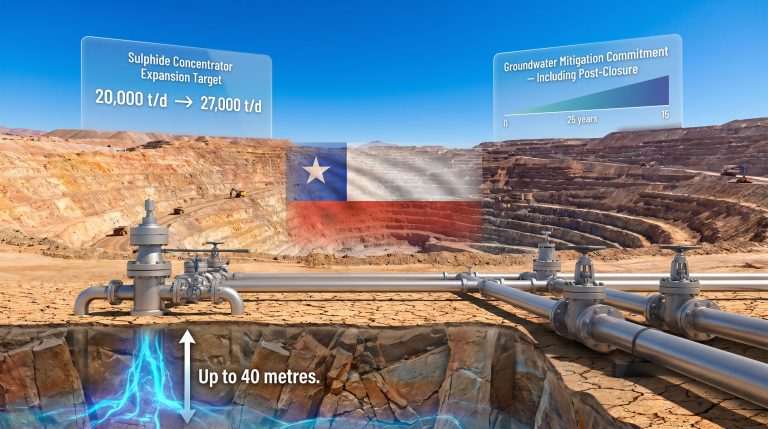
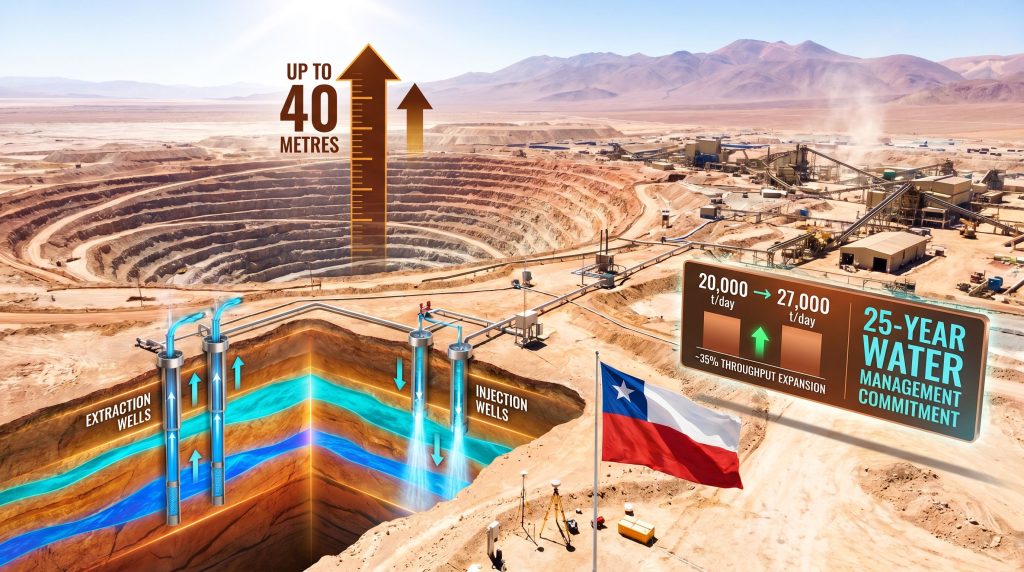
Mantos Blancos is an open-pit copper mine positioned approximately 45 kilometres northeast of the port city of Antofagasta, within the Antofagasta region of northern Chile. The operation is controlled by Capstone Copper, a Vancouver-based copper producer with assets across the Americas. The mine's sulphide concentrator currently processes 20,000 metric tons of ore per day, and the company has targeted an expansion that would push that figure to at least 27,000 metric tons per day, representing a throughput increase of roughly 35%.
The groundwater situation at the site is more complex than a simple over-extraction problem. Capstone's own technical documentation, submitted to Chile's water regulatory authority in March 2026, identifies groundwater effects that reflect the multi-directional nature of subsurface disturbance in active mining environments.
Documented Groundwater Anomalies at the Site
| Groundwater Issue | Scale or Severity | Regulatory Status |
|---|---|---|
| Water table rise in specific sectors | Up to 40 metres vertical increase | Classified as significant |
| Water quality degradation | Mining-linked contamination confirmed | Significant and cumulative |
| Seepage and infiltration events | Associated with infrastructure damage risk | Previously flagged by environmental authorities |
| Standing water accumulation | Ongoing operational hazard identified | Subject to enforcement orders |
The 40-metre vertical rise in water table elevation recorded in one sector represents a substantial departure from pre-mining baseline conditions. Rather than indicating over-extraction, this upward movement suggests that seepage and altered subsurface flow pathways have introduced recharge into a zone that historically discharged water at a much slower rate.
Capstone's own internal documentation characterises these groundwater effects using language that carries direct regulatory weight under Chilean environmental law: the impacts are described as significant, compounding, and cumulative. Each of those terms has specific meaning within Chile's environmental assessment framework, and their use in a formal regulatory submission creates a documented record of materiality that cannot be walked back.
The 2024 Rejection and Its Implications
Chilean environmental authorities had previously ordered Capstone to address the groundwater situation at Mantos Blancos. The company submitted a mitigation proposal, which regulators rejected in 2024 on the grounds that it did not meet the technical and evidentiary standards required to demonstrate adequate control of groundwater impacts.
This rejection is significant beyond its immediate procedural consequences. A failed mitigation submission in Chile's regulatory system does not simply delay a timeline by a few months. It resets the evidentiary burden entirely, requiring the operator to produce a substantially more rigorous technical case before the next submission can be assessed on its merits.
It also explains why a separate, less capital-intensive expansion plan for Mantos Blancos was abandoned approximately two years before the current proposal. The regulatory complexity surrounding the groundwater situation had made a lower-intensity expansion path unviable, necessitating a more comprehensive approach that embeds environmental remediation as a structural feature of the project. The broader copper supply crunch makes resolving these delays all the more pressing for global markets.
Regulatory insight: When a Chilean regulator rejects a groundwater mitigation plan for insufficient rigor, the company must not only improve the technical quality of its proposed measures, it must also demonstrate through monitoring data, hydrogeological modelling, and independent expert review that its understanding of the subsurface system is comprehensive enough to underpin reliable impact predictions.
Inside the Revised Mitigation Framework
Capstone's March 2026 submission to Chile's water regulator outlines a dual-mechanism approach to groundwater management that represents a meaningful upgrade from the rejected 2024 plan.
The Two-Pillar Technical Strategy
1. Active Groundwater Drawdown
In sectors where water table elevation has risen abnormally, Capstone proposes deploying pumping wells to extract excess groundwater and restore hydrogeological conditions closer to pre-mining baselines. The engineering challenge here is precise calibration: over-extraction risks creating drawdown cones that damage adjacent aquifer zones or trigger subsidence, while under-extraction fails to resolve the original problem.
2. Aquifer Recharge and Quality Protection
In separate site sectors, Capstone proposes installing injection wells to reintroduce treated, higher-quality water back into the subsurface. This approach serves two purposes: it dilutes contaminated groundwater plumes that have developed as a consequence of mining activities, and it helps maintain aquifer pressure in zones that require protection from further quality degradation.
The combined system is designed to remain operational for up to 25 years, explicitly including the post-closure period. This is the detail that most clearly illustrates the scale of the environmental liability being created.
How the Plan Benchmarks Against Industry Practice
| Mitigation Element | Capstone's Revised Plan | Industry Benchmark |
|---|---|---|
| Monitoring duration | Up to 25 years including post-closure | 20 to 30 years post-closure depending on jurisdiction |
| Active pumping intervention | Yes, targeted drawdown wells | Standard in high-risk arid zone operations |
| Aquifer recharge injection | Yes, quality protection wells | Less common; considered advanced practice |
| Environmental impact assessment | Targeted submission end of June 2026 | Required prior to expansion approval |
| Previous plan rejection | Yes, in 2024 | Atypical; indicates initial plan was sub-standard |
The use of injection-based aquifer recharge is worth particular attention. Most copper operations in water-scarce regions rely on passive monitoring and selective pumping to manage groundwater impacts. The addition of active recharge injection places Capstone's revised plan toward the more technically ambitious end of the spectrum for the industry, though it also reflects the severity of the water quality degradation that has already occurred.
The Economics of Long-Duration Environmental Liability
A 25-year operational commitment to active groundwater management is not simply a technical footnote. It is a financial obligation that must be provisioned on Capstone's balance sheet as a closure and rehabilitation liability, and it will be scrutinised by institutional investors, credit rating agencies, and ESG-focused capital allocators.
The costs associated with maintaining pumping and injection infrastructure, conducting ongoing hydrogeological monitoring, and fulfilling regulatory reporting requirements for two and a half decades after the mine's productive life ends are not trivial. In the context of mine closure cost estimation, active water management systems of this duration typically represent one of the largest single line items in a closure liability calculation.
For investors evaluating Capstone's asset base, the Capstone Mantos Blancos groundwater issues introduce several layers of financial complexity:
- The cost of the revised mitigation infrastructure must be funded as part of the expansion capital programme, not deferred to closure
- Post-closure water management obligations will need to be adequately bonded or provisioned, which affects the company's balance sheet and potentially its debt covenants
- The EIA submission, targeted for the end of June 2026, must incorporate the groundwater framework as a core component before expansion approval can be granted, making water management a critical path item for the entire project
- Any further regulatory rejection or request for additional technical work would extend the pre-approval period and delay the revenue uplift the expansion is intended to generate
Investor consideration: The gap between a company's stated expansion timeline and the regulatory approval timeline in water-sensitive Chilean mining jurisdictions has historically been wider than initially projected. Environmental assessment processes for operations with documented groundwater impacts carry inherently higher uncertainty around review duration, which should be factored into any discounted cash flow modelling of the expansion's value contribution.
The ESG Dimension: Disclosure Strategy and Its Consequences
One aspect of the situation that deserves specific analytical attention is the disclosure strategy the company has adopted. Rather than minimising or deferring formal acknowledgement of the groundwater impacts, Capstone has characterised them explicitly in regulatory submissions using language that establishes clear materiality.
This approach carries both risks and benefits from an ESG and investor relations perspective. On the benefit side, proactive disclosure of environmental impacts is increasingly favoured by institutional investors and ESG rating frameworks that evaluate mining companies on water stewardship metrics.
On the risk side, once terms like significant, compounding, and cumulative appear in formal regulatory submissions, they become part of the public evidentiary record. They can be referenced in future enforcement proceedings, litigation, community consultation processes, and investor due diligence exercises for as long as the mine operates and beyond.
The three structural shifts this case illustrates for the broader copper mining industry are:
- Environmental compliance is now a production constraint, not merely a reputational consideration. Regulatory rejection of inadequate mitigation plans directly blocks expansion approvals and forces costly redesigns.
- Water management timelines are extending beyond mine life. The expectation that operators maintain active groundwater remediation for 25 or more years post-closure fundamentally alters the economics of copper project development in arid regions.
- Proactive environmental disclosure is becoming the preferred regulatory and investor relations strategy. Companies that formally document material environmental effects and propose credible responses are better positioned than those that minimise impacts until compelled to act.
The next major ASX story will hit our subscribers first
What This Means for Chile's Copper Supply Outlook
The Antofagasta region does not host one major copper operation. It hosts a concentration of them, many operating in or near shared aquifer systems. As regulators move from site-by-site assessment methodologies toward basin-wide hydrological evaluations, the cumulative groundwater impacts of multiple simultaneous operations become the relevant analytical unit.
The Chile copper price outlook is consequently shaped not only by ore grades and reserve life but also by how effectively the sector navigates increasingly stringent water governance frameworks. Furthermore, the Codelco production decline already weighing on Chilean output makes delays at other operations even more consequential for global supply balances.
If the regulatory trajectory evident in this case is applied consistently across the northern Chilean mining corridor, the permitting timeline for capacity expansions across the sector could lengthen materially. Chile holds the world's largest known copper reserves, and the energy transition's demand projections for the metal are well-established. The constraint on supply growth is increasingly not ore grade or reserve life — it is the capacity of regulatory frameworks, water governance systems, and environmental assessment processes to process the volume of expansion proposals the industry needs to advance simultaneously.
In addition, the major copper project pipeline globally is also subject to similar environmental scrutiny, suggesting that supply-side risks extend well beyond Chile's borders. That is a supply-side risk factor that belongs in any serious analysis of global copper market balances over the next decade.
Frequently Asked Questions: Groundwater Issues in Copper Mining
What causes groundwater levels to rise inside an open-pit copper mine?
Counterintuitively, water tables can rise in specific mine sectors when excavation or infrastructure changes redirect subsurface water flow. Seepage from process water circuits, tailings storage facilities, or altered drainage gradients can create localised recharge that exceeds natural discharge rates, pushing water levels upward in zones where accumulation was not anticipated during mine planning.
Why did Chilean regulators reject Capstone's original groundwater mitigation plan?
The 2024 rejection was based on insufficient technical rigor, meaning the proposed measures did not meet the evidentiary standards required to demonstrate that groundwater impacts would be reliably controlled. This outcome reflects an increasingly demanding environmental review process for mining operations in Chile's water-scarce northern region.
How long will the proposed water management measures remain in place?
Under the current framework, active infrastructure including both extraction and injection wells is designed to operate for up to 25 years, extending well beyond the mine's productive life into the post-closure period.
What is the difference between groundwater drawdown and aquifer recharge injection?
Drawdown involves pumping water out of the subsurface to reduce elevated water tables. Recharge injection involves pumping treated water back underground to improve water quality and maintain aquifer pressure in protected zones. Capstone's revised plan employs both techniques in different sectors of the site, making it a more technically sophisticated response than the standard single-mechanism approach.
How does this affect the Mantos Blancos expansion timeline?
The expansion targeting an increase from 20,000 to at least 27,000 metric tons of ore processed per day requires regulatory approval of an environmental impact assessment. The groundwater mitigation framework must be accepted as part of that assessment before construction can proceed, making water management the critical path item for the entire project.
What are the financial implications of a 25-year water management commitment?
Long-duration post-closure environmental obligations represent material financial liabilities that require balance sheet provisioning. Maintaining active pumping and injection infrastructure for decades, combined with ongoing monitoring and regulatory reporting, can constitute a significant share of total mine closure costs and must be factored into asset valuation models. Reuters has reported extensively on the regulatory dimensions of the Mantos Blancos situation, providing further context for investors assessing the financial exposure involved.
Readers seeking further analysis of regulatory developments, water governance frameworks, and production updates across Latin American copper jurisdictions can explore ongoing coverage at Mining.com, which tracks environmental compliance issues and expansion project progress across the region's major copper-producing operations.
Disclaimer: This article is intended for informational purposes only and does not constitute financial or investment advice. Statements regarding regulatory timelines, financial projections, and market outlooks involve inherent uncertainty. Readers should conduct independent due diligence before making any investment decisions related to companies or projects discussed in this article.
Want to Know When the Next Major Copper Discovery Hits the ASX?
Discovery Alert's proprietary Discovery IQ model scans ASX announcements in real time, instantly identifying significant mineral discoveries — including copper — and delivering actionable alerts before the broader market can react. Explore historic discoveries and their extraordinary returns, then begin your 14-day free trial to position yourself ahead of the next major find.