June 19, 2026
When Water Becomes the Bottleneck: Groundwater Risk and the Future of Copper Expansion in Chile's Arid North
Copper mining has long been synonymous with the Chilean north, but the industry's most pressing constraint in the coming decade may have nothing to do with ore grades, commodity prices, or capital availability. It may come down to water. The Capstone groundwater issues at Mantos Blancos mine have brought this reality into sharp focus, raising questions about whether individual operations can demonstrate, to a standard regulators now consider non-negotiable, that they understand what they are doing to the water beneath the ground.
The Antofagasta region sits within one of the most water-stressed mining jurisdictions on the planet. Annual rainfall in parts of the Atacama Desert measures in single-digit millimetres, and surface water is functionally absent across vast stretches of the copper belt. That reality forces every operation in the region to interact with groundwater systems in ways that would be considered incidental elsewhere but are treated here as existential variables by regulators, communities, and increasingly by investors.
When big ASX news breaks, our subscribers know first
The Hydrogeological Sensitivity of Open-Pit Copper Mining
To understand why the Capstone groundwater issues at Mantos Blancos mine matter beyond the boundaries of a single operation, it helps to understand what happens underground when large-scale open-pit mining proceeds through water-bearing geological formations.
What Happens When a Pit Descends Through Aquifer Zones?
When an open pit descends through rock that contains or transmits groundwater, it creates a pressure differential. Water that previously moved laterally through natural flow paths is redirected toward the excavation. In some configurations, water tables that were once stable can rise in certain areas as extraction activity compresses or redirects subsurface flow.
This is not a simple drain-and-forget problem. Aquifer systems in arid mining districts are often slow to recharge, chemically sensitive, and structurally complex. The lag between cause and measurable effect can span years, which is precisely what makes pre-emptive disclosure and proactive management so technically demanding. Furthermore, Chile's copper supply gap adds pressure on operators to expand production even as environmental constraints tighten.
Water quality degradation adds another layer of complexity. When mining infrastructure intersects with water-bearing formations, the chemical environment changes. Oxidation of sulphide minerals in the exposed rock faces can introduce acidity and dissolved metals into the subsurface water. Quantity impacts and quality impacts require entirely separate mitigation strategies, and addressing one without adequately managing the other is insufficient under Chilean regulatory standards.
The lag effect in groundwater systems is one of the most underappreciated risks in arid-zone mining. Damage that began years ago may only become measurable today, and corrective action taken today may not stabilise conditions for another decade.
What the Mantos Blancos Disclosure Reveals
Capstone Copper's Mantos Blancos operation is an open-pit copper mine situated in the Antofagasta region of northern Chile. It currently processes approximately 20,000 tonnes of ore per day through a sulphide concentrator and represents a core asset within Capstone's production portfolio.
In March 2026, Capstone submitted a detailed hydrogeological presentation to Chile's water regulator, the Dirección General de Aguas (DGA). The submission was made in the context of a proposed expansion review, not as a standalone environmental report. The materials, reviewed by Reuters, revealed several substantive findings that have since elevated the site's regulatory complexity considerably.
The key documented impacts included:
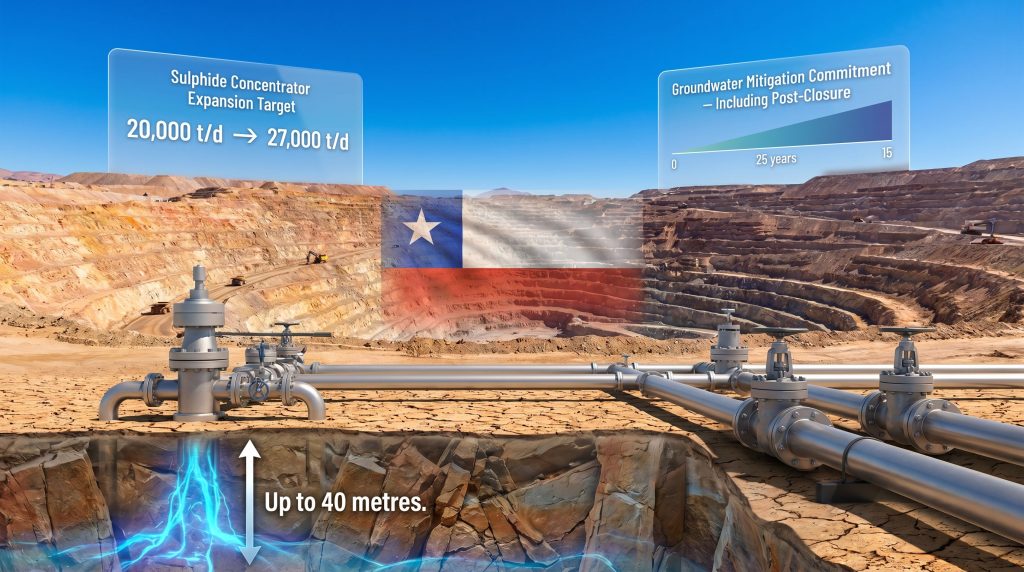
- Groundwater levels rising by as much as 40 metres in one sector of the mine
- Measurable alteration of subsurface water chemistry linked to mining activities
- Prior identification of seepage and infiltration risks by environmental officials, including concerns about infrastructure damage and standing water accumulation
- Formal classification of the groundwater effects as significant, compounding, and cumulative by the company itself
The last point deserves attention. These are not terms chosen casually. In Chilean environmental assessment language, characterising impacts as compounding and cumulative signals that effects are building on each other across time and space, rather than remaining discrete and reversible. That framing carries significant weight in EIA proceedings.
A History of Regulatory Friction
Adding historical texture to the situation, a less intensive expansion plan for Mantos Blancos was abandoned approximately two years before the current proposal was developed. Chilean environmental authorities also rejected a Capstone groundwater mitigation proposal in 2024 on the grounds that it lacked sufficient technical rigour. That rejection established a clear regulatory baseline: formulaic, minimum-compliance submissions would not pass scrutiny, and the bar for acceptable groundwater management had been definitively raised.
The 2024 rejection of a prior mitigation plan signals that Chilean regulators are no longer willing to accept hydrogeological risk assessments that lack long-duration, technically comprehensive remediation pathways. The industry benchmark has shifted.
The Proposed Mitigation Framework: A Technical Breakdown
The groundwater management plan now attached to the expansion proposal involves a dual-infrastructure approach designed to address both the quantity and quality dimensions of the problem simultaneously.
| Mitigation Component | Mechanism | Target Outcome |
|---|---|---|
| Pumping wells | Active drawdown in elevated-risk sectors | Lower groundwater levels, prevent upward migration |
| Injection wells | Reintroduction of treated, cleaner water into subsurface | Dilute and displace contaminated groundwater plumes |
| Long-term monitoring | Continuous hydrogeological surveillance | Track effectiveness, enable adaptive management |
| Post-closure operation | Infrastructure maintained after mine shuts | Manage long-tail environmental liability |
The proposed operational lifespan of these measures extends to up to 25 years, with the critical caveat that mitigation infrastructure would remain active even after the mine itself has ceased production. This is not standard practice in conventional mine closure planning. The commitment to post-closure groundwater management reflects a fundamental shift in how environmental liabilities are being structured in Chilean copper project approvals, one that internalises long-duration risk into project economics from the outset.
The expansion itself targets a sulphide concentrator throughput increase from the current 20,000 t/d to at least 27,000 t/d, representing a capacity uplift of at least 35%. Capstone has indicated it plans to submit the full environmental impact assessment (EIA) through Chile's Sistema de Evaluación de Impacto Ambiental (SEIA) by the end of June 2026. Regulatory approval of the EIA, including acceptance of the groundwater management framework, is a prerequisite for the expansion proceeding. A thorough definitive feasibility study will also be essential before capital commitments can be finalised.
Regulatory Architecture and the Tightening Compliance Environment
Chile's groundwater governance framework has evolved considerably under pressure from scientific bodies, community groups, and indigenous stakeholders across the northern regions. The DGA oversees water rights and extraction licensing, while the SEIA process determines whether projects can proceed based on environmental assessments that increasingly demand multi-decade mitigation commitments rather than point-in-time compliance snapshots.
A Ratcheting Regulatory History
What makes the Mantos Blancos case instructive for the broader industry is the compounding nature of the regulatory history at the site:
- Environmental officials previously identified seepage and infiltration risks, issuing remediation orders to Capstone.
- A less intensive expansion plan was abandoned roughly two years before the current proposal.
- A groundwater mitigation submission was rejected outright in 2024.
- The current EIA submission now carries the full weight of this accumulated scrutiny.
Each of those steps represents a ratchet in regulatory expectations that does not unwind. Operators across Chile's copper belt are watching closely, because the standards being applied at Mantos Blancos are becoming the reference point for what regulators will demand elsewhere. This tightening environment is also influencing the broader copper supply crunch narrative, as approval timelines extend and project economics are recalibrated.
Capital Expenditure and Investor Risk Implications
For investors analysing Capstone Copper's Mantos Blancos expansion, the Capstone groundwater issues at Mantos Blancos mine introduce several layers of financial consideration that extend well beyond conventional project execution risk.
Direct capital cost escalation is the most immediate factor. Heavy investment in pumping infrastructure, injection well networks, and monitoring systems now forms a mandatory component of the expansion's capital budget. These are not discretionary expenditures that can be deferred or value-engineered away without regulatory consequence.
Post-closure provisioning is the longer-term variable. A 25-year environmental commitment that survives mine closure must be reflected in financial models as a material liability. The present value of 25 years of groundwater management operations, monitoring, and adaptive remediation is not trivial. Investors and analysts who assess project economics without adequately provisioning this liability risk significantly overstating net asset value.
Timeline risk remains elevated. Given the history of regulatory friction at this specific site, including an abandoned expansion and a rejected mitigation plan, EIA approval timelines cannot be assumed to follow standard industry benchmarks. Chilean EIA processes for projects with significant classified groundwater impacts have historically extended well beyond initial projections when iterative regulatory dialogue is required.
ESG-linked financing sensitivity adds another dimension. Water stewardship practices in copper mining have become a core screening criterion for ESG-mandated investment frameworks. Institutional capital that is benchmarked against sustainability indices increasingly requires evidence of proactive, technically credible groundwater risk management, not merely regulatory compliance documentation. For context, the Chile copper price outlook remains constructive, but regulatory delays can materially erode project returns regardless of favourable commodity conditions.
The next major ASX story will hit our subscribers first
Industry-Wide Context: Water Stress Across Chile's Copper Belt
The situation at Mantos Blancos is not an isolated occurrence. It reflects structural pressures that every copper operator in the Antofagasta region faces to varying degrees.
| Dimension | Industry-Wide Picture |
|---|---|
| Regional aridity classification | Antofagasta among the world's most water-scarce mining jurisdictions |
| Regulatory trajectory | DGA standards for aquifer interference tightening across all major operations |
| Community and indigenous pressure | Water licence challenges through legal and regulatory channels are increasing |
| Technology adoption | Desalination, closed-loop processing, and water recycling increasingly standard practice |
| Groundwater recharge rates | Extremely slow in hyperarid zones, making aquifer recovery multi-generational once compromised |
Dewatering Versus Unintended Groundwater Change
One of the least discussed dynamics in Chilean copper water risk is the distinction between dewatering operations, which actively lower groundwater to keep pit floors dry, and the unintended groundwater level changes documented at Mantos Blancos. The latter reflects a more complex hydrogeological interaction where extraction activity and surface infrastructure create unplanned pressure redistribution in aquifer systems.
This type of impact is harder to model in advance and harder to defend before regulators than conventional dewatering scenarios, partly because it challenges the assumption that the operator had adequate predictive control from the outset. Consequently, operating copper mine comparisons increasingly highlight groundwater management sophistication as a key differentiator between well-governed and poorly-governed operations.
The growing adoption of desalination infrastructure across Chile's copper sector reflects the industry's recognition that groundwater dependency is a vulnerability that must be systematically reduced over time. Several major copper operations now source the majority of their process water from desalination plants on the Pacific coast, pumping it hundreds of metres uphill to mine sites. While capital intensive, this approach reduces aquifer interaction and the regulatory exposure that comes with it.
What Separates Proactive Hydrogeological Design from Reactive Mitigation
The Mantos Blancos situation illustrates the cost differential between integrating aquifer modelling into mine planning from the feasibility stage versus attempting to remediate problems that have already developed. Proactive design, in which hydrogeological consultants map subsurface flow paths, model extraction-induced pressure changes, and engineer groundwater control infrastructure before production begins, is considerably less expensive and politically less complicated than remediation after the fact.
Leading practice in arid-zone copper mining now includes:
- Pre-feasibility stage hydrogeological modelling with multiple extraction scenarios
- Baseline groundwater monitoring networks established before any earthworks begin
- Integrated water balance models that account for evaporation, seepage, process losses, and aquifer interaction
- Community and indigenous engagement built into water management planning, not bolted on after approvals are sought
- Environmental bonds or financial provisions for post-closure groundwater liabilities structured into project financing
The Mantos Blancos case may ultimately serve the industry as a demonstration of what happens when these elements are insufficiently integrated at earlier project stages, and what it costs to address that deficit under heightened regulatory scrutiny.
Disclaimer: This article is informational in nature and does not constitute financial, investment, or legal advice. Forward-looking statements regarding project timelines, regulatory outcomes, and capital expenditure estimates involve uncertainty and should not be relied upon as predictions of actual outcomes. Investors should conduct independent due diligence before making any investment decisions.
Want to Stay Ahead of the Next Major Copper Discovery on the ASX?
Discovery Alert's proprietary Discovery IQ model delivers real-time alerts on significant ASX mineral discoveries — instantly translating complex geological data into actionable investment opportunities for both short-term traders and long-term investors. Explore historic mineral discovery returns on Discovery Alert's discoveries page and begin your 14-day free trial today to position yourself ahead of the broader market.