
June 19, 2026
Why JORC Classification Is the Real Language of Project Finance
Large-scale copper development does not live or die on the volume of metal in the ground. It lives or dies on how that metal is classified. This is a distinction that separates experienced project finance professionals from retail investors scanning headline tonnage figures, and it sits at the heart of what Caravel Minerals' (ASX: CVV) latest Ore Reserve update actually communicates to the market.
Porphyry copper systems, by their nature, are enormous, low-grade, bulk-tonnage deposits. The Caravel Copper Project in Western Australia's Wheatbelt region fits this description precisely. What transforms a geological inventory into a financeable asset is not the raw copper count, but the rigour applied to classifying that inventory under the JORC Code 2012 framework, and specifically the proportion of that inventory sitting in the highest-confidence Proved category.
Understanding this mechanism reframes the entire Caravel Minerals proved copper tonnes 48% ore reserve update in a way that headline readers will miss.
When big ASX news breaks, our subscribers know first
Breaking Down the Updated Ore Reserve: Numbers at a Glance
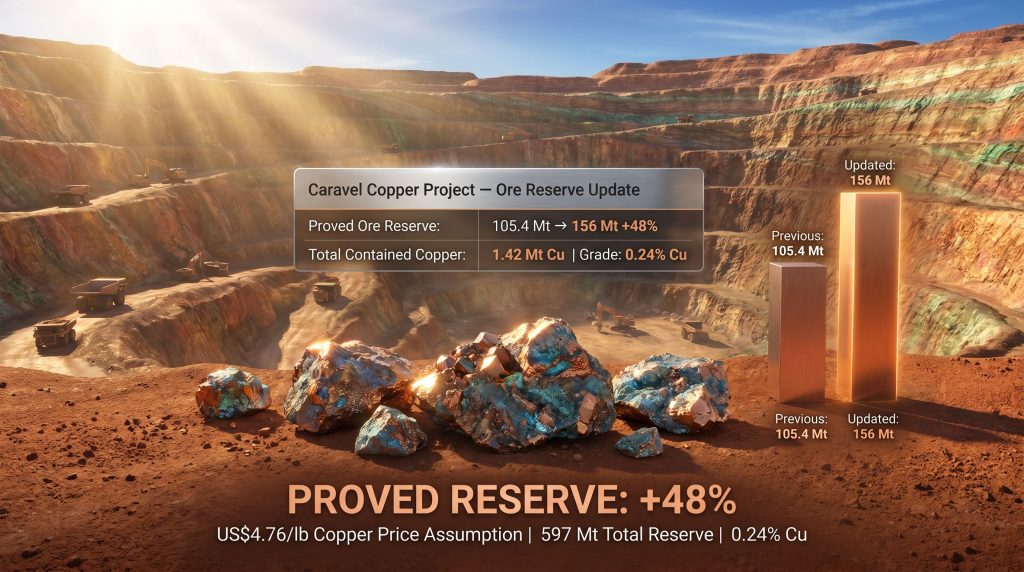
The total Reserve position shifted only modestly from the maiden 2022 estimate, but the internal architecture of that Reserve changed substantially.
| Reserve Category | Previous Position | Updated Position | Change |
|---|---|---|---|
| Proved Ore Reserve | 105.4 Mt | 156 Mt | +48% |
| Total Ore Reserve | ~583 Mt (maiden 2022) | 597 Mt | Modest increase |
| Contained Copper (Total) | ~1.42 Mt Cu | 1.42 Mt Cu | Unchanged |
| Copper Grade | 0.24% Cu | 0.24% Cu | Unchanged |
The critical observation here is that total contained copper barely moved. The Caravel Minerals proved copper tonnes 48% ore reserve update is not a discovery announcement. It is a reclassification exercise, moving approximately 50.6 million tonnes from the Probable column into the Proved column through additional geological work and modelling rigour.
What Stayed the Same and Why That Is the Entire Point
- Average copper grade held at 0.24% Cu across the full 597 Mt Reserve
- Total contained copper remained at approximately 1.42 million tonnes
- The life-of-mine copper recovery is modelled at 86% to a 20% Cu concentrate, with no smelter penalty issues identified in metallurgical testwork
- The economic cut-off grade was calculated at 0.09% Cu before by-product credits, with management electing to apply a more conservative 0.10% Cu cut-off consistent with the underlying Mineral Resource
The metal was already known. The update repackages it into a form that debt providers and offtake partners can act on with materially lower risk adjustment.
How JORC Classification Works: A Technical Primer for Investors
The JORC Code 2012, administered by the Australasian Joint Ore Reserves Committee, provides the classification framework used across Australian and many international mining projects. Its two-tier Reserve structure creates a direct link between geological data density and financing risk pricing.
Proved vs. Probable: More Than a Label
Proved Ore Reserves occupy the top tier of the JORC hierarchy. They are derived from Measured Mineral Resources, which themselves require closely spaced drilling, high geological continuity, and detailed three-dimensional modelling. The conversion from Measured Resource to Proved Reserve also requires full application of modifying factors, including mining, metallurgical, economic, social, and environmental parameters. The result is the tightest confidence classification the JORC framework provides.
Probable Ore Reserves are derived from Indicated Mineral Resources and, in some cases, Measured Resources where uncertainty remains in the modifying factors. They are entirely acceptable for resource estimation purposes, but they carry a higher uncertainty profile in mine scheduling, particularly for the early years of production.
Furthermore, when interpreting drill results from porphyry systems, it is worth noting that true vs apparent widths can materially affect how geological continuity is assessed during the confidence upgrade process.
In project finance, the distinction between Proved and Probable is not academic. Lenders apply risk-adjusted discount rates that penalise Probable tonnes when stress-testing early mine schedule cash flows. A larger Proved Reserve proportion in the opening years of a mine plan translates directly into a lower effective cost of debt capital.
The First Years of Production Are the Most Scrutinised
Project debt structures in large-scale mining typically target full repayment within 8 to 12 years of first production. This means the mine schedule covering this window receives the most aggressive stress-testing from lenders. Within this repayment period, debt providers want to see Proved Reserve dominance, not Probable.
Moving 50.6 Mt from Probable into Proved materially improves the early mine schedule risk profile that any formal project finance mandate will be built around. This is the practical engineering reason behind the update, independent of any change in the total copper inventory.
The Copper Price Assumption Embedded in the Reserve: US$4.76 per Pound
Every Ore Reserve under JORC requires an economic framework, and the Caravel Reserve is anchored to a copper price assumption of US$4.76 per pound. This is a defensible figure relative to prevailing copper spot prices, but it sits above the long-run consensus assumptions that many mining analysts apply in their valuation models. Consequently, understanding broader copper market trends is essential context for assessing whether this price assumption remains defensible over the project's financing horizon.
By-Product Credits: Formally Inside the Reserve for the First Time
One of the more technically significant changes embedded in this update is the formal incorporation of by-product revenue streams into the Reserve economics. These were not previously reported within the Reserve boundary. You can review the full updated ore reserve details on the Caravel Minerals website for a comprehensive breakdown.
| By-Product | Status in Updated Reserve |
|---|---|
| Molybdenum | Now formally reported within Reserve |
| Silver | Now formally reported within Reserve |
| Gold | Now formally reported within Reserve |
| Iron | Now formally reported within Reserve |
| Sulphur | Now formally reported within Reserve |
Individually, none of these by-products are project-defining. Molybdenum is the most economically meaningful of the group, given that porphyry copper systems commonly carry molybdenite mineralisation spatially associated with the copper sulphide assemblage. However, the combined inclusion of all five by-products refines the revenue model that future offtake negotiations will be structured around and provides incremental downside protection in copper price sensitivity scenarios.
Sensitivity Considerations: Understanding the Reserve's Vulnerabilities
- The 0.09% Cu economic cut-off versus the applied 0.10% Cu cut-off provides a modest buffer against copper price softening before pit shells need to contract
- A sustained reduction in long-run copper price assumptions would compress the optimised pit geometry and reduce mineable tonnage
- By-product credits, now embedded in the Reserve, provide an additional economic cushion that was absent from the earlier Reserve iteration
- The 86% life-of-mine copper recovery to a 20% Cu concentrate with no smelter penalty flags is a positive metallurgical signal for offtake pricing discussions
Disclaimer: Forward-looking statements regarding copper price assumptions, reserve sensitivities, and project economics involve inherent uncertainty. Investors should conduct independent research and seek professional financial advice before making investment decisions.
What a DFS at ±10% Accuracy Actually Unlocks
The Reserve update has been completed alongside a Mining definitive feasibility study conducted to a plus or minus 10% accuracy standard. This accuracy band is not arbitrary. It represents the threshold at which formal project finance mandates can realistically be initiated.
Studies at lower accuracy levels, such as Pre-Feasibility Studies typically carried at plus or minus 25%, are insufficient for lenders to issue term sheets. The step from Pre-Feasibility to DFS-level accuracy is the engineering inflection point that separates a project under study from a project under financing consideration.
The Sequential Pathway from Reserve to Finance Mandate
- Mineral Resource Estimate establishes geological confidence across the deposit
- Ore Reserve Declaration applies economic and technical modifying factors; JORC classification assigned
- DFS at ±10% accuracy tightens capital cost, operating cost, and schedule estimates to bankable study standards
- Proved Reserve dominance in the early mine schedule passes lender stress-testing
- Offtake agreements establish revenue certainty for debt serviceability modelling
- Project finance mandate enables formal debt structuring to commence
- Construction-ready status targeted for Q1 2028
The updated Ore Reserve feeds directly into step four of this sequence. Without a materially strengthened Proved Reserve position, the DFS would have had a financing gap in the early mine schedule, regardless of how well the engineering was executed.
The Broader Mineral Resource: Understanding the Scale of Optionality
The Caravel Copper Project's total Mineral Resource stands at approximately 1.28 billion tonnes at 0.24% Cu, containing an estimated 3.03 million tonnes of copper. The Ore Reserve of 597 Mt containing 1.42 Mt Cu represents roughly 47% of total contained copper in the broader Resource. The full scope of the project's mineral resource and reserve position is documented in detail in Caravel's published technical reports.
This gap is not a problem. It reflects the additional screening that distinguishes an Ore Reserve from a Mineral Resource. The remaining material, predominantly classified as Inferred, sits outside the Reserve boundary because geological confidence has not yet been established to the density required for JORC Reserve classification, not because it is uneconomic.
The Drilling Conversion Pathway: Where Long-Term Upside Lives
The mechanism for closing this gap is straightforward in principle, though it requires sustained drilling investment:
- Inferred Mineral Resources cannot be included in a JORC Ore Reserve under any circumstances
- Converting Inferred to Indicated requires additional drilling to increase data density and geological confidence
- Indicated material then feeds into the Probable Reserve column following application of modifying factors
- Subsequent tightening of drill spacing within Probable zones can further upgrade material into the Proved category
Investor consideration: The 3.03 Mt of total contained copper in the Mineral Resource compared to 1.42 Mt in the Ore Reserve represents a substantial optionality layer. Systematic drilling to convert Inferred material into higher confidence categories could materially grow the Reserve over time. This conversion is not guaranteed, and Inferred Resources carry sufficient uncertainty that they should not be assumed to report as Ore Reserves following further work.
The next major ASX story will hit our subscribers first
Regulatory Approvals: The Binding Constraint on the Construction Timeline
The geology is understood. The metallurgy is characterised. The engineering has reached DFS accuracy. What gates the path to construction is not any of these technical factors, but the regulatory approvals process for critical infrastructure components.
Key Approvals Still Being Progressed
| Approval Item | Status | Target |
|---|---|---|
| Tailings Storage Facility (TSF) | In progress | Pre-end 2027 |
| Waste Rock Dump (WRD) environmental clearance | In progress | Pre-end 2027 |
| Process Residue Storage Facility | In progress | Pre-end 2027 |
| Ministerial environmental approval | Pending | End 2027 |
Tailings storage facility approvals for large-scale open-cut operations in Western Australia's Wheatbelt involve assessment of hydrogeological impacts, dust and odour management, and long-term closure planning, among other factors. These are standard regulatory processes for a project at this scale and location, but they represent hard dependencies on the construction timeline.
Any delay to Ministerial approval cascades directly into the construction start date, which in turn affects the first production timeline and, by extension, the debt repayment schedule that lenders will model against the Reserve.
Catalyst Map: What to Watch From Here
| Catalyst | Current Status | Expected Timing |
|---|---|---|
| TSF and waste rock dump approvals | Progressing | Pre-end 2027 |
| Process Residue Storage Facility approval | Progressing | Pre-end 2027 |
| Ministerial environmental approval | Pending | End 2027 |
| Binding offtake agreements | Negotiation stage | TBC |
| Resource conversion drilling (Inferred to Indicated) | Optionality pathway | Post-approvals |
| Construction-ready status | Targeted | Q1 2028 |
Of the items above, binding offtake agreements carry particular weight for the financing case. Offtake commitments from creditworthy counterparties provide the revenue certainty that underpins debt serviceability modelling, and they are a standard prerequisite before major project finance mandates are issued in the copper sector.
Frequently Asked Questions
What does the Caravel Minerals proved copper tonnes 48% ore reserve update actually mean?
The 48% increase refers specifically to the volume of ore classified under the highest JORC confidence tier, Proved Ore Reserves, rising from 105.4 million tonnes to 156 million tonnes. This does not represent new copper discovery. It reflects a geological confidence upgrade of previously Probable material following additional study work. Total contained copper in the Reserve remained at approximately 1.42 million tonnes.
Why didn't total contained copper change if Proved tonnes rose by nearly half?
The reclassification is a confidence upgrade, not a resource expansion. The copper inventory was already captured within the broader Reserve. Upgrading tonnes from Probable to Proved changes how lenders and counterparties assess project risk; it does not add new metal to the inventory.
What is the difference between a Mineral Resource and an Ore Reserve?
A Mineral Resource is a geological estimate of mineralisation with reasonable prospects for eventual economic extraction. An Ore Reserve is a subset of the Mineral Resource that has passed through a full assessment of technical, economic, and modifying factors under the JORC Code, confirming it meets the threshold for economic extraction under defined conditions. Caravel's Mineral Resource contains approximately 3.03 Mt of copper; its Ore Reserve contains 1.42 Mt, reflecting the additional rigour applied in the conversion process.
When is Caravel targeting construction readiness?
The company is targeting construction-ready status in Q1 2028, contingent on receiving Ministerial environmental approval by the end of 2027 and progressing offtake agreements from negotiation to binding commitments.
Key Takeaways: What the Reserve Update Signals About Project Maturity
- The 48% increase in Proved tonnes is a financing preparation exercise, not a geological discovery
- Total contained copper at 1.42 Mt Cu and grade at 0.24% Cu are unchanged; the update's value lies in classification, not inventory
- A DFS-level Mining Study at ±10% accuracy, combined with a strengthened Proved Reserve position, positions the project for formal lender engagement
- Five by-product streams (molybdenum, silver, gold, iron, sulphur) are now formally embedded in the Reserve, refining the revenue model for offtake negotiations
- Regulatory approvals, not geology or metallurgy, are the binding constraint on the path to construction
- The gap between the 3.03 Mt Mineral Resource and 1.42 Mt Ore Reserve represents a long-term optionality layer contingent on further drilling and JORC classification work
This article is intended for informational purposes only and does not constitute financial advice. Forecasts, timelines, and project economics referenced herein involve inherent uncertainty and may not be achieved. Investors should conduct their own due diligence and consult a licensed financial adviser before making investment decisions.
Readers seeking further context on the Caravel Copper Project and the broader Western Australian copper development landscape can find related coverage at Stocks Down Under, which provides ongoing analysis of ASX-listed resource companies across the mining and metals sector.
Want to Identify the Next Major ASX Mineral Discovery Before the Broader Market Does?
Discovery Alert's proprietary Discovery IQ model delivers real-time alerts on significant ASX mineral discoveries, translating complex geological and reserve data into clear, actionable investment insights — the kind of structured understanding this article demonstrates in practice. Explore Discovery Alert's dedicated discoveries page to see how historic mineral discoveries have generated substantial returns, and begin your 14-day free trial today to position yourself ahead of the market.