
June 19, 2026
The Brownfield Advantage: Why Long-Life Copper Assets Are Redefining Mine Economics
The global copper industry is quietly entering one of its most consequential decades. Existing mines are depleting faster than new discoveries can replace them, permitting timelines for greenfield projects have stretched into the double digits in years, and the structural demand surge tied to electrification is no longer a forecast — it is a measurable reality unfolding across power grids, EV production lines, and renewable energy installations worldwide. Against this backdrop, the global copper supply gap is widening, and mining companies that can extend production from proven, infrastructure-rich assets hold a distinct competitive advantage that the market is only beginning to fully price.
The Hudbay Copper Mountain mine expansion, specifically the New Ingerbelle project in British Columbia's Similkameen region, illustrates precisely this dynamic. Rather than chasing undeveloped ground, Hudbay is deepening its commitment to an asset with decades of operational history, established processing infrastructure, and a reserve base that now stretches production well beyond 2040. Understanding why this matters requires examining not just the project's numbers, but the broader geological, economic, and strategic logic that makes brownfield copper expansion so compelling right now.
When big ASX news breaks, our subscribers know first
Understanding New Ingerbelle: Geology, Strip Ratios, and the Hidden Value in Old Pits
The Technical Case for Revisiting the Ingerbelle Pit
The Ingerbelle pit has a production history that spans multiple decades. It was actively mined between 1972 and 1980, then again during a shorter period from 1995 to 1996. The fact that it was mined twice before and is now being revisited a third time under a more sophisticated technical and economic framework reflects something important about how ore bodies are understood over time.
Modern block modelling, updated resource estimation techniques, and improved metallurgical understanding have allowed Hudbay to identify higher-grade mineralisation within the expanded pit geometry that earlier operators either did not recognise or could not access economically. The New Ingerbelle expansion involves a pushback of the existing Ingerbelle pit walls, effectively widening and deepening the pit envelope to access ore zones that sit beneath and beyond the original excavation boundaries.
What makes this particularly compelling from a mining economics perspective is the strip ratio advantage. The expansion area carries a stripping ratio approximately three times lower than Copper Mountain's current active mining zones. Strip ratio is a fundamental metric in open-pit mining — it represents the volume of waste rock that must be moved for every unit of ore extracted. A lower strip ratio means less diesel consumption, fewer equipment hours, reduced tyre wear on haulage trucks, and lower cost per tonne of copper produced. In practical terms, a threefold improvement in strip ratio can translate into a materially lower operating cost profile over the life of mine.
| Metric | Current Mining Areas | New Ingerbelle |
|---|---|---|
| Relative Strip Ratio | Baseline | ~3x lower |
| Infrastructure Required | Existing | Reused/shared |
| Precious Metal Content | Standard | Higher-grade |
| Capital Requirement | N/A | Minimal incremental |
Reserve Profile: Copper, Gold, and Silver as a Polymetallic Package
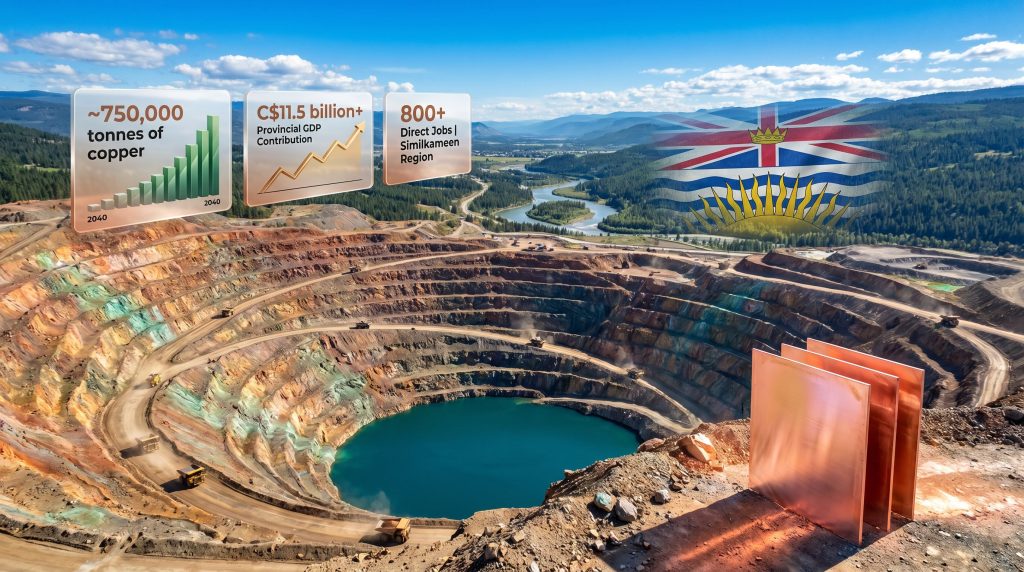
From current reserves, the New Ingerbelle project is projected to yield approximately 750,000 tonnes of copper, 900,000 ounces of gold, and 5.5 million ounces of silver over the life of mine. The polymetallic character of this ore body is worth examining closely because it changes the project's financial resilience profile in ways that a pure copper operation cannot match.
When copper prices soften, as they periodically do through commodity cycles, the gold and silver byproduct credits effectively act as a natural hedge. Revenue from gold and silver offsets the cost base, keeping cash operating margins positive even during periods of copper price weakness. The fact that New Ingerbelle carries higher precious metal content relative to the current pit areas adds a layer of margin protection that pure copper operations lack.
This polymetallic structure also matters for concentrate marketing. Copper concentrates that carry elevated gold and silver values are typically more attractive to smelters and refiners, sometimes commanding premium treatment terms or reduced penalty charges depending on the smelter's specific configuration. Furthermore, these copper processing benefits are a nuanced commercial consideration that does not always surface in headline project economics but contributes meaningfully to realised revenue.
How the Pit Pushback Methodology Works in Practice
Step-by-Step: Open-Pit Pushback Mechanics
A pit pushback is one of the most commonly misunderstood concepts in open-pit mining among non-specialist audiences. It is not a new mine — it is a deliberate geometric expansion of an existing excavation to access additional mineralisation that lies beyond or below the current pit limits.
-
Geotechnical evaluation of existing pit walls to determine whether slope angles can be safely maintained as the pit perimeter expands outward.
-
Overburden stripping in the pushback zone to progressively remove waste rock and expose the ore horizon beneath.
-
Bench development at each new mining level, creating the stepped terraced geometry that characterises open-pit operations and provides safe working platforms.
-
Integration with existing haulage network so that ore trucks can route directly to the established mill without requiring new road construction or haul route infrastructure.
-
Progressive ore feed into the existing processing circuit, maintaining continuous mill throughput throughout the transition from current pit areas to New Ingerbelle.
The critical advantage here is continuity. There is no production gap, no commissioning risk on new processing infrastructure, and no requirement to recruit an entirely new workforce. The existing concentrator, tailings storage facilities, power supply, and accommodation infrastructure are all retained and redeployed.
Why Reusing Existing Mill Infrastructure Is a Structural Advantage
Building a new concentrator from scratch in British Columbia today would require hundreds of millions of dollars in capital, years of engineering and procurement, and a separate permitting process. Hudbay avoids all of this by routing New Ingerbelle ore through the existing Copper Mountain mill. The 2023 mine plan outlined a throughput expansion to 50,000 tonnes per day targeted for 2027, and New Ingerbelle feeds directly into this expanded processing capacity.
Capital avoidance is a genuinely underappreciated value driver in mining. The absence of a large capital commitment is not merely a cost saving — it is a risk elimination. Projects that require new processing infrastructure carry commissioning risk, cost overrun exposure, and timeline uncertainty. Brownfield expansions that leverage existing plant sidestep all three.
Hudbay's Portfolio Logic: Canada's Third-Largest Copper Producer Extends Its Runway
From Acquisition to Multi-Decade Asset
Hudbay's acquisition of Copper Mountain in 2023 was a defining transaction for the company's Canadian production profile, establishing it as Canada's third-largest copper producer. At the time, the Copper Mountain mine was a competent mid-tier operation with a defined but finite mine life. The New Ingerbelle expansion fundamentally changes the asset's investment classification.
A mine with a life extending to the early 2030s is valued and operated differently from one that produces into the mid-2040s and potentially beyond. Longer mine lives support more favourable financing terms, justify more sustained capital investment in efficiency and automation, and provide a stable platform for workforce development and community investment. They also change the risk-adjusted return calculation for investors evaluating the company's long-term free cash flow generation.
The 21-year mine life outlined in the 2023 updated mine plan, now further reinforced by New Ingerbelle's reserve contribution, positions Copper Mountain as one of the longer-duration copper assets operating in Canada. In an industry where the average time from discovery to first production for a new copper mine now exceeds 16 years globally, existing long-life assets command a scarcity premium that is only likely to grow.
The Economic Footprint: British Columbia's Similkameen Region and the Numbers That Matter
Quantifying the Regional and Provincial Impact
The economic projections associated with the Hudbay Copper Mountain mine expansion are substantial by any measure, and they carry particular significance for the Princeton and Similkameen region, which has a relatively concentrated economic base.
| Economic Indicator | Projected Value |
|---|---|
| Provincial GDP Contribution | C$11.5 billion+ |
| Direct Jobs Supported | 800+ |
| Labour Income Generated | C$2.2 billion+ |
| Mine Life Extension | ~12 additional years beyond 2040 |
More than 800 direct jobs in a regional economy of this scale represents a meaningful proportion of total employment. The C$2.2 billion in labour income projected over the life of mine flows into local businesses, housing markets, schools, and community services across the Similkameen Valley. These are not abstract macroeconomic projections — they represent decades of sustained payroll activity in a region where the mine is one of the most significant private-sector employers.
British Columbia's Minister of Mining and Critical Minerals, Jagrup Brar, attended the June 17, 2026 groundbreaking ceremony and characterised the expansion as a reflection of both worker capability and the momentum building across the province's mining sector. The minister's observation that the expansion validates the skills and training of the regional workforce highlights an often-overlooked dimension of large mining projects: their role in sustaining and developing technical expertise that is transferable across the broader industry.
Permitting, Indigenous Partnerships, and Responsible Development
A Regulatory Timeline That Worked
The permitting process for New Ingerbelle followed a structured pathway that is worth examining as a potential model for future projects within the British Columbia mining framework.
-
April 2025: Formal application submitted to the BC Major Mines Office.
-
February 19, 2026: Amended Mines Act permit and amended Environmental Management Act permit both issued by the MMO.
-
February 2026: Refreshed participation agreements signed with both the Upper Similkameen Indian Band and the Lower Similkameen Indian Band.
-
June 17, 2026: Official groundbreaking ceremony marking construction commencement.
The approximately ten-month timeline from application to permit issuance is notably efficient by Canadian standards, where permitting processes for mine expansions can extend significantly longer depending on project complexity and engagement requirements. This outcome reflects the quality of Hudbay's pre-application engagement with regulators and communities, as well as the project's brownfield character, which reduces the scope of environmental assessment required compared to a new site development.
Indigenous Stewardship as an Operational Framework
The participation agreements established with both Similkameen Bands are not merely compliance instruments. They represent a framework for ongoing collaborative governance of the project's environmental and social impacts throughout its operating life.
Chief Charles Allison of the Upper Similkameen Indian Band articulated a stewardship mandate centred on the protection of the Similkameen River and surrounding ecosystems as the project advances. This framing is significant because it establishes a clear environmental priority that will govern ongoing dialogue between Hudbay and the Bands throughout the mine's expanded operational period.
The Similkameen River is ecologically important, supporting fish populations and downstream water users across the valley. A mining operation that maintains the health of this waterway through its expanded phase demonstrates that responsible resource development and ecological stewardship are not mutually exclusive outcomes. Rob Carter, Hudbay's Senior Vice President, Canada, described the expansion as the next chapter in a long relationship between the mine and its host community, emphasising the company's enduring commitment to both the asset and the people whose working lives are tied to it.
The next major ASX story will hit our subscribers first
Copper's Supply-Demand Trajectory and Why Mine Life Extension Matters Now
The Structural Demand Case Is Increasingly Well-Established
Copper is an irreplaceable conductor in virtually every electrification technology that underpins the global energy transition. Each electric vehicle contains roughly two to four times more copper than a conventional internal combustion engine vehicle. Offshore wind turbines require several tonnes of copper per megawatt of generating capacity. Grid-scale battery storage systems, charging infrastructure, and transmission upgrades all represent incremental copper demand that did not exist at scale a decade ago.
The challenge is that supply growth has not kept pace. Many of the world's largest copper deposits were discovered and developed decades ago and are now entering the later stages of their mine lives, where grades decline and costs increase. Furthermore, the copper supply crunch means the pipeline of new projects that could replace this depleting capacity is thin, and the permitting, financing, and construction requirements for greenfield copper mines make rapid supply responses to demand signals structurally difficult.
Industry analysis consistently points to a meaningful copper supply-demand deficit emerging through the 2030s. The exact magnitude is debated, but the directional consensus among analysts and major mining companies is clear: existing long-life, low-cost copper assets will be operating in a structurally tighter market than the one that existed when they were built.
This is the macro environment into which the Hudbay Copper Mountain mine expansion lands. An asset producing copper well into the 2040s, from a low-strip-ratio ore body with precious metal byproducts, in a jurisdiction with established regulatory frameworks and Pacific export access, is precisely the kind of long-duration copper supply that market fundamentals suggest will be increasingly valuable.
British Columbia's Position in the Critical Minerals Landscape
British Columbia's combination of geological endowment, technical workforce, established mining regulation, and proximity to Asian export markets positions it as one of the more strategically important copper jurisdictions outside of the major Latin American producing countries. The province's Priority Resource Projects program, to which New Ingerbelle was added, provides a structured mechanism for coordinating regulatory review across multiple agencies for projects deemed significant to provincial economic and resource policy objectives.
This classification does not substitute for rigorous environmental and social review, but it does signal provincial commitment to ensuring that economically and strategically significant projects receive the administrative attention and coordination required to progress efficiently through the system. In addition, investors exploring copper investment strategies will find that jurisdictional stability of this kind materially influences long-term asset valuation.
Frequently Asked Questions: Hudbay Copper Mountain Mine Expansion
What is the New Ingerbelle expansion at Copper Mountain?
New Ingerbelle is a pit pushback expansion at Hudbay's Copper Mountain mine in British Columbia that accesses higher-grade copper, gold, and silver mineralisation using existing mill infrastructure, extending mine life beyond 2040.
How long will the Copper Mountain mine operate after the expansion?
Based on current reserves and the New Ingerbelle project, the mine is expected to operate beyond 2040, representing approximately 12 additional years of mine life compared to previous projections.
How much copper will New Ingerbelle produce?
From current reserves, New Ingerbelle is projected to yield approximately 750,000 tonnes of copper, 900,000 ounces of gold, and 5.5 million ounces of silver over the life of mine.
What is the economic impact of the expansion on British Columbia?
The project is forecast to contribute more than C$11.5 billion to provincial GDP, support over 800 direct jobs, and generate more than C$2.2 billion in labour income for the Similkameen region.
When did Hudbay receive permits for the New Ingerbelle project?
Amended Mines Act and Environmental Management Act permits were issued by the BC Major Mines Office on February 19, 2026, following an application process that began in April 2025.
What makes New Ingerbelle economically attractive compared to current mining operations?
The expansion features a stripping ratio approximately three times lower than current active mining areas, combined with higher precious metal content, which significantly improves both the cost and revenue profile of the project.
Key Takeaways: The Strategic Significance of the Hudbay Copper Mountain Mine Expansion
-
New Ingerbelle transforms Copper Mountain from a mid-life asset into a multi-decade copper producer with a reserve base extending well beyond 2040.
-
The threefold strip ratio advantage over current mining areas directly reduces operating costs per tonne and improves the project's margin profile through commodity price cycles.
-
A polymetallic reserve of approximately 750,000 tonnes copper, 900,000 oz gold, and 5.5 million oz silver provides byproduct revenue diversification that strengthens financial resilience.
-
The brownfield expansion model, which reuses existing mill circuits, haulage equipment, and site infrastructure, delivers capital efficiency that greenfield copper development fundamentally cannot replicate.
-
The project's projected C$11.5 billion GDP contribution and support for more than 800 direct jobs make it a material long-term economic anchor for the Princeton and Similkameen region.
-
Refreshed participation agreements with both Similkameen Bands and a transparent MMO permitting process establish a responsible development framework that aligns with evolving ESG expectations in institutional mining investment.
-
With copper demand structurally tied to global electrification and the supply pipeline for new mines remaining constrained, long-life brownfield assets like Copper Mountain are positioned to supply the market during its most demand-intensive period.
This article contains forward-looking projections relating to mine life, production estimates, and economic impact figures. These projections are based on current reserve estimates and company disclosures and are subject to change as operational, geological, and market conditions evolve. Nothing in this article constitutes financial or investment advice.
Want to Track the Next Major Copper Discovery Before the Market Moves?
Discovery Alert's proprietary Discovery IQ model scans ASX announcements in real time, instantly identifying significant mineral discoveries across copper and more than 30 other commodities — turning complex geological data into clear, actionable opportunities for investors at every level. Explore how historic discoveries have generated exceptional returns on Discovery Alert's dedicated discoveries page, then begin your 14-day free trial to position yourself ahead of the broader market.