
August 25, 2026
Why Legacy Mine Waste Is Redefining the Mining Investment Landscape
The economics of primary copper mining have become increasingly difficult to justify. Greenfield projects routinely require a decade or more of exploration, environmental assessment, community consultation, and permitting before a single tonne of ore is processed. Capital requirements frequently stretch into the billions, execution risk is substantial, and the timeline to cash flow is measured in years rather than months.
Against this backdrop, a structural reappraisal of legacy mine waste has begun reshaping how sophisticated investors and industrial operators think about near-term metal supply. Tailings deposits, once considered a remediation liability requiring management rather than monetisation, are increasingly being evaluated through a different lens: as pre-permitted, infrastructure-adjacent, metal-bearing assets that can potentially be brought into production at a fraction of the cost and timeline of a conventional mine.
The Case for Tailings Reprocessing as a Distinct Asset Class
Several converging forces are driving institutional attention toward tailings reprocessing as a credible investment strategy rather than a niche technical exercise:
- Permitting timelines for new primary mines continue to extend, with ESG-linked community and environmental obligations compressing the universe of viable greenfield sites.
- Tailings deposits frequently sit within existing mining licences, meaning the most time-consuming regulatory hurdle has, in many cases, already been navigated by previous operators.
- Infrastructure adjacency reduces capital requirements substantially. Legacy processing sites typically retain access roads, power connections, and established local workforces.
- Circular economy positioning has become a genuine differentiator for institutional capital, with tailings reprocessing offering a no-deforestation, no-new-community-displacement operational footprint.
The defining advantage of a tailings reprocessing project over a greenfield alternative is not just cost or timeline. It is the compression of execution risk across nearly every dimension of project development simultaneously.
Chile provides perhaps the most instructive case study for this thesis. Furthermore, more than a century of intensive copper mining activity across the Atacama and surrounding regions has produced over 760 registered tailings deposits across the country, a figure cited in discussions between project developers and Chilean ministerial and government agency representatives. Despite this extraordinary inventory, the major mining companies operating in Chile have largely continued their focus on large-scale greenfield copper stories, creating a meaningful strategic gap for specialist reprocessors.
The Halo Minerals Playa Verde tailings reprocessing project sits directly within this opportunity space, representing one of the most technically advanced and economically defined tailings reprocessing assets in the Latin American copper sector.
When big ASX news breaks, our subscribers know first
Understanding the Playa Verde Asset: Geology, Formation, and Resource Definition
How a Century of Industrial Activity Created a Unique Ore Body
The Playa Verde deposit occupies a category of its own within the tailings reprocessing universe because of the physical mechanics of how it formed. Between the 1930s and approximately the 1970s, two significant copper operations, the Potrerillos and El Salvador mines located in Chile's Atacama Region, discharged an estimated 250 million tonnes of tailings material into a dry riverbed. Over the following decades, those tailings were carried approximately 120 kilometres downstream to accumulate on the coastal shoreline at Chañaral.
That 120-kilometre migration was not merely a transport mechanism. The downstream journey functioned as a natural homogenisation process, what geologists and project operators describe as a prograding effect, which blended the material into a relatively continuous and consistent ore body. The result is a beach-surface deposit with strong structural uniformity across its lateral extent, a characteristic that significantly simplifies resource estimation and processing design compared to heterogeneous hard-rock deposits.
The physical dimensions of the onshore deposit are substantial:
- Approximately 5.5 kilometres of shoreline extent
- 1 to 1.5 kilometres from the shoreline to the back of the beach
- An average volumetric depth of approximately 9 metres, extending to as much as 18 metres at its deepest
- Total onshore resource of approximately 53.4 million tonnes at 0.24% copper
JORC Resource Summary
| Resource Category | Tonnage | Copper Grade | Contained Copper |
|---|---|---|---|
| Total JORC Resource (Onshore) | ~53.4 Mt | 0.24% Cu | ~125,820 t |
| Ore Reserves | 32 Mt | 0.25% Cu | ~80,000 t |
| Western Burman Shoreline (Additional) | ~21 Mt | TBC | Incremental |
| Offshore / Submarine (Chañaral Bay) | Up to 100 Mt | Exploratory | Phase 2-3 Upside |
The resource definition underpinning this inventory rests on more than 300 drill holes and in excess of 2,500 samples collected across the onshore footprint. Independent technical work has been conducted by Wardell Armstrong, Cube Consulting, and EMI Consultores, providing multiple layers of quality assurance across the estimation process. Critically, a dedicated metallurgist has maintained continuous oversight of the project since approximately 2012, providing an institutional depth of project knowledge that is difficult to replicate in newly assembled technical teams.
There is also a documented sweet spot in resource concentration at the mouth of the river at the back of the beach, where the prograding effect concentrated higher-grade fractions. While the broader ore body is characterised by strong homogeneity, this localised enrichment zone is an additional detail that informs sequencing decisions within the mine plan.
The Environmental Dimension: From Pollution Legacy to Remediation Asset
UNESCO identified the Chañaral coastline as one of the Pacific's largest industrial pollution events following a site assessment in the 1980s. The contamination profile includes elevated arsenic concentrations and broader heavy metal loading associated with historical mine waste discharge, a legacy that has rendered the beach inaccessible for recreational use for decades.
This environmental history creates a secondary value layer for the Playa Verde project that extends beyond copper production. The reprocessing operation is designed to reduce heavy metal concentrations, including arsenic, in the reconstituted sands returned to the beach following processing. The stated objective is that upon completion of the reprocessing programme, the beach will be returned to the local municipality for recreational use, effectively converting the project into a large-scale funded environmental remediation exercise as well as a copper producer.
For ESG-focused investors and multilateral financing institutions, this dual-outcome structure represents a materially different risk and return profile compared to a conventional extractive operation. In addition, the mining decarbonisation benefits associated with reprocessing existing waste rather than opening new mines strengthen the project's appeal to sustainability-conscious capital.
The Processing Architecture: Proven Technologies in a Novel Configuration
Why the Dual-Circuit Flowsheet Is Technically Necessary
One of the less immediately obvious technical characteristics of the Playa Verde deposit is its oxidation profile. Because the tailings material has been exposed to decades of wave action, wind, and coastal atmospheric conditions on the beach surface, a meaningful portion of the sulfide copper minerals originally present have been partially converted to oxide phases. This is not a flaw in the resource, but it is a constraint that determines the required processing approach.
A single-circuit processing plant, whether flotation-only or leach-only, would recover only a fraction of the available copper. The dual-circuit flowsheet adopted for Playa Verde addresses this directly:
Step 1: A single-wheel floating suction dredge extracts tailings material directly from the beach surface. The free-flowing, homogeneous nature of the ore body means the dredge effectively backfills itself through gravity as it advances, making this a highly efficient extraction method for this specific deposit type.
Step 2: Extracted material is transported via belt conveyor to an onshore processing facility. Sulfide-associated copper is directed through a conventional flotation circuit. Oxidised copper fractions are processed through acid leaching followed by solvent extraction and electrowinning, the SX-EW circuit, to produce copper cathode directly.
Step 3: The dual circuit produces approximately 7,500 tonnes per annum of copper cathode via SX-EW and approximately 8,000 to 8,500 tonnes per annum of copper-gold flotation concentrate at roughly 20% copper with a 5.5 grams per tonne gold credit. The combined circuit targets an overall copper recovery rate of approximately 72% of contained metal.
The processing innovation at Playa Verde is not technological. Dredge mining, flotation, and SX-EW are all well-established methods used extensively in mineral sands, alluvial mining, and conventional copper hydrometallurgy. The value lies in their coordinated application to a beach-surface tailings deposit with a mixed oxidation profile.
Annual processing throughput is designed for 5 million tonnes per annum, with the entire operation configured for continuous 24-hour, 365-day production. Extensive studies addressing high-tide lines, tsunami risk analysis, and beach stability have been completed to support the operational safety case for the permanent onshore plant installation.
Dredge Strategy: Capital Efficiency Through Contracting
An important development in the current project advancement phase involves a reassessment of the dredge acquisition and operational model. Royal IHC, a prominent dredging equipment and engineering firm, was originally engaged to validate the technology selection for the project, providing confidence in the fundamental approach.
Current investigations have identified a universe of used dredges that may be available at pricing approximating scrap metal value, representing a potentially material reduction from the approximately US$10 million dredging equipment budget included in the published capital cost estimate. A parallel analysis is underway regarding lease and contract operation models, which would convert the dredge capital expenditure into an operating cost, reducing the upfront equity requirement.
The preference expressed by the project development team is to contract the dredge operation entirely to a specialist operator with established performance guarantees, rather than building an in-house dredging capability. This approach mirrors the broader capital-light, contract-heavy operational model being pursued across the project and is consistent with how comparable mineral sands and alluvial operations have been structured globally.
A further consideration is the potential acquisition of two used dredges simultaneously, providing operational redundancy in the event of scheduled or unscheduled maintenance downtime and ensuring continuity of throughput at the processing facility.
Project Economics: A Compelling Return Profile at Conservative Commodity Assumptions
Published Economic Parameters
The economic case for the Halo Minerals Playa Verde tailings reprocessing project is anchored in a Competent Persons Report published in conjunction with the company's AIM admission in Q1 2025. The economics presented are based exclusively on the 32 million tonne ore reserve component of the broader 53.4 million tonne resource, meaning they exclude both the 21 million tonne western shoreline resource and the potential 100 million tonne offshore submarine deposit.
| Economic Metric | Published Estimate | Notes |
|---|---|---|
| Copper Price Assumption | US$5.30/lb | CPR base case |
| Gold Price Assumption | US$4,300/oz | CPR base case |
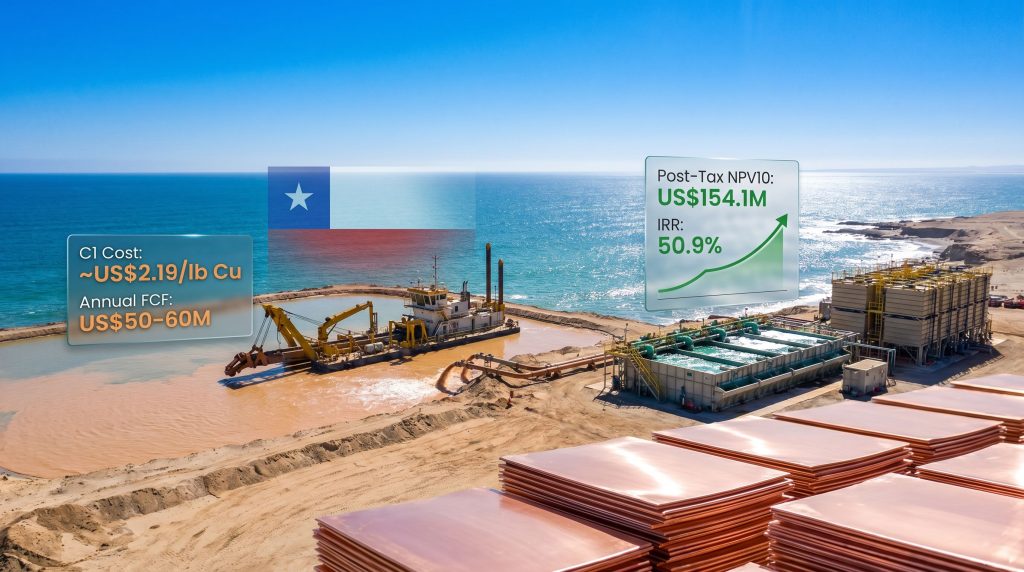
| Post-Tax NPV10 | US$154.1 million | Ore reserves basis only |
| Internal Rate of Return | 50.9% | |
| Annual Free Cash Flow | US$50-60 million | Steady-state production |
| Total Capital Expenditure | US$86.5 million | Includes contingency |
| C1 Operating Cost | ~US$2.19/lb Cu | Includes ~10c contingency |
| Ramp-Up to Full Capacity | 4-6 weeks post-commissioning |
Capital Expenditure Breakdown
| CapEx Component | Estimated Cost |
|---|---|
| Dredging Equipment | ~US$10 million (reduction opportunity identified) |
| Plant and Equipment | ~US$33 million (50-60% vendor finance potential) |
| Construction Costs | ~US$30 million |
| Indirect CapEx (incl. transmission line) | ~US$10 million |
| Contingency | ~US$6-7 million |
| Total | ~US$86.5 million |
Why the Published Numbers Are Likely Conservative
Several factors suggest the published NPV and IRR figures represent a conservative floor rather than a central estimate of project value.
First, copper spot prices at the time of the company's IPO and subsequent disclosure were trading above US$6.40 per pound, representing a premium of approximately 21% above the CPR's base case assumption of US$5.30 per pound. Gold was broadly aligned with or above the US$4,300 per ounce assumption used in the study.
Second, the economics are computed on ore reserves alone, meaning the 21 million tonnes of onshore western shoreline resource adds no value to the published NPV despite being a tangible incremental processing opportunity. Processing that additional resource would require only sustaining capital expenditure rather than full project capex, since the plant infrastructure would already be in place, making each additional tonne processed incrementally highly valuable.
Third, the potential 100 million tonnes of offshore submarine tailings in Chañaral Bay is entirely absent from the economic model and represents a material long-term resource life extension opportunity.
Published at US$154.1 million on 32 million tonnes, the project NPV excludes approximately 21 million tonnes of additional onshore resource and up to 100 million tonnes of offshore upside. The stated economics reflect a deliberately conservative, reserve-only base case.
Cost Position and Competitive Context
The C1 operating cost of approximately US$2.19 per pound of copper, inclusive of a contingency allowance of roughly 10 cents per pound, positions the project at the lower boundary of the global second cost quartile. The project's cost structure benefits from several structural advantages over conventional primary mining operations:
- No truck haulage fleet required within the mining operation
- Solar supplementation of energy demand being evaluated
- No underground development capital or sustaining costs
- Rapid ramp-up to full operating capacity within four to six weeks of commissioning, compared to months or years for underground mines
The combination of dredge optimisation and operational contracting efficiencies being pursued in the current BFS-level cost update creates a credible pathway toward first-quartile cost positioning. Understanding the broader copper supply crunch context reinforces why low-cost, near-term production assets command a premium in the current market environment.
Permitting Status: The Critical De-Risking Milestone Already Achieved
EIA Approval and Its Significance
For mining projects in Chile, the Environmental Impact Assessment represents the most consequential and time-consuming regulatory milestone. The Playa Verde EIA was unanimously approved by Chile's ministerial committee, with the formal written resolution received in October 2024. This approval, which followed a process that commenced in 2019, effectively marks the transition of Playa Verde from a development-stage project to a near-production asset.
The ministerial engagement associated with the project has spanned an unusually broad range of government departments, reflecting the multi-dimensional nature of the operation:
- Ministry of Mining
- Ministry of Energy
- Ministry of Health
- Ministry of Defense (maritime concession application)
- Ministry of Housing
- Copiapó Regional Government
Permitting Pathway to FID
| Milestone | Target Timing |
|---|---|
| Updated BFS-Level CapEx / OpEx Numbers | Near-term (Q2 2025) |
| Partner Identification Finalised | Q3 2025 |
| Final Investment Decision | Q4 2025 (subject to financing) |
| Construction Phase | 18 months post-FID |
| First Production | H2 2028 |
The Article 17 beach mining use permit is the principal ancillary permit outstanding. Given that the project holds the underlying mining licence for the area and has already received EIA approval, which is typically the primary basis on which beach mining permits are evaluated, the project team expresses high confidence in a positive outcome. Additional ancillary permits are being progressed in parallel to avoid sequential delays.
Understanding the mining permitting realities that typically confront greenfield operators helps contextualise just how significant Playa Verde's existing approvals are. The maritime concession application to access the offshore submarine resource in Chañaral Bay is a longer-duration process, filed with the Ministry of Defense, and is appropriately classified as a Phase 2 or Phase 3 growth driver.
Financing the Project: A Non-Dilutive, Layered Capital Strategy
The Preferred Funding Architecture
With a total capital requirement of approximately US$86.5 million and a market capitalisation at IPO of approximately £10 million, the project financing strategy necessarily relies on a structured, layered approach that minimises equity dilution while leveraging the project's strong technical definition and near-term cash flow profile.
The inbound expressions of interest received from metal trading counterparties within 48 hours of the EIA written resolution in October 2024 are instructive. They signal that the commercial validation of the project within the commodity trading community preceded the public investment community's awareness, a pattern commonly observed in well-defined, near-production assets with strong offtake fundamentals.
The five-layer funding stack being assembled is structured as follows:
Layer 1: Offtake and Pre-Payment Arrangements. Multiple metal trading counterparties have expressed interest in pre-payment and offtake structures. These are self-liquidating financing instruments, satisfied through future copper cathode and concentrate delivery, that simultaneously underpin revenue certainty and enhance the project's bankability with other financing providers.
Layer 2: Vendor Financing for Plant and Equipment. An estimated 50 to 60% of the US$33 million plant and equipment budget is considered potentially available on vendor finance terms, materially reducing the effective upfront equity requirement.
Layer 3: Royalty and Streaming Finance. Gold streaming and copper royalty arrangements are under active discussion. These non-dilutive instruments provide upfront capital in exchange for a share of future production revenues, and are particularly well-suited to a project with dual-commodity output.
Layer 4: Project Development Debt. Investment bank-style project finance discussions are ongoing. The project's strong definition, with over US$8 million invested in technical studies to date, combined with a rapid ramp-up profile and projected annual free cash flow of US$50 to US$60 million, supports debt serviceability analysis and creates a credible case for accelerated amortisation.
Layer 5: Equity. Positioned as a contingency or strategically opportunistic instrument to be accessed only after the preceding layers are substantially committed, and ideally at a share price that minimises dilution to the existing register. Consequently, well-structured copper investment strategies that prioritise near-production assets with layered financing structures are increasingly attractive to sophisticated investors.
The next major ASX story will hit our subscribers first
The Growth Platform Beyond Playa Verde
Building a Tailings Reprocessing Pipeline Across Chile
The Halo Minerals Playa Verde tailings reprocessing project is framed as the anchor asset of a broader ESG metals strategy targeting Chile's extensive inventory of registered tailings deposits. With over 760 such deposits across the country and limited specialist reprocessors operating at scale, the competitive landscape for well-capitalised operators with established technical credibility and local regulatory relationships remains relatively open.
The invitation from the Copiapó Regional Government to explore collaborative tailings remediation represents an early-stage but strategically meaningful signal. Conventional, non-beach tailings deposits across the region share a common characteristic: they were often constructed under older environmental standards, and ageing dam structures with documented contamination risks are increasingly viewed as liabilities requiring resolution. For a specialist reprocessor, those same liabilities are potential metal-bearing assets.
The Offshore Upside: Phase 2 and Phase 3 Economics
The submarine tailings deposit in Chañaral Bay, estimated at up to 100 million tonnes at a comparable grade profile to the onshore resource, represents the most significant single source of unquantified project upside. The critical economic insight is that accessing this material would require a maritime concession and incremental capital, but the existing onshore processing infrastructure would already be in place. However, the incremental cost per tonne of offshore material processed would therefore reflect a sustaining capital figure rather than a full project capital figure, making the economics of each additional phase highly attractive.
Copper's Structural Demand Tailwinds
The macro context for copper supply development has rarely been more compelling. Electric vehicles require approximately four to five times the copper content of conventional internal combustion engine vehicles, and the accelerating global buildout of AI data centre infrastructure adds a substantial new industrial demand vector. Furthermore, the future of copper mining increasingly favours operators who can combine technical credibility, ESG credentials, and near-term production pathways.
The fragility of the existing copper supply chain was brought into sharp public focus when disruptions at major producing assets created supply uncertainty in 2024, reinforcing the investment case for projects with near-term, fully-permitted production pathways. The Halo Minerals permitting milestone at Playa Verde consequently positions the project favourably within this tightening supply environment.
Disclaimer: This article contains forward-looking statements, economic projections, and commodity price assumptions sourced from company disclosures. These figures are subject to change and should not be interpreted as financial advice. Readers should conduct their own due diligence and consult a qualified financial adviser before making investment decisions. Mineral resource estimates and project economics are based on information available at the time of publication and may be subject to revision.
Want to Identify the Next Major Copper Discovery Before the Market Does?
Discovery Alert's proprietary Discovery IQ model scans ASX announcements in real time, delivering instant alerts on significant mineral discoveries — including copper — so subscribers can act on actionable opportunities ahead of the broader market. Explore how historic discoveries have generated substantial returns on Discovery Alert's dedicated discoveries page, and begin your 14-day free trial today to position yourself at the forefront of the next major find.