June 18, 2026
Argentina's RIGI-PEELP Framework: How a Two-Tier Incentive System Is Reshaping the Global Copper Investment Landscape
The global race to secure long-duration copper supply has quietly shifted one of its most consequential battlegrounds to the high-altitude Andes of western Argentina. For decades, Chile and Peru dominated the conversation about South American copper investment, backed by established regulatory frameworks, mature infrastructure corridors, and deep institutional familiarity among global mining majors. Argentina, despite hosting some of the world's most geologically compelling mineral systems, sat on the periphery of that conversation. That dynamic is now changing, and the mechanism driving that change is a regulatory architecture called RIGI, and more specifically, its most powerful classification tier known as PEELP.
Understanding why the Vicuña RIGI-PEELP approval in Argentina represents far more than a single project milestone requires stepping back from the announcement itself and examining the structural incentives that make this classification so consequential for capital allocation decisions at a global scale.
When big ASX news breaks, our subscribers know first
What Is Argentina's RIGI Framework and How Does PEELP Differ?
Argentina's Large Investment Incentive Regime, known by its Spanish acronym RIGI (Régimen de Incentivo para Grandes Inversiones), was designed with a clear objective: attract large-scale domestic and foreign capital into strategic economic sectors by offering long-term fiscal predictability in a country historically associated with regulatory volatility. The framework operates across multiple sectors including mining, energy, and infrastructure, and it creates a contractual-style relationship between investors and the Argentine state that is intended to survive changes in government.
Within RIGI, there are two distinct tiers of classification, and the distinction between them is not trivial for investors deploying capital measured in billions of dollars.
| Feature | Standard RIGI | RIGI-PEELP |
|---|---|---|
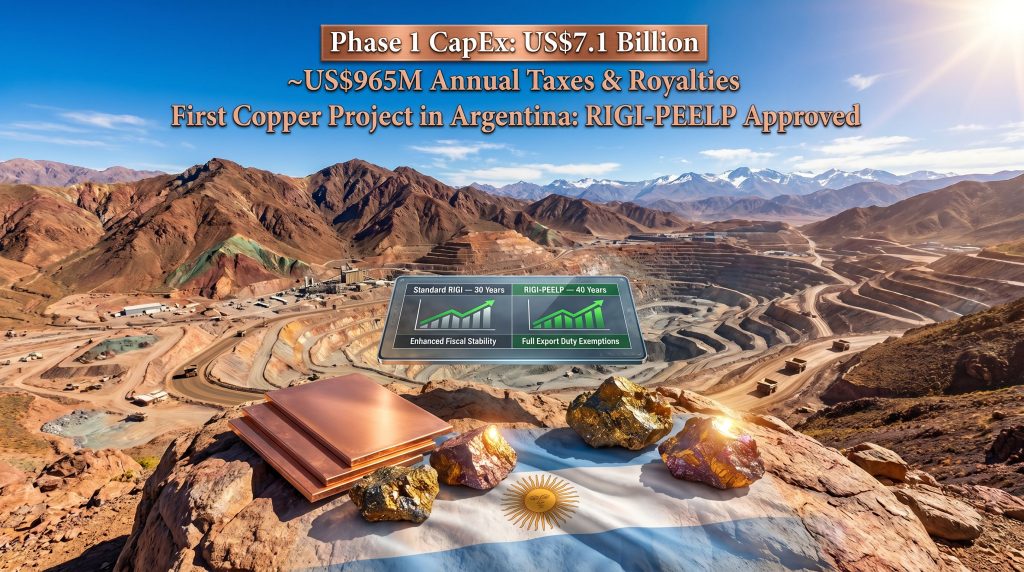
| Benefit Period | 30 years | 40 years |
| Revenue Repatriation Access | Standard timeline | Accelerated access |
| Export Duty Treatment | Partial exemptions | Full export duty exemptions |
| Fiscal Stability Guarantee | Moderate | Enhanced long-term certainty |
| Strategic Project Classification | General | Long-Term Strategic Export |
Standard RIGI status delivers meaningful protections, but PEELP, which designates a project as a Long-Term Strategic Export Project, elevates those protections substantially. The additional decade of benefit coverage, from 30 to 40 years, is particularly significant in mining, where capital payback cycles routinely extend beyond 15 to 20 years and where multi-phase development can stretch asset life well past the half-century mark.
This is especially relevant given the growing copper supply crunch facing global markets, which is placing renewed urgency on bringing large-scale projects into production within viable fiscal frameworks.
"The PEELP classification fundamentally restructures the risk-return equation for institutional capital. When a project of this scale can lock in fiscal conditions across a 40-year window, the discount rate assumptions embedded in financial models shift meaningfully in favour of investment viability."
The full export duty exemptions under PEELP are equally critical. Argentina has historically applied export taxes, locally called retenciones, that have at various points applied to mining exports. For a copper project targeting global offtake markets, duty-free export access over four decades is not a peripheral benefit. It is a core determinant of project economics.
The Vicuña District: Understanding the Geology Behind the Numbers
Why Porphyry Copper Systems at This Scale Are Rare
The Vicuña district, located in San Juan Province in Argentina's Andean cordillera, hosts two major deposits: Josemaría and Filo del Sol. Both are classified as porphyry copper-gold-silver systems, a geological architecture that forms through the intrusion of magmatic fluids into surrounding rock over millions of years, depositing disseminated copper, gold, and silver mineralisation across very large volumes of rock.
Porphyry systems are the workhorses of the global copper industry. The world's largest copper mines, including Escondida in Chile and Grasberg in Indonesia, are porphyry deposits. What makes the Vicuña district notable is not simply that it contains porphyry mineralisation, but that the Josemaría and Filo del Sol deposits are spatially and genetically related, suggesting they form part of a major copper system in Argentina rather than two isolated occurrences.
This distinction matters enormously for long-term production planning. District-scale systems offer the possibility of multi-phase, multi-decade mine life extensions as new resource areas are delineated over time. Single-asset operations carry a finite resource ceiling that limits the scalability of capital infrastructure. District systems do not carry that same constraint in the same way.
Josemaría and Filo del Sol: Complementary Asset Architecture
Phase 1 of the Vicuña development strategy centres on the Josemaría deposit, which will anchor the initial sulphide processing plant. Sulphide ore requires conventional milling and flotation to produce copper concentrate, which is then smelted and refined into finished copper cathode or rod. The Filo del Sol deposit contributes meaningfully to the broader resource base and incorporates leachable oxide mineralisation, which is the focus of Phase 2 development.
The strategic elegance of this phased architecture is that the oxide component can be processed through heap leach and solvent extraction-electrowinning (SX-EW) technology, a lower-capital-intensity pathway that produces copper cathode directly without requiring a smelter. By sequencing sulphide processing first and layering oxide processing into Phase 2, the Vicuña development team has structured a capital programme that can demonstrate operational performance before committing the full capital envelope for subsequent phases.
Phase 1 Capital Commitment: Contextualising $7.1 Billion
The Phase 1 initial capital requirement of US$7.1 billion, as outlined in the technical report published on 16 February 2026, places Vicuña among the most capital-intensive single-phase mining commitments in Latin American history. To contextualise that figure, consider that the average capital cost for a new copper mine globally has escalated sharply over the past two decades as ore grades decline, deposits move to higher altitudes and more remote locations, and labour and equipment costs inflate.
The Vicuña RIGI-PEELP approval in Argentina encompasses both Phase 1 capital and certain components of Phase 2 related to oxide processing, meaning the total capital envelope embedded within the regulatory framework is even larger than the Phase 1 figure alone suggests.
"At a capital intensity of this magnitude, even marginal improvements in fiscal terms translate into hundreds of millions of dollars of present value. The RIGI-PEELP framework, by eliminating export duties and extending fiscal protections to 40 years, effectively improves project NPV in ways that can determine whether a Final Investment Decision is viable or not."
Furthermore, the target for the Phase 1 Final Investment Decision (FID) is before the end of 2026. That timeline, now materially de-risked by the regulatory approval announced by Vicuña Corp., implies that the project could be moving toward construction mobilisation within a timeframe relevant to near-term copper supply forecasts.
Economic Footprint: What Vicuña Means for Argentina and San Juan Province
The projected economic contribution of the Vicuña project to Argentina is substantial across multiple dimensions:
- Annual fiscal contribution: approximately US$965 million in combined taxes and royalties to national and provincial governments
- Direct employment: approximately 5,500 workers and contractors during construction and operations
- Indirect employment: approximately 19,000 jobs generated through supply chain and service sector activity during the construction phase
- Export revenue contribution: significant addition to Argentina's foreign exchange earnings, directly relevant to the country's structural current account dynamics
San Juan Province, which hosts the project, is a mining-focused jurisdiction with existing infrastructure for large-scale extraction operations. The province's government has been an active participant in the RIGI-PEELP engagement process, reflecting the local economic significance of a project of this scale proceeding to construction.
For Argentina more broadly, copper export revenue represents a meaningful diversification of the country's export base, which has historically been concentrated in agricultural commodities. The Vicuña project, if it proceeds through FID and into production, would position Argentina as a meaningful participant in global refined copper and copper concentrate markets. This aligns well with the broader momentum building around Argentina copper exploration activity across the region.
Ownership Structure: Why BHP's Participation Changes the Risk Calculus
Vicuña Corp., Lundin Mining, and BHP
The project is held through Vicuña Corp., the entity that holds both the Josemaría and Filo del Sol deposit interests. Lundin Mining Corp. serves as project operator and strategic lead. BHP, the world's largest mining company by market capitalisation, holds a partnership position in the venture.
BHP's involvement is not incidental to the story. Global mining majors of BHP's scale apply rigorous technical, financial, and jurisdictional due diligence before committing to projects at this capital level. The company's active participation in the Vicuña RIGI-PEELP application process signals institutional confidence in both the geological merit of the asset and the durability of Argentina's regulatory commitment.
For project financing purposes, BHP's balance sheet presence as a co-investor substantially reduces lender risk perceptions, potentially improving debt financing terms for the project's construction phase. Such majors-junior copper partnerships have increasingly become a structural feature of how the industry finances large, capital-intensive projects. Copper streaming and royalty financing, as well as project-level debt, are all more accessible when a tier-one mining major is anchoring the ownership structure.
Lundin Mining as Operator: Track Record Context
Lundin Mining has a demonstrated history of operating large-scale base metal projects in multiple jurisdictions. The company's role as operator places day-to-day development decisions under its management, while the partnership structure with BHP provides capital depth and technical resource access at the scale required for a project of this complexity. Investors evaluating broader copper investment strategies will find this ownership configuration particularly noteworthy given the risk-reduction it affords.
The next major ASX story will hit our subscribers first
Argentina's First-Mover Copper PEELP Project: Precedent and Competitive Implications
The Vicuña RIGI-PEELP approval in Argentina is the first time a copper mining project in the country has achieved this classification. That precedent carries significance beyond the project itself.
Other large copper, lithium, and gold project developers currently evaluating Argentine assets will study this approval closely. The RIGI-PEELP framework's terms, and the demonstrated willingness of Argentine authorities to grant PEELP classification for a project of sufficient scale and strategic merit, creates a template that other projects can seek to replicate.
Argentina's competitive positioning relative to Chile and Peru in attracting mining capital has historically been constrained by perceptions of sovereign risk. The RIGI framework, and especially the PEELP tier, represents an attempt to contractually insulate investors from that risk for project-specific investment decisions. Whether that insulation proves durable across Argentina's historically volatile political cycles is a key uncertainty for long-term investors. As reported by Mining Review, industry observers regard this approval as a landmark moment for the country's mining sector credibility.
Risk Dimensions Investors Should Understand
Sovereign and Macroeconomic Risk
Argentina has undergone multiple episodes of currency crisis, capital controls, and sovereign debt restructuring in living memory. The RIGI-PEELP framework's 40-year benefit period is explicitly designed to provide protection across those cycles, but legal certainty in Argentina has historically been subject to renegotiation under fiscal pressure. Investors should treat the regulatory framework as risk-mitigating rather than risk-eliminating.
Accelerated revenue repatriation rights under PEELP directly address one of the most acute investor concerns in Argentina: the ability to extract profits from a capital-constrained economy. This provision is particularly significant for foreign equity holders and project lenders who require confidence in cash flow accessibility over the project's operating life.
Operational and High-Altitude Infrastructure Challenges
The Vicuña district sits at high altitude in the Andean cordillera, an operating environment that creates specific logistical and engineering challenges:
- Reduced equipment productivity at altitude due to lower atmospheric oxygen levels
- Extended construction timelines for large civil works in remote mountain terrain
- Water management complexity in a high-altitude Andean watershed, with environmental sensitivity around glacial and periglacial zones
- Supply chain logistics for delivering a US$7.1 billion capital programme to a remote location with limited existing infrastructure
Environmental permitting for high-altitude Andean projects, particularly those near glaciers or in environmentally sensitive catchments, has been a source of delay for comparable projects elsewhere in the Andes. Proponents and investors should, therefore, monitor the environmental permitting pathway as a potential schedule variable.
Social Licence and Community Engagement
The projected 19,000 indirect jobs during construction provides a meaningful foundation for community support in San Juan Province. However, large mining projects in Latin America have faced organised community opposition where engagement has been perceived as inadequate. The ESG standards required by both BHP's and Lundin Mining's institutional investor bases will necessitate rigorous community consultation and environmental management frameworks throughout the development process.
Frequently Asked Questions: Vicuña RIGI-PEELP Approval
What is the RIGI-PEELP framework in Argentina?
RIGI is Argentina's Large Investment Incentive Regime, designed to attract major capital into strategic sectors. PEELP, the Long-Term Strategic Export Project classification within RIGI, offers a 40-year fiscal benefit period, full export duty exemptions, and accelerated revenue repatriation rights. It represents the most advantageous regulatory status available under the Argentine investment incentive architecture.
Why is Vicuña the first copper project to receive this classification?
The PEELP classification requires a project to meet scale, strategic significance, and export contribution thresholds that only a small number of mining projects in Argentina can satisfy. The combination of the Josemaría and Filo del Sol deposits under a single application, backed by Lundin Mining and BHP, met those thresholds in a way no prior copper project in Argentina had achieved.
What is the Phase 1 capital requirement?
Phase 1 carries an estimated capital cost of US$7.1 billion, as published in the technical report dated 16 February 2026, covering the sulphide processing plant and Josemaría deposit development.
When is the Final Investment Decision expected?
The FID for Phase 1 is targeted before the end of 2026. The RIGI-PEELP approval is considered a critical enabling milestone in reaching that decision.
Key Project Metrics at a Glance
| Metric | Detail |
|---|---|
| Project Name | Vicuña (Josemaría + Filo del Sol) |
| Location | San Juan Province, Argentina |
| Approval Type | RIGI-PEELP (Long-Term Strategic Export Project) |
| Benefit Period | 40 years |
| Phase 1 Capital Expenditure | US$7.1 billion |
| Annual Tax and Royalty Contribution | ~US$965 million |
| Direct Employment | ~5,500 workers and contractors |
| Indirect Employment (Construction) | ~19,000 jobs |
| Key Operators | Vicuña Corp., Lundin Mining, BHP |
| FID Target | Before end of 2026 |
| Historic Significance | First copper project in Argentina to achieve RIGI-PEELP status |
Readers seeking broader context on Argentina's mining regulatory environment and Latin American copper market dynamics can explore ongoing coverage published by the Engineering and Mining Journal at e-mj.com. This article contains forward-looking statements and projections that are subject to change. Capital expenditure estimates, employment projections, fiscal contribution figures, and FID timelines are based on publicly available technical reports and company disclosures and do not constitute financial advice. Investment decisions should be made in consultation with qualified financial advisers.
Want to Position Yourself Ahead of the Next Major Copper Discovery on the ASX?
Discovery Alert's proprietary Discovery IQ model scans ASX announcements in real time, instantly identifying significant mineral discoveries across copper and more than 30 other commodities — turning complex data into actionable insights before the broader market reacts. Explore historic examples of major mineral discoveries and their returns, then begin your 14-day free trial at Discovery Alert to secure your market-leading edge.