
June 19, 2026
Copper's Geopolitical Moment: Why the Trump Copper Tariff Decision Could Reshape Global Metal Markets
Few industrial metals have undergone as dramatic a recontextualisation as copper has over the past decade. Once treated primarily as a cyclical bellwether for construction and manufacturing activity, copper has quietly migrated into a new strategic category alongside lithium, rare earths, and other materials that now sit at the intersection of economic security and geopolitical competition. The Trump copper tariff decision, expected to crystallise following a Commerce Secretary review due at the close of June 2026, represents the most significant test yet of how Washington intends to manage this shift.
The stakes extend well beyond commodity pricing. This decision will reveal whether the administration is prepared to impose upstream supply chain costs on US manufacturers in exchange for longer-term resource sovereignty, or whether economic pragmatism prevails over strategic framing.
When big ASX news breaks, our subscribers know first
Copper's Elevation From Commodity to Strategic Asset
To understand why the Trump copper tariff decision carries such weight, it helps to examine how copper's role in the global economy has fundamentally changed. The metal is no longer simply a conductor of electricity in buildings and appliances. It is now central to the physical infrastructure of the digital economy, appearing in AI data centre power systems, high-density server cabling, grid-scale energy storage connections, electric vehicle drivetrains, and renewable energy installations.
Analysts have begun drawing an explicit parallel between copper's current strategic importance and the role oil played throughout the 20th century. Just as access to petroleum shaped foreign policy alliances, military doctrine, and economic statecraft for generations, control over copper supply chains is increasingly viewed through a security lens. An electric vehicle requires roughly two to four times more copper than an equivalent internal combustion vehicle. A single offshore wind turbine can contain up to 25 tonnes of copper.
AI data centres, which are being built at an accelerating pace across North America, require dense copper cabling for power distribution and thermal management systems. This structural demand backdrop gives the tariff debate a dimension that goes far beyond short-term price mechanics. Furthermore, questions around the future of copper mining are becoming increasingly intertwined with national energy and technology policy.
What the Current Tariff Framework Actually Covers
A significant source of market confusion stems from the fact that copper tariffs are not a single, uniform policy. The existing framework is layered, and the pending decision addresses only one component of it.
| Product Category | Tariff Status | Effective Date |
|---|---|---|
| Semi-finished copper products (pipes, rods, wires, tubes) | 50% Section 232 tariff applied | August 1, 2025 |
| Copper-intensive derivatives (cables, connectors, fittings) | 50% Section 232 tariff applied | August 1, 2025 |
| Raw copper inputs (ores, concentrates, anodes, cathodes, scrap) | Excluded from current tariff | N/A |
| Refined copper (cathodes for industrial use) | Under active Commerce review | Decision expected late June 2026 |
The August 2025 Section 232 tariff package targeted copper that had already been processed into usable forms. What it deliberately excluded was the upstream end of the supply chain: raw ores, concentrates, anodes, cathodes, and scrap metal. A separate national security review was initiated to assess refined copper specifically, and it is the outcome of that review which now dominates market attention.
Critical Distinction: The current 50% tariff applies to manufactured copper goods. The pending decision would push duties upstream to refined copper inputs, fundamentally altering cost structures across the US fabrication industry.
The Section 232 legal pathway carries particular significance for the administration. Unlike broader executive tariff actions that have faced judicial scrutiny, national security-based duties under Section 232 have historically proven more durable in court. This gives the copper tariff decision a structural longevity that broader trade actions may lack. Concerns around copper supply under US tariffs have consequently intensified across global markets.
How Markets Are Reading the Policy Uncertainty
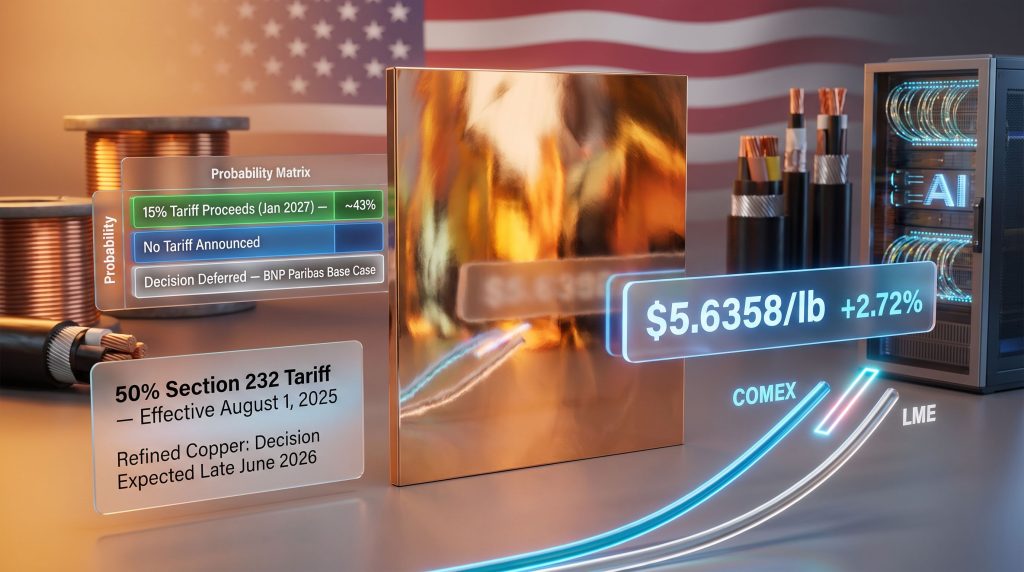
The most visible expression of tariff uncertainty in copper markets is the divergence between Comex futures prices in New York and London Metal Exchange prices. Copper recently traded at $5.6358 per pound, reflecting a 2.72% gain, with a meaningful portion of that premium attributable to ongoing tariff speculation rather than pure physical demand signals.
The mechanics of this dynamic follow a consistent pattern:
- Expectations of a US tariff on refined copper widen the Comex premium over LME prices.
- Traders source copper from global suppliers in Europe, Asia, and Africa at LME-linked prices.
- Metal is shipped to US ports and deposited into Comex-registered warehouses.
- Traders capture the spread between their purchase price and the elevated Comex futures price.
- If tariffs fail to materialise, the trade unwinds rapidly and metal flows back out of the US.
This arbitrage cycle has repeated itself multiple times over the past year, each iteration leaving a residue of elevated US warehouse inventories and distorted global supply signals. The July 2025 tariff exemption on raw metal is a case study in how quickly these flows can reverse when policy surprises in the opposite direction. As reported by CNN, the announcement sent immediate shockwaves through commodity markets.
At the trading firm level, the uncertainty has produced a paralysis effect. Major participants have paused material position-building ahead of the review deadline. Nicole Ni, vice general manager at Eagle Metal International, a trading firm that supplies copper to fabricators, has publicly noted that the policy uncertainty is preventing the firm from executing relevant trades, citing the significant price impact of the pending decision.
The Three Scenarios and What Each Means for Prices
Market participants are broadly coalescing around three potential outcomes, each with distinct implications for pricing, inventory flows, and supply chain strategy.
| Scenario | Probability (Morgan Stanley) | Short-Term Price Impact | Long-Term Supply Effect |
|---|---|---|---|
| 15% tariff proceeds (Jan 2027) | ~43% | Comex prices rise; LME spread widens | Incentivises US domestic production; raises fabricator costs |
| No tariff announced | Not quantified | Sharp Comex pullback; inventory unwind | Global supply normalises; US manufacturers relieved |
| Decision deferred | BNP Paribas base case | Status quo maintained; modest inflows continue | Uncertainty persists; bilateral supply deals possible |
Scenario 1: Tariffs Proceed at 15%
Morgan Stanley's research team, in a June 8, 2026 note, assigned a 43% probability to a tariff commencing at 15% from January 2027, with a potential escalation to 30% from 2028. Under this scenario, a fresh wave of arbitrage flows would likely pull refined copper from European smelters, African exporters including those in the Democratic Republic of Congo and Zambia, and Asian suppliers into Comex warehouses.
Jefferies analysts have identified a group of producers with meaningful US operational exposure who would benefit from a tariff regime: Freeport-McMoRan, Rio Tinto, Hudbay Minerals, and Ivanhoe Electric. The logic is straightforward: domestic producers face no tariff burden while their imported competition does, improving relative economics for US-based output.
Jefferies analysts, led by Christopher LaFemina, have cautioned clients to prepare for tariff-driven price volatility in the near term regardless of the specific outcome, while maintaining a constructive longer-term view. In addition, a tariff-driven copper rally of this nature could further amplify market distortions already present across the supply chain.
Scenario 2: The Administration Stands Down
A decision against tariffing refined copper would trigger the reverse of the current inventory accumulation. Metal stockpiled in Comex warehouses would begin migrating to nearby LME facilities, and whether it ultimately exits the US would depend heavily on demand conditions in China, which remains the world's dominant copper consumer.
The opposition to tariffs on raw material inputs is substantial and well-organised. The American Copper Fabricators Coalition has maintained an active lobbying presence opposing duties on refined copper, warning of cost pass-through that would erode the competitiveness of US-manufactured goods. This is not a fringe position.
David Wilson, senior metals strategist at BNP Paribas in Singapore, has articulated the core logical problem with raw material tariffs: domestic supply cannot be rapidly stimulated through import duties, but input costs for manufacturers rise immediately. The result is a short-term squeeze on US fabricators with no corresponding supply-side relief.
The Fabricator's Dilemma: US copper product manufacturers already absorb the cost of existing 50% tariffs on semi-finished goods. Extending duties to refined copper inputs would compound that burden, potentially creating a scenario where the cumulative tariff load destroys more downstream demand than it generates upstream investment.
Scenario 3: Decision Deferred
BNP Paribas regards a decision deferral as the most likely outcome. Under this scenario, the administration preserves tariff optionality without triggering the immediate market disruption of an announcement. The tariff threat remains credible enough to sustain measured inflows into US warehouses, but the flow rate remains lower than what would occur under a confirmed tariff.
The deferral scenario also opens space for alternative mechanisms, including bilateral supply arrangements with copper-producing allied nations. This approach would allow the administration to pursue resource security objectives without the blunt instrument of import duties that damage downstream manufacturers.
The Underlying Policy Tension the Decision Reveals
At its core, the Trump copper tariff decision functions as a real-time test of the administration's economic philosophy. The tension is genuine and irresolvable in the short term: tariffing refined copper simultaneously serves the goal of resource independence while undermining the goal of competitive domestic manufacturing.
The pro-tariff argument rests on a national security framing that has gained significant traction in Washington. The United States has become structurally dependent on imported refined copper at a moment when the metal underpins AI infrastructure, power grid modernisation, and defence electronics. Proponents argue that short-term manufacturer pain is an acceptable price for reducing long-term strategic vulnerability.
The counter-argument holds that Section 232 copper tariffs, sitting on top of existing 50% duties on semi-finished products, create a compounding cost burden that flows directly through to end customers in sectors including construction, electronics, and automotive manufacturing. Critics further note that import duties cannot conjure new domestic copper mining and refining capacity overnight. The lead time from greenfield copper discovery to first production typically spans 10 to 15 years, encompassing exploration, feasibility studies, permitting, environmental assessments, community engagement, and construction.
The next major ASX story will hit our subscribers first
Why New Copper Supply Cannot Be Tariffed Into Existence
This is perhaps the least appreciated dimension of the copper tariff debate, and one that deserves more attention than it typically receives in trade policy discussions. Copper supply is structurally inelastic in the short to medium term, for reasons that are geological as much as economic.
Global copper ore grades have been declining for decades at major producing operations. As mines age and high-grade zones are depleted, operators must process increasingly larger volumes of rock to extract the same quantity of copper. This grade decline effect means that even existing operations face rising unit costs over time, independent of any trade policy environment.
New mine development faces a compounding set of barriers:
- Permitting timelines in major mining jurisdictions can extend for years, particularly where environmental review processes are comprehensive.
- Community and indigenous engagement requirements have lengthened development timelines substantially across North American jurisdictions.
- Capital intensity for greenfield copper projects has risen sharply as ore grades decline and processing complexity increases.
- Geological scarcity in accessible, politically stable jurisdictions limits the pipeline of investable new projects.
Tariffs on refined copper imports can create an economic incentive for new domestic investment, however that investment cannot translate into new supply within any timeframe relevant to the current policy debate. The supply response, if it comes at all, would emerge years after the tariff decision. Consequently, the broader copper supply crunch that analysts have flagged is unlikely to be resolved by trade measures alone.
Long-Term Copper Fundamentals Remain Intact
Whatever the Trump copper tariff decision ultimately produces in terms of near-term price volatility, the structural demand case for copper over the coming decade is broadly accepted across institutional research.
The three primary demand drivers are:
- AI infrastructure buildout: Data centres require copper-intensive power distribution systems, cooling infrastructure, and high-density cabling. As AI model training and inference workloads scale, so does the physical copper footprint.
- Grid modernisation: North American and European power grids require extensive upgrades to accommodate renewable generation, distributed storage, and rising electrification loads. This represents a multi-decade capital investment cycle with copper embedded throughout.
- Electric vehicle adoption: EV penetration curves continue to rise across major markets, with each vehicle carrying substantially more copper than its combustion equivalent.
Long-Term Consensus: Near-term price volatility driven by tariff uncertainty does not alter the fundamental demand trajectory for copper. The metal's centrality to AI infrastructure, grid expansion, and electrification creates a structural demand floor that trade policy cannot erode over the medium to long term.
The supply side of this equation remains constrained for the geological and regulatory reasons outlined above, creating a projected structural deficit that most analysts expect to widen over the coming decade. Furthermore, the ongoing trade war copper prices dynamic between the US and China adds yet another layer of complexity to an already volatile market. As CNBC notes, these compounding pressures are reshaping how investors and manufacturers alike approach long-term copper exposure.
Frequently Asked Questions: Trump Copper Tariff Decision
What is the Trump copper tariff decision about?
The decision concerns whether the administration will impose new duties on refined copper imports, separate from the existing 50% Section 232 tariff already applied to semi-finished copper products since August 2025. A Commerce Secretary review due at the end of June 2026 will inform the President's determination.
What tariff rate is under consideration for refined copper?
The proposed structure is phased: a 15% tariff on refined copper imports beginning January 2027, potentially rising to 30% from 2028 onward.
Why was refined copper excluded from the August 2025 tariff package?
The August 2025 Section 232 action targeted semi-finished and derivative copper products. Raw inputs including ores, concentrates, anodes, cathodes, and scrap were deliberately excluded, with a separate national security review process initiated to evaluate refined copper specifically.
How would a copper tariff affect US manufacturers?
Manufacturers using refined copper as an input, including wire and cable producers, electrical component manufacturers, and construction product suppliers, would face higher costs. Industry groups warn these costs would be passed through to end customers, potentially reducing the competitiveness of US-made goods relative to imports.
What happens to copper prices if no tariff is announced?
A stand-down would likely trigger rapid unwinding of pre-tariff inventory positions accumulated in Comex warehouses, putting downward pressure on US copper prices and narrowing the Comex premium over LME prices.
Is the long-term copper outlook still constructive?
Broadly yes. Institutional analysts maintain a positive long-term view on copper, citing structural demand growth from AI infrastructure, grid modernisation, and electrification as durable drivers that persist regardless of near-term trade policy outcomes.
This article is intended for informational purposes only and does not constitute financial or investment advice. Commodity price forecasts, probability assessments, and scenario analyses referenced herein are derived from third-party research notes and are subject to change. Readers should conduct their own due diligence before making investment decisions.
Want to Capitalise on the Next Major Copper Discovery Before the Market Moves?
Discovery Alert's proprietary Discovery IQ model scans ASX announcements in real time, delivering instant alerts on significant mineral discoveries — including copper — so subscribers can identify actionable opportunities ahead of the broader market. Explore historic examples of exceptional discovery returns and begin your 14-day free trial today to position yourself at the forefront of the next major find.