June 4, 2026
China's expanding enforcement of strategic mineral export controls has transformed antimony trade from routine commercial activity into a heavily regulated sector where smuggling antimony ingots in China carries severe criminal penalties. The December 2025 Shenzhen Intermediate People's Court ruling, which sentenced 27 individuals for antimony smuggling violations, demonstrates how strategic mineral classifications translate into comprehensive legal frameworks with significant financial and imprisonment consequences.
Strategic Mineral Dependencies Reshape Global Trade Enforcement
The evolution of strategic mineral classifications reflects fundamental shifts in geopolitical risk assessment and supply chain security. Modern defense systems and clean energy infrastructure depend increasingly on materials concentrated in single-country sources, creating unprecedented vulnerabilities for importing nations. These dependencies have transformed commodity trade from purely economic transactions into instruments of foreign policy leverage.
China's dominance in antimony production exemplifies this strategic concentration, with the nation controlling approximately 60-70% of global output according to the U.S. Geological Survey's 2025 Mineral Commodity Summaries. This market position, combined with antimony's irreplaceable role in defense applications and semiconductor manufacturing, positions the mineral as a critical leverage point in international relations.
Recent enforcement actions targeting smuggling antimony ingots in China demonstrate how strategic mineral classifications translate into concrete legal frameworks and prosecution patterns. Furthermore, the strategic antimony loan 2025 initiatives highlight the broader international response to supply chain vulnerabilities.
When big ASX news breaks, our subscribers know first
What Makes Antimony a Strategic Mineral Under Chinese Export Controls?
Critical Applications Driving Export Restrictions
Antimony's strategic designation stems from its essential role across multiple critical sectors where substitute materials offer inferior performance characteristics. The mineral's unique properties make it functionally irreplaceable in specific high-value applications that directly impact national security and economic competitiveness.
In defense applications, antimony compounds serve as primary components in armor-piercing ammunition cores and military-grade flame retardants for aircraft and naval vessel interiors. The U.S. Department of Defense's 2023 Critical Materials Report identifies antimony as essential for electronic warfare equipment and radar systems.
The semiconductor industry depends on antimony-doped materials for p-type dopants in chip production, while flame-retardant coatings on circuit boards require specific antimony compounds. According to the International Technology Roadmap for Semiconductors (ITRS) 2021-2026 Update, manufacturing efficiency directly correlates to antimony purity levels.
Battery technology integration represents an expanding demand sector, where antimony compounds improve lithium-ion battery safety and thermal stability. Lead-acid battery production, still representing over 50% of the global battery market, depends on antimony as a hardener.
China's Market Dominance and Control Strategy
China's antimony market control extends beyond production volumes to encompass the entire supply chain infrastructure. The nation produced approximately 60,000 metric tons in 2023, representing 60-70% of global capacity while controlling approximately 48% of proven reserves totaling 1.3 million metric tons worldwide.
The strategic classification timeline reveals deliberate policy escalation following similar patterns to export controls for bismuth implemented earlier:
- September 2024: Official addition to export control list requiring licenses
- December 2024: Temporary suspension following Xi-Trump bilateral discussions
- December 2025: Licensing requirements remain in effect with active enforcement
Global antimony consumption distribution demonstrates the broad impact of supply restrictions:
- Flame retardants: 40-45% of global consumption
- Batteries and energy storage: 25-30%
- Semiconductors and electronics: 15-20%
- Defense/metallurgical applications: 10-15%
Geographic production concentration creates additional leverage points, with Hunan province accounting for 35-40% of China's antimony output. This concentration enables targeted production and export control implementation while creating chokepoints for global supply chains.
How Do China's Export Control Laws Define Antimony Smuggling?
Legal Requirements for Legitimate Exports
China's export control framework for antimony operates through the Ministry of Commerce (MOFCOM) licensing system, which requires comprehensive documentation and approval processes for all overseas shipments. The legal structure differentiates between legitimate commercial activities and criminal smuggling based on licensing compliance and documentation integrity.
Export licenses specify exact parameters including destination country, shipment volume, consignee verification, and end-use certification. Applicants must demonstrate legitimate business purpose through customer identity verification and supply chain traceability documentation. Processing timelines range from 15-30 business days for standard applications.
Documentation requirements for compliance include:
- Commercial invoices with antimony content verification
- Customs pre-clearance declarations using standardised forms
- Recipient company registration verification and sanctions screening
- Extraction and processing facility certification
- Complete chain of custody records for supply chain traceability
Real-time database cross-referencing with MOFCOM licence registries enables automated flagging for shipments exceeding licensed quantities by more than 5%. Port-level scanning integration with provincial customs bureaus creates multiple verification points throughout the export process.
Criminal Classifications and Penalty Structure
The December 2025 Shenzhen court ruling establishes clear volume-based penalty tiers that reflect organisational hierarchy within smuggling operations. The sentencing pattern demonstrates Chinese authorities' strategy to target network architects rather than individual facilitators through disproportionate penalties for primary organisers.
Penalty Structure from Recent Prosecutions:
| Defendant Category | Volume Threshold | Prison Sentence | Financial Penalty |
|---|---|---|---|
| Primary Organisers | 50+ metric tons | 10-12 years | 1,000,000 yuan |
| Mid-level Operators | 10-50 metric tons | 2-5 years | 500,000 yuan |
| Minor Participants | Under 10 metric tons | 4-18 months | 100,000 yuan |
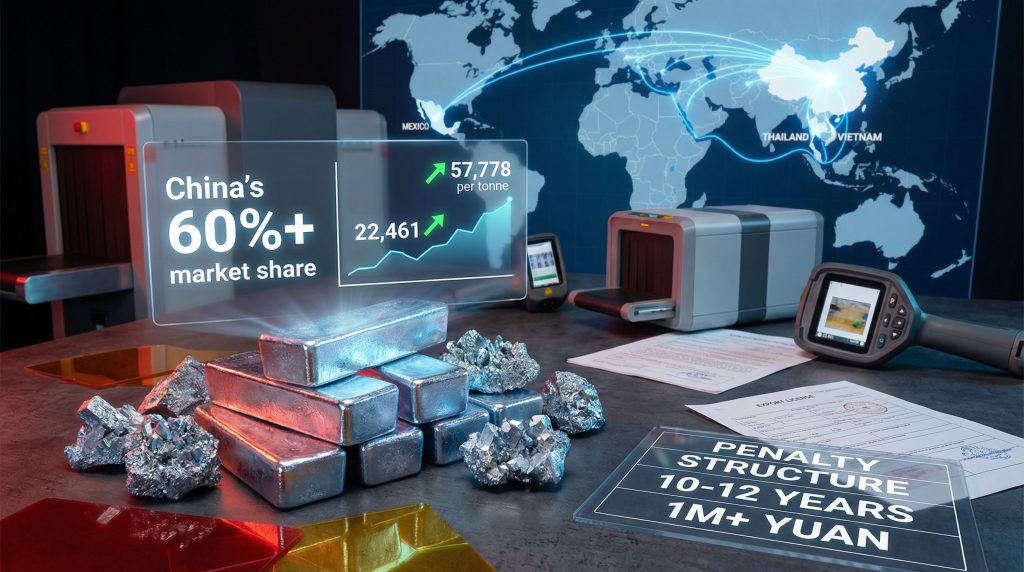
The Wang Wubin case demonstrates enforcement effectiveness with total smuggling volume of 166+ metric tons, customs seizure of 96+ metric tons (57.8% interception rate), and prosecution of 27 individuals across multiple provinces. The 1,000,000 yuan fine on the principal defendant (~$141,899 USD) indicates Chinese authorities view antimony smuggling as economically motivated criminal enterprise requiring substantial financial deterrence.
What Enforcement Patterns Emerge from Recent Prosecutions?
Case Study Analysis: Shenzhen Court Ruling Breakdown
The December 16, 2025 Shenzhen Intermediate People's Court decision provides comprehensive insight into China's antimony smuggling enforcement approach, revealing systematic prosecution patterns that target entire criminal networks rather than individual operators.
Wang Wubin's organisation operated during February-March 2025, utilising false labelling as industrial scrap materials and Thailand-based intermediary networks. Detection occurred through port X-ray scanning at Shenzhen customs, demonstrating technological enforcement capabilities deployed post-September 2024 export controls.
The prosecution timeline reveals enforcement evolution from policy announcement to active legal action within a 15-month window:
- September 2024: Export controls implemented
- February-March 2025: Primary smuggling activity period
- April 2025: Hong Kong authorities seized antimony cargo
- July 2025: Reuters investigation documents unusual Thailand/Mexico routing
- December 16, 2025: Comprehensive sentencing announcement
Network structure analysis from the case reveals typical smuggling organisation hierarchy:
- Tier 1: Wang Wubin (primary organiser, 12 years imprisonment)
- Tier 2: 8 mid-level coordinators managing purchasing and transport (2-5 years)
- Tier 3: 18 workers, drivers, document forgers (4-18 months)
- Overseas Interface: Thailand-based intermediaries (not prosecuted in Chinese courts)
The 57.8% seizure rate (96+ tons seized from 166+ tons total) indicates developing detection capabilities while the 42.2% escape rate suggests sophisticated concealment methods maintain partial effectiveness against enforcement systems.
Geographic Enforcement Hotspots
Multi-provincial enforcement patterns demonstrate coordinated law enforcement responses across China's primary antimony production and export regions. Geographic concentration of smuggling activities reflects both production hub locations and established trafficking route infrastructure.
Primary Enforcement Zones:
-
Shenzhen Port Operations
- Primary detection site handling 40% of China's mineral exports
- Enhanced X-ray and scanning technology deployment
- Multiple detection successes documented in recent cases
-
Guangxi-Vietnam Border Zone
- 1,038 km shared border with historically high smuggling rates
- Land-based antimony transport primary routes
- Cross-provincial coordination in December 2025 case
-
Hunan Province Production Hub
- Source point for approximately 60% of smuggling incidents
- 35-40% of China's antimony production concentrated regionally
- Active provincial law enforcement task forces established
-
Yunnan Province Border Operations
- Transit point for Thailand-bound shipments
- High monitoring intensity due to established trafficking infrastructure
- Cross-provincial task force coordination protocols
However, the evolving enforcement landscape must be considered alongside broader developments in the critical minerals order 2025 initiatives that shape international responses to supply chain vulnerabilities.
Which Smuggling Methods Are Chinese Authorities Targeting Most Aggressively?
Concealment and Misdeclaration Tactics
Enforcement focus concentrates on document-based deception techniques that exploit customs clearance processes and regulatory compliance gaps. The Wang Wubin case demonstrates systematic targeting of false declaration schemes that represent the most prevalent smuggling method for strategic minerals.
Primary concealment methods identified through prosecutions include:
- False customs documentation creating fictional export authorisations
- Product disguise techniques labelling antimony as industrial scrap or non-controlled materials
- Container manipulation designed to obscure X-ray detection systems
- Document forgery operations producing counterfeit end-use certifications
Chinese authorities demonstrate particular aggression toward organised document fraud, viewing systematic paperwork deception as representing greater criminal sophistication than simple physical concealment. The penalty structure reflects this enforcement priority through enhanced sentences for defendants involved in documentation falsification.
Detection technology deployment specifically targets these methods through:
- Enhanced port scanning equipment capable of identifying mineral composition
- Database cross-referencing systems linking export documentation to licence registries
- Chemical composition detection capabilities distinguishing antimony from declared materials
- Real-time monitoring integration across multiple customs checkpoints
Third-Country Transshipment Networks
International routing operations represent the most complex smuggling category, requiring multi-jurisdictional coordination and sophisticated logistics networks. Reuters investigations documented substantial increases in antimony shipments to the United States via Thailand and Mexico following September 2024 restrictions.
Primary Transshipment Routes:
-
Thailand Routing Operations
- 300%+ increase in antimony shipments to US markets
- Intermediate processing facilities obscuring Chinese origin
- Complex documentation chains creating compliance appearance
-
Mexico Intermediary Processing
- Secondary processing and re-export capabilities
- USMCA trade agreement advantages for US market access
- Limited bilateral enforcement cooperation with Chinese authorities
-
Vietnam Border Crossing Networks
- Land-based transit alternative to port shipping
- 1,038 km shared border creating multiple crossing points
- Historical smuggling infrastructure adapted for antimony transport
Chinese enforcement strategy targets these networks through international cooperation agreements, mutual legal assistance treaties with Thailand, Vietnam, and Hong Kong, and information sharing protocols with Interpol and regional partners. Additionally, China's anti-spy agency has warned about foreign attempts to smuggle key minerals as part of the resource competition.
How Do Price Dynamics Influence Smuggling Incentives?
Market Price Volatility Analysis
Antimony price fluctuations create powerful economic incentives driving illegal export operations, with profit margins substantially exceeding traditional commodity smuggling returns. Price volatility following export control implementation demonstrates direct correlation between regulatory restrictions and black market premiums.
Price Evolution and Smuggling Activity Correlation:
| Time Period | Price per Tonne | Percentage Change | Smuggling Risk Level |
|---|---|---|---|
| July 2024 | $22,461 | Baseline | Moderate |
| September 2024 | $28,500 | +27% | Elevated |
| October 2024 | $35,000 | +56% | High |
| February 2025 | $45,600 | +103% | Critical |
| April 2025 | $57,778 | +157% | Peak Activity |
The 157% price increase from July 2024 to April 2025 creates extraordinary profit opportunities that justify significant criminal risk. Wang Wubin's organisation operated during the February-March 2025 peak pricing period, when market conditions provided maximum financial incentive for export control violations.
Risk-adjusted return calculations demonstrate why organised criminal networks target antimony smuggling over alternative illegal activities. With legitimate export licence processing times of 15-30 business days and documentation costs representing less than 2% of shipment value, illegal operations can capture nearly the entire regulatory compliance premium as profit.
Profit Margin Calculations for Illegal Operations
Economic analysis of the Wang Wubin case reveals specific financial structures underlying antimony smuggling operations. With 166+ metric tons valued at approximately $7.6 million at February 2025 prices, the criminal network faced potential profits exceeding $6 million after operational expenses.
Cost-Benefit Analysis for Criminal Networks:
- Procurement costs: Chinese domestic prices (~$18,000/ton in early 2025)
- Transportation and concealment: $2,000-$3,000 per ton
- Documentation fraud: $500-$1,000 per shipment
- International market prices: $45,000-$57,000 per ton
- Gross profit margins: 150-200% of procurement costs
Penalty structure analysis reveals that financial deterrence may prove insufficient against such substantial profit opportunities. Wang Wubin's 1,000,000 yuan fine represents less than 15% of estimated network revenues, suggesting current penalty levels fail to eliminate economic incentives for large-scale operations.
The seizure rate of 57.8% in the Wang Wubin case indicates that even with partial law enforcement success, criminal networks can maintain positive expected returns. Organisations capable of accepting 40-60% loss rates due to interdiction can still generate substantial profits from successful shipments.
The next major ASX story will hit our subscribers first
What Enforcement Technologies Are Chinese Authorities Deploying?
Customs Inspection Enhancement Systems
Technological infrastructure upgrades represent China's primary strategy for improving antimony smuggling detection rates. Post-September 2024 deployments focus on automated identification systems capable of distinguishing antimony from concealment materials and false declarations.
Enhanced port scanning equipment incorporates chemical composition detection capabilities that identify mineral content regardless of packaging or labelling claims. The Shenzhen port detection of Wang Wubin's operations demonstrates effectiveness of upgraded X-ray systems combined with database cross-referencing protocols.
Technology Integration Components:
- Advanced X-ray systems with mineral identification algorithms
- Chemical detection scanners distinguishing antimony from industrial materials
- Database integration platforms linking customs data with MOFCOM licensing
- Real-time alert systems flagging shipments exceeding authorised volumes
- Automated documentation verification detecting forged certificates and permits
Implementation across major ports creates multiple verification checkpoints that increase detection probability for systematic smuggling operations. The 57.8% seizure rate in recent cases suggests improving technological effectiveness while indicating continued opportunities for sophisticated concealment methods.
Inter-Agency Coordination Mechanisms
Multi-agency integration represents the operational framework enabling comprehensive antimony smuggling investigations. The Wang Wubin case demonstrates coordination between Ministry of State Security (MSS), provincial Public Security Bureaus, customs authorities, and MOFCOM licensing divisions.
Information sharing protocols enable real-time communication across 12+ provincial jurisdictions, creating comprehensive monitoring networks for suspicious antimony movements. Cross-provincial task forces coordinate investigations spanning multiple production regions and export routes.
Coordination Framework Elements:
- MSS intelligence gathering on organised smuggling networks
- Customs enforcement operations at ports and border crossings
- Provincial police coordination across production and transit regions
- MOFCOM licensing verification for documentation authenticity
- International cooperation protocols with foreign law enforcement agencies
The comprehensive prosecution of 27 defendants across multiple provinces indicates sophisticated inter-agency coordination capabilities that extend beyond traditional customs enforcement models. This integrated approach enables targeting of entire criminal networks rather than individual smuggling incidents.
How Are International Markets Responding to Enforcement Actions?
Global Supply Chain Disruption Indicators
International market responses to Chinese antimony enforcement demonstrate immediate supply chain adaptations and strategic sourcing diversification efforts. Price volatility in legitimate markets reflects decreased supply reliability and increased compliance costs throughout the global antimony trade.
Downstream industries report extended lead times ranging from 6-8 months for semiconductor manufacturers to 12+ months for defense contractors requiring certified antimony supplies. These delays force strategic stockpiling decisions and alternative material research investments across affected sectors.
Supply Chain Impact Metrics:
- Electronics manufacturing: 40-60% increase in procurement lead times
- Defence contractors: Mandatory 18-month strategic reserve requirements
- Battery production facilities: 200-300% increase in raw material inventory costs
- Chemical processing industries: Supply contract renegotiations with force majeure clauses
Alternative supplier development initiatives focus on previously uneconomical antimony deposits in Australia, Canada, and certain African nations. However, development timelines for new production capacity range from 3-7 years, creating sustained dependence on Chinese sources during transition periods.
Geopolitical Implications for Trade Relations
Antimony enforcement patterns establish precedents for additional strategic mineral controls, creating uncertainty across broader critical materials markets. The temporary suspension following Xi-Trump discussions demonstrates how mineral trade controls function as diplomatic negotiation tools, particularly in the context of evolving us‑china trade strategies.
European Union supply security concerns drive accelerated critical materials strategy implementation, including domestic processing capability development and bilateral agreements with non-Chinese suppliers. Japan and South Korea pursue coordinated sourcing diversification through joint procurement initiatives and shared strategic reserves.
Regional Response Strategies:
- United States: USMCA antimony processing incentives and Defense Production Act applications
- European Union: Critical Raw Materials Act implementation with antimony priority designation
- Japan/South Korea: Bilateral cooperation agreements for alternative sourcing
- Australia: Domestic antimony production revival and export capacity expansion
Trade relationship tensions extend beyond bilateral US-China dynamics, as enforcement actions affect global supply chains regardless of end destination. Third-country processors in Thailand, Vietnam, and Mexico face increased scrutiny and compliance costs that reshape regional trade flows.
What Legal Precedents Are These Cases Establishing?
Sentencing Guidelines Evolution
The December 2025 Shenzhen court ruling establishes volume-based penalty escalation standards that create predictable sentencing frameworks for future antimony smuggling prosecutions. These precedents influence corporate risk assessments and compliance investment decisions throughout the strategic minerals sector.
Repeat offender treatment protocols remain undocumented in current cases, though the hierarchical penalty structure suggests enhanced sentences for organisations with prior strategic mineral violations. Asset forfeiture procedures beyond monetary fines appear limited in current prosecutions, potentially indicating areas for future enforcement expansion.
Precedential Elements from Recent Cases:
- Volume thresholds: 10/50 metric ton breakpoints for penalty escalation
- Organisational role differentiation: Leader versus participant sentencing disparities
- Documentation fraud penalties: Enhanced sentences for systematic falsification
- International conspiracy treatment: Domestic prosecution despite overseas coordination
- Seizure rate implications: Partial loss acceptance in profit calculations
Corporate compliance requirements emerge through negative precedent, as companies observing prosecution patterns invest in verification systems and audit trails to demonstrate legitimate sourcing. The Wang Wubin case drives due diligence standard evolution across antimony supply chains.
Corporate Compliance Requirements
Supply chain verification obligations develop through enforcement pattern analysis rather than explicit regulatory guidance. Companies purchasing antimony implement enhanced documentation requirements and supplier audit systems to demonstrate compliance with export control regulations.
Emerging Best Practice Standards:
- Supplier verification protocols including facility inspections and certification reviews
- Documentation chain integrity with digital verification and blockchain tracking
- Legal counsel consultation for complex sourcing arrangements and third-country processing
- Regular compliance training for procurement and logistics personnel
- Whistleblower protection systems encouraging internal reporting of suspicious activities
Record-keeping requirements extend beyond traditional commercial documentation to include end-use certifications, facility registrations, and compliance attestations that demonstrate legitimate business purpose. These systems create substantial administrative overhead but provide legal protection against criminal prosecution.
Which Industries Face the Greatest Compliance Risks?
High-Risk Sector Identification
Industry-specific compliance risks vary based on antimony usage patterns, supply chain complexity, and regulatory oversight intensity. Sectors utilising antimony in defence applications face enhanced scrutiny due to national security implications and export control sensitivity.
Electronics manufacturing supply chains demonstrate highest vulnerability due to complex sourcing networks, multiple processing stages, and significant volume requirements. Semiconductor production facilities require continuous antimony supplies with specific purity standards that limit supplier diversification options.
Risk Assessment by Industry Sector:
- Defence contractors: Mandatory compliance verification and security clearance requirements
- Electronics manufacturers: Complex supply chains with multiple antimony sources and processing stages
- Battery production facilities: Large volume requirements and technical specification constraints
- Chemical processing industries: Intermediate product sourcing with potential unknowing violations
Defence contractor procurement processes face additional complexity due to security clearance requirements and export control sensitivities. Government auditing standards exceed commercial compliance levels, creating enhanced documentation and verification obligations.
Battery production facility sourcing demonstrates particular vulnerability due to volume requirements that encourage cost optimisation through potentially non-compliant suppliers. The growth trajectory of energy storage markets increases antimony demand faster than legitimate supply capacity expansion.
Compliance Framework Development
Risk mitigation strategies focus on supply chain transparency and documentation integrity rather than alternative material substitution, as antimony's technical properties resist replacement in most applications. Companies implement multi-layered verification systems combining supplier audits, documentation review, and independent testing.
Comprehensive Compliance Components:
- Supplier audit systems with annual facility inspections and management interviews
- Documentation verification including licence authenticity and traceability records
- Independent testing protocols confirming material composition and origin
- Legal compliance monitoring tracking regulatory changes and enforcement patterns
- Insurance and hedging instruments providing financial protection against supply disruption
Regular compliance training programmes ensure procurement personnel understand evolving regulatory requirements and enforcement patterns. Training content includes export control basics, documentation requirements, and suspicious activity identification protocols.
Long-term contract negotiation approaches incorporate compliance clauses and force majeure provisions addressing regulatory changes. Companies negotiate supplier warranties regarding export control compliance and establish audit rights for ongoing verification.
What Future Enforcement Trends Should Markets Expect?
Regulatory Tightening Indicators
Current antimony enforcement patterns suggest expansion potential across additional strategic minerals currently under Chinese export control consideration. Regulatory momentum indicates systematic application of similar frameworks to tungsten, germanium, gallium, and rare earth elements.
Enhanced penalty structures under consideration include asset forfeiture provisions, corporate sanctions capabilities, and enhanced international cooperation agreements. Technology integration improvements focus on artificial intelligence applications for pattern recognition and predictive enforcement targeting, aligning with broader critical minerals strategy 2025 initiatives.
Anticipated Regulatory Developments:
- Additional mineral classifications expanding controlled substances lists
- Enhanced corporate liability including parent company sanctions and directors' personal liability
- International enforcement cooperation through mutual legal assistance treaties
- Technology-enabled monitoring with AI-powered pattern recognition systems
- Strategic reserve regulations potentially controlling domestic stockpiling activities
The success of antimony enforcement in disrupting illegal trade patterns encourages application to other strategic minerals where China maintains production dominance. Regulatory officials observe enforcement effectiveness and economic leverage potential across different commodity categories.
Market Adaptation Strategies
Industry adaptation focuses on supply chain diversification, strategic reserve accumulation, and alternative material development rather than compliance avoidance. Long-term strategies anticipate sustained Chinese export control expansion across multiple critical minerals.
Adaptive Response Frameworks:
- Alternative source development prioritising non-Chinese suppliers despite cost premiums
- Recycling technology investment reducing primary material consumption through circular economy approaches
- Substitute material research developing alternatives for non-critical applications
- Strategic reserve policies maintaining inventory buffers against supply disruption
- Regional processing capabilities reducing dependence on Chinese intermediate products
Technology development investments target antimony recycling from end-of-life products, particularly electronics and batteries where recovery rates currently remain below 10%. Enhanced recycling could provide 20-30% of annual antimony consumption within 5-7 years with appropriate investment and regulatory support.
International cooperation initiatives include joint procurement agreements, shared strategic reserves, and coordinated research programmes among allied nations. These approaches reduce individual country vulnerability while maintaining collective negotiating leverage.
The December 2025 Shenzhen court ruling establishes a clear precedent that smuggling antimony ingots in China represents serious criminal activity warranting substantial prison sentences and financial penalties. As enforcement patterns continue evolving, industries dependent on antimony must develop comprehensive compliance frameworks that address both current regulatory requirements and anticipated future restrictions across strategic mineral categories.
Disclaimer: This analysis contains forward-looking statements regarding regulatory trends, market developments, and industry responses that involve inherent uncertainties and risks. Actual outcomes may differ materially from projections based on changing political conditions, technological developments, and market dynamics. Information regarding specific legal cases and enforcement actions is based on publicly available sources and may not reflect complete or final determinations. Readers should consult legal and compliance professionals for specific guidance regarding export control regulations and strategic mineral sourcing decisions.
Could Strategic Mineral Trade Disruptions Signal Your Next Investment Opportunity?
Discovery Alert's proprietary Discovery IQ model delivers real-time alerts on significant ASX mineral discoveries, including critical materials like antimony that are reshaping global supply chains and creating actionable investment opportunities. With enforcement actions and supply chain disruptions driving unprecedented price volatility across strategic minerals, subscribers gain instant insights into ASX mining companies positioned to benefit from these market dynamics. Begin your 30-day free trial today to identify emerging opportunities in the evolving critical minerals landscape.