July 30, 2026
The Metallurgical Turning Point Western Critical Mineral Investors Have Been Waiting For
Across the global critical minerals landscape, the gap between geological promise and verified metallurgical viability has historically been the graveyard of countless junior mining companies. Securing a credible ore body is only the beginning. What separates projects that attract serious capital from those that languish in perpetual exploration is the ability to demonstrate a clear, technically validated pathway from rock to refined product. That transition, from geological target to actual metal output, is precisely what makes the recent production of ATAA antimony ingots from the Antimony Canyon project in Utah a genuinely significant development in the Western antimony supply chain story.
When big ASX news breaks, our subscribers know first
Why Antimony's Strategic Reclassification Changes Everything
For much of the twentieth century, antimony was treated with something close to indifference by Western commodity markets. It was regarded as a metallurgical contaminant in lead and copper smelting circuits, a minor byproduct that created disposal problems rather than revenue opportunities. That perception has, however, undergone a fundamental reversal.
Today, antimony is formally classified as a critical mineral by the United States, the European Union, and Australia, among other jurisdictions. This reclassification did not happen arbitrarily. Three powerful demand vectors converged simultaneously to elevate its strategic standing:
- Renewable energy storage – Antimony is increasingly relevant to next-generation liquid metal battery architectures, where its electrochemical properties offer advantages in grid-scale energy storage applications.
- Defense and weapons systems – Antimony trioxide functions as a flame retardant in military-grade materials and is embedded in munitions components, making domestic supply a national security consideration for the U.S. Department of Defense. The antimony shortage risks for defence procurement are therefore substantial and growing.
- Advanced microelectronics – As a semiconductor dopant and component in infrared detector manufacturing, antimony sits directly within the technology competition between the United States and China.
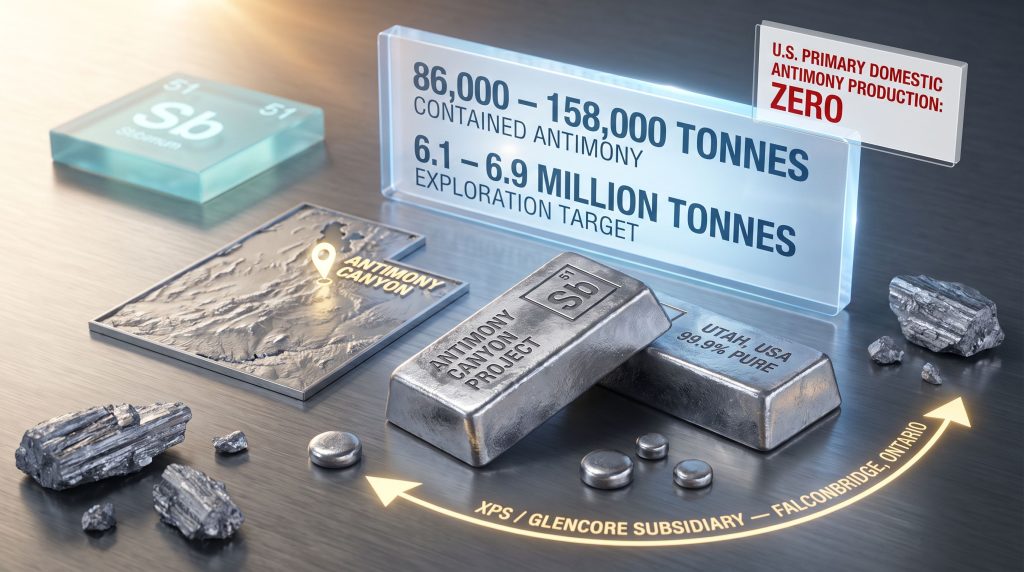
The structural problem underpinning all three demand sectors is the same: the United States currently maintains zero primary domestic antimony production. According to the U.S. Geological Survey's Mineral Commodity Summaries 2024, China accounted for approximately 48% of global antimony mine production in 2023, while the U.S. relies on near-total import dependency for its antimony supply. This is not a theoretical vulnerability. It is a measurable, quantifiable structural exposure embedded in multiple critical supply chains simultaneously. The broader critical mineral benefits to industry and national security make closing this gap an urgent policy priority.
Understanding Stibnite: The Mineralogy Behind Antimony Production
A detail often overlooked in market commentary is the mineralogical character of antimony deposits. The primary ore mineral from which commercial antimony is extracted is stibnite, with the chemical formula Sb₂S₃. It presents as a lead-grey, lustrous sulfide mineral and is the most abundant antimony-bearing mineral found in hydrothermal vein systems.
Stibnite deposits typically form in low-temperature hydrothermal environments, often associated with gold mineralisation. This genetic relationship is not coincidental. Many historically significant gold-antimony districts globally, including parts of China's Hunan Province (home to the world's largest known antimony deposit at Xikuangshan), formed through the same crustal fluid circulation processes.
The Antimony Canyon deposit in Utah is a stibnite-bearing system, making its material directly compatible with well-established antimony extraction metallurgy. This compatibility is precisely why the ingot-production testwork conducted by XPS Expert Process Solutions could proceed efficiently without requiring novel processing chemistry.
The smelting of stibnite involves roasting or direct reduction to separate the antimony metal from the sulfur component, yielding a crude antimony metal that can then be refined to commercial specifications. Furthermore, the fact that approximately 100 kilograms of hand-sorted stibnite from Antimony Canyon followed this pathway cleanly is a technically meaningful outcome.
Antimony Canyon: Scale, Tenure, and the Significance of Patented Claims
How Large Is the Exploration Target?
The Antimony Canyon project carries an exploration target of 6.1 to 6.9 million tonnes grading between 1.4% and 2.3% antimony, representing a conceptual contained antimony range of approximately 86,000 to 158,000 tonnes.
Important Caveat: Exploration targets are conceptual in nature and should not be equated with JORC-compliant or NI 43-101-compliant mineral resources. They represent geological potential estimated from available data, not confirmed reserves. Significant drilling and resource definition work is required before these figures can be upgraded to a formal resource classification.
One frequently underappreciated aspect of the project is its patented claims tenure. In the United States mining system, patented mining claims convey full private property rights over both the surface and the mineral estate, unlike unpatented mining claims where the federal government retains ownership of the land. For context, the mining claims framework in comparable North American jurisdictions illustrates just how materially this tenure distinction can affect project development outcomes.
Patented claims provide materially stronger land tenure security, reduce surface access disputes, and can simplify certain permitting pathways. For a project seeking to attract institutional capital and offtake interest, this distinction matters more than many generalist investors realise.
| Resource Parameter | Reported Range |
|---|---|
| Exploration Target (tonnage) | 6.1 to 6.9 million tonnes |
| Antimony grade range | 1.4% to 2.3% Sb |
| Contained antimony estimate | ~86,000 to 158,000 tonnes |
| Project location | Utah, USA |
| Claim type | Patented claims |
| Current development stage | Exploration / early metallurgical testwork |
How the First ATAA Antimony Ingots Were Actually Produced
The metallurgical pathway that resulted in the first ATAA antimony ingots from the Antimony Canyon project followed a deliberate and methodologically sound sequence:
- Material sourcing – Approximately 100 kilograms of hand-sorted stibnite ore was selected directly from the Antimony Canyon project site in Utah.
- Third-party submission – The material was submitted to XPS Expert Process Solutions, a metallurgical testing and technology transfer firm based in Falconbridge, Ontario, and a wholly owned subsidiary of Glencore (LON: GLEN).
- Smelting execution – XPS applied established smelting protocols to convert the raw stibnite into refined antimony metal.
- Product verification – The resulting output took the form of antimony ingots and buttons, physically confirming that Antimony Canyon ore material can follow a viable mine-to-metal processing route.
XPS characterised the outcome as a metallurgical milestone. This descriptor is significant when it comes from a Glencore-owned entity. Glencore operates as one of the world's largest diversified commodity traders and processors, with decades of experience across base and specialty metals. When a firm operating within that institutional framework validates a junior company's proof-of-concept result, the credibility signal carries genuine weight in the technical due diligence community.
The involvement of XPS also carries a practical implication that extends beyond optics. XPS specialises in process development, technology transfer, and piloting services. Their engagement with the Antimony Canyon project suggests the metallurgical concept study phase will benefit from institutional-grade technical guidance rather than relying solely on academic or boutique consulting resources.
Proof-of-Concept Versus Commercial Production: Why the Distinction Matters
It is essential for observers following this development to calibrate their expectations against the actual stage of the project. The production of ingots from 100 kilograms of hand-sorted material is a proof-of-concept result, not a commercial production outcome. The distinction between these stages is substantial, and a definitive feasibility study remains a significant milestone further along the development pathway.
| Development Stage | What It Represents |
|---|---|
| Proof-of-concept (current) | Confirms ore converts to metal product under controlled conditions |
| Metallurgical concept study | Evaluates the most viable processing route at commercial scale |
| Plant design phase | Engineering work for a commercial-scale processing facility |
| Pilot mining and processing | Small-scale operational testing before full capital commitment |
| Commercial production | Full-scale, revenue-generating output |
American Tungsten and Antimony (ATAA) currently sits between the proof-of-concept and metallurgical concept study stages. The ingot results directly feed into the ongoing concept study, and outcomes from that study will inform the engineering work associated with a potential tertiary antimony processing facility being evaluated for Cedar City, a regional centre in Utah located near the Antimony Canyon site.
The decision to evaluate a processing facility at Cedar City rather than at the mine site itself reflects a deliberate strategic choice. Decoupling the mining and processing locations can offer meaningful advantages in the U.S. regulatory context, including proximity to existing infrastructure, workforce availability, and separation of the mine permitting process from the facility permitting process. Whether those advantages outweigh the additional logistics of ore or concentrate transport will ultimately be determined by the concept study economics.
The next major ASX story will hit our subscribers first
Scenario Analysis: Three Possible Trajectories for Antimony Canyon
Any realistic assessment of the project's forward path must account for a range of outcomes. Three broad scenarios illustrate the spectrum of possibilities:
Scenario 1 – Measured Progression (Base Case)
Drilling and resource definition work continues through 2026 and 2027. The metallurgical concept study delivers actionable economics. A plant design for the Cedar City facility progresses through standard permitting timelines. First commercial output remains a 7-to-10-year horizon under this trajectory.
Scenario 2 – Accelerated Development (Bull Case)
The concept study delivers favourable economics more rapidly than anticipated. Cedar City facility permitting moves efficiently. Antimony prices remain elevated due to sustained geopolitical supply pressures. Consequently, Antimony Canyon could potentially become a functioning domestic supply node within 5 to 7 years.
Scenario 3 – Structural Headwinds (Bear Case)
Antimony prices soften materially, compressing project economics. Permitting for the Cedar City facility encounters delays. Capital markets for junior critical mineral developers tighten. Outcome: Extended development timeline, care-and-maintenance status, or pursuit of a major strategic partner or acquirer.
Investor Note: These scenarios are speculative projections intended to frame the range of outcomes. They are not forecasts and should not be treated as investment advice. Critical mineral development timelines are inherently uncertain, and junior developers face capital intensity risks that can materially affect project advancement. Independent financial and technical advice should be sought before making any investment decisions.
The Broader Western Antimony Development Context
One of the less widely understood aspects of the antimony supply challenge is why the United States arrived at a position of total import dependency in the first place. The answer involves overlapping historical forces: low antimony prices through much of the 1980s and 1990s made domestic antimony production economically unviable, existing domestic operations closed progressively, and the availability of lower-cost Chinese material eliminated the commercial incentive for new development.
Environmental permitting complexity added another layer of friction that further suppressed exploration investment. The result is a structural gap that has taken decades to form and will require years to address, regardless of policy intent.
Projects like Antimony Canyon represent genuine attempts to systematically fill that gap, beginning with the foundational work of demonstrating that domestic ore bodies can yield commercial-grade metal products through technically validated processing pathways. In addition, Utah's growing role in critical mineral development suggests the state may become an increasingly important node in the broader domestic supply chain conversation.
The hand-sorted stibnite used in the XPS testwork was selected specifically to demonstrate maximum ore quality potential. As the project advances toward bulk sampling and eventual pilot mining, the processing characteristics of a representative ore blend, rather than selectively sorted material, will be the more commercially relevant measure. This distinction between hand-sorted testwork material and run-of-mine ore is a standard consideration in metallurgical development, and observers should expect future studies to address this progression explicitly.
Key Risks Observers Should Monitor
For those following the development of American Tungsten and Antimony's Antimony Canyon project, several risk factors warrant ongoing attention:
- Resource definition remains at the exploration target stage, meaning significant drilling is required before a formal mineral resource can be established under any recognised reporting code.
- The processing facility strategy at Cedar City introduces regulatory, community engagement, and capital allocation variables that are independent of the mine permitting process.
- Antimony price volatility remains a critical external variable. Prices have been elevated by geopolitical supply concerns, but commodity cycles can shift on timescales shorter than project development timelines.
- The transition from 100-kilogram testwork to pilot-scale and then commercial-scale processing involves step changes in capital requirements, technical complexity, and operational risk.
- The entire mine-to-metal concept, while now validated at proof-of-concept scale, must be confirmed to remain economically and technically viable as the processing scale increases by multiple orders of magnitude.
From First Ingot to Supply Chain Node: What the Milestone Actually Signals
The production of ATAA antimony ingots from the Antimony Canyon project is best understood not as a commercial event but as a de-risking event. In critical mineral project development, each stage of technical validation performs a specific function in the capital markets ecosystem. Proof-of-concept metallurgy shifts a project from purely geological speculation toward a conversation about processing economics.
That shift matters to a specific audience: the technical reviewers, project financiers, and potential offtake partners who require evidence of end-product capability before engaging seriously. A concentrate-only pathway is far less commercially attractive than a demonstrated mine-to-metal route in the current critical minerals environment, where downstream processing capability has become a key differentiator.
The involvement of XPS, operating within the Glencore institutional framework, adds a dimension of third-party credibility that purely internal testwork cannot replicate. It positions the Antimony Canyon project to engage the next tier of technical and commercial due diligence with a validated foundation rather than a theoretical one.
Whether that foundation translates into a functioning domestic antimony supply node within the United States will depend on the interplay of geology, metallurgy, capital markets, regulatory timelines, and commodity prices over the years ahead. What is no longer speculative is that the ore at Antimony Canyon can become antimony metal. That is now a demonstrated fact.
Disclaimer: This article is intended for informational purposes only and does not constitute financial, investment, or professional advice. The information contained herein is based on publicly available sources and should not be relied upon as the sole basis for any investment decision. Exploration targets referenced in this article are conceptual in nature and do not represent JORC-compliant or NI 43-101-compliant mineral resources. Readers should conduct their own independent due diligence and seek professional advice before making any investment decisions.
Want to Track the Next Major Critical Mineral Discovery Before the Market Does?
Discovery Alert's proprietary Discovery IQ model delivers real-time alerts on significant ASX mineral discoveries — instantly converting complex geological and metallurgical developments into actionable investment insights for both short-term traders and long-term investors. Explore how historic discoveries have generated substantial returns on Discovery Alert's dedicated discoveries page, and begin your 14-day free trial today to position yourself ahead of the broader market.