July 30, 2026
The Architecture of Energy Vulnerability: Why Domestic Gas Production Is Becoming Non-Negotiable for Import-Dependent Economies
Across the Mediterranean's southern rim, a quiet but consequential realignment in energy strategy is underway. Countries that once relied on stable bilateral pipeline arrangements are confronting a new reality: geopolitical fractures, volatile spot markets, and structurally elevated LNG import costs are forcing a fundamental rethink of where national gas supply comes from. For Morocco, this reckoning arrived sharply in 2021 and has not eased since.
The economic logic driving Morocco toward domestic gas production is not simply about cost reduction. It reflects a deeper strategic calculation: that energy security, once taken for granted through a regional pipeline arrangement, can no longer be assumed. Understanding the Managem Tendrara Energy gas operations story requires starting from this macro context, not from the corporate announcement itself.
When big ASX news breaks, our subscribers know first
Morocco's Gas Import Exposure: A Structural Vulnerability in Plain Sight
The Maghreb-Europe Pipeline Rupture and Its Economic Fallout
When Algeria chose not to renew the transit agreement that kept the Maghreb-Europe Gas Pipeline (GME) flowing through Moroccan territory in October 2021, it severed more than a physical supply artery. It eliminated Morocco's access to competitively priced piped gas from a neighbouring producer and forced the country into the higher-cost world of European LNG spot procurement.
The consequences have been tangible. Morocco has since sourced gas from European terminals, exposing its industrial sector to the same price volatility that roiled European manufacturers during the 2021–2022 energy crisis. For energy-intensive industries including chemicals, fertilisers, ceramics, and food processing, this has translated into margin compression and reduced competitiveness in export markets.
The National Office of Electricity and Drinking Water (ONEE) has already moved to secure future domestic gas supply contracts, which itself signals how seriously Morocco's energy institutions have assessed the long-term import exposure risk. The country's annual LNG demand creates a structural supply gap that no single project can fully close, but that domestic production can begin to address in a meaningful way. Shifts in natural gas price trends globally have further reinforced the urgency of this domestic push.
Why Industrial Gas Consumers Cannot Simply Switch Fuels
One underappreciated dimension of Morocco's gas dependency is the lock-in effect within its industrial base. Unlike electricity consumers who can in theory shift between grid sources, gas-intensive industrial processes, particularly those involving direct combustion, feedstock chemistry, or high-temperature heat, cannot be easily or cheaply converted to alternative energy sources on short notice.
This technological lock-in means that industrial gas demand in Morocco is relatively inelastic in the short to medium term. Rising import costs therefore represent a direct and sustained drag on industrial profitability, with limited mitigation options short of domestic supply development or large-scale capital reinvestment in alternative process technologies.
Industry Context: Morocco's industrial gas market is characterised by price-inelastic demand in the near term, meaning that even modest increases in domestically produced supply can generate disproportionate value by displacing the highest-cost imported molecules.
What the Tendrara Concession Actually Represents
Concession Fundamentals: Scale, Location, and Reserve Quality
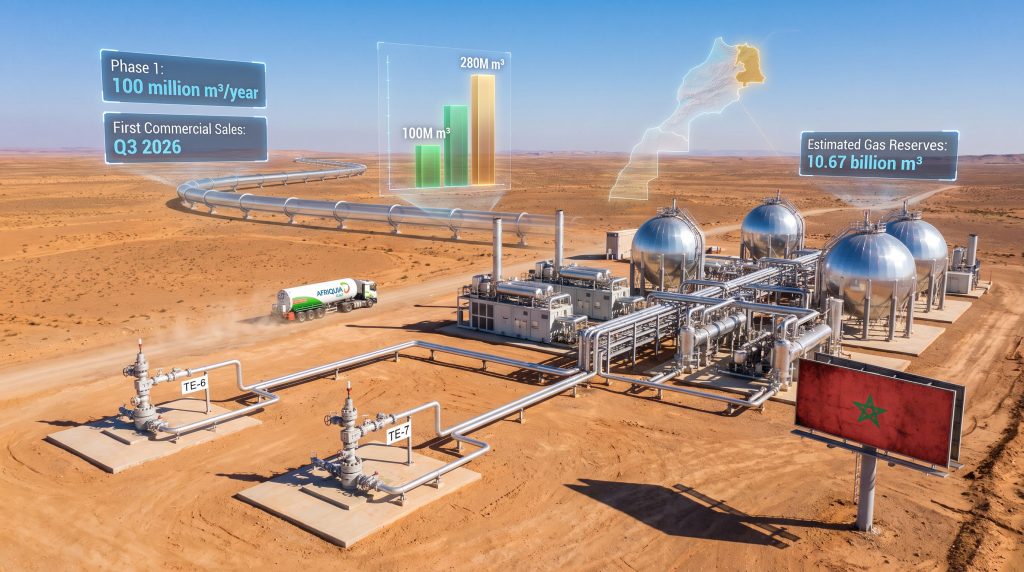
The Tendrara gas concession sits within Morocco's Oriental region in the country's east, spanning 133.5 square kilometres. The field holds estimated reserves of 10.67 billion cubic metres, a volume that positions it as genuinely significant within the context of Morocco's domestic energy landscape, even if modest by global hydrocarbon standards.
| Metric | Detail |
|---|---|
| Location | Oriental Region, eastern Morocco |
| Concession Area | 133.5 square kilometres |
| Estimated Gas Reserves | 10.67 billion cubic metres |
| Phase 1 Annual Production Target | 100 million cubic metres |
| Phase 2 Annual Production Target | 280 million cubic metres |
| Ownership Structure | Managem/affiliates: 75% / ONHYM: 25% |
The Oriental region is geologically distinct within Morocco. The Tendrara field produces from tight, low-permeability reservoir formations, which is why the development model leans toward a concentrated well-programme approach rather than a large multi-well pad development typical of higher-permeability conventional gas fields. Wells TE-6 and TE-7 are the primary production wells being tied into the Phase 1 gathering system, with liquefaction equipment and storage infrastructure in advanced commissioning stages as of mid-2026. Furthermore, according to reporting on the Tendrara liquefaction timeline, the liquefaction plant was targeted for operability by the end of 2025, consistent with first gas entering the gathering system in December 2025.
The Micro-LNG Model: A Technically Elegant Near-Term Solution
One of the less widely discussed aspects of the Tendrara development is its Phase 1 distribution architecture. Rather than waiting for pipeline connectivity, the project employs a micro-LNG supply model, which involves liquefying the produced gas on-site and distributing it to industrial customers via road tanker.
This approach is strategically intelligent for several reasons. It allows commercial gas sales to begin years ahead of pipeline infrastructure completion, generates early revenue that de-risks the balance sheet, and builds operational track record with industrial customers before Phase 2 scale-up. Micro-LNG distribution is an established technology in markets where pipeline density is low or where industrial clusters are geographically dispersed, and its application at Tendrara reflects pragmatic engineering rather than a compromise solution.
Technical Note: Micro-LNG projects typically involve small-scale liquefaction trains producing volumes of between 50,000 and 500,000 tonnes per year of LNG equivalent. At 100 million cubic metres annually, Tendrara's Phase 1 sits at the lower-to-mid range of this spectrum, appropriate for serving a distributed industrial customer base rather than bulk export.
Managem's Staged Acquisition: A Textbook Resource Asset De-Risking Play
How Managem Built Its 75% Controlling Stake
Managem's path to controlling the Tendrara concession followed a deliberate two-stage approach, with each transaction reflecting the asset's changing risk profile as it progressed through the development lifecycle.
-
June 2024: Managem acquired a 55% controlling stake from British energy company Sound Energy for $45.2 million, securing operational control at a time when the project was still in development phase and therefore carrying significant execution risk.
-
May 2026: With commissioning underway and first gas having entered the gathering system in December 2025, Managem acquired an additional 20% stake for $57 million, consolidating its position to 75% ownership at a meaningfully higher per-percentage valuation. Details of this exit by Sound Energy confirm the scale and structure of this transaction.
The Valuation Inflection: What the Price Gap Between Transactions Reveals
| Transaction | Stake Acquired | Transaction Value | Implied Value Per 1% |
|---|---|---|---|
| June 2024 (from Sound Energy) | 55% | $45.2 million | ~$822,000 |
| May 2026 (secondary acquisition) | 20% | $57 million | ~$2.85 million |
| Combined | 75% | $102.2 million | ~$1.36 million average |
The per-percentage valuation increase of roughly 3.5 times between the 2024 and 2026 transactions is not accidental. It reflects a classic resource project value inflection pattern: early-stage acquisitions carry development, technical, and offtake risk premiums that compress asset valuation, while assets approaching commercial production command significantly higher market prices once those risks are resolved.
The fact that Managem was willing to pay this premium in May 2026 also signals its conviction in the asset's commercial trajectory. Paying a higher price for incremental ownership stakes as a project approaches first production is a defensible capital allocation decision when the buyer has operational control and deep knowledge of the underlying asset, since there is limited information asymmetry risk justifying a discount demand.
ONHYM's 25% Stake: Resource Sovereignty in Practice
Morocco's National Office of Hydrocarbons and Mines retains a non-diluted 25% interest in the Tendrara concession. This retained state participation is consistent with Morocco's broader hydrocarbon regulatory framework, which typically requires a national participation component in major resource developments. ONHYM's stake ensures alignment between the private developer's commercial objectives and the state's strategic interest in maximising domestic energy supply benefits. The broader context of resource energy exports from other producing nations illustrates just how critical state participation mechanisms can be in securing long-term strategic value.
Why Tendrara Energy Exists as a Separate Corporate Entity
The Strategic Logic Behind the Restructuring
The establishment of Tendrara Energy as a dedicated subsidiary of Managem reflects a multi-layered strategic rationale that extends well beyond simple organisational tidiness.
-
Competency separation: Gas production, processing, and distribution require fundamentally different technical teams, regulatory relationships, and commercial frameworks than hard-rock mining operations. A dedicated entity can build specialist capability without organisational interference from the mining side of the business.
-
Financial transparency: Standalone gas operations allow investors, lenders, and analysts to assess the gas business on its own financial merits, without the noise of mining cash flows, capital expenditure cycles, and commodity price sensitivities distorting the picture.
-
Regulatory alignment: Morocco's hydrocarbon sector operates under distinct licensing, environmental, and commercial regulatory frameworks compared to the mining sector. A dedicated gas subsidiary is better positioned to manage these relationships effectively.
-
Strategic optionality: A standalone gas entity creates future pathways for independent project financing arrangements, potential joint venture partnerships for Phase 2 development, or even an independent capital markets listing if the gas business reaches sufficient scale.
Investor Perspective: The creation of a dedicated gas subsidiary is a structurally positive signal. It suggests Managem views its gas business as a long-term, standalone value creation engine rather than a temporary opportunistic investment, which has implications for how the market should assess the group's long-term capital allocation priorities.
The Two-Phase Development Architecture: Scale, Infrastructure, and Market Reach
Phase 1: Building Commercial Credibility Through Industrial Supply
Phase 1 of the Tendrara development is built around a 10-year gas supply agreement with Afriquia Gaz, one of Morocco's major energy distribution companies. This long-duration offtake contract is commercially critical: it provides the revenue predictability needed to service project financing and establishes Tendrara Energy as a credible, contracted gas supplier to Morocco's industrial sector.
- Annual production capacity: 100 million cubic metres
- Distribution model: Micro-LNG to industrial customers
- Anchor offtake partner: Afriquia Gaz (10-year contract)
- Current status: Commissioning underway; first commercial sales targeted Q3 2026
- First gas milestone: Gas entered the gathering system in December 2025
Phase 2: The Pipeline Integration Inflection Point
Phase 2 represents a qualitatively different level of ambition. By connecting Tendrara directly to the Maghreb-Europe Gas Pipeline network, Phase 2 would transform the project from a regional industrial gas supplier into a component of Morocco's national gas infrastructure. The broader significance of global LNG supply dynamics makes this pipeline integration all the more strategically valuable for Morocco's long-term energy positioning.
- Annual production capacity: 280 million cubic metres (a 2.8x increase over Phase 1)
- Infrastructure requirement: Direct GME pipeline connection
- Primary new market: Gas-fired power generation via ONEE supply agreement
- FID timeline: Expected by end-2026
- Strategic implication: Moroccan-produced gas injected into a pipeline corridor that historically carried Algerian imports
| Dimension | Phase 1 | Phase 2 |
|---|---|---|
| Annual Volume | 100 million m³ | 280 million m³ |
| Distribution Method | Micro-LNG road tanker | GME Pipeline injection |
| Primary Customers | Industrial sector | Industrial + power generation |
| Anchor Contract | Afriquia Gaz (10-year) | ONEE power supply agreement |
| FID Status | Approved / commissioning | Expected by end-2026 |
The next major ASX story will hit our subscribers first
Scenario Analysis: Three Futures for Morocco's Domestic Gas Supply Balance
At full Phase 2 capacity, the Tendrara project is projected to meet approximately 10% of Morocco's annual LNG demand, according to reporting by Médias24 in August 2025. This positions the project as strategically significant but not singularly transformative, meaning Morocco's broader LNG import dependency persists even under an optimistic Tendrara trajectory.
Scenario A: Phase 1 Only (Constrained Base Case)
Tendrara delivers 100 million cubic metres annually to Moroccan industrial customers under the Afriquia Gaz contract. LNG import volumes decline modestly. Morocco's power generation gas exposure remains unaddressed. Industrial competitiveness improves at the margin.
Scenario B: Phase 2 On Schedule (Optimistic)
A positive FID by end-2026 leads to pipeline connectivity by 2028–2029. Tendrara injects 280 million cubic metres into the national grid annually. ONEE's power generation gas imports decrease. Morocco gains meaningful negotiating leverage in future LNG procurement and covers roughly 10% of national demand domestically.
Scenario C: Phase 2 Delayed or Descoped (Risk Case)
Pipeline connectivity is deferred beyond 2026, potentially into the early 2030s, due to financing gaps, technical challenges, or regulatory delays. Tendrara's impact remains confined to the industrial micro-LNG market. Morocco's structural LNG import dependency for power generation persists.
Critical Analytical Note: The end-2026 FID on Phase 2 is the single most consequential near-term decision point for determining Tendrara's ultimate contribution to Moroccan energy security. Investors and analysts watching Managem Tendrara Energy gas operations should treat this milestone as the primary signal to monitor.
What Tendrara Signals for Managem's Long-Term Strategic Identity
From Hard-Rock Miner to Integrated Energy Producer
Managem has historically been known as one of Morocco's most prominent hard-rock mining groups, with operations spanning cobalt, copper, silver, gold, and fluorine across Africa. The Tendrara investment represents a deliberate strategic pivot toward energy production, a sector with structurally different risk and return characteristics than mining.
The group's stated commitment to expanding its gas business and helping address Morocco's industrial energy needs, as reflected in statements made in May 2026, suggests this is not an opportunistic allocation of surplus capital but a considered long-term positioning decision. Managem appears to be building toward a dual identity: mining group and domestic energy producer, with the latter increasingly anchored by the Tendrara Energy subsidiary.
North African Energy Security: The Broader Significance
The symbolism of Phase 2, should it proceed, should not be understated. The Maghreb-Europe Gas Pipeline was for decades the physical embodiment of Algerian gas flowing westward through Morocco to Europe. If Phase 2 connects Tendrara to the GME network, Moroccan-produced gas would be injected into that same infrastructure corridor, effectively reversing the historical flow dynamic. Comparable transitions in gas infrastructure extension decisions elsewhere illustrate how politically and commercially significant such shifts can be for national energy security.
This transformation — from pipeline transit corridor and LNG import market to domestic producer with pipeline injection capability — represents a structural shift in Morocco's energy security architecture that extends well beyond the economics of a single gas field. Indeed, the energy market importance of domestically sourced supply cannot be overstated for economies seeking to reduce their structural import vulnerability.
Frequently Asked Questions: Managem Tendrara Energy Gas Operations
What is Tendrara Energy?
Tendrara Energy is a wholly owned subsidiary created by Moroccan mining group Managem to independently manage all of the group's natural gas assets and operations in Morocco, with the Tendrara concession in the Oriental region as its core asset.
Who owns the Tendrara gas concession?
Managem and its affiliates hold 75% of the Tendrara concession through Tendrara Energy, with Morocco's National Office of Hydrocarbons and Mines (ONHYM) retaining the remaining 25%.
When will Tendrara produce first commercial gas?
First gas entered the gathering system in December 2025. Phase 1 commercial gas sales are targeted for Q3 2026, following ongoing commissioning of liquefaction and storage infrastructure.
How much did Managem invest to acquire the Tendrara concession?
Managem made two acquisitions totalling approximately $102.2 million: a 55% stake purchased from Sound Energy for $45.2 million in June 2024, and an additional 20% stake acquired for $57 million in May 2026.
What percentage of Morocco's gas demand could Tendrara supply?
At full Phase 2 capacity, the Tendrara project is projected to meet approximately 10% of Morocco's annual LNG demand, representing a meaningful but partial contribution to reducing the country's import dependency.
What is the Final Investment Decision timeline for Phase 2?
A Final Investment Decision on Phase 2, which would expand production to 280 million cubic metres annually and connect Tendrara to the GME pipeline network, is expected by the end of 2026.
Disclaimer: This article contains forward-looking statements, scenario projections, and financial analysis for informational purposes only. Production targets, investment decision timelines, and demand projections are subject to change based on technical, commercial, regulatory, and market factors. Nothing in this article constitutes investment advice. Readers should conduct independent research before making any investment decisions.
Want to Stay Ahead of the Next Major Energy or Mineral Discovery on the ASX?
Discovery Alert's proprietary Discovery IQ model delivers real-time alerts on significant ASX mineral discoveries, transforming complex data across 30-plus commodities into clear, actionable insights for both short-term traders and long-term investors. Explore how historic discoveries have generated substantial returns on Discovery Alert's dedicated discoveries page, and begin your 14-day free trial today to position yourself ahead of the broader market.