
July 30, 2026
The Capital Efficiency Revolution Reshaping Deepwater Oil Production
For decades, the dominant narrative in deepwater oil development centred on the race to find new basins, drill in ever-deeper waters, and sanction massive greenfield projects that promised enormous reserves but demanded enormous patience. That narrative is shifting. Across the Gulf of Mexico, the Brazilian pre-salt, and West Africa's offshore blocks, a quieter but arguably more profitable revolution is underway: the systematic unlocking of additional value from fields that are already producing, already connected, and already generating cash flow.
The BP Atlantis expansion startup is one of the clearest recent expressions of this philosophy. Rather than waiting years for a frontier development to reach first oil, BP has used established subsea infrastructure, an existing production platform, and targeted reservoir management technology to generate meaningful new production from an asset that has been online for nearly two decades. The strategic and financial logic embedded in this approach deserves closer examination.
When big ASX news breaks, our subscribers know first
Understanding the Atlantis Field: A Two-Decade Deepwater Anchor
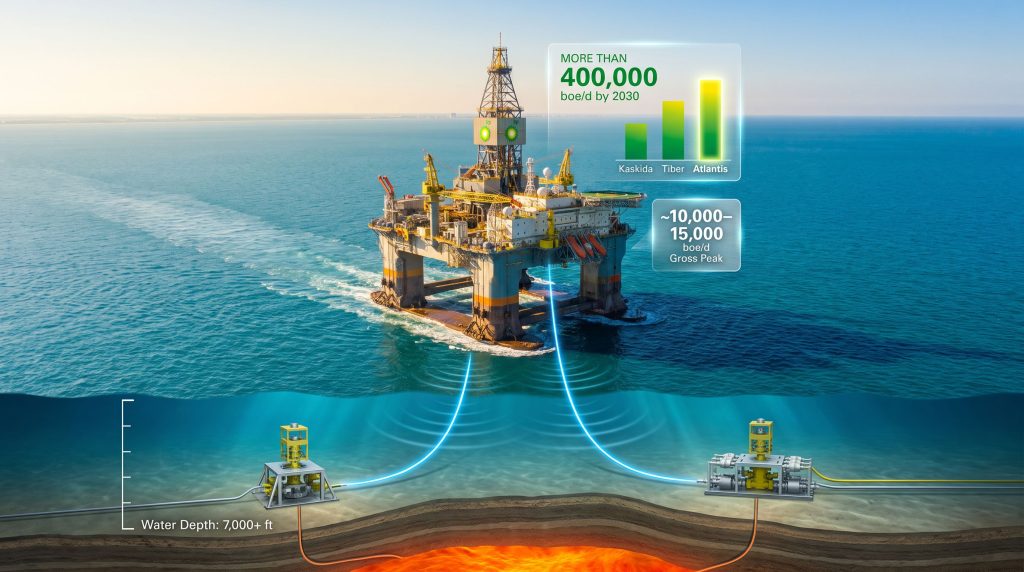
Discovered in 1998 and brought into production in the mid-2000s, the Atlantis field sits approximately 150 miles south of New Orleans in the U.S. Gulf of Mexico. Operating at water depths exceeding 7,074 feet, it represents one of the most technically demanding production environments in North American offshore history.
The field's gross production capacity stands at approximately 200,000 barrels of oil per day and 180 MMcfd of natural gas, making it one of the higher-capacity deepwater assets in BP's global portfolio. BP operates the field with a 56% working interest, while Woodside Energy holds the remaining 44% as a non-operating partner.
Within BP's five-hub U.S. Gulf portfolio, Atlantis occupies a central position:
| Production Hub | Primary Role |
|---|---|
| Atlantis | Flagship deepwater oil producer; active expansion program |
| Argos | Mad Dog Phase 2 anchor; recently brought online |
| Mad Dog | Long-life deepwater production asset |
| Na Kika | Natural gas and condensate hub |
| Thunder Horse | One of the largest deepwater platforms globally |
Each hub plays a distinct role in BP's Gulf production architecture, but Atlantis stands out for its combination of scale, longevity, and demonstrated potential for further development.
How the BP Atlantis Expansion Startup Actually Works
The Engineering Logic Behind Water Injection
The BP Atlantis expansion startup is built around a deceptively straightforward concept: subsea water injection. The project involves two new subsea water injection wells, new subsea trees, and upgraded topside water injection pumps. These components work together to address one of the most fundamental challenges facing any long-producing deepwater reservoir.
As hydrocarbons are extracted from a subsea reservoir over time, the natural pore pressure that drives oil toward the wellbore gradually declines. Left unmanaged, this pressure depletion accelerates production decline rates and leaves significant volumes of recoverable oil effectively stranded within the rock matrix.
Water injection counteracts this process by:
- Pumping treated seawater into dedicated injection wells positioned to sweep oil toward producing wellbores.
- Maintaining reservoir pressure at levels that sustain productive flow rates.
- Displacing oil within the pore space, effectively pushing additional volumes toward the surface.
- Extending the productive life of the field beyond what natural depletion alone would permit.
Technical Perspective: In mature deepwater fields, unmanaged reservoir pressure decline can accelerate annual production decline rates to between 15% and 25%. Systematic water injection programs are one of the most proven mechanisms for flattening this decline curve and recovering incremental barrels that would otherwise remain unproduced.
What the Expansion Delivers in Production Terms
| Metric | Detail |
|---|---|
| Gross peak annualized production added | Approximately 10,000 boe/d |
| Net production contribution to BP | Approximately 5,000 boe/d (56% working interest) |
| Project delivery | Completed ahead of schedule and under budget |
| Well configuration | Two-well subsea tieback to existing Atlantis platform |
| Future development capacity | Additional water injection capacity preserved for subsequent phases |
The two-well tieback configuration is significant from a cost perspective. By connecting new subsea infrastructure directly to the existing Atlantis production platform, the project avoids the capital-intensive requirement to install new floating production facilities. The platform's processing, export, and utilities infrastructure, already amortised over nearly 20 years of production, effectively provides a pre-built foundation for incremental development at materially lower per-barrel cost.
Why Delivering Ahead of Schedule Matters More Than It Sounds
Industry data consistently shows that completing a major offshore project both ahead of schedule and under budget is statistically uncommon. Historical analysis of large offshore developments suggests that fewer than 35% of major projects meet both criteria simultaneously, with cost overruns and schedule delays representing persistent industry-wide challenges.
When a deepwater project does deliver early, the financial consequences compound positively:
- Accelerated cash flow recovery improves the project's internal rate of return (IRR) by pulling forward revenue that was otherwise modelled to arrive later.
- Capital redeployment becomes possible sooner, freeing funds for subsequent development phases or debt reduction.
- Contractor and project management credibility is reinforced, supporting BP's ability to attract competitive bids on future Gulf developments.
- Reservoir pressure support begins earlier, potentially reducing the decline volume that would have accumulated during a delayed startup period.
Furthermore, for Woodside Energy, which holds 44% of the field, early production startup equally accelerates the timeline for cost recovery on its proportional share of development expenditure.
BP's 2030 Gulf Strategy: Where Atlantis Fits the Larger Picture
The 400,000 boe/d Ambition
BP has outlined a publicly stated target to grow its U.S. Gulf of Mexico production capacity to more than 400,000 boe/d by 2030. The Atlantis expansion contributes an incremental but meaningful share of that trajectory, and critically, it contributes now rather than at the end of a multi-year greenfield development timeline. Crude oil price trends will naturally influence the pace at which BP accelerates further investment across its Gulf portfolio.
The larger volume growth in BP's Gulf strategy is expected to come from two recently sanctioned deepwater developments:
| Project | Expected Gross Production Contribution | Development Status |
|---|---|---|
| Kaskida | Part of combined ~160,000 bpd capacity | Sanctioned |
| Tiber | Part of combined ~160,000 bpd capacity | Sanctioned |
| Atlantis Expansion | ~10,000 boe/d gross peak | Online (2025/2026) |
Kaskida and Tiber represent the volume-growth phase of BP's Gulf ambition, while mature asset expansions like Atlantis provide the near-term production bridge that supports cash flow while longer-cycle projects are under development.
Infrastructure Leverage as Competitive Advantage
One of the less-discussed but strategically important aspects of the BP Atlantis expansion startup is what it reveals about the economics of infrastructure leverage. When an operator installs a deepwater production platform, the capital cost of that facility is distributed across the barrels produced over the platform's entire working life. By the time the Atlantis platform has been producing for nearly 20 years, its capital costs are largely amortised.
Any incremental production added through tiebacks to that existing infrastructure effectively benefits from:
- Zero new platform construction cost for the incremental barrels.
- Established export pipeline capacity already in place and paid for.
- Existing processing and utilities systems capable of handling additional throughput.
- Proven reservoir knowledge accumulated over two decades of production data.
This structural cost advantage means that brownfield tieback developments at mature deepwater hubs can achieve breakeven economics at oil prices significantly below those required to justify equivalent greenfield projects. In the current environment, where institutional capital increasingly scrutinises capital allocation strategies and payback timelines, this distinction matters considerably.
The Broader Industry Context: Brownfield Deepwater as a Growth Category
The Atlantis expansion is not an isolated decision. It reflects an industry-wide shift in how deepwater operators approach capital allocation. Three converging forces are driving this trend:
- Post-2014 capital discipline: The oil price collapse between 2014 and 2016, followed by COVID-19's demand shock in 2020, imposed lasting changes on how major oil companies evaluate and sanction projects. Short payback periods and high capital efficiency have become prerequisites rather than preferences.
- Investor pressure for returns: ESG-aligned institutional investors and traditional value-focused shareholders alike have pushed operators to prioritise return on capital employed over production volume growth for its own sake.
- Subsea technology maturity: Advances in subsea tree design, flexible flowline technology, and remote intervention systems have extended the practical tieback distance and operational depth at which brownfield developments can be executed cost-effectively.
Industry Observation: The global deepwater brownfield segment has emerged as one of the highest-return development categories available to major oil producers, combining the volume potential of large reservoirs with the cost efficiency of established infrastructure networks.
However, it is worth noting that commodity market volatility remains a persistent consideration for operators assessing the long-term economics of even the most capital-efficient deepwater developments.
Woodside Energy's Strategic Position at Atlantis
For Woodside Energy, the 44% non-operating interest in Atlantis provides proportional exposure to every production increment delivered at the field. The expansion adds net barrels to Woodside's portfolio at a development cost shared with BP and structured around infrastructure that Woodside has already been contributing to for years.
This type of position carries characteristics that differ meaningfully from a standard exploration-stage investment. The reservoir is known, the infrastructure is operational, the operator has a multi-decade track record at the asset, and the incremental development risk profile is substantially lower than for frontier developments. For Woodside, Atlantis represents a low-risk production increment that complements its broader deepwater and LNG growth strategy across multiple basins. In addition, the relationship between commodity prices and company performance means that sustained oil prices will directly shape the value Woodside extracts from this stake over time.
The next major ASX story will hit our subscribers first
Frequently Asked Questions About the BP Atlantis Expansion Startup
What is the BP Atlantis expansion project?
The BP Atlantis expansion startup involves two new subsea water injection wells, new subsea trees, and upgraded topside water injection pumps connected to the existing Atlantis production platform. The project is designed to maintain reservoir pressure, extend productive field life, and unlock oil volumes that would otherwise remain inaccessible as natural reservoir depletion continues. BP's full range of major projects across its global portfolio provides further context for how this expansion fits within the company's broader development strategy.
Where exactly is the Atlantis field located?
The field is positioned approximately 150 miles south of New Orleans in the U.S. Gulf of Mexico, operating at water depths of around 7,074 feet.
How much production does the expansion add?
The project adds approximately 10,000 boe/d of gross peak annualized production, with BP's net share estimated at approximately 5,000 boe/d based on its 56% working interest.
Was the project delivered on schedule?
The project was completed ahead of its scheduled timeline and under its approved budget, which represents an above-average delivery outcome for deepwater subsea developments of comparable technical complexity.
How does the expansion support future development at Atlantis?
Beyond the immediate production contribution, the new water injection infrastructure provides additional reservoir pressure support capacity that BP can leverage for subsequent development phases at the field, preserving long-term optionality at a lower marginal cost. Furthermore, OPEC market influence over global supply dynamics will continue to shape the revenue environment within which these future phases are evaluated and sanctioned.
Key Takeaways: What the Atlantis Startup Reveals About Deepwater's Next Chapter
The BP Atlantis expansion startup carries implications that extend well beyond a single production milestone. It is a practical demonstration of how deepwater operators are repositioning mature assets as active growth vehicles rather than declining legacy positions.
- Mature deepwater reservoirs retain significant upside when reservoir management tools like pressure-supported water injection are deployed at the right stage of field life.
- Infrastructure leverage creates a structural cost advantage for brownfield tieback developments compared to greenfield alternatives competing for the same capital.
- Delivering projects ahead of schedule in deepwater represents genuine value creation through accelerated IRR and earlier cash flow generation.
- BP's five-hub Gulf portfolio is in active growth mode, with the Atlantis expansion representing one production milestone within a broader programme that includes the larger Kaskida and Tiber sanctions.
- Woodside Energy's 44% stake positions it to benefit proportionally from every incremental barrel unlocked through ongoing Atlantis development.
Strategic Observation: The BP Atlantis expansion startup is not simply a production milestone. It is a case study in how capital-disciplined deepwater operators are generating competitive returns by maximising value from established infrastructure rather than depending solely on frontier volume growth to meet long-term production targets.
This article is intended for informational purposes only and does not constitute investment advice. Production forecasts, development timelines, and capital targets referenced herein are subject to change based on operational, regulatory, and market conditions. Readers should conduct independent research before making any investment decisions.
Want to Track the Next Major Resource Discovery Before the Market Moves?
Discovery Alert's proprietary Discovery IQ model scans ASX announcements in real time, delivering instant alerts on significant mineral discoveries and turning complex resource data into clear, actionable investment insights — explore the historic returns major discoveries have generated and begin your 14-day free trial at Discovery Alert to position yourself ahead of the broader market.