
July 30, 2026
The Coloured Gemstone Market and Why Gemfields' Position Within It Matters
Few segments of the global luxury commodities landscape operate as distinctly as the coloured gemstone market. Unlike gold or platinum, which trade on transparent spot markets with continuous price discovery, coloured gemstones such as emeralds and rubies are priced through a combination of rarity, aesthetic quality, geographic origin, and buyer sentiment. This structural opacity has historically made large-scale industrial mining of coloured gemstones commercially challenging, yet it is precisely this complexity that Gemfields has transformed into a competitive moat through its proprietary auction-based sales model.
The global coloured gemstone market has attracted increasing attention from luxury jewellery brands and high-net-worth collectors through 2025 and into 2026, driven partly by the post-pandemic premiumisation trend in luxury goods and growing consumer interest in origin-traceable, responsibly sourced materials. Gemfields sits at the intersection of these forces as the world's dominant large-scale producer of both emeralds and rubies, operating through two 75%-owned joint ventures: Kagem Mining in Zambia and Montepuez Ruby Mining (MRM) in Mozambique.
Against this backdrop, the company's unaudited Gemfields operational results for the first half of 2026 carry considerable analytical weight, not only for shareholders but for anyone seeking to understand the health of the broader coloured gemstone supply chain. Furthermore, understanding these results requires familiarity with both mining company performance metrics and the unique structural characteristics of coloured gemstone markets.
Disclaimer: All financial figures cited in this article are drawn from Gemfields' unaudited H1 2026 operational update. Directors have assumed full responsibility for their accuracy. Audited interim results are scheduled for release on 25 September 2026. Nothing in this article constitutes financial advice.
When big ASX news breaks, our subscribers know first
A 71% Revenue Recovery: Unpacking the H1 2026 Auction Numbers
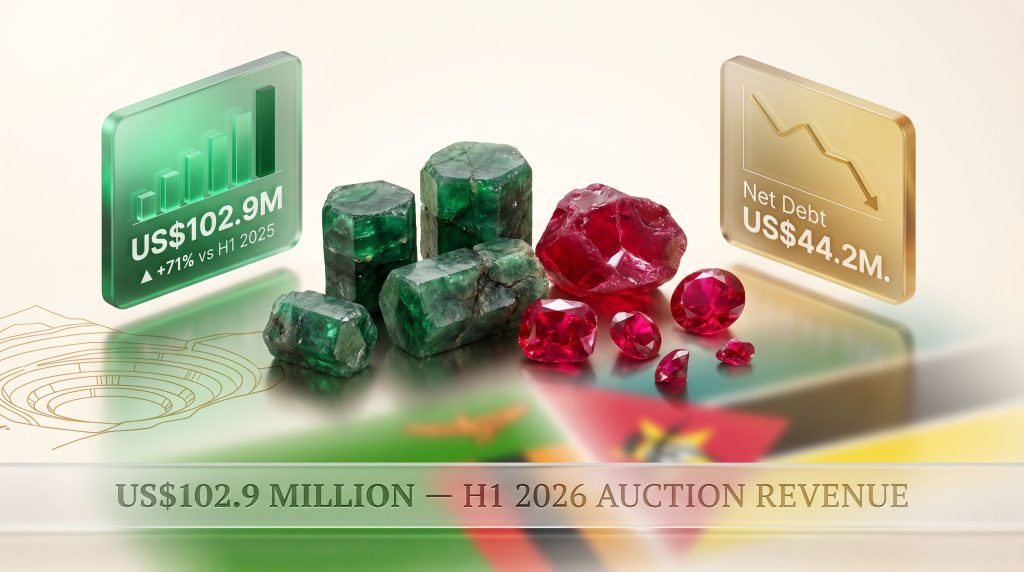
The headline figure from Gemfields' H1 2026 operational update is difficult to overlook: total auction revenues reached US$102.9 million for the six months ending 30 June 2026. To appreciate the magnitude of this recovery, it is necessary to understand what preceded it.
The full year 2025 was among the more difficult trading periods in the company's recent history. Full-year auction revenues came in at approximately US$135.1 million, roughly 32% below 2024 levels, weighed down by production challenges at MRM and the deferral of a planned December 2025 ruby auction. The H1 2025 contribution to that full-year figure was approximately US$60 million, meaning the implied second-half contribution was only around US$75 million.
The H1 2026 result of US$102.9 million already surpasses that entire second-half 2025 revenue figure, pointing to a meaningful operational and commercial reset. For comparison, H1 2024 recorded auction revenues of approximately US$128 million, providing a clearer picture of where Gemfields stood before the 2025 deterioration and how far the recovery still has to run.
H1 2026 Revenue Comparison Table
| Period | Auction Revenue (USD) | EBITDA | Net Debt |
|---|---|---|---|
| H1 2024 | ~US$128.0 million | ~US$49.6 million | Not disclosed |
| H1 2025 | ~US$60.0 million | Loss of US$4.9 million | US$61.2 million |
| FY 2025 | US$135.1 million | US$6.3 million | Not disclosed |
| H1 2026 | US$102.9 million | TBC (Sept 2026) | US$44.2 million |
Equally important is the movement in the company's debt position. Net debt stood at US$61.2 million as of 30 June 2025 (before US$16.1 million in auction receivables that were subsequently collected in full). By 30 June 2026, that figure had contracted to US$44.2 million, excluding US$33.3 million in outstanding auction receivables at the reporting date. This trajectory indicates improving cash generation capacity and validates the creditworthiness of Gemfields' auction buyer base.
Understanding Gemfields' Auction Model: Why Revenue Is Structurally Lumpy
One of the most misunderstood aspects of Gemfields' financial profile is the inherent periodicity of its revenue recognition. Unlike a bulk commodity producer that sells continuously into a spot market, Gemfields holds discrete auction events throughout the year, attended by licensed buyers including gem traders, cutting houses, and jewellery manufacturers. Revenue is only recognised when auctions are completed, creating concentrated inter-period recognition patterns.
This has two important implications for stakeholders:
-
Timing distortions are real and recurring. The deferral of the December 2025 ruby auction shifted revenue that would normally have fallen in FY 2025 into a later period, artificially depressing annual comparisons and amplifying the apparent severity of the 2025 downturn.
-
Auction receivables function as a cash bridge. The US$33.3 million in receivables outstanding at 30 June 2026 represents completed auction sales whose cash has not yet been collected. The fact that all US$16.1 million in H1 2025 receivables were subsequently collected in full demonstrates that buyer default risk within Gemfields' auction ecosystem is low.
The Indian city of Jaipur functions as the world's dominant coloured gemstone cutting and polishing hub, handling an estimated 80–90% of the global rough gemstone supply before it reaches retail markets. Buyer participation from Jaipur-based cutting houses at Gemfields' auctions is therefore a direct proxy for downstream luxury market demand, making auction revenue figures a meaningful leading indicator for the broader sector.
Montepuez Ruby Mining: Grade Recovery Challenges and the Path Forward
While the auction revenue recovery is encouraging, MRM's operational picture remains the most technically complex element of the Gemfields operational results. Premium grade ruby recovery at the Mozambique operation averaged 0.025 carats per tonne during the period, a metric that carries disproportionate revenue implications.
Why Carats Per Tonne Is the Wrong Metric in Isolation
In coloured gemstone mining, total carat output and premium grade carat output are fundamentally different value drivers. A mine can produce large volumes of low-quality, commercial-grade material while simultaneously generating very limited quantities of premium-grade crystals. At auction, premium grade rubies from MRM typically command prices orders of magnitude higher per carat than commercial grade material, meaning that the grade mix of any given auction lot directly determines realised revenue per carat sold.
The 0.025 ct/t premium recovery rate reflects the geological reality of open-pit mining across a large deposit: different zones of the orebody carry substantially different grade profiles, and mining sequencing through lower-grade areas temporarily suppresses premium recovery even when the deposit as a whole retains significant high-grade potential. Consequently, this is a critical distinction when assessing whether MRM's current challenge is structural or cyclical. The principles of cut-off grade economics are particularly relevant here, as they determine which material is economically worth processing.
Management's deliberate reorientation of activity toward higher-grade zones, supported by geological mapping and grade control methods, strongly suggests confidence that the recovery challenge is cyclical rather than structural. This is a technically informed interpretation worth monitoring closely through the H2 2026 audited results.
The Second Processing Plant: Capacity as a Volume Lever
MRM's second processing plant, expected to reach full commissioning during the second half of 2026, introduces an important throughput variable into forward-looking analysis. Processing capacity is a constraint that operates independently of grade recovery: even at a flat 0.025 ct/t premium recovery rate, increased throughput volume would proportionally lift total premium carat output assuming consistent grade across processed material.
Speculative Scenario: If the second processing plant effectively increases total ore throughput by a meaningful margin while premium grade recovery holds at current levels, MRM's total premium carat output for H2 2026 could rise substantially relative to H1. However, the critical unknown remains the grade profile of material fed through additional processing capacity. Premium carat output is a function of both throughput volume and the grade of material being processed, making this a scenario that depends heavily on which mining areas supply the new plant.
Rising fuel costs and the logistical demands of deeper pit operations are adding pressure to MRM's per-tonne cost structure. As open-pit mines deepen, haul distances lengthen and equipment fuel consumption per tonne of ore processed increases, which directly compresses operating margins when commodity prices or recovery rates do not compensate.
Kagem Mining: Emerald Output Resilience Under Cost Pressure
Kagem Mining, situated within Zambia's Kafubu emerald district, represents one of the world's highest-volume emerald-producing operations. The deposit sits within a geological setting known as a "reaction zone" where chromium-bearing ultramafic rocks interact with beryllium-bearing granites to produce the chromium-rich colour saturation that distinguishes Zambian emeralds from those produced elsewhere, such as Colombia or Brazil.
Zambian emeralds are geologically distinctive for their relatively low iron content, which produces a purer, more vivid green hue with high transparency. This origin-specific quality characteristic has become increasingly valued by premium jewellery brands seeking consistency across large supply volumes, a requirement that artisanal mining sectors typically cannot satisfy.
Three Cost Headwinds Weighing on Kagem's Margins
Despite maintaining healthy premium emerald output through H1 2026, Kagem is navigating a challenging operating cost environment driven by three intersecting pressures:
-
Fuel price escalation affecting open-pit haulage and processing energy costs across both diesel-powered equipment fleets and electricity generation.
-
Zambian Kwacha volatility creating unpredictability in USD-denominated cost reporting, since a significant portion of Kagem's operating expenditure is denominated in local currency.
-
Intensified mining activity requiring deeper extraction levels and increased waste stripping ratios, both of which amplify total material movement costs without proportionally increasing ore yield.
Kagem vs. MRM: Side-by-Side Operational Snapshot
| Metric | Kagem Mining (Zambia) | Montepuez Ruby Mining (Mozambique) |
|---|---|---|
| Commodity | Emeralds | Rubies |
| Gemfields Ownership | 75% | 75% |
| H1 2026 Production | Healthy premium output | Premium grade at 0.025 ct/t |
| Primary Challenge | Rising operating costs | Grade recovery and throughput |
| Capacity Development | Ongoing optimisation | Second plant commissioning H2 2026 |
| Revenue Model | Periodic auctions | Periodic auctions |
| Geological Setting | Kafubu emerald district, Copperbelt | Montepuez complex, Cabo Delgado |
ESG, Traceability, and the Responsible Sourcing Premium
A dimension of Gemfields' competitive positioning that extends beyond operational metrics is its investment in responsible sourcing credentials. The company operates community development programmes in both Mozambique and Zambia, and its provenance-assured supply chain has become increasingly material to procurement decisions made by major luxury jewellery brands. In addition, considerations around natural capital in mining are becoming ever more relevant to how institutional investors evaluate resource companies such as Gemfields.
The coloured gemstone industry has historically faced significant challenges around informal and artisanal supply chains, where origin documentation is unreliable and community benefit from extraction is limited. Gemfields' traceability infrastructure, which documents gemstone origin from mine face to auction lot, provides luxury brands with a defensible responsible sourcing narrative that is difficult to replicate using informally mined material.
This traceability premium is increasingly embedded in realised auction prices, as brands are willing to pay above-market rates for gemstones whose origin story can withstand regulatory scrutiny and consumer transparency demands.
The next major ASX story will hit our subscribers first
Key Risks Heading Into H2 2026
The operational momentum evidenced in the Gemfields operational results for H1 2026 faces several risk factors that could influence the trajectory through the second half of the year and the upcoming audited reporting.
| Risk Category | Specific Risk | Potential Impact |
|---|---|---|
| Production | Continued low premium ruby recovery at MRM | Reduced auction revenue per carat in H2 |
| Commissioning | Delay in MRM second plant full commissioning | Throughput upside deferred into 2027 |
| Cost Structure | Fuel price escalation at both operations | Margin compression across Kagem and MRM |
| Currency | Kwacha and Metical volatility vs. USD | Unpredictable operating cost base |
| Auction Timing | H2 2026 auction schedule and composition | Revenue concentration and inter-period risk |
| Macro Demand | Global luxury goods softening | Reduced buyer participation at auctions |
The distinction between structural and cyclical grade recovery challenges at MRM deserves particular investor attention. If geological mapping confirms that higher-grade zones remain accessible through planned mining sequences, the current low recovery rate is a temporary sequencing issue with a defined remediation path. If higher-grade zones prove shallower or more laterally constrained than anticipated, however, the recovery challenge takes on a longer-term character that would require more fundamental operational responses.
Forward Catalysts: What to Watch Through the Rest of 2026
Several specific milestones will define the informational landscape for Gemfields through the remainder of 2026. The Gemfields investor calendar provides the most up-to-date scheduling for these upcoming announcements. Furthermore, mining project feasibility assessments may become increasingly relevant as MRM's second plant moves toward full operational status.
-
25 September 2026: Full audited interim results, including EBITDA, free cash flow, and detailed commentary from management on operational progress at both Kagem and MRM.
-
MRM second plant commissioning: Confirmation of full commissioning timing and initial throughput data will be the single most important operational data point for assessing H2 ruby output potential.
-
H2 2026 auction calendar: The number, sequencing, and lot composition of planned ruby and emerald auctions will determine how much of any operational improvement translates into recognised revenue within the 2026 financial year.
-
Debt trajectory: If auction receivables of US$33.3 million are collected on schedule and H2 auctions perform in line with H1, the net debt position could improve further from the current US$44.2 million level.
Frequently Asked Questions: Gemfields H1 2026 Results
What were Gemfields' total auction revenues for H1 2026?
Gemfields reported total unaudited auction revenues of US$102.9 million for the six months ending 30 June 2026, representing a year-on-year increase of approximately 71% compared to the US$60 million recorded in H1 2025.
What is the company's net debt position?
As of 30 June 2026, Gemfields held a net debt position of US$44.2 million, excluding US$33.3 million in auction receivables outstanding at the reporting date.
Why does premium grade recovery matter so much at MRM?
Premium grade rubies command substantially higher per-carat prices at auction than commercial grade material. Even a modest improvement in the premium recovery rate from the current 0.025 ct/t average could deliver outsized upside to auction revenues per carat sold.
When will audited results be released?
Gemfields has confirmed that full audited interim results for H1 2026, along with detailed management commentary, will be published on 25 September 2026.
How does Gemfields sell its gemstones?
The company sells rough emeralds and rubies through periodic competitive auctions attended by licensed buyers. Revenue is recognised at auction completion rather than on a continuous basis, which creates natural inter-period revenue concentration.
H1 2026 Operational Scorecard
| Metric | H1 2026 Value | Trend vs. H1 2025 |
|---|---|---|
| Total Auction Revenue | US$102.9 million | +71% year-on-year |
| Net Debt | US$44.2 million | Improved from US$61.2 million |
| Auction Receivables Outstanding | US$33.3 million | Pending collection |
| MRM Premium Ruby Recovery | 0.025 ct/t | Ongoing challenge |
| MRM Second Plant Status | Commissioning in H2 2026 | Capacity expansion underway |
| Kagem Emerald Output | Healthy premium production | Resilient despite cost pressures |
| Next Major Reporting Date | 25 September 2026 | Audited interim results |
Editorial Note: All H1 2026 figures referenced throughout this article are unaudited. Readers should treat them as directionally informative rather than finalised financial outcomes pending the 25 September 2026 audited release. This article does not constitute investment advice.
Want to Identify the Next Major ASX Mineral Discovery Before the Broader Market Does?
Discovery Alert's proprietary Discovery IQ model delivers real-time alerts on significant ASX mineral discoveries, transforming complex geological and commodity data into clear, actionable insights for both short-term traders and long-term investors — explore historic discoveries and their returns to understand the scale of opportunity, then begin your 14-day free trial to position yourself ahead of the market.