June 10, 2026
The Invisible Metal Driving Australia's Most Expensive Industrial Bet
Most investors and policy watchers focus on lithium, cobalt, or rare earths when they think about critical minerals. Yet one of the oldest industrially processed metals on earth, antimony, has quietly become the catalyst for the most significant coordinated industrial funding commitment Australia has seen in a generation. Understanding why requires looking past the headline dollar figures and into the structural vulnerabilities that have made Western governments increasingly anxious about their exposure to concentrated foreign supply chains.
Antimony is not glamorous. It does not feature prominently in electric vehicle narratives or solar panel marketing. However, remove it from the equation, and entire segments of defence manufacturing, semiconductor fabrication, and grid-scale energy storage become compromised. That strategic reality sits at the heart of the AU$240 million in Nyrstar government funding and antimony production that has flowed to Australian operations since mid-2025, and it explains why three separate governments chose to coordinate their fiscal commitments around a single multi-metal processor.
When big ASX news breaks, our subscribers know first
What Makes Antimony Strategically Irreplaceable
To understand the funding logic, it helps to first understand why antimony occupies such an outsized position in critical minerals policy circles. Furthermore, unlike many battery metals, antimony's demand profile spans multiple industries with very different risk tolerances and procurement behaviours. As an antimony critical mineral, it underpins sectors that cannot easily substitute alternative materials.
-
Defence applications: Antimony trioxide is used in flame retardants embedded in military-grade composite materials, and antimony compounds appear in ammunition primers and infrared sensor components. Defence procurement agencies treat supply interruptions as operational risk, not just commercial inconvenience.
-
Semiconductor manufacturing: Antimony trioxide functions as a synergist in flame retardant systems used in printed circuit boards and chip packaging. As semiconductor supply chains have become a geopolitical flashpoint, the upstream inputs that underpin them have drawn increasing scrutiny.
-
Energy storage: Antimony-based flow batteries, particularly vanadium-antimony and all-antimony variants, are emerging as serious contenders in grid-scale stationary storage. Their long cycle life and thermal stability give them structural advantages over lithium-ion in certain utility applications.
-
Automotive sector: Lead-acid batteries, which still power the majority of internal combustion and hybrid vehicles globally, incorporate antimony as a hardening agent in their grid alloys. This is not a legacy application disappearing overnight.
What amplifies the strategic concern is that global antimony supply is heavily concentrated. China has historically accounted for a dominant share of both mine production and refined output. In addition, China's bismuth export controls signal a broader pattern of restricting critical mineral exports to Western markets, directly affecting industrial supply chains and accelerating policy conversations in allied nations about domestic processing alternatives.
China introduced export restrictions on antimony in September 2024, creating immediate ripple effects across Western defence and electronics supply chains and accelerating policy conversations in allied nations about domestic processing alternatives.
The antimony shortage risks facing Western defence and industrial sectors have consequently become a primary driver of government intervention, giving urgency to the Australian government's decision to fund Nyrstar's antimony production ambitions at Port Pirie.
Nyrstar's Two Facilities: Different Assets, Shared Strategic Purpose
Nyrstar's Australian footprint consists of two processing facilities that, taken together, cover a remarkably broad spectrum of critical and specialty metals.
| Facility | Location | Primary Metals Processed | Strategic Critical Minerals Focus |
|---|---|---|---|
| Port Pirie Refinery | South Australia | Lead, Zinc, Antimony, Bismuth | Antimony pilot plant, bismuth extraction |
| Hobart Smelter | Tasmania | Zinc, Germanium, Indium | High-purity specialty metals for optics and electronics |
The Port Pirie facility has operated for over a century, making it one of the world's longest-running continuous lead-zinc refining operations. That longevity is not merely historical trivia. It means the site carries embedded infrastructure, environmental approvals, and metallurgical expertise that would cost billions of dollars and take decades to replicate from greenfield. When policymakers describe the Nyrstar investment as supporting brownfield capability, they are acknowledging that the real value is not just the physical plant but the institutional knowledge embedded within its workforce.
The Hobart smelter's economic contribution to Tasmania is substantial. The facility generates more than AU$510 million in annual economic activity for the state, supporting over 600 direct jobs and more than 1,000 indirect roles across contractor and supplier networks. For a state the size of Tasmania, those figures represent a meaningful share of industrial employment.
How the AU$240 Million in Nyrstar Government Funding Was Structured
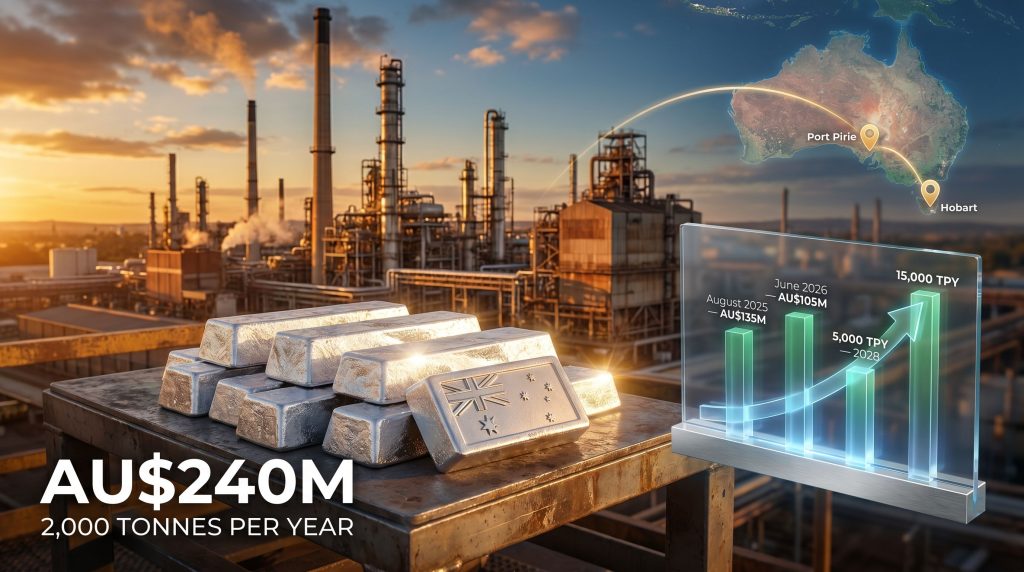
The total government commitment did not arrive as a single payment. It was structured across two tranches, each serving a distinct operational and strategic purpose.
Tranche 1: August 2025
The initial package of AU$135 million was assembled from three government contributors:
| Funding Source | Amount |
|---|---|
| Australian Commonwealth | AU$57.5 million |
| South Australian Government | AU$55 million |
| Tasmanian Government | AU$22.5 million |
| Total | AU$135 million |
This first tranche was designed to prevent an operational collapse at both facilities while feasibility work and facility upgrade planning were undertaken. Critically, it also fast-tracked the development of an antimony pilot plant at Port Pirie, which moved from concept to physical operation within the funding period.
Tranche 2: June 2026
The second commitment of AU$105 million, announced in June 2026 by the same three government partners, serves a broader set of objectives:
-
Sustaining zinc smelting and lead-zinc refining operations throughout the remainder of 2026 to prevent workforce dispersal and facility degradation.
-
Funding the completion of pre-feasibility studies for expanded production of antimony, bismuth, germanium, and indium.
-
Establishing the terms for a formal joint review between Nyrstar and all three funding governments to define a commercially and strategically viable long-term pathway for both facilities.
Federal Industry and Innovation Minister Tim Ayres articulated the national strategic rationale clearly, framing the investment as a deliberate effort to position Australia higher in global industrial value chains by building the refining and processing capability that advanced economies require, rather than simply exporting raw ore. The critical minerals energy security dimension of this argument has resonated strongly across all three levels of government involved in the funding decision.
From Pilot Plant to Commercial Export: Antimony Production Milestones
One of the most important aspects of the Nyrstar story is the speed with which antimony production progressed from a policy ambition to a physical reality. The timeline below illustrates how quickly the pilot plant moved through development phases:
| Date | Milestone |
|---|---|
| August 2025 | AU$135M government package announced; antimony pilot plant development accelerated |
| November 2025 | First antimony metal cast at Port Pirie from pilot plant operations |
| February 2026 | First shipment of commercial-grade antimony metal produced at Port Pirie |
| H1 2026 | Initial antimony exports commenced into international markets |
| End of 2026 (target) | 2,000 tonnes per year production capacity |
| 2028 (conditional target) | 5,000 tonnes per year subject to further investment |
| Long-term phase | Potential expansion to 15,000 tonnes per year |
The significance of the first commercial shipment in early 2026 should not be understated. It transformed Port Pirie from a facility with antimony production potential into a verified antimony production node within Western-aligned supply chains. That distinction matters enormously when the facility is seeking long-term offtake agreements with defence contractors, semiconductor manufacturers, or energy storage developers who require proof of commercial-scale production before entering procurement discussions.
A critical but underappreciated aspect of Port Pirie's antimony capability is that antimony enters the facility not as a primary feed but as a co-product within lead-zinc concentrates. This means the extraction economics are fundamentally different from a standalone antimony mine, where all fixed costs must be allocated to a single product. At Port Pirie, antimony refining is layered onto an existing processing infrastructure that is already being paid for by lead and zinc output.
This co-product economics model is one reason the brownfield approach at Port Pirie compares favourably to greenfield antimony projects globally, which face the full burden of capital recovery from antimony revenues alone. Consequently, the strategic antimony funding approaches being adopted internationally reinforce just how seriously allied governments are treating this supply chain vulnerability.
Beyond Antimony: The Full Critical Minerals Portfolio Under Assessment
The June 2026 funding extension broadens the strategic scope well beyond antimony. Pre-feasibility studies are now advancing for a portfolio of specialty and critical metals across both facilities:
| Metal | Facility | Primary Applications |
|---|---|---|
| Antimony | Port Pirie | Defence materials, energy storage, semiconductors |
| Bismuth | Port Pirie | Pharmaceuticals, lead-free solders, metallurgical additives |
| Germanium | Hobart | Fibre optic cables, infrared optical systems, solar cells |
| Indium | Hobart | LCD display panels, thin-film photovoltaic cells |
Bismuth deserves particular attention as an underappreciated co-product opportunity. As regulatory pressure on lead content in manufacturing has intensified globally, bismuth has emerged as a technically viable substitute in soldering applications and as a pharmaceutical ingredient in bismuth subsalicylate formulations. Port Pirie's existing metallurgical circuit already processes bismuth as a by-product stream, meaning the incremental cost of capturing and refining it is lower than building dedicated extraction infrastructure.
Germanium and indium at Hobart represent a different kind of strategic value. Both metals are classified as critical by the Australian government, the European Union, and the United States, and both face significant supply concentration risks. Germanium is essential for high-speed fibre optic transmission and next-generation infrared imaging systems used in defence platforms. Indium underpins the transparent conductive oxide layers in touchscreens, LCD panels, and thin-film solar modules.
The next major ASX story will hit our subscribers first
Political Framing Across Three Jurisdictions
The way each government has framed its participation in the Nyrstar funding package reflects distinct regional priorities, even as the overarching national security narrative provides a unifying thread.
Tasmania has emphasised employment and energy economics. Premier Jeremy Rockliff has pointed to the Hobart smelter's role in supporting over 600 direct jobs and its connection to Tasmania's comparatively low industrial electricity prices, which give the facility a structural cost advantage over smelters in higher-energy-cost jurisdictions.
South Australia has leaned into the opportunity framing, with Premier Peter Malinauskas highlighting that recent global supply chain disruptions have validated the case for accelerating domestic antimony and critical metals production capacity at Port Pirie. The subtext is that Port Pirie, a city with a complex industrial history, has an opportunity to reposition itself as a critical minerals processing hub for the 21st century.
The federal government has anchored its language in value chain ambition. The consistent message from Canberra has been that Australia must move beyond being a raw materials exporter and develop the processing capability that commands higher margins and greater strategic leverage in global trade.
Questions the Joint Review Must Answer
The joint government-Nyrstar review announced as part of the June 2026 package represents a genuine inflection point. Several unresolved questions will determine whether the AU$240 million commitment becomes the foundation of a self-sustaining industrial asset or whether it requires a third tranche of public capital to maintain momentum.
-
What is the commercial break-even point for antimony production at Port Pirie at various price scenarios, and how sensitive is that calculation to zinc and lead revenue contributions?
-
Can the facility reliably reach 2,000 tonnes per year of antimony by end-2026 on the current capital base, and what operational bottlenecks exist between pilot-scale and full commercial throughput?
-
What specific milestones must Nyrstar meet before the conditional 5,000 tonne and 15,000 tonne expansion phases are triggered, and who bears the capital risk for those expansions?
-
How do the economics of the Hobart smelter's germanium and indium recovery compare to those of the antimony programme at Port Pirie, and which facility presents the stronger case for long-term standalone viability?
How Australia's Approach Compares to Allied Nation Strategies
The Nyrstar model sits within a broader global pattern of allied-nation intervention in critical minerals processing, but it has several distinctive characteristics:
| Country | Strategic Approach | Primary Mechanism |
|---|---|---|
| United States | Defense Production Act activations, DoD direct procurement | Loan guarantees, offtake agreements |
| European Union | Critical Raw Materials Act framework | Strategic project classifications, permitting support |
| Canada | Critical Minerals Strategy | Federal co-investment in processing infrastructure |
| Australia (Nyrstar) | Multi-government co-funding of brownfield processing | Operational continuity grants and feasibility support |
What distinguishes the Australian approach is its explicit integration of regional employment outcomes with national security objectives. The funding is not purely a defence procurement tool or a technology subsidy; it is also a regional industrial policy instrument that connects job preservation in Port Pirie and Hobart to the strategic goal of building sovereign processing capability. This dual mandate introduces complexity but also creates political durability, because the investment has constituencies in multiple states and at the federal level simultaneously.
Frequently Asked Questions: Nyrstar Government Funding and Antimony Production
How much total government funding has Nyrstar received in Australia?
Across two tranches since mid-2025, Nyrstar has received approximately AU$240 million in combined support from the Australian Commonwealth, the South Australian government, and the Tasmanian government. The first tranche of AU$135 million was announced in August 2025, and the second tranche of AU$105 million followed in June 2026.
What is the current antimony production target for Port Pirie?
Nyrstar is targeting 2,000 tonnes of antimony per year by the end of 2026. A conditional expansion to 5,000 tonnes per year by 2028 is subject to further investment and operational performance, with a longer-term ambition of reaching 15,000 tonnes per year in a subsequent phase.
Why is antimony classified as a critical mineral?
Antimony earns its critical classification through a combination of highly concentrated global supply, substitution difficulty in key applications, and demand exposure to sectors with strong growth trajectories. Its roles in defence flame retardants, semiconductor packaging, and emerging antimony-based flow battery technologies make it difficult to replace with alternative materials in most applications.
What other critical minerals is Nyrstar targeting at its Australian facilities?
Pre-feasibility studies are advancing for bismuth at Port Pirie and germanium and indium at the Hobart smelter, all of which carry critical mineral status under Australian government classification. Each of these metals shares the characteristic of concentrated global supply and high application specificity.
What happens after the June 2026 funding extension concludes?
A formal joint review between Nyrstar and the three funding governments is scheduled to take place in the coming months. The outcome of this review will shape whether the facilities receive further public support, transition to commercial self-sufficiency, or pursue a hybrid model involving private capital alongside ongoing government partnerships.
Key Takeaways
-
Australia's AU$240 million commitment to Nyrstar government funding and antimony production represents a deliberate pivot toward domestic critical minerals processing capability rather than raw material export dependence.
-
The co-product economics of antimony extraction at Port Pirie, layered onto existing lead-zinc processing infrastructure, provide a structural cost advantage over standalone greenfield antimony projects.
-
Antimony production moved from pilot plant to commercial export within approximately six months of the first funding tranche, establishing a credible industrial track record.
-
The multi-metal portfolio under assessment at both facilities, spanning antimony, bismuth, germanium, and indium, broadens the strategic and commercial rationale beyond any single commodity.
-
The joint review scheduled for later in 2026 will be the critical decision point that determines whether the Nyrstar model becomes a replicable template for Australian critical minerals processing investment or a one-off intervention.
This article contains forward-looking statements and production targets that are subject to change based on operational, commercial, and market conditions. Readers should not rely on projected timelines or production volumes as guarantees of future outcomes. Independent financial and industry advice should be sought before making any investment decisions related to the critical minerals sector.
Want To Stay Ahead Of The Next Major Critical Minerals Discovery On The ASX?
Discovery Alert's proprietary Discovery IQ model scans ASX announcements in real time, instantly identifying significant mineral discoveries across antimony, bismuth, germanium, and more than 30 other commodities — turning complex data into actionable investment insights for both short-term traders and long-term investors. Explore how historic discoveries have generated substantial returns on Discovery Alert's dedicated discoveries page, and begin your 14-day free trial today to position yourself ahead of the broader market.