
June 10, 2026
The Infrastructure Trap: Why Gulf Oil's Biggest Vulnerability Has Nothing to Do With Reserves
Energy security debates almost always centre on reserves, production costs, and geopolitical alliances. Rarely do they focus on the single most fragile link in the entire Gulf export chain: the physical geography of how oil actually leaves the region. For Kuwait, that geography has become an acute crisis. Every barrel of crude and refined product the country exports travels through one narrow waterway, and when that waterway closes, Kuwait's entire revenue base effectively goes dark. The US-Iran war that began on 28 February 2026 turned that theoretical vulnerability into an operational reality, and the response now taking shape — centred on Kuwait pipeline tie-ups to bypass Hormuz via Saudi and Emirati infrastructure — represents the most significant restructuring of Gulf export architecture in decades.
When big ASX news breaks, our subscribers know first
Why the Strait of Hormuz Remains the Gulf's Most Dangerous Single Point of Failure
The Chokepoint Problem: Scale, Dependency, and Asymmetric Risk
The Strait of Hormuz is not merely a busy shipping lane. It is the exit valve for the world's most concentrated pool of exportable crude. According to the US Energy Information Administration's 2019 report on global oil transit chokepoints, approximately 21 million barrels per day of crude, condensate, and refined products transited Hormuz in 2018, representing roughly 21 percent of global petroleum liquids consumption at the time. No other chokepoint comes close to that volume — not the Suez Canal, not the Strait of Malacca, and not the Turkish Straits.
What makes the current crisis particularly instructive is that Hormuz's closure has not affected all Gulf producers equally. Saudi Arabia and the UAE both possess overland pipeline systems that terminate at ports entirely outside the strait's influence. Kuwait does not. The country has no coastline on the Red Sea or the Gulf of Oman, no domestic bypass pipeline, and no unilateral alternative. This is not a policy oversight; it reflects the basic geography of a nation whose entire coastline faces the Arabian Gulf, funnelling all maritime traffic toward Hormuz.
Furthermore, the distinction between producers with partial bypass capacity and those with zero alternative export routes is not academic. Under a full Hormuz closure, it determines whether a producer continues to generate export revenue or shuts in the vast majority of its output entirely. Understanding oil price movements in this context helps explain why Kuwait's exposure has drawn such intense attention from energy markets.
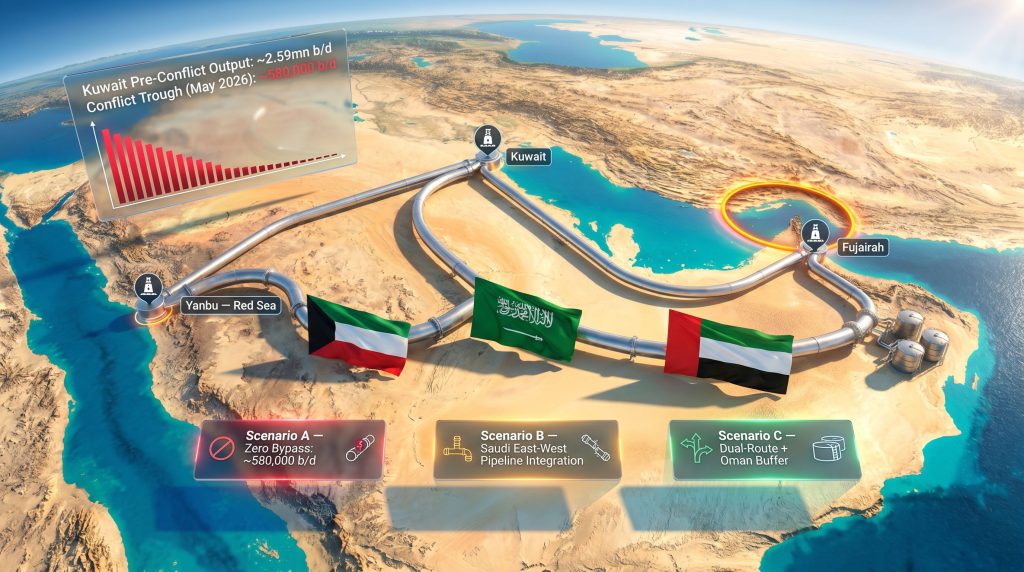
The numbers make this concrete. Kuwait's crude output stood at approximately 2.59 million b/d in February 2026, according to Argus Media estimates. By May 2026, that figure had collapsed to around 580,000 b/d, representing just 22 percent of pre-conflict capacity. Production was deliberately scaled back to domestic consumption requirements only, because there was simply nowhere for exported barrels to go.
How Does Kuwait's Export Infrastructure Compare to Its GCC Neighbors?
A Structural Comparison of Gulf Bypass Capacity
The contrast between Kuwait and its GCC partners becomes starkest when their bypass infrastructure is examined side by side.
| Producer | Bypass Pipeline | Rated Capacity | Export Terminal | Outside Hormuz? |
|---|---|---|---|---|
| Saudi Arabia | East-West Pipeline | ~7 mn b/d | Yanbu (Red Sea) | Yes |
| UAE | ADCOP Pipeline | ~1.7 mn b/d | Fujairah (Gulf of Oman) | Yes |
| Kuwait | None (standalone) | 0 b/d | — | No |
| Iraq | Limited overland routes | Partial | Ceyhan (Turkey) | Partial |
Saudi Arabia's East-West Pipeline is the most significant bypass asset in the region by a considerable margin. Running from the Abqaiq processing complex in the Eastern Province to the Yanbu terminal on the Red Sea, it carries crude entirely outside Iranian strike range over the strait itself, at a rated capacity of 7 million b/d. The UAE's Abu Dhabi Crude Oil Pipeline (ADCOP) is smaller at 1.7 million b/d but connects Habshan in Abu Dhabi directly to the port of Fujairah on the Gulf of Oman, again bypassing Hormuz entirely. The UAE's pipeline acceleration efforts have further reinforced this advantage under active conflict conditions.
Kuwait's historical decision not to build a standalone bypass pipeline was not arbitrary. Engineers and planners who examined the option faced an immediate cross-border routing problem: any pipeline connecting Kuwait's oilfields to a port outside Hormuz would need to traverse either Saudi or Iraqi territory over hundreds of kilometres, raising costs, sovereignty questions, and engineering complexity that ultimately made a unilateral solution unviable. The current regional cooperation talks represent a return to the question with a fundamentally different structure — sharing existing infrastructure rather than building new.
There is also a subtler issue around the GCC's informal mutual-support mechanism. In theory, if one member state cannot export, another with spare pipeline capacity can export on its behalf and reconcile volumes later. In practice, when every major producer is simultaneously managing disruptions, compression constraints, and terminal vulnerabilities, that informal arrangement breaks down. The current crisis has exposed the limits of informal coordination and created pressure for something more durable.
What Pipeline Tie-Ups Is Kuwait Pursuing With Saudi Arabia and the UAE?
The Regional Cooperation Model: From Bilateral Talks to Export Architecture
Kuwait Petroleum Corporation (KPC) has shifted decisively from the idea of a standalone national solution toward a framework built on integrating Kuwaiti volumes into existing GCC pipeline systems. The strategic logic is straightforward: rather than spending years and billions constructing new infrastructure, Kuwait can potentially connect its crude into pipelines that already terminate at accessible export points. Indeed, OPEC's market influence over collective GCC production decisions adds another layer of complexity to how these bypass arrangements are structured commercially.
The two primary routes under discussion are:
- Saudi Arabia's East-West Pipeline — Kuwaiti crude would need to enter the Saudi network somewhere in the Eastern Province, travel through the Abqaiq hub, and exit at Yanbu on the Red Sea.
- UAE's ADCOP line to Fujairah — A secondary conduit that could absorb a portion of Kuwaiti barrels and route them to the Gulf of Oman terminal.
Complementary to both is the idea of using oil storage facilities in Oman as a buffer mechanism. Rather than requiring real-time throughput on any single route, stored volumes in Oman could act as a 30 to 60 day shock absorber against simultaneous terminal disruptions, decoupling production scheduling from moment-to-moment export availability.
What Would a Kuwait-Saudi-UAE Pipeline Integration Actually Look Like?
The engineering and commercial questions involved are substantial. Several key challenges need resolution before any arrangement becomes operational:
- Upstream connection points: Where precisely Kuwaiti crude enters the Saudi or UAE network determines pipeline pressure requirements, crude blending considerations, and metering arrangements for commercial settlement.
- Compression headroom: Long-distance crude pipelines rely on compression stations spaced at intervals to maintain flow rates. Any additional volume from Kuwait would require verification that existing compression capacity can handle the incremental throughput without requiring new facilities.
- Capacity absorption: Saudi Arabia's East-West Pipeline carries a rated capacity of 7 million b/d, but actual utilisation during the conflict, combined with attack-related reductions, means available headroom needs careful modelling rather than assumption.
- Tariff and revenue-sharing frameworks: Routing Kuwaiti crude through Saudi or Emirati infrastructure raises commercially sensitive questions about transit fees, sovereign ownership of pipeline access, and how volumes are reconciled between national oil companies.
None of these challenges are insurmountable, but none are trivial either. The timeline for moving from exploratory discussions to a functional arrangement is likely measured in months at minimum, even with strong political will on all sides.
How Vulnerable Are the Existing Bypass Routes to Military Targeting?
Stress-Testing Gulf Pipeline Resilience Under Active Conflict Conditions
One of the most important and underappreciated points emerging from KPC's public communications is the frank acknowledgement that pipeline tie-ups do not eliminate geopolitical risk — they redistribute it. A bypass pipeline is only as useful as the export terminal at its end, and those terminals have proven to be high-value targets throughout the current conflict. These geopolitical oil factors are precisely what energy planners are now being forced to incorporate into long-term infrastructure decisions.
The attack record between late February and early June 2026 is sobering:
- Fujairah port (UAE): Targeted on five separate occasions, according to Argus tracking.
- Yanbu port (Saudi Arabia): Struck once during the same period.
- East-West Pipeline: Hit once, temporarily reducing throughput capacity by approximately 700,000 b/d.
Infrastructure analysts classify pipeline vulnerability across three distinct tiers, each with very different recovery timelines and operational consequences.
Tier 1: The pipeline itself. Physical pipeline sections are the easiest and fastest element to repair. Replacement sections can be pre-positioned, and welding crews can restore flow within days to weeks depending on the severity of damage.
Tier 2: Compression facilities. These are the critical nodes that maintain flow rates across long distances. Destroying a compression station creates a throughput bottleneck that can take weeks to months to resolve, depending on the availability of replacement equipment and engineering resources.
Tier 3: Export terminals. Terminal destruction is the most operationally catastrophic outcome. Even if a pipeline is entirely intact and all compression stations are functioning, a disabled export terminal renders the entire upstream network non-functional for commercial purposes. Recovery timelines at this tier can extend to many months.
This three-tier framework has direct implications for how Kuwait and its GCC partners should think about the resilience of any bypass arrangement. A dual-route strategy spanning both the Red Sea and Fujairah is more resilient than either route alone, but it still carries terminal exposure risk at both ends.
Scenario Modelling: Three Export Risk Profiles for Kuwait Under Hormuz Closure
Scenario A: Full Hormuz Closure, No Regional Pipeline Integration
Kuwait is forced to scale output to domestic consumption requirements only, sustaining approximately 580,000 b/d, as observed in May 2026. This represents a production reduction of roughly 78 percent relative to the February 2026 baseline of 2.59 million b/d. Revenue generation from crude exports effectively falls to zero.
Scenario B: Partial Integration via Saudi East-West Pipeline
Kuwait secures transit rights for a defined volume of crude into the Saudi network, routing it to Yanbu. Partial export capability is restored, subject to available compression headroom and Saudi spare capacity. The risk profile remains elevated due to Yanbu's documented vulnerability to Iranian strike capability.
Scenario C: Dual-Route Integration (Saudi and UAE) With Oman Storage Buffer
Kuwaiti barrels are distributed across both the Red Sea and Fujairah outlets, with Omani storage providing a buffer against simultaneous terminal disruptions. This configuration offers the strongest resilience but requires the highest degree of diplomatic alignment, commercial agreement, and operational coordination between at least three sovereign national oil companies.
What Is Kuwait's Production Recovery Timeline if Hormuz Reopens?
Reservoir Dynamics and the Phased Restart Problem
Kuwait's ability to recover production once Hormuz reopens is shaped not just by surface infrastructure but by subsurface reservoir behaviour. This is an area where Kuwait carries a meaningful structural advantage relative to many global producers.
KPC's leadership has indicated that approximately 80 percent of shut-in production could be restored within roughly three weeks of a Hormuz reopening, citing the resilient nature of Kuwait's reservoir geology. With around 2.0 million b/d shut in at the conflict trough, this implies a rapid recovery of approximately 1.6 million b/d, lifting total output back toward 2.1 million b/d in a compressed timeframe.
There is also a speculative but geologically plausible dimension to extended shut-in periods that deserves attention. When reservoirs are shut in for extended durations, pressure can partially recharge as formation fluids redistribute within the subsurface structure. This means that some of Kuwait's producing zones may return to operation in a slightly stronger pressure state than when they were curtailed, potentially improving early recovery rates in those formations. This is not a universal outcome and depends heavily on individual reservoir architecture, but it represents a genuine upside consideration in Kuwait's recovery scenario.
The final 20 percent of shut-in capacity, however, presents a disproportionately difficult recovery challenge. Restarting marginal wells, heavier crude streams, or fields with more complex production characteristics typically requires more time, specialist equipment, and operational attention. The estimated timeline for restoring that remaining tranche extends to three to four additional months beyond the initial rapid restart phase.
Kuwait Production Snapshot:
- Pre-conflict output (February 2026): ~2.59 mn b/d
- Conflict trough (May 2026): ~580,000 b/d
- Total shut-in volume: ~2.0 mn b/d
- Projected rapid recovery (within
3 weeks): ~1.6 mn b/d (80% of shut-in)- Projected full production restoration: 4 to 5 months post-reopening
The next major ASX story will hit our subscribers first
How Has the US-Iran Conflict Reshaped Gulf Energy Infrastructure Strategy?
Macro-Structural Shifts in Regional Energy Security Planning
The conflict that began on 28 February 2026 has done something that years of academic risk modelling and policy white papers could not: it has forced GCC producers to treat infrastructure redundancy as an operational imperative rather than a contingency line item. The scale of the disruption, and the difficulty in predicting when it will end, has permanently altered the planning assumptions of every national oil company in the region.
The IMO's formal advisory against Hormuz transits issued in June 2026 added a regulatory and reputational dimension to the physical risks. The agency's secretary-general Arsenio Dominguez stated that in the absence of reliable security assurances, safe passage through the strait does not exist and that no commercial or operational consideration can justify exposing seafarers to conditions where risks are known, significant, and clearly beyond mitigation, according to Argus Media reporting dated 10 June 2026. For insurance underwriters, shipping companies, and cargo buyers, this advisory carries significant commercial weight independently of the military situation.
Vessel traffic data from Vortexa illustrates the tentative nature of any recovery. The first nine days of June 2026 recorded 51 Hormuz crossings, up from 26 in the same period in May, but still materially below the 68 crossings recorded in the equivalent period in April. The trajectory is cautiously upward, but the gap to pre-conflict norms remains very large. The shooting down of a US Apache helicopter near the coast of Oman on 9 June, followed by retaliatory US strikes on Iranian targets that same day, demonstrated how quickly the security situation can deteriorate.
By June 2026, UK Maritime Trade Operations had recorded a total of 54 incidents affecting vessels operating in and around the Mideast Gulf, the Strait of Hormuz, and the Gulf of Oman since the start of the conflict on 28 February, according to Argus reporting. Consequently, the oil price rally dynamics that many market participants had anticipated from conflict-related supply disruption have been complicated by demand-side uncertainty running in parallel.
Will GCC Pipeline Cooperation Create a Permanent Regional Energy Architecture?
The analogy most often cited in discussions of cross-border energy interconnection is the evolution of European gas and electricity grids. What began as bilateral crisis-response arrangements in the 1970s and 1980s gradually became institutionalised through the European Union's internal energy market framework, creating a system where infrastructure assets in one country provide genuine security-of-supply benefits to neighbouring states.
The GCC faces several obstacles that Europe did not in the same form:
- Sovereignty sensitivities: Routing one nation's crude exports through another's domestic pipeline infrastructure raises questions about control, access rights, and the conditions under which transit could be suspended.
- Commercial pricing disputes: Setting transit tariffs between national oil companies involves negotiations where both sides have strong incentives to maximise their own positions, and there is no existing supranational framework to arbitrate disagreements.
- Political complexity: Formalising pipeline-sharing arrangements requires sustained high-level political commitment across multiple governments simultaneously, at a time when each is managing its own domestic energy and security priorities.
Despite these obstacles, the structural logic for a formalised GCC bypass network is compelling. A system in which Kuwaiti, Saudi, and Emirati export capacity can be routed flexibly across multiple corridors and terminals would make the collective GCC export architecture far more resilient to any single attack, closure, or disruption event. However, as the Gulf state bypass alternatives debate makes clear, building durable resilience requires more than pipelines alone — it demands institutional frameworks that can sustain cooperation under pressure.
FAQ: Kuwait Pipeline Tie-Ups and the Hormuz Bypass Question
Why Doesn't Kuwait Have Its Own Pipeline to Bypass the Strait of Hormuz?
Historical assessments found that the engineering and cost challenges of routing a Kuwaiti pipeline to a non-Hormuz port were prohibitive without crossing Saudi or Iraqi territory. The current approach focuses on integrating Kuwaiti volumes into existing GCC pipeline systems rather than constructing an entirely new route.
What Is the Capacity of Saudi Arabia's East-West Pipeline?
The pipeline runs from the Abqaiq oil processing complex in Saudi Arabia's Eastern Province to the Yanbu terminal on the Red Sea and carries a rated capacity of approximately 7 million b/d, making it by far the largest bypass asset in the GCC.
How Much of Kuwait's Oil Production Was Shut In During the Hormuz Closure?
Kuwait reduced output from approximately 2.59 million b/d in February 2026 to roughly 580,000 b/d by May 2026, retaining only enough production for domestic consumption. The shut-in volume was approximately 2.0 million b/d. Furthermore, the sanctions on oil trade across other major producers have added further complexity to how global supply gaps are being filled during the disruption period.
Are the UAE and Saudi Arabia's Bypass Pipelines Safe From Attack?
Neither route is fully protected. Fujairah was targeted on at least five occasions between late February and early June 2026, Yanbu was struck once, and the East-West Pipeline itself sustained one confirmed strike that temporarily reduced throughput by around 700,000 b/d, according to Argus Media tracking.
What Is Kuwait Discussing With Oman Regarding Oil Storage?
Kuwait is exploring the use of Omani storage facilities as a buffer mechanism to reduce real-time dependency on any single transit route, complementing the pipeline discussions with Saudi Arabia and the UAE.
How Quickly Could Kuwait Restore Full Oil Production if Hormuz Reopens?
Approximately 80 percent of shut-in production, or around 1.6 million b/d, could potentially be restored within three weeks due to Kuwait's geologically resilient reservoir characteristics. Full production recovery is estimated to require a further three to four months beyond that initial rapid restart phase.
The Strategic Takeaway: Regional Pipeline Cooperation as the New Gulf Energy Security Model
The Hormuz crisis has made one structural reality impossible to ignore: Kuwait's export architecture, unchanged for decades, places it in a categorically different risk tier from its GCC neighbours. While Saudi Arabia and the UAE can continue generating export revenue through bypass infrastructure during a strait closure, Kuwait's options under the status quo are binary — export through Hormuz, or don't export at all.
The regional cooperation model being pursued through Kuwait pipeline tie-ups to bypass Hormuz via Saudi and Emirati systems is the only near-term solution that does not require years of greenfield infrastructure development. It is also, however, a solution with its own vulnerability profile. Pipelines are only as operationally effective as the terminals at their end, and the attack record across Fujairah and Yanbu during the current conflict demonstrates that bypass capacity does not confer immunity.
The three-tier infrastructure risk framework — distinguishing between pipeline sections, compression facilities, and export terminals — should shape how any future GCC pipeline-sharing arrangement is designed. It is not just a question of whether bypass capacity exists, but whether terminal resilience and redundancy are built into the architecture from the outset.
What is now clear is that the Gulf's energy planners are operating with a fundamentally revised threat model. Infrastructure redundancy, once treated as a long-term strategic aspiration, has become a short-term operational necessity. Whether the current crisis produces a durable formalised GCC bypass network or remains a collection of bilateral discussions will depend on political will, commercial alignment, and the pace of events in the strait itself.
Disclaimer: This article contains forward-looking analysis, scenario modelling, and projections based on publicly available data and reported statements. Actual production figures, recovery timelines, and geopolitical developments may differ materially from projections discussed. This content does not constitute financial or investment advice. Readers are encouraged to conduct independent research and consult qualified advisers before making decisions based on information contained herein.
For further context on Gulf energy infrastructure and Hormuz geopolitics, Argus Media publishes ongoing market intelligence at argusmedia.com.
Want To Stay Ahead of the Next Major Resource Discovery Triggered by Shifting Energy Geopolitics?
While Gulf energy infrastructure disruptions reshape global commodity markets, Discovery Alert's proprietary Discovery IQ model delivers real-time alerts on significant ASX mineral discoveries — instantly translating complex resource data into actionable opportunities for investors at every level. Explore how historic discoveries have generated substantial returns and begin your 14-day free trial today to position yourself ahead of the broader market.