June 10, 2026

The New Architecture of Minerals Intelligence: Why Shared Data Beats Trade Deals
For decades, resource security strategy relied on a familiar playbook: bilateral trade agreements, preferential tariff schedules, and diplomatic assurances exchanged at summits. Yet as the clean energy transition accelerates and critical minerals demand intensifies, that playbook is showing its age. The fundamental problem is not a lack of trade relationships, it is a lack of intelligence. Nations with access to real-time data on supply chain vulnerabilities, price signals, and geopolitical concentration risks are gaining structural advantages that no trade agreement alone can replicate.
This is precisely the gap that India and the UK critical minerals cooperation through the GSCO launch is designed to address. Rather than adding another layer of diplomatic machinery, the two nations have opted to build something far more durable: a shared intelligence infrastructure anchored in institutional expertise and continuously updated data.
When big ASX news breaks, our subscribers know first
What the GSCO Actually Is (And What It Is Not)
The Critical Minerals Global Supply Chain Observatory, known by its acronym GSCO, is a jointly operated, data-driven platform designed to monitor and analyse global critical mineral supply chains in real time. It is important to understand what this initiative does not represent. It is not a trade deal, not an investment fund, and not a stockpiling agreement.
It functions instead as a living analytical layer, one that enables both India and the UK to act on the same supply chain intelligence simultaneously, reducing the information asymmetry that has historically slowed policy responses to disruptions.
This distinction matters enormously in practice. Traditional bilateral instruments require renegotiation when conditions change. A data observatory, by contrast, is inherently adaptive, updating its outputs as global supply chain dynamics evolve without requiring new treaty-level negotiations.
The Institutions Behind the Platform
The GSCO is jointly operated by three institutions, each bringing a distinct and complementary capability to the platform:
| Institution | Country | Core Contribution |
|---|---|---|
| TEXMiN (Technology Innovation in Exploration & Mining Foundation) | India | Applied mining technology and exploration expertise |
| IIT (ISM) Dhanbad | India | Research capacity and quantitative data analytics |
| University of Cambridge | United Kingdom | Advanced modelling, strategic foresight, and supply chain analysis |
This tripartite structure is not incidental. It reflects a deliberate design choice: by embedding universities and research foundations as operational partners rather than advisory bodies, the GSCO gains a structural durability that government-only initiatives frequently lack. When administrations change, the institutional anchors remain.
A Three-Stage Journey to Operational Launch
The GSCO did not materialise from a single announcement. Its development followed a structured progression across three distinct phases:
- October 2025 – UK Prime Minister Keir Starmer's visit to India produced the initial announcement, framing the GSCO as a mechanism to expand mineral coverage, integrate advanced technologies, and unlock new bilateral investment opportunities.
- March 2026 – A formal research collaboration agreement was signed between TEXMiN, IIT (ISM) Dhanbad, and the University of Cambridge, establishing the institutional and operational framework.
- 5 June 2026 – The GSCO was officially launched in New Delhi, jointly marked by India's Coal and Mines Minister G. Kishan Reddy and UK Foreign Secretary Yvette Cooper.
The measured pace of this development is itself significant. The GSCO was designed with institutional longevity in mind, not diplomatic optics.
The Shared Vulnerability That Drives This Partnership
Despite occupying very different positions in the global economic hierarchy, India and the UK share structurally similar critical mineral challenges. Both nations face:
- Heavy import dependency on a geographically concentrated set of suppliers for minerals essential to clean energy and advanced manufacturing
- A real-time intelligence deficit that leaves policymakers reacting to supply disruptions rather than anticipating them
- Escalating demand pressure from domestic decarbonisation commitments, electric vehicle mandates, and industrial policy targets that require a reliable, diversified mineral supply
This convergence of vulnerabilities is what makes the partnership strategically coherent rather than merely symbolically appealing.
Which Minerals Fall Within Scope
While the GSCO is designed to expand its mineral coverage over time, its initial analytical focus centres on materials critical to three broad industrial domains:
- Battery technology and electric vehicles: lithium, cobalt, nickel, manganese, and graphite
- Renewable energy infrastructure: rare earth elements used in permanent magnets for wind turbines and solar panel manufacturing chains
- Advanced manufacturing and defence applications: titanium, tungsten, and specialty alloys with both commercial and strategic end uses
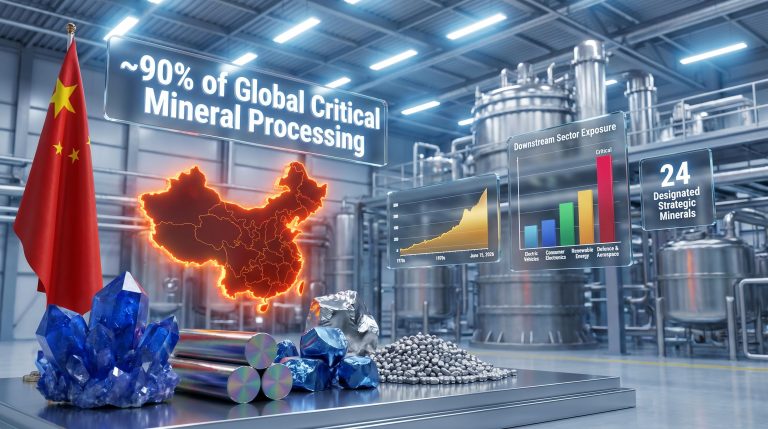
The rare earth element category deserves particular attention. Despite the name, most rare earths are not geologically scarce, they are processing scarce. Furthermore, China's export restrictions have highlighted that even nations with domestic rare earth deposits face a bottleneck at the processing stage. An observatory that tracks processing-level concentration risks, not just mining output, represents a meaningful advance over conventional supply chain monitoring.
How the GSCO Functions: The Operational Logic
The platform operates across four interconnected analytical functions, each feeding into a broader decision-support architecture:
- Supply Chain Monitoring – Continuous tracking of production volumes, trade flows, and logistical constraints across key mineral-producing and transit regions
- Risk Detection – Early-warning capability for geopolitical disruptions, export restrictions, tariff escalations, and supply concentration events
- Market Intelligence – Price trend analysis, forward demand modelling, and mapping of investment flows into exploration and processing capacity
- Policy Support – Structured reporting outputs designed to inform bilateral and multilateral decision-making on mineral security strategy
What makes this architecture particularly valuable is the simultaneity it enables. When both India and the UK receive alerts from the same data system, they can coordinate responses without the delays introduced by separate intelligence-gathering processes. In a market where export restriction announcements can move prices within hours, that speed advantage is not trivial.
What the GSCO Means for India's Energy Transition Strategy
India has set ambitious targets for renewable energy capacity and electric vehicle adoption as part of its national industrial and energy policy frameworks. Delivering on those targets requires not just domestic policy commitment but access to a reliable and diversified supply of the minerals that underpin them. The critical minerals energy transition agenda makes this more urgent than ever.
The GSCO strengthens India's strategic position across several dimensions:
- Alternative sourcing identification: The platform enables India to map potential supply corridors before existing sources face disruption, rather than scrambling for alternatives after the fact
- Security benchmarking: India can assess its mineral security posture against international standards and identify the most critical concentration risks in its supply base
- Domestic policy calibration: Intelligence on global stockpile levels, producer capacity constraints, and demand trajectories can directly inform decisions on strategic reserve management and processing investment
- Investment signal generation: Demonstrating sophisticated supply chain monitoring capability strengthens India's credibility as a partner for bilateral mineral investment agreements
India's Coal and Mines Minister G. Kishan Reddy described the observatory's launch as a significant step toward strengthening critical mineral supply chains and supporting clean energy transitions through the bilateral partnership, positioning the initiative as foundational infrastructure for India's energy transition diplomacy rather than a peripheral research exercise.
The next major ASX story will hit our subscribers first
The UK's Strategic Calculus: Post-Brexit Minerals Positioning
For the United Kingdom, the GSCO serves a different but equally pressing strategic purpose. Following its departure from the European Union, the UK has pursued an independent critical minerals strategy that requires new bilateral partnerships to compensate for reduced access to EU-level coordination and collective bargaining mechanisms.
The GSCO delivers three specific strategic assets to the UK:
- Access to India's institutional knowledge of South and Southeast Asian mineral supply networks, a geography where the UK has limited independent intelligence infrastructure
- Direct embedding of the University of Cambridge into a globally significant minerals intelligence platform, strengthening the UK's soft power credentials in the Indo-Pacific minerals governance space
- A demonstrable track record as a trusted bilateral partner for minerals data sharing, which enhances the UK's positioning in future multilateral minerals negotiations
UK Foreign Secretary Yvette Cooper indicated that enhanced access to critical mineral intelligence and improved information-sharing would deliver concrete benefits to both nations, and further noted the observatory's potential to serve as a foundation for broader strategic collaboration across critical minerals and adjacent industries.
How the GSCO Compares to Existing Global Initiatives
The GSCO does not exist in isolation. A growing number of multilateral and bilateral frameworks address critical mineral security, each with different architectures and objectives:
| Initiative | Members | Primary Mechanism | Data Model |
|---|---|---|---|
| Minerals Security Partnership (MSP) | USA + 13 partners | Investment facilitation | Government-to-government diplomacy |
| Critical Raw Materials Club (EU) | EU member states | Regulatory sourcing diversification | Coordinated policy frameworks |
| Quad Critical Minerals Working Group | USA, India, Japan, Australia | Supply chain resilience dialogue | Diplomatic consultation |
| India-UK GSCO | India + UK | Real-time supply chain intelligence | Shared institutional data platform |
The GSCO occupies a distinctive position in this landscape. Most existing frameworks operate through diplomatic channels and are therefore subject to political cycle disruptions. The GSCO's institutional anchoring in universities and research foundations gives it an operational continuity that government-led initiatives cannot guarantee. Furthermore, the critical raw materials facility approach taken by the EU offers a useful point of comparison, as research partnerships between IIT (ISM) Dhanbad and the University of Cambridge can continue producing analytical outputs regardless of shifts in diplomatic priorities.
The Broader Geopolitical Signal
The India and the UK critical minerals cooperation through the GSCO launch sits within the India-UK Technology Security Initiative, a broader bilateral framework covering cooperation across strategic and emerging technology domains. Its placement within that framework is telling: critical minerals are no longer treated as a commodities-sector concern to be managed by trade ministries. They have been elevated to the status of a technology security issue, managed at the level of foreign and strategic affairs.
This elevation reflects a structural shift in how resource access is understood geopolitically. Nations that build robust minerals intelligence capacity gain the ability to anticipate export restrictions before they are announced, position themselves as preferred partners in multilateral governance discussions, and attract private capital into strategically aligned exploration and processing projects.
A less commonly recognised dynamic in critical mineral markets is the distinction between geological scarcity and supply scarcity. Many of the minerals tracked by the GSCO exist in sufficient geological abundance globally. The bottleneck is not in the ground, it is in the processing, refining, and logistics infrastructure that transforms ore into battery-grade or magnet-grade material. The rare earth processing challenges that currently constrain global supply chains illustrate precisely why an observatory tracking processing capacity utilisation rates and refinery investment pipelines provides a fundamentally different and more actionable picture than one focused solely on mining output.
Frequently Asked Questions: India-UK GSCO and Critical Minerals Cooperation
What is the GSCO and when was it launched?
The Critical Minerals Global Supply Chain Observatory is a joint India-UK platform for monitoring and analysing global critical mineral supply chains. It was officially launched on 5 June 2026 in New Delhi, as reported by The Hindu alongside other major outlets covering the announcement.
Who operates the GSCO?
The platform is jointly operated by TEXMiN and IIT (ISM) Dhanbad in India, and the University of Cambridge in the United Kingdom.
What minerals does the GSCO monitor?
The GSCO covers minerals critical to clean energy, EV batteries, renewable infrastructure, and advanced manufacturing, including lithium, cobalt, nickel, rare earth elements, titanium, and tungsten, with coverage expected to expand over time.
How does the GSCO differ from trade agreements on minerals?
Trade agreements operate on fixed terms and require formal renegotiation to adapt. The GSCO functions as a dynamic data platform that continuously updates its analysis as global supply chain conditions change, without requiring new diplomatic negotiations.
When was the GSCO first announced?
The initiative was first announced during UK Prime Minister Keir Starmer's October 2025 visit to India, with a formal institutional agreement signed in March 2026 ahead of the June 2026 operational launch.
Key Takeaways for Understanding the GSCO's Long-Term Significance
- The India and the UK critical minerals cooperation model represented by the GSCO is built on shared data infrastructure rather than conventional trade instruments
- Its institutional architecture combining Indian mining expertise with research-grade analytical capacity from Cambridge gives it long-term operational credibility independent of political cycles
- The platform's design to expand mineral coverage and attract future investment partners positions it as a scalable template for multilateral minerals intelligence frameworks
- For both India and the UK, the observatory functions as a strategic hedge against supply chain concentration risks in an increasingly fragmented and contested global minerals market
- The GSCO's focus on processing-level and logistics-level data, not just mine-gate output, addresses the most consequential and least monitored bottleneck in critical mineral supply chains
This article is intended for informational purposes only and does not constitute financial or investment advice. Forward-looking statements about policy outcomes, market dynamics, and platform development involve inherent uncertainty and should not be relied upon as predictions of actual results.
Want To Stay Ahead of the Next Major Mineral Discovery?
Discovery Alert's proprietary Discovery IQ model delivers real-time alerts the moment significant ASX mineral discoveries are announced, transforming complex supply chain and commodity data into clear, actionable investment insights. Explore Discovery Alert's dedicated discoveries page to understand how historic mineral finds have generated extraordinary returns, and begin your 14-day free trial today to position yourself ahead of the broader market.