
August 14, 2026
The Architecture of Dependency: Understanding China's Critical Mineral Framework
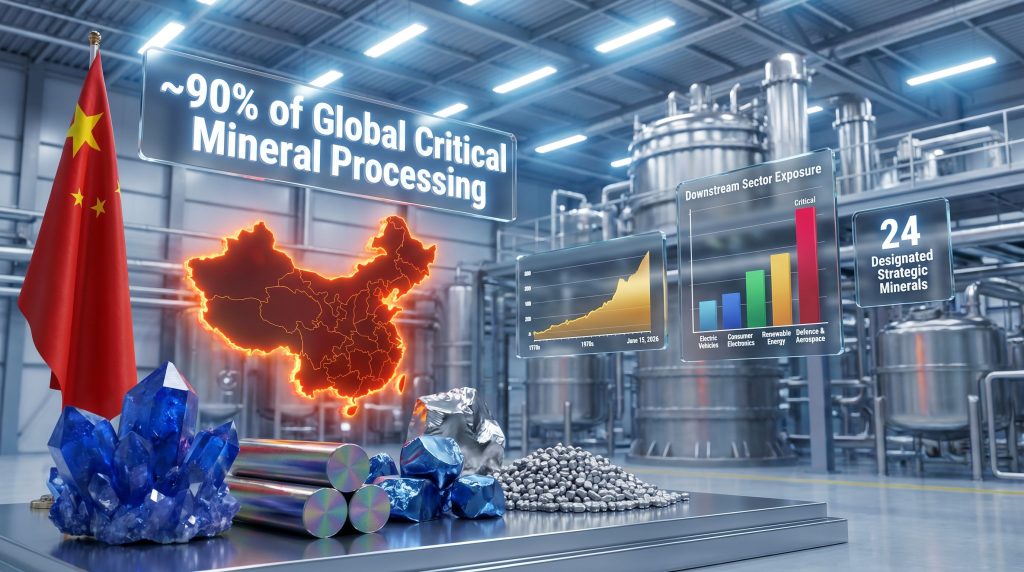
The global economy has spent decades constructing an intricate dependency that few policymakers fully appreciated until it became impossible to ignore. Critical mineral supply chains, the invisible backbone of electric vehicles, consumer electronics, wind turbines, and defence systems, flow through a single processing chokepoint with a concentration that would be considered unacceptable in virtually any other industrial context. Approximately 90% of global critical mineral processing capacity sits within one country's borders, and as of June 15, 2026, that country has formalised its control through a consolidated regulatory framework that redefines how the world must think about resource security.
Understanding the China critical mineral framework requires stepping back from individual policy announcements and appreciating a structural reality built across five decades of deliberate industrial investment. Furthermore, the critical minerals demand driving this dependency continues to intensify as clean energy targets accelerate globally.
When big ASX news breaks, our subscribers know first
Why Processing Concentration Is the Real Strategic Variable
A common misconception in public discourse is that critical mineral risk is primarily about mining and extraction. In reality, the more consequential vulnerability lies downstream, in the refining, separation, and processing stages that convert raw ore into the high-purity materials that technology supply chains actually require.
Extraction is geographically distributed. Australia, Chile, the Democratic Republic of Congo, and Brazil all hold substantial in-ground mineral reserves. However, possessing ore in the ground is functionally useless without access to processing infrastructure capable of converting it into battery-grade lithium carbonate, separated rare earth oxides, or refined cobalt sulphate. Building that infrastructure requires:
- Decades of accumulated metallurgical and chemical engineering expertise
- Substantial capital investment in hydrometallurgical and pyrometallurgical facilities
- Regulatory frameworks that permit industrial-scale chemical processing
- Established supply relationships with downstream manufacturers
China did not arrive at ~90% processing dominance by accident. It is the outcome of coordinated industrial policy stretching from the late 1970s through to the present, progressing through phases of domestic capacity building, environmental consolidation, strategic mineral designation, and, most recently, national security integration.
The Policy Evolution Behind Five Decades of Processing Dominance
| Era | Policy Focus | Key Instrument |
|---|---|---|
| 1970s–1990s | Rare earth industry development | Domestic subsidies, production quotas |
| 2000s–2010s | Illegal mining crackdowns, pollution controls | National production caps, environmental standards |
| 2016–2020 | Strategic mineral identification | National Plan for Mineral Resources: 24 designated strategic minerals |
| 2020 | Export control formalisation | Export Control Law (effective December 2020) |
| 2024 | Dual-use regulation consolidation | Expanded rare earth and dual-use export controls |
| 2026 | Supply chain security unification | New Mineral Resources Law implementation regulations (effective June 15, 2026) |
What this timeline reveals is that the June 2026 regulations are not a sudden escalation. They represent the logical endpoint of a policy trajectory that has been clearly visible for years, and that importing nations have been comparatively slow to address. The China rare earth strategy underpinning these developments has been decades in the making.
What the June 2026 Mineral Resources Regulations Actually Do
Chinese Premier Li Qiang approved new implementation regulations under China's Mineral Resources Law in May 2026, with the framework entering force on June 15, 2026. The official framing positions these measures as tools to improve transparency, promote responsible mineral development, and strengthen environmental accountability.
Analysts and industry executives monitoring the situation interpret the practical effect rather differently. The framework operates across three distinct but interconnected layers:
Layer 1: Domestic Supply Chain Governance
The regulations codify Beijing's authority to manage production volumes, processing allocations, and export eligibility across critical mineral categories. This includes strengthening the regulatory architecture governing mining licences, environmental compliance thresholds, and production standards. The effect is to give Chinese authorities finer-grained control over how much processed material enters global markets at any given time.
Layer 2: Export Control Integration
Building upon the 2020 Export Control Law and 2024 dual-use expansion measures, the June 2026 framework embeds supply chain security provisions directly into mineral resource governance. According to the IEA's analysis of export controls, a notable technical detail is the extension of controls to cover foreign-made products that incorporate Chinese-origin materials or technologies, which meaningfully broadens the jurisdictional reach of Chinese export regulation.
Layer 3: National Security Mandate
This is the layer that carries the most geopolitical significance. The 2026 provisions unify export controls, investment screening, data security requirements, and retaliatory countermeasures under a consolidated national security architecture. This grants Chinese authorities broader discretionary power to restrict mineral flows based on geopolitical considerations, without requiring the justification of specific trade violations.
According to Anurag Singh, Managing Director of Global Capability Hub at Primus Partners, the new framework provides China with expanded tools to leverage political and commercial advantages from supply chains where it holds a dominant market position, while simultaneously acknowledging that China retains a strong interest in maintaining access to global demand.
The Dual Vulnerability Paradox That Most Analysis Overlooks
One of the most underappreciated dimensions of China's critical mineral position is that Beijing operates simultaneously as a dominant processor and a large-scale importer of raw mineral inputs. China does not possess abundant domestic reserves of all the materials it processes. It imports substantial volumes of lithium from Australia and Chile, cobalt from the Democratic Republic of Congo, and nickel from Indonesia and the Philippines before refining them into battery-grade materials.
This creates what analysts describe as a dual vulnerability paradox. China holds enormous leverage over global supply chains through its processing dominance, but it cannot weaponise that leverage without limits. Aggressive supply restrictions would:
- Disrupt its own industrial inputs if retaliatory measures were applied to Chinese importers
- Damage export markets for finished goods that rely on international customer demand
- Accelerate investment in non-Chinese processing capacity, eroding its long-term competitive position
This internal tension is a meaningful constraint on how forcefully Beijing deploys its new regulatory tools, though it does not eliminate the risk of targeted restrictions during acute geopolitical disputes.
Historical Precedent: The 2010 Rare Earth Embargo
The most instructive historical parallel remains China's 2010 rare earth export restrictions against Japan during the Senkaku Islands territorial dispute. Within months, Japanese rare earth imports from China fell by more than 40%, sending global prices for certain rare earth elements to multiples of their pre-restriction levels.
The episode demonstrated that supply restrictions do not need to be permanent to be economically damaging, and that the threat of restriction is itself a form of leverage. The Andersen Institute's research on export control architecture provides a thorough examination of how these mechanisms function as strategic pressure points. The 2026 framework provides the legal and administrative infrastructure to execute similar interventions with greater precision and legal defensibility.
Downstream Sector Exposure: Who Bears the Most Risk?
| Sector | Exposure Level | Key Vulnerability |
|---|---|---|
| Electric Vehicles and Batteries | Very High | Lithium, cobalt, nickel processing dependency |
| Consumer Electronics | High | Rare earth elements for magnets and displays |
| Renewable Energy (Wind and Solar) | High | Neodymium, dysprosium, polysilicon |
| Defence and Aerospace | Critical | Specialty alloys, rare earth permanent magnets |
| Automotive (ICE and EV) | Medium to High | Platinum group metals, lithium, cobalt |
According to K Srikumar, Senior Vice President and Co-Group Head at ICRA Ltd, China's decision to consolidate control over critical mineral supply chains carries direct consequences for downstream manufacturers. The likely effects include increased price volatility, risks of supply shortages, and margin compression for industries operating in automotive, electronics, and related sectors.
Three Supply Chain Risk Scenarios Under the New Framework
Scenario A: Regulatory Friction (Base Case)
Processing approvals and export documentation requirements become more administratively complex, introducing lead-time delays of weeks to months. Buyers respond by building precautionary inventory, tightening spot market availability and elevating prices even without explicit supply restrictions.
Scenario B: Targeted Restriction (Elevated Risk)
Beijing deploys national security provisions to selectively restrict mineral flows to specific trading partners during geopolitical tensions. The 2010 Japan precedent demonstrates the speed and scale at which this can affect trade flows.
Scenario C: Structural Realignment (Long-Term)
Sustained use of supply restrictions accelerates capital allocation toward non-Chinese processing capacity in Australia, Canada, the European Union, and the United States. A bifurcated global critical mineral supply chain gradually emerges over the following decade.
India's Specific Vulnerability and Near-Term Industry Responses
India's exposure to the June 2026 framework is particularly acute given the current state of domestic critical mineral processing infrastructure. Unlike Japan, South Korea, or Germany, which have spent years developing at least partial diversification strategies, India currently lacks sufficient refining and processing capacity to substitute Chinese supply at meaningful scale.
Manas Majumdar, Partner-Lead for Energy and Resources at PwC India, has noted that while the stated purpose of the regulations is supply chain stabilisation and price shock prevention, their practical effect is to make China's dominant position more permanent and to strengthen Beijing's control over supply to countries including India.
Indian industries facing the highest exposure include:
- Automotive manufacturing, where both internal combustion and electric vehicle production depend on processed critical minerals
- Consumer electronics, where rare earth elements remain essential for magnets, displays, and battery components
- Renewable energy development, where wind turbine generators and solar panel production require materials processed almost exclusively in China
Near-term industry responses being adopted across Indian import markets include:
- Strategic inventory accumulation to buffer against potential near-term supply disruptions
- Supplier diversification programmes exploring African, Australian, and South American raw material sources, constrained by the absence of comparable non-Chinese processing capacity
- Price risk management through revised procurement contracts and commodity hedging instruments
The medium-term outlook remains challenging. As Srikumar's analysis highlights, meaningful dependence on Chinese processing capacity is likely to persist given the absence of non-Chinese refining infrastructure at comparable scale or cost. Consequently, the energy security risks for nations like India are compounding year on year.
The next major ASX story will hit our subscribers first
How Western Policy Responses Compare to China's Framework
| Dimension | China's Approach | US and Western Approach |
|---|---|---|
| Policy Maturity | 50+ years of layered development | Accelerated post-2022 via IRA and EU CRM Act |
| Processing Capacity | ~90% global share | Less than 10% combined, rapidly scaling |
| Strategic Mineral List | 24 designated strategic minerals (2016) | 50 critical minerals (USGS list) |
| Export Control Mechanism | Export Control Law plus dual-use regulations | Entity lists, ITAR, EAR controls |
| International Cooperation | Belt and Road Initiative mining investments | Minerals Security Partnership (MSP) |
| Domestic Incentive Structure | State-directed industrial policy | Market incentives combined with federal subsidies |
The Minerals Security Partnership, launched in 2022 and now comprising 14 partner nations including Australia, Canada, Japan, the EU, and the United States, represents the most structured Western attempt to coordinate investment in non-Chinese critical mineral supply chains. The US critical minerals strategy and the European supply strategy both reflect this urgent push for processing independence.
However, the fundamental constraint remains time. Building processing capacity from investment decision to commercial-scale output typically requires 10 to 15 years, meaning near-term dependency on Chinese processing is structurally locked in regardless of current policy commitments.
The Clean Energy Transition Paradox
Perhaps the most profound strategic irony embedded in the current situation is that the minerals most essential to the global energy transition are precisely those most concentrated in Chinese processing infrastructure. Lithium, cobalt, nickel, graphite, neodymium, and dysprosium are all central to decarbonisation technology and all flow predominantly through Chinese refining facilities.
Nations pursuing aggressive net-zero targets are therefore simultaneously deepening their dependency on a single-country processing chokepoint. Resolving this tension requires either a dramatically accelerated timeline for non-Chinese processing investment or a fundamental rethinking of clean technology material requirements through approaches such as material substitution research, recycling infrastructure development, and next-generation battery chemistries that reduce dependence on the most constrained minerals.
Long-Term Strategic Implications for the Global Minerals Order
Three structural shifts are reshaping how governments, investors, and industrial companies think about critical mineral supply chains in the wake of the June 2026 framework.
Shift 1: Supply Chain Security as National Policy
The explicit national security framing of the 2026 regulations signals that the China critical mineral framework is now a geopolitical instrument rather than a purely industrial matter. This reframing will accelerate reciprocal policy responses from importing nations, embedding mineral supply chains into the broader architecture of strategic competition in ways that will be difficult to reverse.
Shift 2: Price Volatility as a Structural Feature
With processing concentration at approximately 90%, even moderate administrative friction in Chinese approval processes can generate significant price dislocations in global spot markets. Downstream manufacturers in automotive, electronics, and clean energy sectors should treat elevated input cost volatility as a permanent feature of their operating environment rather than a temporary disruption.
Shift 3: The Non-Chinese Processing Race
Western governments and private capital are committing to rare earth and critical mineral processing facilities outside China at an accelerating pace. Australia's critical minerals strategy, the EU's Critical Raw Materials Act, and US Inflation Reduction Act incentives all represent real policy commitments. But the 10 to 15 year development timeline for processing infrastructure means the global supply chain will remain substantially China-dependent through at least the mid-2030s under any realistic investment scenario.
Disclaimer: This article contains forward-looking analysis, scenario projections, and third-party expert assessments. These represent informed analytical perspectives and should not be interpreted as investment advice or definitive forecasts. Actual supply chain, price, and policy outcomes may differ materially from scenarios described.
Frequently Asked Questions: China Critical Mineral Framework
What is China's critical mineral framework?
It is a multi-decade system of industrial policy, export controls, national security provisions, and investment strategies designed to consolidate China's dominant position in critical mineral processing while securing stable access to raw material inputs from global sources.
When did the new mineral regulations take effect?
The implementation regulations under China's Mineral Resources Law, approved by Premier Li Qiang in May 2026, entered force on June 15, 2026.
How many minerals has China designated as strategic priorities?
China's National Plan for Mineral Resources identified 24 strategic minerals under its 2016 planning cycle.
What share of global processing does China control?
China controls approximately 90% of global critical mineral processing capacity, giving it structural leverage over supply chains for electric vehicles, consumer electronics, renewable energy, and defence applications.
What is the difference between the 2020 Export Control Law and the 2026 regulations?
The 2020 Export Control Law established the formal legal basis for restricting exports of dual-use items on national security grounds. The 2026 Mineral Resources implementation regulations extend this framework specifically to critical mineral supply chains, consolidating export controls, investment screening, and supply chain security provisions under a unified national security mandate.
How long before non-Chinese processing capacity can offset Chinese dominance?
Given standard development timelines of 10 to 15 years from investment decision to commercial-scale output, meaningful offsetting of Chinese processing dominance is unlikely before the mid-2030s at the earliest.
Want to Know Which ASX Miners Are Positioned to Benefit From the Critical Minerals Supply Chain Shift?
As Western governments race to build non-Chinese processing capacity over the coming decade, the exploration and discovery phase happening right now on the ASX represents a critical early window for investors. Discovery Alert's proprietary Discovery IQ model delivers real-time alerts on significant ASX mineral discoveries — turning complex geological and commodity data into actionable insights — so subscribers can identify opportunities ahead of the broader market. Explore historic discovery returns to understand what major mineral finds have delivered in the past, and begin a 14-day free trial to position yourself at the forefront of the critical minerals opportunity.