August 6, 2026
Why Antimony Supply Chains Are Being Rebuilt From the Ground Up
The global race to secure non-Chinese sources of critical minerals has quietly elevated antimony from a niche industrial commodity to one of the most strategically contested metals of the mid-2020s. The antimony shortage risks facing Western governments and resource developers alike have shifted the calculus decisively. With China historically accounting for the majority of global antimony production, and with Beijing's export control measures tightening access to this metal across multiple end-use industries, developers outside China are now attracting serious commercial attention for the first time in a generation.
Against this backdrop, ASX-listed developer EV Resources has formalised a binding five-year ore supply agreement with Lucero Grupo Minero de Puebla, converting a previously non-binding memorandum of understanding into a commercial contract. This will see antimony ore from the Chinantla mine in Puebla, Mexico, delivered to EV Resources' Tecomatlán processing plant. The EV Resources antimony offtake agreement Mexico positions the company as one of the few developers actively building a functioning antimony processing operation within geographic proximity to the United States market.
When big ASX news breaks, our subscribers know first
Understanding the Commercial Anatomy of This Agreement
From MOU to Binding Contract: Why Does the Conversion Matter?
In junior mining, non-binding memoranda of understanding are commonplace. They signal intent, open dialogue, and sometimes generate market attention, but they carry no enforceable obligation. The conversion of an MOU into a binding, term-defined commercial agreement is, however, a materially different event. It introduces legal accountability, establishes pricing mechanisms, and creates a framework that counterparties and investors can rely upon.
The Chinantla binding agreement is specifically structured as an ore supply agreement, not a product offtake agreement. This distinction is important for investors to understand:
- An ore supply agreement commits a third-party mine operator to deliver raw ore feedstock to a processor. EV Resources, in this case, is the buyer of ore.
- A product offtake agreement commits a buyer to purchase processed output, such as antimony concentrate, from the producer. EV Resources has not yet announced a downstream product offtake arrangement.
- Monitoring for a downstream product offtake announcement remains a key milestone for assessing the full commercial stack of the Tecomatlán operation.
Investors should note that securing feedstock input is a necessary but not sufficient condition for commercial processing success. The downstream sales structure for processed antimony concentrate from Tecomatlán remains a critical piece of the commercial puzzle to watch.
The Core Terms of the Chinantla Agreement
| Parameter | Detail |
|---|---|
| Counterparty | Lucero Grupo Minero de Puebla |
| Ore Source | Chinantla mine, Puebla, Mexico |
| Destination | Tecomatlán processing plant |
| Initial Delivery Volume | 200-tonne bulk sample |
| Purpose of Initial Volume | Proof-of-concept production study |
| Pricing Reference | International antimony market conditions |
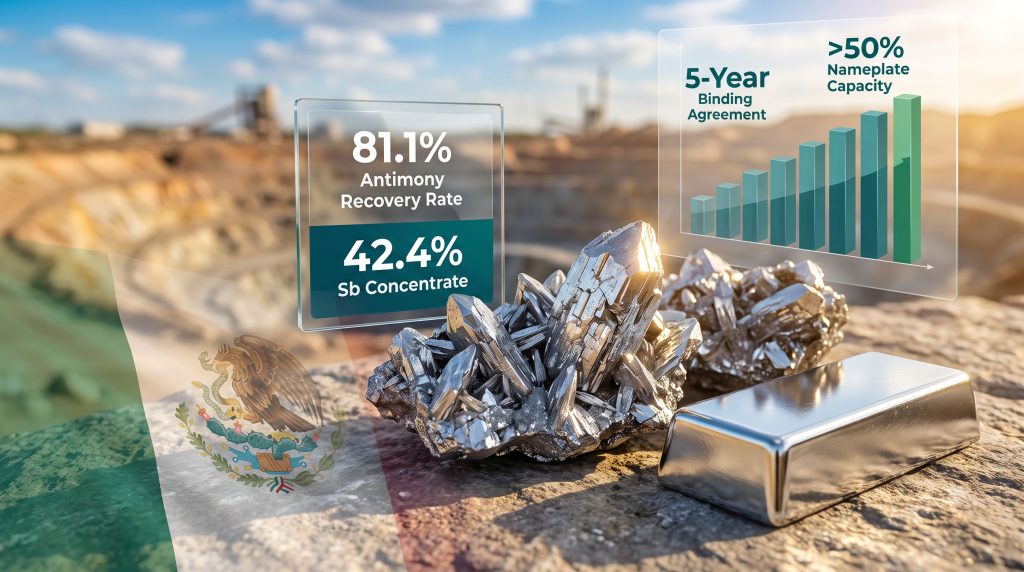
| Agreement Term | Five years (binding) |
| Existing MOU Feedstock Coverage | Greater than 50% of Tecomatlán nameplate capacity |
The pricing mechanism referenced against prevailing international antimony market conditions is standard for concentrate-based supply agreements in this sector. Antimony is typically priced against benchmark quotations from the Asian Metal or Metal Bulletin indices, which track both Chinese domestic and international spot prices for antimony trioxide and antimony metal. Furthermore, given that Chinese export restrictions have already introduced significant price premiums for non-Chinese material, this referencing approach could work in EV Resources' favour as feedstock costs are likely negotiated against a market that is itself being pushed higher by supply scarcity. The ongoing antimony price surge reinforces the commercial logic of locking in supply at terms tied to international benchmarks.
Metallurgical Performance: What Do the Numbers Actually Mean?
Flotation Testwork Results and Processing Economics
The metallurgical programme completed on Chinantla ore produced results that are commercially meaningful rather than merely indicative. Flotation testwork achieved an 81.1% antimony recovery rate, generating a concentrate grading 42.4% antimony (Sb).
To contextualise these figures for non-specialist readers:
- Flotation is a mineral separation process that uses chemical reagents and air bubbles to selectively attach to target mineral particles, allowing them to be skimmed from a slurry. It is the dominant processing method for sulphide antimony ores globally.
- Recovery rate refers to the proportion of total antimony in the feed ore that is successfully captured in the concentrate. An 81.1% recovery rate is commercially competitive for antimony sulphide ores.
- Concentrate grade of 42.4% Sb means that just under half the weight of the produced concentrate is pure antimony metal equivalent. This is considered a high-grade antimony concentrate by international smelting standards, which typically require a minimum of 45–60% Sb for direct smelting, though blending practices vary.
A 42.4% Sb concentrate is well within the range that attracts interest from international smelters, particularly those operating outside China who are actively seeking non-Chinese sourced feedstock to satisfy downstream customers in defence, energy storage, and flame retardant manufacturing.
The significance of running testwork before the proof-of-concept campaign rather than during it should not be understated. This sequencing substantially reduces the technical risk of the initial 200-tonne bulk processing run, because the plant's reagent suite, circuit configuration, and expected recoveries are already characterised from prior laboratory and pilot-scale work. You can review EV Resources' Los Lirios project details for further context on the broader asset base underpinning this strategy.
The Tecomatlán Regional Hub Model
Building a Multi-Supplier Ore Aggregation Network
EV Resources' strategic vision for Tecomatlán is not that of a conventional single-source processing plant. The company is executing what can be described as a regional ore aggregation model, where multiple nearby antimony producers supply ore to a central processing hub that generates concentrate for sale into international markets.
This model has precedent in other commodity sectors, particularly in gold processing in West Africa and tin processing in Southeast Asia, where centralised toll treatment facilities have historically allowed small-scale miners to monetise ore that they lack the capital or technical capacity to process independently. Applied to antimony in Mexico's Puebla-Oaxaca mining corridor, the approach has several structural advantages:
- Mexico's Sierra Madre Occidental belt hosts numerous small and medium-scale antimony occurrences that are individually too small to justify standalone processing infrastructure.
- Centralised processing at Tecomatlán allows these operators to convert run-of-mine ore into saleable concentrate without capital-intensive individual plant construction.
- EV Resources captures processing margin across multiple ore streams, diversifying revenue risk away from dependence on any single supply source.
- Proximity to ore sources reduces haulage costs, a meaningful consideration given that antimony ore carries relatively low value per tonne compared to the refined metal.
Prior to the Chinantla binding agreement, EV Resources held non-binding feedstock MOUs collectively representing more than 50% of Tecomatlán's nameplate processing capacity. The conversion of Chinantla to binding status establishes a legal and commercial template for converting the remaining MOU relationships into equivalent long-term supply contracts. The MOU executed with Wogen and XCLR to advance Los Lirios further illustrates how the company is building out this commercial network.
Los Lirios: The Proprietary Supply Pillar
Why Third-Party Supply Is a Bridge, Not the Destination
The Tecomatlán hub strategy is explicitly designed as a two-phase construction. Phase one, currently underway, relies on third-party ore supply agreements to generate throughput and demonstrate the plant's operational capability. Phase two pivots toward proprietary production from EV Resources' 70%-owned Los Lirios antimony project in Oaxaca, Mexico.
This sequencing is strategically sound for several reasons. Processing a plant on third-party ore before proprietary production begins allows the operator to:
- Validate metallurgical performance at commercial scale before committing capital to mine development.
- Generate early cash flows or operational data that can support project financing for Los Lirios.
- Build operational expertise and workforce capability ahead of the more complex task of managing a vertically integrated mine-to-concentrate operation.
Once Los Lirios reaches production, Tecomatlán transitions from a tolling and processing hub into the central node of a vertically integrated antimony value chain, where EV Resources controls ore from the ground through to saleable concentrate. Consequently, the commercial importance of Los Lirios extends well beyond its resource size alone.
Nevada and the US Market Dimension
Dual Jurisdiction Positioning as a Competitive Differentiator
EV Resources holds 100%-owned antimony exploration prospects in Nevada, adding a US domestic dimension to what is primarily a Mexico-based operating strategy. This positioning is tactically significant in the context of how US industrial and defence procurement increasingly prioritises supply chain provenance. Indeed, the role of antimony in defence applications has become one of the primary drivers behind government-level interest in securing alternative supply chains.
Antimony is used in ammunition primers, armour-piercing projectile components, night-vision optics, and nuclear applications within the defence sector, in addition to its well-established civilian uses in flame retardants and lead-acid battery alloys. The emergence of antimony as a component in certain next-generation energy storage chemistries has further widened its demand profile. In addition, antimony's industrial uses across flame retardants and battery technologies continue to underpin long-term structural demand.
Holding exploration assets within the United States, even at an early stage, positions EV Resources within a jurisdiction that is actively seeking to develop domestic sources of materials on its critical minerals list. This does not constitute confirmed government support or project designation, but it does mean the company operates within a regulatory environment that is structurally aligned with its development objectives.
The next major ASX story will hit our subscribers first
Why Antimony's Supply Crisis Is Structural, Not Cyclical
The Chinese Export Control Effect on Global Pricing and Availability
China has historically controlled an estimated 50–60% of global mined antimony supply and an even higher proportion of refined antimony output. Export control measures introduced by Chinese authorities have not simply tightened short-term availability; they have fundamentally altered how buyers outside China think about supply chain security for this metal.
When a dominant supplier restricts export volumes, the market response typically involves:
- Price premiums for non-Chinese material as buyers compete for limited available supply.
- Long-term contracting as buyers seek to lock in supply at predictable prices rather than rely on a spot market subject to policy-driven volatility.
- Developer re-rating as projects previously considered marginal become economically viable at higher prevailing prices.
All three of these dynamics are currently visible in the antimony market, and all three create a more favourable operating environment for a developer like EV Resources. Furthermore, the availability of strategic antimony funding at the government level in the United States signals just how seriously Western policymakers are now treating this supply chain vulnerability. For EV Resources, building processing capacity in Mexico with a line of sight to the US market places the company directly within the solution set that buyers and governments are actively seeking.
Disclaimer: This article contains forward-looking statements and analysis based on publicly available information. It does not constitute financial advice. Investors should conduct their own due diligence before making any investment decisions related to companies or projects discussed herein.
Key Milestones to Monitor
The Chinantla binding agreement is the first concrete commercial proof point in EV Resources' multi-year supply chain construction strategy. For investors and industry observers tracking the company's progress, the following milestones represent the logical next steps in the development sequence:
- Completion of the 200-tonne proof-of-concept bulk processing campaign at Tecomatlán, including published recovery and grade results at commercial scale.
- Conversion of remaining feedstock MOUs into binding supply agreements using the Chinantla agreement as a commercial template.
- Announcement of a downstream product offtake agreement for Tecomatlán's antimony concentrate output.
- Advancement of the Los Lirios project through feasibility-stage studies to establish a timeline for proprietary ore supply.
- Progression of Nevada exploration with any results that could define resource potential within a US jurisdiction.
The structural logic of EV Resources' approach — combining regional ore aggregation at Tecomatlán with proprietary production development at Los Lirios and exploration optionality in Nevada — reflects a considered understanding of how antimony supply chains need to be rebuilt in the post-Chinese-dominance era. The EV Resources antimony offtake agreement Mexico represents not just a single commercial transaction, but the first legally binding proof point of a broader supply chain architecture that is still being carefully assembled.
Want to Stay Ahead of the Next Major Mineral Discovery on the ASX?
Discovery Alert's proprietary Discovery IQ model scans ASX announcements in real time, instantly identifying significant mineral discoveries across antimony, gold, and more than 30 other commodities — translating complex data into actionable investment insights before the broader market reacts. Explore how historic discoveries have generated extraordinary returns on Discovery Alert's dedicated discoveries page, and begin your 14-day free trial today to position yourself at the forefront of the next major find.