August 6, 2026
The Logistics Crisis That Redrew the Map for South African Coal
Few forces reshape mining investment decisions as decisively as infrastructure failure. Commodity prices fluctuate, geopolitics shift, and demand cycles turn — but when the physical pathway from mine to market collapses, even the most economically viable resource becomes stranded capital. That is precisely what happened to South Africa's thermal coal sector between 2021 and 2023, when the progressive deterioration of Transnet Freight Rail's coal line triggered a cascading withdrawal of growth capital from one of the world's most established export coalfields.
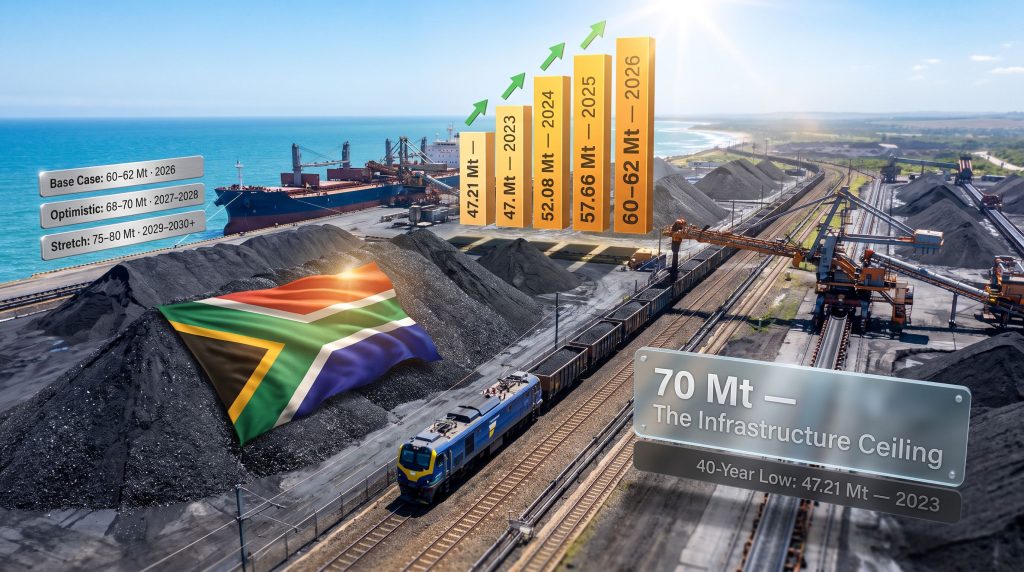
The consequences were measurable and severe. Richards Bay Coal Terminal, the privately-operated export facility through which the overwhelming majority of South Africa's seaborne thermal coal passes, recorded shipments of just 47.21 million tonnes (Mt) in 2023 — the lowest annual throughput in four decades. For context, RBCT had previously operated at volumes approaching and occasionally exceeding 80Mt per annum before TFR's maintenance backlog, locomotive shortages, and management dysfunction began compounding into a systemic export bottleneck.
It is against this backdrop that the potential Glencore South African coal projects restart carries significance that extends well beyond a single company's operational update. Furthermore, the story connects to broader coal supply challenges that have reshaped global thermal coal markets throughout this period.
When big ASX news breaks, our subscribers know first
From 47Mt to 62Mt: Quantifying South Africa's Export Recovery
The turnaround in South African thermal coal export volumes over the past two years is not marginal — it represents a structural re-rating of the country's export potential that is now attracting renewed capital interest across the sector.
| Year | RBCT Thermal Coal Exports | Year-on-Year Change |
|---|---|---|
| 2023 | 47.21 Mt | 40-year low |
| 2024 | 52.08 Mt | +10.3% |
| 2025 | 57.66 Mt | +10.7% |
| 2026 (projected) | 60–62 Mt | +4–7% |
Source: Richards Bay Coal Terminal reporting
RBCT CEO Alan Waller confirmed in July 2026 that exports had reached 30Mt in the first half of the year, placing full-year volumes on a trajectory toward 60–62Mt — a figure that would represent the strongest annual throughput since the logistics crisis began. The confidence behind that projection was reinforced by an unplanned operational stress test: a TFR derailment on the coal line in June 2026 that, in earlier years, would have caused extended disruption.
Instead, Transnet's rapid return to operational tempo following the incident was noted as a qualitatively different response to what the sector had experienced historically, suggesting that institutional repair is beginning to take root at a practical level. In addition, the contrast with ongoing Mozambique coal rail disruption highlights just how significant South Africa's relative infrastructure improvement has become for regional export competitiveness.
The Private Sector Recapitalisation Thesis: Why TFR Is Performing Differently
Understanding why TFR's performance has materially improved requires looking past headline export volumes to the structural interventions underpinning them. The recovery is not a product of organic state-led reform alone — it reflects a deliberate private sector capital injection into what had become a chronically underinvested freight network.
Key Infrastructure Changes Driving the Recovery
- 105 new Class 23E electric locomotives have been delivered specifically for the coal export corridor, resolving the traction power deficit that was the single largest operational constraint on throughput growth
- TRIM (Transport Infrastructure Management Company) was launched to allow independent private operators access to the TFR network — a structurally significant policy shift that introduces competitive discipline into what had been an exclusively state-operated monopoly
- A targeted capacity uplift of 20Mt across all commodity corridors has been programmed through the combined effect of new rolling stock, maintenance investment, and operational partnerships
- Wagon availability is currently assessed as adequate at existing throughput rates, with meaningful constraints only anticipated once volumes push north of 70Mt per annum
The locomotive detail is particularly important and often underappreciated in mainstream analysis. South Africa's coal export line operates on 25kV AC electrification, and the Class 23E represents the latest generation of electric freight locomotive suited to this network. The previous locomotive shortage was not simply a procurement failure — it reflected years of deferred capital investment and a maintenance culture that allowed existing assets to deteriorate beyond economic repair. The delivery of 105 new units represents a physical recapitalisation of the network's pulling power, not merely an administrative fix.
The TRIM Framework: A Structural Shift in Rail Governance
The introduction of TRIM as an independent infrastructure management vehicle deserves particular attention. The model is conceptually borrowed from successful rail reform frameworks in other jurisdictions, where separating infrastructure ownership from train operations introduces efficiency incentives that a vertically integrated state monopoly structurally cannot generate.
In practical terms, TRIM's ability to grant access rights to private operators creates a competitive dynamic on the TFR network that could, over time, prove more durable than locomotive purchases alone as a driver of sustained throughput improvement. Consequently, the relationship between commodity prices and miner performance in South Africa is increasingly being influenced by logistics resolution as much as by global demand signals.
How Glencore Is Thinking About the Restart Decision
Murray Houston, CEO of Glencore Coal South Africa, has been clear that the company is now actively re-evaluating growth projects that were decelerated or placed on hold during the three-to-four-year logistics crisis period. The framing matters: this is not a confirmed restart announcement but a pre-feasibility re-engagement — a preparatory phase that precedes capital commitment.
The internal decision framework Glencore has articulated involves a specific and non-trivial economic threshold. For every 5Mt of incremental rail capacity that becomes reliably available, the company requires a production margin buffer exceeding 1Mt of excess capacity to justify the associated capital deployment. This ratio reflects a fundamental truth about expansion economics in a constrained logistics corridor: adding production volume into a system running near capacity creates compressive margin risk that only resolves when throughput headroom is genuinely established.
According to Glencore's own reporting, the company produced 5% more South African energy coal in the first quarter of 2025, a signal that operational momentum is already building ahead of any formal restart commitment.
Glencore's internal position reflects a company that recognises its South African coal assets were not fundamentally uneconomic — they were logistically stranded. The distinction is critical for understanding the speed and scale at which capital could return once the infrastructure threshold is credibly met.
The Capital Allocation Competition
Any South African coal project restart must navigate Glencore's global capital allocation process. Projects do not receive funding on a regional basis — they compete against the company's entire portfolio across all commodities and geographies. This means that even a technically viable and commercially attractive restart project in Mpumalanga must demonstrate sufficient risk-adjusted return to displace alternative uses of capital elsewhere in Glencore's pipeline.
The sequence is therefore:
- Rail capacity moves sustainably toward the 70Mt threshold
- Individual projects are returned to full feasibility study status at Glencore's cost
- Completed feasibility studies are submitted into the global capital allocation process
- Projects that clear the hurdle rate receive committed funding and operational mobilisation begins
No South African coal project is currently confirmed to have cleared step two, let alone steps three or four. However, the mining industry consolidation trend unfolding globally means that Glencore's competitive advantage in restarting established South African assets may be time-sensitive.
Glencore's South African Coal Portfolio in Focus
Glencore's Mpumalanga coalfields encompass a range of operational, development, and exploration-stage assets that were at various stages of activity when the logistics crisis forced a strategic pullback.
| Asset | Status | Nature |
|---|---|---|
| Tweefontein | Active | Thermal coal operation with extension potential |
| Goedgevonden | Active | Operational with capacity upside |
| iMpunzi | Paused | Development optionality |
| Oogiesfontein | Non-operational | Potential restart candidate |
| Nooitgedacht | Development stage | Pre-feasibility |
| Zonnebloem | Exploration/development | Early stage |
| Paardekop | Early stage | Pre-feasibility |
The Mpumalanga coalfields sit within the Witbank and Highveld coalfields geological sequence, which produces thermal coal with ash and sulphur characteristics that are broadly competitive in Asian markets. South African export coal typically targets the 5,500 kcal/kg NAR specification that anchors Asian spot pricing benchmarks, though higher-quality product streams are also produced from select operations.
The 70Mt Ceiling and the 80Mt Question
The near-term structural ceiling for South Africa's coal export corridor is widely assessed at approximately 70Mt per annum — a figure that reflects infrastructure realities rather than demand limitations. The pathway to that level is conditional on sustained TFR operational improvement without significant regression, continued private investment in rolling stock and maintenance, and successful implementation of independent operator frameworks under TRIM.
Scenario Modelling: Export Capacity Recovery Pathways
| Scenario | Projected RBCT Throughput | Timeline | Key Dependency |
|---|---|---|---|
| Base Case | 60–62 Mt | 2026 | TFR sustains current performance |
| Optimistic | 68–70 Mt | 2027–2028 | Private rail investment accelerates |
| Stretch Target | 75–80 Mt | 2029–2030+ | Full TRIM implementation + new rolling stock |
Whether South Africa can return to 80Mt — a throughput level achieved before the TFR deterioration cycle — remains genuinely uncertain. The infrastructure investment required, combined with the complexity of expanding private rail access and maintaining rolling stock at scale, makes the 80Mt scenario a medium-to-long-term possibility rather than a near-term probability. Glencore's own forward guidance acknowledges this uncertainty explicitly, treating 80Mt as a question rather than a planning assumption.
Beyond Coal: The Broader South African Recalibration
The potential Glencore South African coal projects restart does not exist in isolation — it sits within a broader strategic recalibration of the company's South African footprint across multiple commodity verticals simultaneously. The common thread is infrastructure resolution as the unlock mechanism rather than commodity price alone.
In the ferrochrome segment, Glencore's Lion Smelter in Limpopo reached first production in February 2026 following NERSA tariff approval. The Boshoek and Wonderkop smelters are being reactivated following Eskom electricity supply agreements struck at 62 cents per kilowatt-hour — a tariff level identified as the threshold for commercially viable long-term ferrochrome smelting in South Africa.
The structural parallel is striking. Just as RBCT's logistics recovery is unlocking coal growth optionality, the resolution of South Africa's electricity supply and tariff structure is unlocking dormant ferrochrome smelting capacity. In both cases, the underlying assets retained their economic merit throughout the crisis period — what they lacked was a functional infrastructure pathway to market.
Simultaneously, Glencore's exploration of an Australian Securities Exchange listing signals a broader strategic repositioning of its energy and thermal coal portfolio visibility, potentially aimed at investor bases in markets where coal exposure is assessed differently than in European financial centres. These broader resource export challenges are influencing how the company thinks about portfolio geography and investor relations strategy.
The next major ASX story will hit our subscribers first
Asian Demand: The Commercial Anchor for Restart Economics
The commercial rationale for re-engaging with South African coal growth projects is underpinned by persistent thermal coal demand across South and Southeast Asian power markets. Energy supply deficits in these economies continue to support seaborne thermal coal demand at levels that provide adequate pricing support for new production from competitive-cost suppliers.
South African export coal's competitive positioning in Asian markets reflects several structural advantages:
- Quality characteristics that align with Asian power station specifications, particularly in the 5,500 kcal/kg NAR band
- Freight cost competitiveness on certain Asian routing options relative to Australian and Indonesian origins
- Port infrastructure at RBCT that, when operating at capacity, delivers efficient vessel loading and logistics handling
The combination of recovering export infrastructure and supportive Asian demand creates the commercial environment in which restart economics can be credibly modelled. This does not guarantee capital commitment — but it establishes the pricing foundation without which feasibility studies would not proceed. For further context on how Glencore is positioning its South African operations, the company has signalled readiness to move quickly once key infrastructure thresholds are met.
What Investors and Industry Observers Should Watch
For those tracking the Glencore South African coal projects restart story, several forward indicators will determine whether pre-feasibility re-engagement translates into committed capital:
- Monthly RBCT throughput data as the most direct measure of TFR operational consistency
- TRIM framework implementation progress and the commercial terms on which private operators access the network
- Glencore's semi-annual production and capital guidance for indications that South African coal projects have entered formal feasibility review
- Asian thermal coal spot pricing relative to South African production cost benchmarks
- TFR rolling stock utilisation rates as a leading indicator of whether the 70Mt threshold is being approached sustainably
Disclaimer: This article contains forward-looking statements, projections, and analysis based on publicly available information as of the date of publication. Nothing in this article constitutes financial or investment advice. Readers should conduct their own due diligence and consult qualified advisers before making investment decisions. Mining project timelines, production volumes, and capital allocation decisions are subject to material change.
Want to Stay Ahead of the Next Major Mining Opportunity?
Discovery Alert's proprietary Discovery IQ model delivers real-time alerts on significant ASX mineral discoveries, transforming complex resource data into actionable investment insights — whether you're tracking coal infrastructure recoveries or the next transformative find. Explore how historic mineral discoveries have generated substantial returns on Discovery Alert's dedicated discoveries page, and begin your 14-day free trial today to position yourself ahead of the broader market.