
August 6, 2026
The Structural Fault Line in South Africa's Industrial Ambitions
When governments attempt to accelerate industrial transformation through resource policy, the results are rarely straightforward. History offers repeated examples of commodity-rich nations deploying export restrictions and production mandates in pursuit of downstream value creation, only to find that the structural barriers to manufacturing success remain stubbornly intact. The underlying logic is seductive: if raw materials stay onshore, processing industries will inevitably follow. However, this assumption consistently underestimates the complexity of building competitive manufacturing capacity from the ground up.
South Africa's current policy debate around the Industrial Development Strategy 2026 sits squarely within this global pattern. The strategy, published by the Department of Trade, Industry and Competition (dtic) in June 2026, has drawn a formal and substantive response from the Minerals Council South Africa, the peak body representing the country's mining industry. At the core of the disagreement lies a fundamental question: can mining rights conditionality and export restrictions drive industrial revival, or do these mechanisms merely add regulatory risk to an investment environment already under pressure?
When big ASX news breaks, our subscribers know first
Mining as an Economic Anchor: Understanding the Stakes
South Africa's mining sector is not a peripheral contributor to national economic life. It underpins export revenue, generates direct and indirect employment across multiple provinces, and provides the fiscal receipts that fund public services. Any policy intervention that materially alters the risk calculus for mining investment therefore carries consequences that extend well beyond the sector itself.
The South Africa Industrial Development Strategy mining concerns raised by industry are best understood against this backdrop. The Minerals Council's position is not a defence of the status quo. Rather, it reflects a specific concern that the mechanisms embedded in the strategy — particularly those attaching beneficiation conditions to mining rights and imposing export restrictions on chrome — are structurally misaligned with the investment realities of long-duration capital projects.
Mining projects typically require planning horizons measured in decades. Feasibility studies, environmental approvals, capital raises, and construction timelines mean that regulatory conditions attached to a mining right today will shape cash flow projections and risk models for the next twenty to thirty years. Introducing ambiguity around what obligations may accompany a mining right is not a minor administrative adjustment. For exploration-stage companies and junior miners, it can be decisive in determining whether a project proceeds at all, further complicating the already challenging junior mining investment landscape.
The Beneficiation Debate: Two Sectors, One Policy Lever
One of the most technically significant arguments advanced in the industry's response relates to the structural distinction between mining and beneficiation. These are not two phases of a single activity. They represent separate economic sectors with distinct capital requirements, market structures, risk profiles, and competitive drivers.
Mining extracts and produces mineral materials that serve as inputs for downstream consumers, both domestically and internationally. Beneficiation, which involves transforming those raw or semi-processed materials into higher-value intermediate or finished goods, is fundamentally a manufacturing activity. Its viability depends on access to affordable energy, skilled labour, efficient logistics, and a sufficiently large addressable market for the end products.
The Minerals Council's position reflects this distinction clearly. Attaching beneficiation obligations to mining rights does not resolve any of the structural deficiencies that make manufacturing commercially difficult in South Africa. It simply transfers a manufacturing policy problem into the mining investment framework, where it distorts exploration incentives and new mine development decisions without generating the intended industrial outcome.
A useful analogy surfaces from within the industry debate itself: requiring an automotive manufacturer to also invest in iron ore mines and steel mills before it can operate would be recognised immediately as a policy design failure. The same logic applies in reverse. Requiring a mining company to invest in processing capacity as a condition of its extractive rights conflates two economically distinct decisions.
The Chrome Export Restriction Question
Chrome occupies a particularly sensitive position within this debate. South Africa holds the world's largest known chromite reserves, and chrome ore exports represent a meaningful component of the country's minerals export revenue. The proposed restrictions on chrome exports, accompanied by associated tariffs, have been characterised within the industry response as a blunt instrument.
The concern is straightforward: restricting exports without first establishing domestic processing capacity at commercially competitive scale risks reducing export revenue without generating the manufacturing activity the policy is designed to stimulate. Ferrochrome smelting, which is the primary downstream processing pathway for chromite ore, is an energy-intensive process. South Africa's electricity tariffs, even following recent reforms, remain a significant cost burden relative to competing ferrochrome producers in other jurisdictions.
Without addressing energy costs and logistics efficiency, export restrictions alone cannot make domestic ferrochrome production cost-competitive against established global producers. Furthermore, the shifting mining geopolitical risks globally mean that South Africa's competitive position in chrome could erode faster than policymakers anticipate.
Deindustrialisation: Diagnosing the Actual Problem
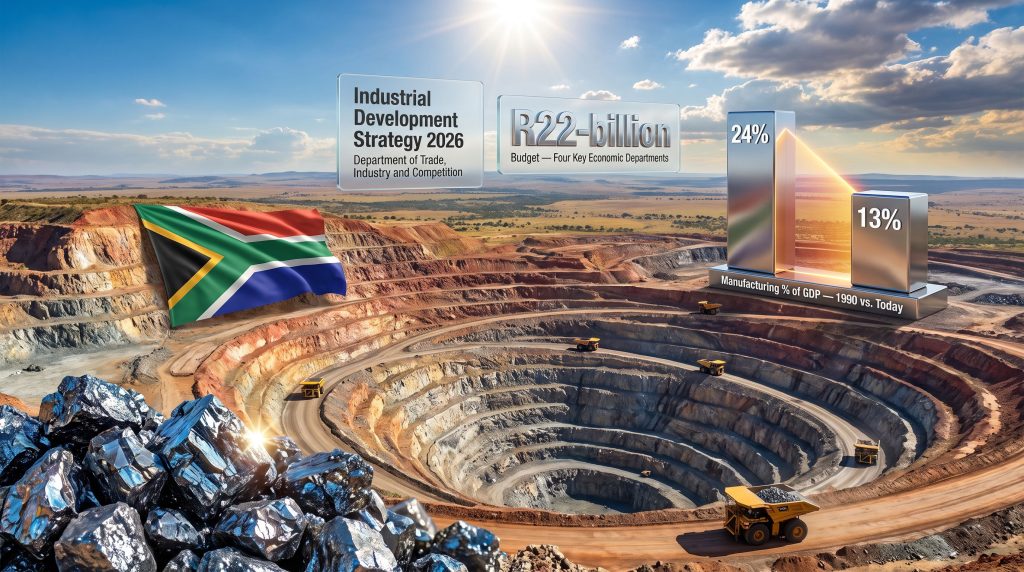
Manufacturing's contribution to South Africa's GDP has contracted from approximately 24% in 1990 to around 13% in recent years, representing one of the more severe cases of deindustrialisation among middle-income economies over that period. Understanding why this contraction occurred is essential to designing policies capable of reversing it.
The primary drivers are well-established across economic and industry literature:
- Persistently high electricity tariffs that inflate manufacturing operating costs relative to regional and global competitors
- Chronic load-shedding, which until recently imposed direct production losses and damaged investment confidence across the manufacturing base
- Underperforming rail and port infrastructure that raises logistics costs and reduces export competitiveness
- Water supply disruptions linked to deteriorating municipal infrastructure and governance failures
- Elevated costs of doing business relative to comparable emerging market manufacturing destinations
None of these constraints are addressed by imposing beneficiation obligations on mining companies or restricting mineral exports. They require targeted infrastructure investment, regulatory reform, and governance improvement across multiple departments and levels of government.
This is where the governance gap identified in the industry's formal response becomes particularly significant. Four departments central to economic regulation — namely Trade, Industry and Competition; Mineral and Petroleum Resources; Agriculture; and Transport — collectively operate on a budget of approximately R22-billion. Given the scale of economic activity those departments regulate, this resource allocation is considered deeply inadequate. Under-resourced regulatory bodies generate permitting backlogs, weak policy implementation, and administrative uncertainty, all of which compound the investment risk that the broader enabling environment already presents.
What Effective Beneficiation Policy Actually Requires
The Minerals Council's position is not anti-beneficiation. It is pro-sequencing. The argument is that sustainable downstream manufacturing capacity can only be built on a foundation that makes it commercially viable, and that foundation currently does not exist at the scale required.
| Policy Approach | Mechanism | Likely Outcome | Risk Level |
|---|---|---|---|
| Rights conditionality (mandates) | Attach processing obligations to mining rights | Short-term compliance pressure, long-term investment deterrence | High |
| Incentive-led frameworks | Tax relief, SEZ infrastructure, energy tariff reductions | Attracts manufacturing investment on commercial terms | Lower |
| Export restriction instruments | Restrict raw mineral exports to force domestic processing | Reduces export revenue without guaranteeing processing capacity | High |
| Regional integration strategy | SADC market development for processed minerals | Expands addressable market for downstream production | Medium |
The incentive-led approach represents the most structurally coherent pathway. Lower electricity tariffs for industrial users, well-executed Special Economic Zones that genuinely deliver on energy, logistics, and permitting commitments, and targeted investment incentives for manufacturing in sectors where South Africa has realistic competitive advantages, create conditions in which beneficiation can develop organically and sustainably.
Regional economic integration through the Southern African Development Community also deserves more analytical attention than it typically receives in domestic policy debates. In addition, strategies for critical mineral mining across southern Africa highlight how expanding the addressable market for processed South African minerals across the SADC region could substantially improve the commercial case for downstream manufacturing investment, without requiring the distortions associated with export restrictions.
The Exploration Pipeline: A Hidden Vulnerability
One aspect of this debate that receives insufficient attention is the health of South Africa's exploration pipeline. Junior mining companies and exploration-stage developers are the most vulnerable segment of the industry to regulatory uncertainty. Their business models depend on the rapid conversion of exploration rights into producing assets, and their access to capital is acutely sensitive to the perceived stability of the regulatory environment.
South Africa's geoscientific data coverage is considered inadequate relative to the country's known and prospective mineral endowment. Fragmented data management systems and limited publicly available geological datasets reduce the country's attractiveness for early-stage exploration capital, which is typically the most mobile and risk-sensitive category of mining investment. Consequently, without healthy resource exploration funding feeding new project development, the long-term production base of the sector faces gradual attrition.
Introducing beneficiation conditionality into the mining rights framework at this juncture would almost certainly accelerate the withdrawal of exploration-stage capital, precisely when South Africa needs more of it.
The next major ASX story will hit our subscribers first
The Recovery Trajectory and What It Requires
South Africa has made genuine and measurable progress on electricity reform over the past two years. The reduction in load-shedding frequency and the expansion of private sector participation in power generation represent a meaningful improvement in the operating environment for both mining and manufacturing. The government-business partnership frameworks established in recent years have contributed to improved investor sentiment in ways that were not inevitable.
Industry analysis suggests that poorly calibrated industrial policy interventions, particularly those that increase regulatory risk for mining, could arrest this recovery momentum and reverse hard-won improvements in investor confidence at a critical point in the economic cycle.
The Minerals Council has indicated it is developing a dedicated investment and growth strategy for the South African mining sector in parallel with its engagement with the dtic. This initiative signals a constructive rather than adversarial posture. Furthermore, the formal response to the Industrial Development Strategy explicitly frames the desired outcome as a whole-of-economy approach in which government and industry work together across departments and value chains.
The South Africa Industrial Development Strategy mining concerns ultimately reflect a broader tension between legitimate industrial ambitions and the investment realities of a capital-intensive sector. However, the growing importance of critical minerals demand globally means South Africa cannot afford to deter the very investment that would make its mineral endowment more strategically valuable. The mining industry consolidation trends already reshaping the global sector add further urgency to getting this policy balance right.
The most durable industrial strategy for South Africa is one that treats mining and manufacturing as complementary pillars of a diversified economy, rather than conflating them into a single policy instrument that serves neither sector well. Getting the sequencing right — by first building the enabling environment that makes beneficiation commercially viable, and then designing incentive frameworks that attract manufacturing investment on competitive terms — offers a far more credible pathway to industrial revival than mandates and restrictions imposed on a sector only beginning to recover its investment momentum. The South Africa Industrial Development Strategy mining concerns raised by the Minerals Council deserve serious engagement, precisely because the stakes for the broader economy are so high.
This article is intended for informational purposes only and does not constitute financial or investment advice. Readers should conduct independent research and consult qualified advisers before making any investment decisions. Forecasts and projections referenced in this article are subject to material uncertainty and may not reflect actual outcomes.
Want To Track The Next Major ASX Mineral Discovery Before The Market Reacts?
As South Africa's policy debate highlights the strategic importance of mineral endowments and the complexities of resource investment, Discovery Alert's proprietary Discovery IQ model delivers real-time alerts on significant ASX mineral discoveries, instantly transforming complex geological data into actionable investment insights. Explore Discovery Alert's discoveries page to understand how historic mineral discoveries have generated substantial returns, and begin a 14-day free trial to position ahead of the broader market.