August 6, 2026
The Quiet Architecture of Commodity Revenue Capture
Across commodity-exporting economies, one of the most persistent and least visible forms of revenue erosion is not theft, sanctions evasion, or outright fraud. It is the mundane, institutionalised practice of transfer pricing manipulation, specifically the technique known as under-invoicing. A mining company or plantation operator exports goods at a declared value well below the true market price, funnelling the difference to a related offshore entity in a lower-tax jurisdiction. The sovereign state receives royalties, taxes, and levies calculated against the understated figure. The gap between what was earned and what was declared disappears into a web of intercompany transactions that regulators in developing economies often lack the tools to untangle.
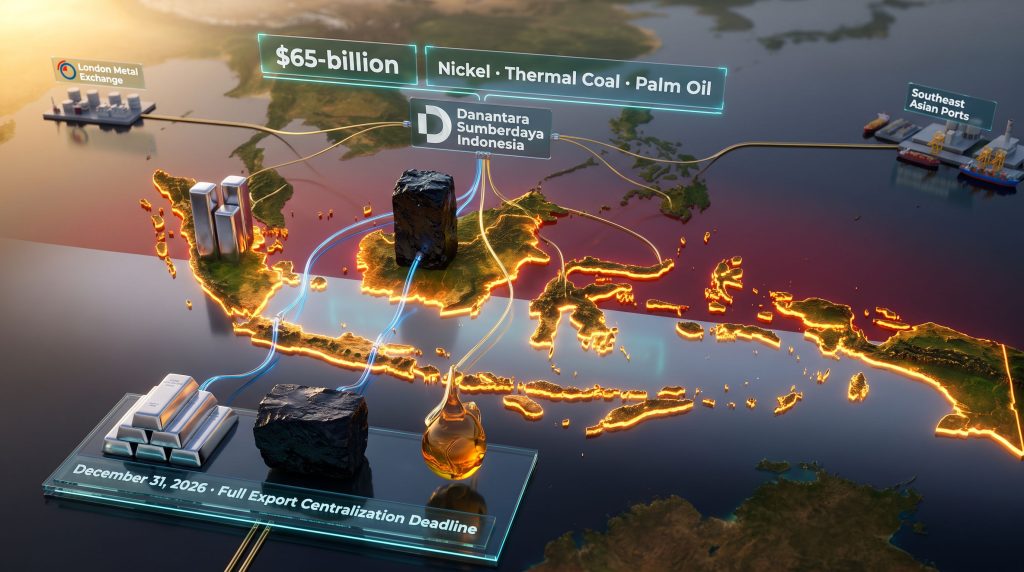
This is the structural problem that Indonesia's government has placed at the centre of its most ambitious commodity policy in decades. The Indonesia commodity export plan is not unique in facing this challenge, but its exposure is particularly acute given its position as a globally significant supplier of nickel, thermal coal, and palm oil simultaneously. The combined annual export value of these three commodities exceeds $65-billion, flowing from a fragmented production base of miners, plantations, and smelters distributed across thousands of islands. Monitoring that system for pricing integrity, let alone centralising control over it, represents an administrative challenge of extraordinary complexity.
When big ASX news breaks, our subscribers know first
Understanding the Indonesia Commodity Export Plan: What DSI Was Built to Solve
The institutional response to this challenge is Danantara Sumberdaya Indonesia, known as DSI, established as a subsidiary of Indonesia's sovereign wealth fund following an announcement by President Prabowo Subianto in May 2026. The stated objective was straightforward: create a mechanism that ensures Indonesia's strategic commodity exports are transacted at verifiable market prices, closing the under-invoicing loophole and directing more resource revenue back to the state.
Subianto's own framing of the problem has been striking in its scale. In a July 2026 cabinet address, the president described the country as haemorrhaging hundreds of billions of dollars annually from its natural resource wealth. Internal assessments produced by Danantara have reportedly placed the actual revenue loss figure from under-invoicing considerably lower than the presidential claims of losses reaching as much as $150-billion per year, according to people familiar with those internal discussions. That discrepancy matters, because the political urgency driving the policy's most aggressive features appears to rest partly on figures that Danantara's own analysts may not fully endorse.
The Transfer Pricing Mechanism: How Revenue Disappears
To appreciate what DSI is designed to prevent, it helps to understand precisely how under-invoicing operates within a commodity export context:
-
An Indonesian producer exports a cargo of thermal coal to an affiliated trading entity registered in a low-tax offshore jurisdiction.
-
The invoice declares the cargo at, say, 80% of the prevailing spot market price.
-
The offshore entity resells the cargo to the final buyer at full market price, capturing the 20% margin in a jurisdiction with minimal taxation.
-
Indonesian royalties, corporate income taxes, and export levies are all calculated against the lower declared value.
-
The Indonesian state receives a fraction of the revenue it would be entitled to under correct market pricing.
This mechanism is not unique to Indonesia, but the country's reliance on commodity exports as a pillar of national revenue makes its exposure disproportionate. The archipelago's geography, with production scattered across remote islands, also makes real-time price verification against international benchmarks technically demanding. Furthermore, the Indonesian nickel industry faces particularly acute transfer pricing pressures given the complexity of its downstream processing chains.
The Regulatory Framework: Timelines and Legal Architecture
The legal foundation underpinning DSI's authority is a government regulation specifying that after December 31, 2026, designated commodities may only be exported through a state-authorised body, which will carry the authority to set sale prices and export margins. A companion measure requiring natural resource exporters to retain 100% of export earnings within Indonesian state banks came into effect from June 1, 2026, functioning as a parallel currency and revenue control mechanism.
| Policy Measure | Effective Date | Target Commodities | Mechanism |
|---|---|---|---|
| DSI Establishment | May 2026 | Nickel, Coal, Palm Oil | State export intermediary |
| Export Earnings Retention | June 1, 2026 | All natural resources | 100% held in Indonesian state banks |
| Full Export Centralisation Deadline | December 31, 2026 | Designated commodities | Sole state export authority |
| Governance System Soft Launch | September 2026 | Initial phase | Integrated monitoring platform |
The September 2026 operational target, as described by Subianto, envisions DSI functioning as a one-stop shop for natural resource exports. That timeline is aggressive given that, as of mid-2026, DSI's own CEO Luke Mahony has publicly characterised the agency's current priorities as institution building, recruitment, digital capability development, and stakeholder engagement, with market principles remaining central to commercial negotiations and pricing.
Two Visions in Direct Conflict
The central tension within Indonesia's commodity export policy is not a disagreement about whether reform is needed. It is a fundamental dispute about what kind of institution DSI should become.
Vision A positions DSI as a price verification and monitoring body. Under this model, DSI collects export pricing data, benchmarks declared transaction values against verifiable market references, and flags discrepancies for regulatory follow-up. Private commodity traders continue executing shipments, maintaining buyer relationships, and managing logistics. DSI improves tax compliance without displacing the existing commercial ecosystem.
Vision B positions DSI as a state trading powerhouse. Under this model, DSI becomes the sole commercial intermediary between Indonesian producers and international buyers, signing offtake agreements, acquiring customers, setting margins, and potentially operating on the London Metal Exchange. Private traders are consequently removed from their role in Indonesia's most valuable export markets.
The statements emerging from Danantara's leadership do not consistently point to either model. Danantara COO Dony Oskaria stated in June 2026 that the plan was not for the agency to seize exports or act as a reselling middleman, but rather to prevent transfer pricing and ensure fair market pricing for strategic goods. Danantara CEO Rosan Roeslani indicated in July 2026 that DSI would become Indonesia's sole sales agent, while exporters would retain the ability to execute shipments and maintain long-term contracts. The phrase "sole sales agent" carries unmistakable commercial implications that sit uneasily with a pure monitoring function.
The job description for a DSI business head role reviewed by Bloomberg explicitly required candidates capable of building a fully-fledged trading operation, from executing offtake agreements with producers to acquiring external customers. This is structurally inconsistent with a compliance monitoring mandate.
According to Khairunnisa A. Damayanti, an analyst at Southeast Asia-focused risk advisory firm Cascade Asia, the regulatory foundation itself confirms the commercial intent: the agency has statutory authority to set sale prices and determine export margins, which is not a monitoring function but a commercial one. Indeed, global commodity traders are watching this development with considerable unease, as displacement from one of the world's largest resource export markets would be commercially significant.
The Talent Problem and Its Systemic Causes
DSI's ambitions, whichever vision ultimately prevails, depend entirely on the quality of people it can recruit. Danantara has sought to hire experienced professionals from major international commodity trading firms to lead three operational divisions covering nickel, coal, and palm oil. Chief Investment Officer Pandu Sjahrir has indicated the fund is exploring opportunities for DSI on the London Metal Exchange and views London's commodity trading talent pool as a key recruitment target.
The recruitment effort has encountered significant resistance. At least two senior traders from major international commodity firms declined DSI positions, citing compensation packages that failed to offset the risks associated with the role. The risk in question is not market risk in the conventional sense. It stems from a specific feature of Indonesian law that exposes employees at state-owned enterprises to criminal prosecution for causing losses to state finances, even when those losses result from unintentional decisions within inherently volatile markets. Multiple high-level executives have been jailed under this framework in past years.
Siwage Negara, a research fellow at Singapore's ISEAS-Yusof Ishak Institute, has noted that international professionals considering these positions face the compounded deterrent of both prosecution exposure and the structural friction of operating within Indonesia's bureaucratic environment.
This talent constraint is not simply a hiring inconvenience. It is a structural ceiling on DSI's institutional capacity. A state trading operation competing in global nickel, coal, and palm oil markets requires deep counterparty networks, real-time market intelligence, sophisticated hedging capability, and experienced risk managers. These capabilities take years to build within private sector firms. Assembling them within a new state entity, on an aggressive political timeline, under legal frameworks that criminalise commercial losses, represents a formidable challenge that no announcement can shortcut.
How Indonesia Compares to Other Resource Nationalism Models
Indonesia's approach is distinctive in a global context because it targets trade intermediation rather than resource ownership. Most successful state resource enterprises have captured revenue at the production level. However, the broader geopolitical mining landscape increasingly reflects how resource nationalism is reshaping competitive dynamics worldwide.
| Country | Model | Commodity Focus | Outcome |
|---|---|---|---|
| Saudi Arabia (Aramco) | State ownership of production | Oil | High revenue capture; efficient at scale |
| Chile (Codelco) | State producer, private traders | Copper | Stable coexistence model |
| Malaysia (Petronas) | Integrated state enterprise | Oil and Gas | Successful but capital-intensive |
| Russia (Rosneft consolidation era) | Forced production consolidation | Oil | Revenue gains; significant market distortion |
| Indonesia (DSI model) | State trading intermediary | Coal, Palm Oil, Nickel | Outcome unresolved |
The distinction between state ownership of resources and state intermediation of their trade is critical. Aramco and Codelco derive their effectiveness from controlling the resource at its point of extraction. DSI would be inserted between producers it does not own and buyers it has not yet cultivated. Building that position in competitive global commodity markets, where trust, pricing speed, and logistical reliability determine commercial relationships, is a fundamentally different institutional challenge.
The next major ASX story will hit our subscribers first
Commodity-by-Commodity Exposure Analysis
Thermal Coal
Indonesia ranks among the world's largest thermal coal exporters, with major Asian power markets, including Japan, South Korea, India, and China, relying heavily on Indonesian supply. Centralised export control introduces pricing rigidity into a market where spot flexibility is commercially essential for both producers and buyers. Long-term contract partners may seek supply diversification as a hedge against regulatory uncertainty, with Australia and South Africa as the most immediately accessible alternative sources.
Palm Oil
Indonesia supplies a dominant share of global palm oil demand across food systems, biofuels, and oleochemical manufacturing. The existing private trading infrastructure for Indonesian palm oil is highly sophisticated, with established grading, logistics, financing, and forward market mechanisms. Replication of this infrastructure within a new state entity is not a near-term prospect, making supply disruption risk in this segment particularly acute if the full trading monopoly model is pursued.
Nickel
Indonesia already holds an exceptionally powerful market position in nickel following its earlier ore export ban, which reshaped global nickel supply chains and accelerated downstream processing investment within the country. In addition, the surge in critical minerals demand globally has further elevated the strategic importance of Indonesia's nickel reserves. DSI's nickel division would operate from a position of genuine market leverage, making this the segment where a state trading function is theoretically most defensible.
Three Scenarios for Market Participants
The range of potential outcomes from the Indonesia commodity export plan can be organised into three distinct scenarios, each with different implications for global supply chains and investor positioning.
Scenario 1: Monitoring Model
DSI operates as a price verification layer. Private traders continue executing shipments. Modest improvement in tax compliance with limited disruption to existing offtake contracts. Market outcome: low disruption, moderate and gradual revenue improvement for the Indonesian state.
Scenario 2: Hybrid Transition
DSI assumes pricing authority incrementally while private traders retain logistics execution. Contract renegotiation risk emerges for long-term buyers. An uncertainty premium enters pricing for Indonesian commodities. Market outcome: moderate supply chain disruption, meaningful compliance improvement.
Scenario 3: Full State Trading Monopoly
All exports are routed through DSI. Private commodity traders are displaced. Severe disruption to global palm oil, thermal coal, and nickel supply chains occurs as a consequence. Investment deterrence intensifies. The Indonesian rupiah faces additional pressure. Market outcome: high disruption, deeply uncertain revenue benefit given DSI's institutional limitations.
Baldev Bhinder, Managing Director at Singapore-based commodities law firm Blackstone and Gold, has observed that it is the uncertainty itself, rather than the regulatory change as such, that presents the greatest concern for market participants. Furthermore, these commodity market challenges echo broader anxieties about state intervention in globally integrated resource markets. Commodity markets are capable of adapting to new frameworks, but prolonged ambiguity about the precise powers and operational role of the agency creates friction, buyer hesitancy, and potentially a slowdown in new commercial deals.
What Investors and Market Participants Should Monitor
For those tracking the evolution of the Indonesia commodity export plan, several concrete indicators will signal which scenario is materialising:
-
The profile of DSI's final senior executive appointments: monitoring-focused compliance professionals versus trading-experienced commercial operators.
-
Whether the September 2026 governance platform launch functions as a data reporting system or a transaction execution platform.
-
Subianto's response to continued resistance from within Danantara's leadership on the full trading monopoly vision.
-
Rupiah stability and foreign direct investment flows into Indonesia's resources sector as a real-time barometer of market confidence.
-
Whether the December 31, 2026 deadline is enforced as written, extended, or quietly restructured.
-
The extent to which major international palm oil and coal buyers begin diversifying supply sources as a precautionary measure.
Investor note: This article presents analytical perspectives on a policy in active development. The ultimate regulatory outcome remains genuinely uncertain. Investors with exposure to Indonesian commodity producers, downstream processors, or logistics infrastructure should treat all scenario projections as directional rather than predictive, and should monitor official regulatory announcements closely as the December 2026 deadline approaches.
The Indonesia commodity export plan, in whatever form it ultimately takes, will function as one of the most closely watched case studies in the tension between resource nationalism ambition and the operational realities of participating in sophisticated global commodity markets. Whether DSI becomes a compliance tool, a commercial intermediary, or something unresolved between the two, its institutional evolution will shape pricing dynamics, supply chain decisions, and investment calculus across three markets that collectively matter deeply to global industry.
Further coverage of Indonesia's resource sector governance and sovereign wealth fund developments is available through Mining Weekly at miningweekly.com.
Want to Capitalise on the Next Major Commodity Discovery Before the Broader Market?
Indonesia's evolving resource nationalism policy is a reminder of how rapidly commodity market dynamics can shift — and how critical it is to stay ahead of significant developments. Discovery Alert's proprietary Discovery IQ model delivers real-time alerts on significant ASX mineral discoveries across nickel, coal, and over 30 other commodities, turning complex market signals into actionable investment insights. Explore historic examples of major discovery returns and begin your 14-day free trial today to position yourself ahead of the market.