August 6, 2026
The Hidden Economics of Keeping an Aging Offshore Oil Field Alive
Offshore oil fields rarely die quickly. They fade across decades, surrendering barrels one percentage point of reservoir pressure at a time, until the cost of extraction finally outpaces the value of what comes to the surface. Understanding this slow decline is essential to grasping why operators continue drilling into fields that, by conventional reserve metrics, appear almost entirely spent. The Vaalco Etame field Gabon production story is precisely this kind of operation, and it offers a rare window into the technical and economic calculus that governs late-life offshore asset management across sub-Saharan Africa.
When big ASX news breaks, our subscribers know first
A Field Built for the Long Game: Etame Marin's Operational Foundation
The Etame Marin block, located in Gabon's offshore waters, has been generating commercial crude oil since 2002. That two-decade-plus production history places it among the longest-running offshore operations in the country, and cumulative output has now exceeded 100 million barrels of crude, a figure that marks both impressive commercial longevity and the unmistakable reality of reserve maturation.
Vaalco Energy, the U.S.-based operator, holds a 58.8% to 63.6% working interest in the block, giving it dominant influence over all capital decisions, drilling sequencing, and infrastructure investments. The field produces through a Floating Storage and Offloading (FSO) vessel system, which was reconfigured in 2022 to improve storage throughput, reduce logistical bottlenecks, and lower the frequency of offtake tanker visits. That infrastructure upgrade was not simply cosmetic. Reducing the cost per barrel of logistics is one of the few levers available to operators when reservoir performance itself is structurally constrained.
To understand the field's significance, it helps to situate Etame within Gabon's national production picture. According to OPEC data, Gabon's total oil output stood at approximately 216,000 barrels per day (bpd) as of January 2026, a steep contraction from the country's peak production of more than 350,000 bpd recorded during the 1990s. That three-decade decline of roughly 38% reflects a sector-wide pattern: legacy fields depleting faster than new discoveries can replace them, and frontier exploration failing to generate the replacement volumes needed to stabilise national output. Furthermore, current crude oil prices add another layer of complexity to these operational decisions.
Gabon's oil sector faces a structural supply challenge, not a cyclical one. The depletion of legacy fields without sufficient replacement volumes creates a compounding fiscal vulnerability for a government that remains heavily dependent on hydrocarbon revenues.
Reservoir Depletion at Etame: What the Numbers Actually Mean
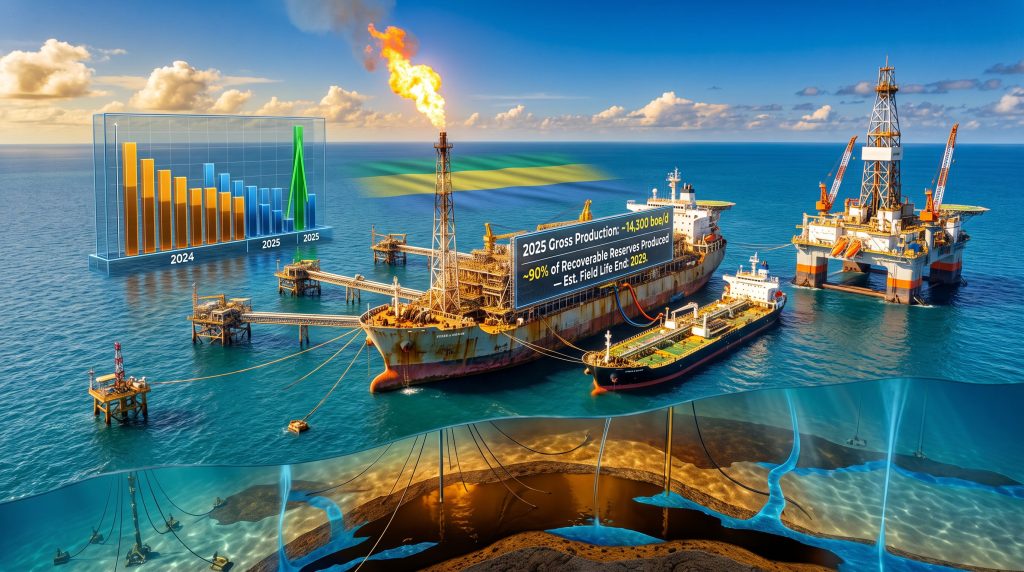
The most striking data point attached to the Etame field is not its production rate. It is the reserve depletion figure. According to GlobalData, approximately 90% of the field's recoverable reserves have already been extracted, and the field is projected to reach its economic production limit by around 2029 under current depletion trajectories. That four-year window shapes every capital decision Vaalco makes at the asset level.
| Metric | Data Point |
|---|---|
| Cumulative production milestone | 100+ million barrels |
| Estimated reserves already produced | ~90% of recoverable reserves |
| Projected economic field life end | ~2029 |
| 2024 gross Gabon production | ~19,000 bpd |
| 2025 gross Gabon production | ~14,300 boe/d |
| Year-on-year production decline | ~24.7% |
The production decline from 19,000 bpd in 2024 to 14,300 bpd in 2025 represents a loss of approximately 4,700 barrels per day in a single year. That is a natural decline rate of roughly 24.7%, which is steep by offshore standards. Mature offshore fields typically experience exponential decline curves as reservoir pressure diminishes and formation water progressively invades the production zone, diluting the oil-to-fluid ratio at the wellhead.
Understanding Water Cut: The Silent Production Killer
One of the clearest indicators of Etame's reservoir maturity is the water cut recorded at recently drilled wells. The Etame 15H-ST well came online at approximately 2,000 bpd with a 38% water cut. This metric, often underappreciated by non-technical observers, is critically important to field economics.
What is a water cut? It is the proportion of total produced fluid that consists of water rather than oil. A 38% water cut means that for every 100 barrels of fluid lifted from the reservoir, 38 barrels are water that must be separated, treated, and disposed of. This increases processing costs, reduces net oil yield per well, and compresses per-barrel margins. Reservoir engineers generally treat water cuts above 30-40% as a signal that a field is entering its late productive phase.
As water cut rises, the economics of each barrel produced become progressively less attractive. The field's processing facilities must handle ever-larger volumes of produced water relative to oil, increasing operating costs even as gross oil output declines. This dynamic is one reason why energy cost optimisation at the platform level becomes strategically important at late field life: reducing costs per barrel of fluid processed partially offsets the declining oil-to-water ratio.
Vaalco's Two-Track Operational Strategy: Infrastructure and Appraisal
Rather than accepting Etame's decline as a fixed trajectory, Vaalco has pursued a dual-track programme designed to simultaneously lower the cost base and test remaining reservoir upside. Both tracks reflect a capital-efficient philosophy appropriate for an asset with a compressed remaining productive life. However, oil market geopolitical factors continue to influence the broader environment in which these decisions are made.
Track One: Gas Well Infrastructure and Cost Reduction
The first element of the current campaign involved commissioning a new gas well to supply power directly to Etame's offshore production facilities. Previously, the platform relied on diesel transported by vessel, a logistically complex and cost-intensive supply chain that added operational overhead to every barrel produced.
The shift to field-generated gas power delivers several compounding benefits:
- Elimination of diesel freight costs and the logistical complexity of marine fuel supply runs
- Improved power supply reliability, which reduces the risk of unplanned production downtime caused by fuel supply interruptions
- More consistent operation of artificial lift systems, including gas lift and electric submersible pumps, which are increasingly critical as natural reservoir pressure declines
- Potential uplift to existing well productivity through more stable processing and separation capacity
Vaalco's CEO George Maxwell indicated publicly that this infrastructure change is expected to reduce operating costs and improve the performance of existing producing wells. From a reservoir engineering perspective, more reliable artificial lift is not a minor detail. As a depleted reservoir loses natural drive energy, the difference between consistent and intermittent artificial lift can translate directly into meaningful differences in recovered oil volume over a multi-year production tail.
Track Two: Appraisal Drilling into Bypassed Reservoir Zones
The second operational track involves drilling an appraisal well targeting a reservoir interval that was not fully evaluated during earlier development phases. This is a recognised late-life strategy in mature offshore fields: using modern well technology and updated subsurface imaging to access compartments that were either geometrically inaccessible or economically marginal when the field was originally developed.
If the appraisal confirms viable hydrocarbons, Vaalco's plan is to convert the well into a producer immediately, compressing the timeline from discovery to first oil and minimising the capital cost of a separate production well. This appraisal-to-producer conversion approach is a well-established technique for maximising capital efficiency in assets with limited remaining life.
The operational context for this decision is strengthened by results from an earlier well in the same drilling campaign, launched in late 2025. That well achieved an initial production rate exceeding 8,000 bpd, representing Vaalco's strongest single-well result at Etame in several years and providing meaningful validation that the remaining reservoir system still contains commercially productive intervals.
| Well | Initial Production Rate | Notable Characteristic |
|---|---|---|
| Etame 14H | ~4,850 gross BOPD | Recent infill producer |
| Etame 15H-ST | ~2,000 BOPD | 38% water cut |
| 2025 Campaign Well | >8,000 BOPD | Strongest result in years |
Can New Wells Close the Gap? Vaalco's 2026 Production Targets in Context
Vaalco's 2026 African portfolio production guidance of 20,100 to 22,400 bpd sets a clear quantitative test for the drilling campaign's success. Reaching even the lower end of that range from a 2025 Gabon base of approximately 14,300 bpd requires the new wells to deliver substantial net production contributions, not merely slow the rate of decline.
The 8,000+ bpd result from the late-2025 campaign well is likely already partially reflected in the company's 2026 guidance assumptions. The outcome of the current appraisal well will therefore be a meaningful swing factor in whether Vaalco achieves the upper portion of its guidance range. In addition, crude oil price trends will play a significant role in determining the commercial viability of sustained investment at the asset level.
2024 Gabon Production:        ~19,000 bpd
2025 Gabon Production:        ~14,300 bpd
Year-on-Year Decline:         ~4,700 bpd (-24.7%)
2026 African Portfolio Target: 20,100–22,400 bpd
Key Variable:                 Appraisal well outcome
Investor note: The compressed payback window created by Etame's projected 2029 economic life means that capital deployed today must generate returns within approximately three to four years. This constrains the scale of acceptable investment and raises the bar on per-well productivity targets. Wells that fail to recover their capital costs within this window represent a net negative for the asset's end-of-life economics.
With a 63.6% working interest, Vaalco captures a majority share of production upside from successful wells, but also absorbs a majority of the cost exposure from capital-intensive programmes on a declining asset. This concentrated ownership structure amplifies the financial consequences of both outcomes.
The Broader Challenge: Mature Field Dominance in Gabon's Oil Sector
The operational decisions at Etame are not isolated to a single company or block. They mirror a structural challenge that runs through Gabon's entire oil sector and resonates across multiple mid-tier African producing nations. Consequently, understanding the trade war impact on oil is increasingly relevant for operators navigating this complex environment.
Gabon's production decline from more than 350,000 bpd in the 1990s to approximately 216,000 bpd in January 2026 has occurred over three decades of gradual reserve depletion. The country's output base remains anchored primarily to fields discovered in earlier development eras, with frontier exploration activity insufficient to generate replacement volumes at the rate needed to stabilise national production.
This creates a structural fiscal exposure for a government that derives a substantial share of budget revenues from oil royalties and taxes. When mature fields like Etame continue declining without equivalent new field development entering the production pipeline, the revenue shortfall compounds over time.
The technical strategies available to operators managing this environment fall into a recognisable set of approaches:
| Strategy | Description | Status at Etame |
|---|---|---|
| Infill drilling | Target undrained compartments between existing wells | Active |
| Energy cost optimisation | Replace high-cost fuel sources with field-generated power | Completed |
| FSO/infrastructure upgrade | Improve storage and offloading logistics efficiency | Completed (2022) |
| Appraisal of bypassed zones | Evaluate reservoir intervals not accessed in early development | Active |
| Artificial lift optimisation | Sustain flow rates as natural pressure declines | Ongoing |
Each strategy extends the field's economic productive life incrementally. None of them reverses the fundamental trajectory of a reservoir that has surrendered roughly 90% of its recoverable resource base. What they collectively accomplish is a managed, value-maximising decline rather than an abrupt operational conclusion.
The next major ASX story will hit our subscribers first
Frequently Asked Questions: Vaalco Etame Field Gabon Production
When did Vaalco begin producing oil from the Etame field in Gabon?
Commercial production at the Etame Marin block commenced in 2002. Over more than two decades, the field has produced in excess of 100 million barrels of crude oil, making it one of Gabon's most significant long-running offshore oil assets.
How much oil does the Etame field currently produce?
Field-level production declined from approximately 19,000 bpd in 2024 to around 14,300 boe/d in 2025. Individual well contributions vary considerably, with a 2025 campaign well achieving rates above 8,000 bpd while the Etame 15H-ST came online at approximately 2,000 bpd.
What percentage of Etame's reserves have been produced?
Industry estimates indicate that approximately 90% of the field's recoverable reserves have already been extracted. The field is projected to approach its economic production limit around 2029 under current depletion trajectories.
What is Vaalco's working interest in the Etame Marin block?
Vaalco Energy holds a 58.8% to 63.6% working interest in the Etame Marin block and serves as the block operator, providing primary control over drilling decisions and capital deployment across the asset.
Why is Vaalco drilling new wells at an almost fully depleted field?
Late-life drilling serves multiple economically rational purposes. New wells can target reservoir compartments that were geometrically inaccessible or uneconomic under earlier development conditions, access intervals bypassed by original well trajectories, and deliver production volumes whose capital costs are recoverable within the field's remaining productive window. With an asset-level breakeven compressed to a three-to-four year horizon, well productivity requirements are high but not necessarily unachievable, as the 8,000+ bpd result from the 2025 campaign demonstrates.
What is Gabon's current national oil production level?
As of January 2026, Gabon's national oil output stood at approximately 216,000 bpd according to OPEC data, representing a significant contraction from the country's production peak of more than 350,000 bpd recorded during the 1990s.
What Etame's Trajectory Tells Investors About African Offshore Risk
For investors tracking frontier and mid-tier African oil operators, the Vaalco Etame field Gabon production story carries several instructive dimensions that extend beyond a single asset's operational results. An oil price shock can rapidly alter the economics of late-life assets, making cost discipline even more critical for operators like Vaalco.
Fields at 90% reserve depletion with sub-five-year economic horizons require a fundamentally different analytical framework than growth-stage assets. The relevant questions shift from reserve replacement ratios and long-term production profiles to near-term cash generation efficiency, cost-per-barrel trajectory, and the operator's ability to extract maximum value from a diminishing but still productive resource base.
The gas well infrastructure decision exemplifies this logic. An investment that reduces diesel dependency and lowers operating costs per barrel may appear modest in absolute terms, but its impact on per-barrel economics across a multi-year production tail can meaningfully extend the period over which the remaining reserves are profitably extractable. In late-life field management, operational cost discipline is frequently a more powerful value driver than aggressive new drilling.
The Etame case also highlights a less-discussed dynamic in offshore field economics: the role of infrastructure quality as a margin buffer. The 2022 FSO reconfiguration, the shift to field-generated power, and the continued investment in artificial lift optimisation collectively represent a systematic effort to lower the breakeven cost per barrel as gross production volumes decline. This cost engineering approach is the operational equivalent of widening a shrinking margin, buying time for the remaining reservoir intervals to be produced at acceptable returns before the field reaches its economic limit around 2029.
Readers seeking ongoing coverage of Gabon's energy sector and broader West African offshore oil developments can follow reporting from Ecofin Agency, which provides detailed tracking of African hydrocarbon markets, operator activity, and production trends across the continent's key energy basins. For broader context on global upstream activity, the International Energy Agency publishes regular analysis on oil market balances and field-level depletion trends.
This article contains forward-looking statements and production estimates derived from company reporting, OPEC data, and third-party industry analysis. Production outcomes, reserve estimates, and field life projections are subject to geological, operational, and market uncertainties. This content is intended for informational purposes only and does not constitute financial or investment advice.
Want to Identify the Next Major Mineral Discovery Before the Market Moves?
While late-life offshore assets like Etame illustrate the value of acting early in a resource's productive cycle, Discovery Alert's proprietary Discovery IQ model delivers real-time notifications on significant ASX mineral discoveries the moment they are announced — explore historic examples of exceptional discovery returns and begin your 14-day free trial to position yourself ahead of the broader market.