EV Resources Ltd
- ASX Code: EVR
- Market Cap: $18,240,019
EV Resources plots a 10–12 month course to antimony production as Los Lirios Phase 1 drilling wraps up
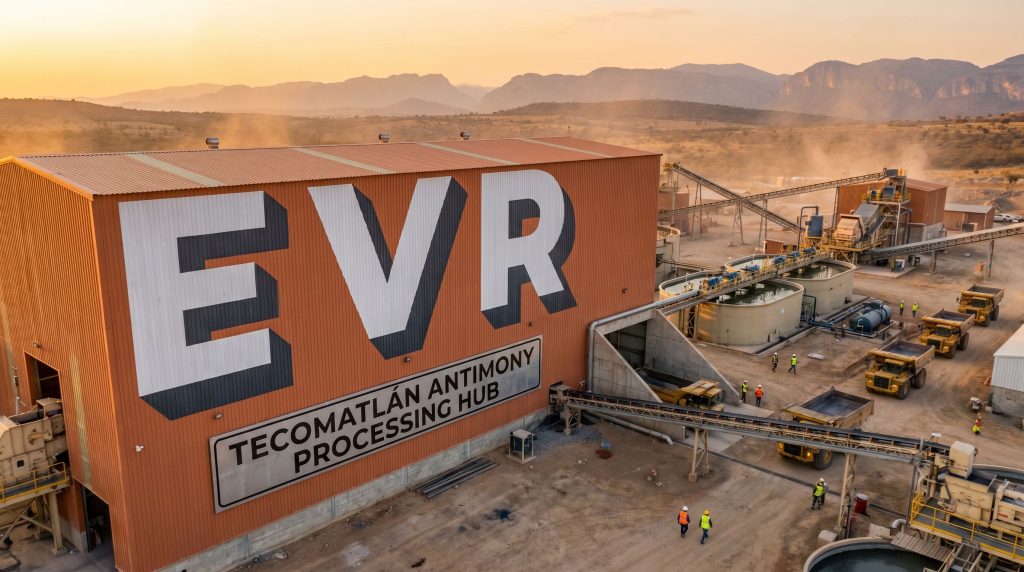
EV Resources Ltd (ASX: EVR) has outlined a 10–12 month estimated timeline to bring its Tecomatlán antimony processing plant in Mexico into operation using third-party ore. The EV Resources antimony production timeline at Tecomatlán and Los Lirios drilling results, as confirmed in the ASX announcement dated 8 July 2026, signals a pivotal moment for the company as it advances permits, third-party ore contracts, and metallurgical test work in parallel.
The company is positioning Tecomatlán as a regional processing hub and Los Lirios as its primary project pipeline asset. EV Resources Ltd now presents as a Mexican-focused antimony developer with a defined processing pathway, a shallow carbonate replacement deposit at Los Lirios, and an early-stage critical minerals portfolio in Nevada.
Managing director Mike Brown reported that the company is "working at shortening the time frame" for Tecomatlán based on advice from environmental consultants and will update the market as timelines are refined.
When big ASX news breaks, our subscribers know first
Tecomatlán: a 10–12 month pathway to flotation-led production
EV Resources Ltd has committed to a flotation-led development strategy at the Tecomatlán plant, combining its earlier Stage 1 gravity-only circuit and Stage 2 flotation circuit into a single integrated build.
The company has provided a 10–12 month estimated timeline to completion and operation of this configuration, treating third-party ore secured under non-binding Memoranda of Understanding (MoUs). This replaces previous guidance that targeted end of CY2026 for a gravity-only circuit.
The company attributes the roughly 4-month incremental extension over the original Stage 1 schedule to the change in flowsheet, which is reported to deliver:
- Materially better recovery of contained antimony
- A higher value concentrate
- Improved economics based on internal assessments
Key workstreams identified in the announcement include:
Permitting
- The first environmental submission, the Informe Preventivo, has been prepared and is expected to be lodged shortly
- Preparation of the full Mexican environmental impact assessment, the Manifestación de Impacto Ambiental (MIA), is progressing
Commercial agreements
- Advancement of existing third-party feedstock MoUs to definitive supply agreements
- Ongoing offtake discussions for antimony concentrate
Technical work
- Additional metallurgical testing to optimise the integrated gravity–flotation flowsheet
- Ongoing refurbishment and installation of processing infrastructure
Hub-and-spoke antimony processing model
The Tecomatlán plant is described in the ASX announcement as a hub-and-spoke processing facility for regional antimony production. Rather than relying solely on EV Resources Ltd's own ore, the plant is intended to treat ore from multiple third-party suppliers.
According to the company, the plant will source ore from antimony miners located across the Mexican states of Puebla, Oaxaca and Guerrero. These miners are currently required to truck ore to smelters up to 1,200 km away, with associated transport costs. Tecomatlán, furthermore, offers a regional alternative that could meaningfully reduce haulage distances and costs for those suppliers.
From EV Resources Ltd's perspective, this model provides an opportunity to generate cash flow once the plant is operational, is not dependent on Los Lirios reaching production stage, and is partly de-risked by existing non-binding MoUs.
The company reports that the volumes contemplated under these MoUs would cover more than 50% of Tecomatlán's nameplate capacity. EV Resources Ltd is consequently seeking additional MoUs to further increase potential throughput.
Tecomatlán hub-and-spoke summary
| Factor | Detail |
|---|---|
| Plant location | Tecomatlán, Mexico |
| Feedstock source | Third-party antimony miners in Puebla, Oaxaca, Guerrero |
| Current MoU coverage | >50% of plant nameplate capacity |
| Alternative smelter distance | Up to 1,200 km away for regional miners |
| Development approach | Integrated flotation + gravity circuit |
| Targeted operational timeline | 10–12 months (estimated) |
For investors, this configuration positions EV Resources Ltd as a potential toll processor for regional antimony production while it advances its own Los Lirios project and US assets.
Metallurgical test work: flotation vs gravity
The decision to move directly to a flotation-led plant is based on metallurgical test work from the Chinantla antimony project, a third-party ore source under an executed non-binding MoU. According to earlier ASX releases referenced in the 8 July 2026 announcement, test work produced the following comparative outcomes:
| Processing method | Antimony recovery | Concentrate grade |
|---|---|---|
| Flotation | ~81% Sb | 42.4% Sb |
| Gravity concentration | 29.25% Sb | 20.54% Sb |
These results indicate that, on this style of ore, flotation recovered almost three times as much contained antimony as gravity-only processing. In addition, the flotation concentrate grade was more than double that of the gravity method.
EV Resources Ltd therefore considers flotation to be the preferred route for treating third-party ore from Chinantla. The company also reports that for mixed-state Los Lirios ore, gravity-only test work achieved up to 90.8% Sb recovery with concentrate grades of 22%–36% Sb, whilst for a high-grade sulphide sample from Los Lirios grading 31.2% Sb, flotation achieved 99.2% Sb recovery.
Based on these outcomes, the company plans to install a flotation circuit as the primary processing route for third-party ore, maintain a gravity circuit to preserve flexibility across different ore types, and use Tecomatlán as a pilot plant for Los Lirios material once operational.
Educational section: what is a carbonate replacement deposit (CRD)?
The Los Lirios project is described as a very shallow, strata-bound Carbonate Replacement Deposit (CRD). Understanding this deposit style is central to interpreting the EV Resources antimony production timeline at Tecomatlán and Los Lirios drilling results.
What defines a CRD?
A Carbonate Replacement Deposit (CRD) is a type of ore deposit that forms when metal-rich fluids move through reactive carbonate rocks such as limestone and replace the original minerals with new metal-bearing minerals. Key characteristics include:
- Host rock — the deposit is hosted mainly in limestone or other carbonate rocks
- Replacement process — mineralising fluids chemically react with the carbonate rock, dissolving it and replacing it with minerals containing metals such as antimony, lead, zinc, silver or copper
- Geometry — mineralisation often develops along layers (strata) within the host rock and can extend laterally from feeder structures such as faults
Why CRDs matter at Los Lirios
According to the ASX announcement, recent work at Los Lirios has confirmed a very shallow, strata-bound CRD unit, where mineralisation sits close to surface and follows bedding planes within the limestone. Furthermore, the work has identified that high-grade antimony zones occur close to feeder structures — sub-vertical faults that acted as fluid pathways.
This geological model provides EV Resources Ltd with a clearer understanding of where mineralisation is located in three dimensions, a "vectoring" tool for Phase 2 drilling, and an improved basis for planning potential future resource drilling to JORC (2012) standards.
Key technical terms explained
| Term | Explanation |
|---|---|
| CRD (Carbonate Replacement Deposit) | A deposit where metal-rich fluids chemically replace parts of limestone or other carbonate rocks with ore minerals |
| Strata-bound | Mineralisation confined to specific rock layers, often following bedding planes |
| Feeder structures | Faults or fractures that allowed mineralising fluids to move upwards and sideways into host rocks |
| Stibnite | The main ore mineral for antimony, with chemical formula Sb₂S₃ |
| Flotation | A processing method that uses chemicals and air bubbles to separate valuable minerals from waste rock |
| Gravity concentration | A processing method that separates minerals based on differences in density |
| pXRF | Portable X-ray fluorescence, a handheld device for approximate, on-site metal readings |
Los Lirios Phase 1 drilling: program now complete
The 8 July 2026 announcement confirms that Phase 1 drilling at Los Lirios is complete, with all results either reported previously or accounted for. Drill hole DDH-L2-15-26, listed as "Pending" in the company's 22 June 2026 exploration target release, has now been finalised. The hole intersected the CRD unit, however no visually significant mineralisation was observed in core, and the hole has not been submitted for laboratory assaying.
Phase 1 drilling summary
| Hole ID | Final depth (m) | Status in 8 July 2026 release |
|---|---|---|
| DDH-L1-01-26 | 200.15 | Not assayed |
| DDH-L1-02-26 | 14.85 | Previously reported |
| DDH-L1-03-26 | 110.00 | Not assayed |
| DDH-L1-04-26 | 36.10 | Previously reported |
| DDH-L1-05-26 | 42.10 | This release |
| DDH-L1-06-26 | 44.40 | This release |
| DDH-L1-07-26 | 80.00 | This release |
| DDH-L1-08-26 | 48.60 | Previously reported |
| DDH-L1-09-26 | 78.30 | Previously reported |
| DDH-L1-10-26 | 129.15 | Previously reported |
| DDH-L1-11-26 | 106.00 | Previously reported |
| DDH-L2-12-26 | 130.75 | Not assayed |
| DDH-L2-13-26 | 207.00 | Not assayed |
| DDH-L2-14-26 | 57.70 | Previously reported |
| DDH-L2-15-26 | 25.05 | Not assayed (this release) |
EV Resources Ltd states that Phase 1 drilling, together with recent channel sampling and Controlled Source Audio-frequency Magnetotellurics (CSAMT) geophysics, is being integrated into a single geological model. This integrated dataset is expected to support targeting for Phase 2 drilling, with the company previously signalling that upcoming work will be oriented toward a maiden JORC-compliant resource estimate.
Cofradia channel results: laboratory assays confirm high-grade nature
The ASX announcement reports certified laboratory results for two channel samples from the Cofradia zone at Los Lirios. These samples were initially reported as portable XRF readings in the 22 June 2026 announcement.
Cofradia channel assay comparison
| Sample ID | Interval length | pXRF result | Lab assay result (Sb-XRF15c) | Variance |
|---|---|---|---|---|
| 856882 | 0.3 m | 10.66% Sb | 8.99% Sb | ~19% over-report |
| 856833 | 0.3 m | 9.61% Sb | 7.89% Sb | ~22% over-report |
Both samples sit within a broader channel previously reported as 2.2 m at 5.66% Sb on a pXRF-only basis. When the new laboratory assays are incorporated, the interval is revised to 2.2 m at 5.20% Sb (laboratory basis).
The company states that the roughly 20% variance between pXRF and laboratory results is considered reasonable and expected. For investors, these Cofradia results indicate the presence of high-grade antimony over multi-metre widths and demonstrate that initial pXRF work is tracking within expected bounds once laboratory data are available.
Next steps and key milestones for EV Resources Ltd
The 8 July 2026 ASX announcement outlines the immediate next steps for EV Resources Ltd across permitting, metallurgy, commercial agreements and exploration.
Permitting and technical studies
- Presentation of Informe Preventivo — prepared and expected to be submitted shortly
- Completion of MIA preparation — ongoing work on the full environmental impact assessment
- Additional metallurgical testing — continued optimisation of the integrated gravity–flotation flowsheet for third-party ore and Los Lirios material
Commercial and exploration progression
- Advancement of feedstock MoUs to definitive agreements, aiming to lock in ore supply to the Tecomatlán plant
- Ongoing advancement of offtake agreement discussions for antimony concentrate
- Integration of Phase 1 drilling results with channel sampling and CSAMT geophysics to finalise Phase 2 drilling targets at Los Lirios
- Phase 2 expected to focus on resource-oriented drilling, with a view to defining a maiden JORC Resource if results support this
Alongside Tecomatlán and Los Lirios in Mexico, EV Resources Ltd also holds two 100%-owned antimony projects in Nevada, United States, named Dollar and Milton, which are positioned to support the US critical minerals supply chain.
The next major ASX story will hit our subscribers first
Why this update matters to investors
The EV Resources antimony production timeline at Tecomatlán and Los Lirios drilling results, as detailed in the 8 July 2026 ASX announcement, provides several elements that may be relevant to investors considering exposure to antimony and critical minerals:
- Defined production timeline — a 10–12 month estimated schedule to Tecomatlán operation using third-party ore provides a time-bound development pathway, subject to permitting, financing and execution
- Processing model not solely reliant on in-house ore — the hub-and-spoke configuration, with >50% of nameplate capacity already covered by non-binding MoUs, indicates a business plan that can potentially generate concentrate from regional ore while Los Lirios advances
- Technical basis for flowsheet choice — metallurgical evidence showing ~81% Sb recovery at 42.4% Sb concentrate via flotation on Chinantla ore supports the decision to prioritise a flotation-led flowsheet
- Improving geological clarity at Los Lirios — confirmation of a shallow, strata-bound CRD with high-grade zones near feeder structures offers a clearer framework for Phase 2 drilling and possible future resource estimation
- Validation of field sampling methods — laboratory confirmation of high-grade channel samples at Cofradia, albeit at approximately 20% below pXRF readings, supports the company's approach of using pXRF as an indicative tool only
Against a backdrop where antimony is recognised as a critical mineral by the US, EU and Australia, EV Resources Ltd is positioning Tecomatlán and Los Lirios as key components of its strategy to become a near-term antimony producer, whilst maintaining exploration and development exposure in Nevada.
Ready to Learn More About EV Resources' Path to Antimony Production?
EV Resources Ltd (ASX: EVR) is advancing on multiple fronts — from a 10–12 month timeline to processing operations at Tecomatlán to a completed Phase 1 drill programme and high-grade results at Los Lirios. For investors seeking exposure to a near-term antimony developer with a defined processing strategy, hub-and-spoke commercial model, and a growing project pipeline across Mexico and Nevada, find out more by visiting the EV Resources website.