May 14, 2026
When Supplier Networks Cross Borders: Latin America's Mining Ecosystem Enters a New Phase
The architecture of global mining supply chains rarely makes headlines, yet it shapes the economic outcomes of entire regions. When a major supplier association steps outside its home market for the first time, it signals something more profound than a calendar event: it reflects a structural realignment of where capital, opportunity, and industrial capacity are converging. That convergence is now unmistakably pointing toward Argentina.
On 13 May 2026, APRIMIN, one of Chile's most influential industrial supplier associations, held the inaugural international edition of its APRIMIN Club de la Minería Internacional en Argentina, staged within the broader framework of Expo San Juan Minera. The decision to cross the Andes was not incidental. It was a calculated response to observable shifts in regional mining investment, cross-border project development, and the growing demand for specialised supply chain integration in one of South America's most dynamic mineral corridors.
When big ASX news breaks, our subscribers know first
What the Club de la Minería Platform Actually Does
To understand the significance of this debut, it helps to understand what the Club de la Minería is designed to accomplish. The format is not a trade show in the conventional sense. It operates as a structured encounter between procurement decision-makers, supplier companies, industry executives, and community stakeholders, built around thematic presentations and moderated panel discussions that address real operational challenges.
The platform performs several distinct functions simultaneously:
- It connects supplier firms with procurement officers from active mining projects at a stage when commercial relationships are still being established.
- It creates a forum for technical knowledge transfer between international operators and regional supply chain participants.
- It integrates non-corporate voices, including community organisations and youth chambers, into conversations that have historically excluded them.
- It positions APRIMIN as an active architect of sectoral ecosystems rather than a passive membership body.
The expansion of this format to Argentina marks the first time APRIMIN has taken the platform outside Chile, reflecting an institutional judgement that Argentina's mining ecosystem has reached sufficient maturity to warrant this level of engagement. Paula Frigerio, General Manager of APRIMIN, described the move as a reflection of the enormous strategic relevance that Argentina, and San Juan in particular, now holds for the regional mining supplier ecosystem. (Source: Reporte Minero, May 13, 2026)
The Club de la Minería is also distributed in podcast format via Spotify, a detail that signals institutional communications sophistication and broadens reach beyond attendees at physical events.
Why San Juan Became the Logical First International Stop
The Province's Geological and Commercial Position
Argentina's mining geography is concentrated in the Andean cordillera, and San Juan sits at a particularly productive section of that arc. The province hosts a portfolio of copper, gold, and strategic mineral projects, several of which have progressed from exploration into development and pre-construction phases. Furthermore, Argentina copper exploration activity in the region continues to attract significant institutional attention from international operators and supplier networks alike.
This transition from discovery to development is precisely the moment when supply chain ecosystems begin to form — when procurement frameworks are designed, contractor qualification criteria are established, and regional suppliers either secure a foothold or miss the window entirely.
San Juan's emergence as a mining hub is further reinforced by its geographic proximity to Chile's established mining infrastructure, including Atacama Region operations, logistics corridors, and the deep reservoir of mining expertise concentrated in Santiago and northern Chilean provinces. Cross-border project development is not theoretical here: it is already underway, with the emergence of a major copper system along the binational Andean corridor drawing sustained investment interest.
Macro Conditions Favoring the Expansion
A headline from the same day as the Club de la Minería event noted that copper had reached a historic price high, providing fiscal relief to Chile's economy. (Source: Reporte Minero, May 13, 2026) That broader commodity context matters for understanding why supplier organisations are expanding their geographic footprint now. When copper prices are elevated, project economics improve, investment flows accelerate, and the commercial case for early-stage supplier engagement strengthens considerably.
Current copper market trends point to sustained structural demand driven by the global energy transition, renewable infrastructure buildout, electric vehicles, and grid modernisation — all of which depend heavily on copper supply. Argentina holds reserves relevant to multiple categories of this demand profile, and San Juan's contribution spans both copper-gold systems and adjacent critical minerals demand endowments that are increasingly central to energy security strategies worldwide.
The window between early-stage project engineering and the commencement of construction represents the single most important period for regional suppliers seeking long-term commercial relationships with major operators. Missing this window often means being locked out for the duration of a project's productive life.
The Vicuña Project: A Joint Venture That Is Reshaping Regional Supply Chains
Structure and Strategic Significance of Vicuña Corp
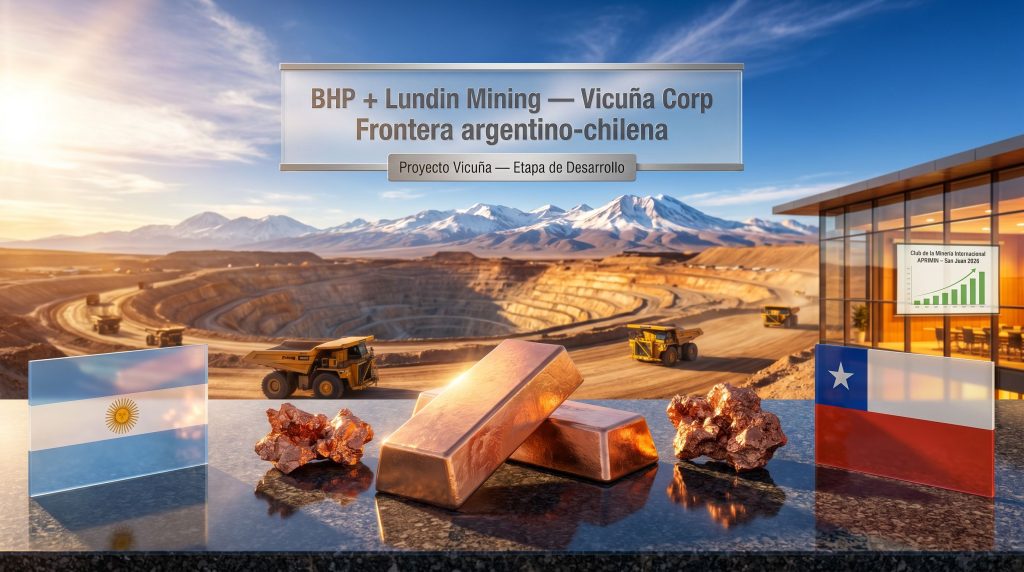
The centrepiece of the Club de la Minería San Juan agenda was a dedicated presentation on the Vicuña Project, a large-scale mining initiative developed through Vicuña Corp, the joint venture formed by BHP and Lundin Mining. The project is located on the Argentina-Chile border, placing it within both jurisdictions simultaneously — a geographic characteristic that has direct implications for procurement strategy.
| Project Parameter | Detail |
|---|---|
| Operating Entity | Vicuña Corp |
| Joint Venture Partners | BHP and Lundin Mining |
| Geographic Location | Argentina-Chile border region |
| Development Stage | Development / Pre-construction |
| Procurement Presenter | Leonardo Guevara, Procurement & Contracts Manager |
| Supplier Opportunity | Early-stage contract engagement |
Leonardo Guevara, who leads procurement and contracts for Vicuña Corp, presented to the assembled supplier community at the event. His remarks addressed the structure of the project's development trajectory and the specific opportunities available to regional suppliers as the project advances through its engineering and pre-construction phases. (Source: Reporte Minero, May 13, 2026)
Why Early Procurement Engagement Defines Long-Term Commercial Outcomes
In major mining projects, procurement architecture is established well before construction begins. The qualification criteria that determine which suppliers are invited to tender, the preferred contractor lists that govern subcontracting decisions, and the relationship frameworks between operators and vendors are all shaped during the engineering phase.
For Argentine and Chilean suppliers, the binational character of the Vicuña Project creates both opportunity and complexity. Supply decisions may be subject to dual regulatory environments, require compliance with procurement standards set by two major international mining houses, and involve logistics frameworks that span a significant elevation and distance range along the Andes. Suppliers capable of demonstrating technical competence across these parameters are, consequently, positioned advantageously.
BHP and Lundin Mining both operate under publicly stated supply chain sustainability commitments, which typically include local content preferences, ESG compliance requirements for contractors, and structured vendor development programmes. Whilst these policies apply at the corporate level, they routinely cascade into project-specific procurement frameworks.
Suppliers as Community Development Agents: Redefining the Social Role of the Supply Chain
The Panel Discussion and Its Participants
One of the most structurally interesting elements of the San Juan event was a dedicated panel titled El valor de los proveedores en el desarrollo de las comunidades (The Value of Suppliers in Community Development). Moderated by Juan Pablo Arévalo, APRIMIN's Communications and Marketing Manager, the panel brought together representatives from four distinct organisations:
- Finning Sudamérica — the regional authorised dealer for Caterpillar heavy equipment, with deep presence across South American mining operations
- Epiroc Cono Sur — Swedish multinational supplying mining and rock excavation equipment, and an active participant in the global push toward zero-emission mining
- Techint Ingeniería y Construcción — one of Latin America's largest engineering and construction contractors, with significant exposure to large-scale mining infrastructure projects
- CADEMI (Cámara de Jóvenes Mineros de Iglesia) — the youth mining chamber representing communities in the Iglesia Department, directly adjacent to active and prospective mining zones on the Argentine side of the border
The inclusion of CADEMI alongside three multinational corporations is a notable structural choice. It reflects an emerging governance model in which community organisations are not merely consulted as a compliance exercise but actively participate in shaping the frameworks around employment, training, and social investment.
The Four Development Axes
The panel's thematic architecture covered four interrelated dimensions of supplier community engagement:
1. Local Employment Generation
The capacity of suppliers to prioritise regional hiring is a critical determinant of whether mining investment translates into lasting economic benefit for host communities. Strategies for connecting local labour pools with skills requirements vary significantly between operators, and suppliers often function as intermediaries in this process.
2. Technical Knowledge Transfer
International equipment suppliers and engineering firms bring specialised technical competencies that may not exist locally. Certification programmes, apprenticeships, and technical training partnerships can leave permanent capacity in communities even after specific projects conclude.
3. Female Participation in Mining
Gender representation in mining supply chains remains one of the sector's most visible structural challenges. Indeed, female participation in mining has become a formal agenda item at industry forums, reflecting recognition that supplier-level diversity commitments are part of the broader gender equity agenda — not merely an operator responsibility.
4. Permanent Capacity Development
Perhaps the most strategically complex of the four axes, permanent capacity development addresses the sustainability challenge inherent in resource extraction: how do supplier activities build community resilience that persists beyond the economic cycle of any single project?
CADEMI's participation at the discussion table alongside multinationals represents a meaningful shift in how the mining industry is approaching community relations. When youth chambers have formal voice in procurement conversations, the gap between corporate social responsibility commitments and actual community outcomes begins to narrow.
APRIMIN's International Expansion: Strategic Architecture and Industry Implications
What the International Debut Means for Supplier Networks
APRIMIN's decision to hold the APRIMIN Club de la Minería Internacional en Argentina for the first time represents a deliberate expansion of institutional reach into a market that Chile's mining supply chain has historically served from a distance. For member companies, the event opens several tangible commercial pathways:
- Direct access to procurement decision-makers from binational projects like Vicuña without requiring separate commercial development investments
- Visibility within Argentina's institutional mining ecosystem, including provincial government stakeholders, chambers of commerce, and community organisations
- Positioning in advance of construction phases that are expected to accelerate demand for specialised services and equipment
- Cross-border partnership frameworks with Argentine suppliers capable of complementing Chilean capabilities
For APRIMIN as an institution, the international edition also represents a claim on regional relevance. Chile's mining sector, anchored by its status as the world's largest copper producer, has historically exported both ore and expertise. The Club de la Minería model, applied internationally, attempts to export institutional ecosystem architecture as well.
Is the Format Replicable Across Latin America?
The San Juan edition establishes a template applicable to other mining markets where Chilean suppliers have expanding commercial interests. Peru, Colombia, and Brazil each host major mining operations with supply chain ecosystems at varying stages of development. The Club de la Minería format, with its combination of project-specific procurement sessions and community development dialogue, could logically be deployed in any jurisdiction where:
- A major project is entering or approaching pre-construction
- Regional supplier capacity exists but lacks structured connectivity to international operators
- Community stakeholder groups have developed sufficient organisational capacity to participate meaningfully in industry dialogue
Nueva Minería noted that the 2026 edition focused specifically on innovation, sustainability, and the inclusion of women in the industry — themes that underline how seriously APRIMIN is treating this international expansion as a substantive policy platform, not merely a commercial exercise.
The next major ASX story will hit our subscribers first
Technological Transformation and ESG Pressures on Regional Supply Chains
Digitisation and Automation as New Competitive Thresholds
The presence of Epiroc at the San Juan panel is worth examining from a technological perspective. Epiroc is among the leading global manufacturers advancing battery-electric mining equipment and remote automation systems — technologies that are progressively becoming standard requirements for contracts with major operators pursuing carbon neutrality commitments.
For regional suppliers seeking to participate in projects operated by BHP and Lundin Mining, demonstrating compatibility with these technological directions is no longer optional; it is a qualification criterion. Regional suppliers in Argentina and Chile consequently face a technological adaptation challenge: scaling technical capabilities, digital infrastructure, and equipment fleets to meet standards that were barely applicable five years ago but are now embedded in major operator procurement frameworks.
ESG Standards as Contract-Level Requirements
Environmental, social, and governance compliance has migrated from corporate reporting into contract-level supplier requirements. Major mining operators now routinely include ESG screening in vendor qualification processes, requiring suppliers to demonstrate:
- Environmental management systems aligned with international standards
- Community engagement frameworks and social licence documentation
- Diversity and inclusion metrics at the workforce level
- Transparent governance structures and anti-corruption compliance
For mid-scale regional suppliers across Argentina and Chile, meeting these requirements demands institutional investment that many are still making. APRIMIN's role as a facilitator of ESG standard adoption among its member base is therefore a competitive infrastructure function, not merely a reputational one.
Frequently Asked Questions About the APRIMIN Club de la Minería Internacional en Argentina
What is APRIMIN's Club de la Minería and how does it function?
The Club de la Minería is a structured industry platform organised by APRIMIN that convenes supplier companies, mining executives, procurement specialists, and community stakeholders to address sectoral opportunities, challenges, and emerging trends. It combines project-specific presentations with moderated panel discussions on cross-cutting themes. Content from the platform is also distributed via podcast on Spotify.
Why did APRIMIN choose Argentina and San Juan for its first international edition?
San Juan hosts some of the most commercially advanced mining projects in Argentina, including the Vicuña Project, a large-scale development operated by BHP and Lundin Mining through their joint venture Vicuña Corp. The province's active project pipeline, combined with the hosting of Expo San Juan Minera, created a concentrated forum of relevant stakeholders.
What is Vicuña Corp and what stage is the Vicuña Project at?
Vicuña Corp is the joint venture formed by BHP and Lundin Mining to develop the Vicuña Project, a large-scale mining initiative located on the Argentina-Chile border. As of May 2026, the project is in the development and pre-construction phase, which makes it an active opportunity for suppliers seeking early contract engagement.
Which companies participated in the community development panel?
The panel titled El valor de los proveedores en el desarrollo de las comunidades included representatives from Finning Sudamérica, Epiroc Cono Sur, Techint Ingeniería y Construcción, and CADEMI (Cámara de Jóvenes Mineros de Iglesia), moderated by APRIMIN's Communications and Marketing Manager Juan Pablo Arévalo.
What themes were addressed at the first international Club de la Minería?
The event covered local employment generation, technical knowledge transfer, female participation in mining, community capacity development, sustainability, technological innovation, and community relations across project development cycles.
Where can I access Club de la Minería content?
APRIMIN distributes industry conversations and analytical content from the Club de la Minería through its podcast, available on Spotify, featuring participants from across the regional mining industry. Further details on APRIMIN's institutional programmes and membership are available directly through aprimin.cl.
The Bigger Picture: Latin American Mining's Supplier Ecosystem at a Structural Inflection Point
The APRIMIN Club de la Minería Internacional en Argentina is not simply a networking event that crossed a border. It is a marker of where the Latin American mining industry's centre of gravity is shifting. As copper prices reach historic highs, as critical mineral demand intensifies with the acceleration of global energy transition infrastructure, and as large-scale projects like Vicuña move from feasibility into active development, the supply chain ecosystem surrounding these operations becomes economically decisive.
For suppliers, the message from San Juan is direct: the window for establishing commercially viable relationships with major operators is open now — during engineering and pre-construction — and it will progressively narrow as contracts are awarded and preferred contractor lists are finalised. The format pioneered by APRIMIN in this international debut provides a structured mechanism for accessing that window.
For communities in San Juan and the broader Iglesia region, the model emerging from this event — where organisations like CADEMI sit alongside procurement managers from joint ventures backed by BHP and Lundin Mining — offers a more participatory approach to the social dimensions of industrial development than has historically been common in the sector.
And for Chile's established mining supply ecosystem, Argentina represents both a commercial opportunity and an institutional challenge: the opportunity to extend commercial relationships into a growing market, and the challenge of doing so whilst meeting the elevated ESG, technological, and local content expectations that now define competitive supplier status in large-scale mining operations.
For ongoing coverage of regional mining developments across Argentina, Chile, and Latin America, industry professionals can follow reporting and analysis from Reporte Minero at reporteminero.cl, which tracks project updates, sector trends, and industry events throughout the region.
This article is intended for informational purposes only. References to specific projects, investment timelines, or procurement opportunities reflect publicly available information as of the date of source publication. No statement in this article should be construed as investment advice or a guarantee of commercial outcomes.
Want to Identify the Next Major Mineral Discovery Before the Broader Market Does?
While Latin America's mining supply chains reshape around large-scale copper and critical mineral projects, Discovery Alert's proprietary Discovery IQ model scans ASX announcements in real time — instantly translating complex mineral data into actionable opportunities for both traders and long-term investors. Explore historic discoveries and their remarkable returns, then start your 14-day free trial at Discovery Alert to position yourself ahead of the market.