May 13, 2026
When Mining Consumables Become a Strategic Asset
Underground mining has always been an exercise in managing invisible risk. The rock above a miner's head is held in place by systems that most people outside the industry rarely think about, yet their reliability determines whether a mine operates safely and productively or not at all. Ground support consumables, specifically rock bolts and resin capsules, occupy this critical but unglamorous space in the mining supply chain. They are ordered by the thousands, consumed continuously, and largely taken for granted until they are not available.
That quiet dependency is now attracting serious strategic attention. The Sandvik and Alpha Metallurgical Resources joint venture in West Virginia represents one of the clearest signals yet that major mining industry evolution participants are rethinking where and how these consumables are manufactured, not as a logistics optimisation exercise, but as a fundamental question of operational sovereignty.
When big ASX news breaks, our subscribers know first
What the Joint Venture Actually Involves
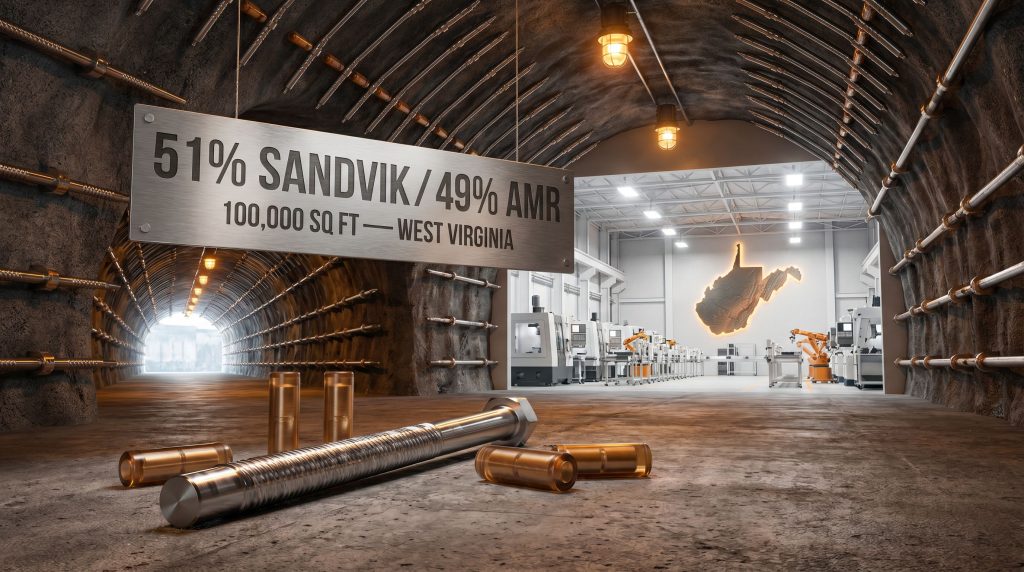
Announced in May 2026, the agreement between Sandvik and Alpha Metallurgical Resources (NYSE: AMR) establishes a jointly owned manufacturing entity with a clear mandate: produce ground support consumables on American soil for American underground mining operations. The ownership structure places Sandvik in the majority position with a 51% controlling stake, while Alpha Metallurgical Resources holds the remaining 49%.
This is not a simple supplier agreement repackaged as a partnership. The structure involves genuine co-investment, shared commercial exposure, and a long-term exclusive supply arrangement that provides Alpha with priority access to the facility's output. Beyond Alpha's own operational requirements, the joint venture is also designed to serve third-party customers across the broader US underground mining market.
The planned facility spans 100,000 square feet and will be situated in West Virginia, chosen for its geographic alignment with Alpha's Central Appalachian mining operations. Initial production will concentrate on two product categories:
- Rock bolts: Tensioned steel or fibreglass rods installed into drilled boreholes in mine roofs and walls to prevent rock mass separation and roof failure
- Resin capsules (Sandvik Fasloc): Two-component resin systems that chemically anchor rock bolts into the surrounding strata, providing rapid-setting adhesion to maintain mining productivity without extended curing delays
The Fasloc product line is Sandvik's established brand within underground mining resin systems, and its inclusion in the initial production mandate reflects the intent to manufacture complete, compatible ground support systems rather than individual components.
Rock Bolts and Resin Capsules: More Than Commodity Consumables
The Technical Case for Integrated Ground Support Manufacturing
To understand why this joint venture carries strategic weight, it helps to appreciate the technical interdependence between rock bolts and resin capsules. These two products are not interchangeable or independently effective. A rock bolt performs its structural function only when correctly anchored by a compatible resin system. Mismatched bolt diameters and capsule sizes, or incompatible resin formulations and setting times, can compromise the entire installation.
Manufacturing both products under a single roof eliminates a critical compatibility variable and gives operators greater confidence in system performance, particularly in high-stress geological environments where ground support failure carries serious safety consequences.
In longwall coal mining operations, which dominate Alpha's underground production methodology in Central Appalachia, ground support is not a one-time installation. Roof bolts are installed continuously as mining advances, meaning consumable supply must be uninterrupted. A shortfall of even a few days can halt production in a sequential mining system where each step depends on the last.
Room-and-pillar mining, another method used in the region, similarly requires dense networks of roof bolts to maintain the structural integrity of mine entries over extended operational periods. The consumption rate across a medium-sized underground coal operation can reach tens of thousands of bolts per month, creating a significant and recurring procurement burden that is acutely sensitive to supply chain disruptions.
Why Resin Capsule Chemistry Matters at Scale
Resin capsules are more technically sensitive than their simple appearance suggests. They consist of two segregated chemical components, typically a resin and a catalyst, housed within a shared encapsulation that ruptures on installation. When a rotating rock bolt is driven through the capsule, the components mix and initiate a rapid chemical cure that bonds the bolt to the surrounding rock within seconds.
The critical variables in this process include:
- Setting time: Faster-setting formulations allow immediate tensioning and resumed drilling; slower formulations may be required for specific geological conditions
- Temperature sensitivity: Resin chemistry is affected by ambient temperature, meaning underground environments with temperature variation require formulations calibrated to local conditions
- Shelf life: Resin capsules have finite storage lives, making proximity of supply particularly important to minimise inventory waste
- Compatibility with bolt diameter: Capsule outer diameter must match borehole and bolt specifications precisely to ensure complete mixing and full-column anchorage
Producing resin capsules domestically, in proximity to end-users, directly addresses the shelf-life and temperature-chain management challenges that complicate long-distance international supply.
Alpha Metallurgical Resources: Understanding the Anchor Customer
Alpha Metallurgical Resources is positioned among the most significant producers of metallurgical coal in the United States, with operations concentrated in Central Appalachia spanning West Virginia and adjacent states. The company's output feeds the global blast furnace steelmaking industry, with customers distributed across North America, Europe, South America, and Asia.
| Dimension | Detail |
|---|---|
| Primary commodity | High-quality metallurgical (coking) coal |
| Geographic base | Central Appalachia, primarily West Virginia |
| Mining methods | Underground (longwall, room-and-pillar) and surface |
| Exchange listing | NYSE: AMR |
| Export markets | North America, Europe, South America, Asia |
| Strategic focus | Steelmaking raw material supply chain |
For a company of this operational scale, the continuous procurement of ground support consumables represents both a significant cost line and a critical operational dependency. By co-investing in domestic manufacturing, Alpha transitions from being a price-taking buyer in an import-influenced market to a partial owner of its supply infrastructure.
Andy Eidson, Chief Executive Officer of Alpha Metallurgical Resources, described the rationale in terms of supply chain security, framing the joint venture as a step toward manufacturing more of the company's mining materials within Central Appalachia itself. The emphasis on regional manufacturing reflects awareness that geographic proximity to supply sources is itself a form of operational resilience.
The Reshoring Dynamic Reshaping Mining Supply Chains
Import Dependency as Operational Vulnerability
The US underground mining industry has historically relied on a mix of domestic and imported ground support consumables. International supply chains introduce lead time exposure that domestic production eliminates. When a manufacturer located overseas faces logistics disruptions, port congestion, or production delays, the downstream impact reaches mine sites weeks or months later, with limited ability to rapidly substitute alternative supply.
The broader industrial environment of 2025 and 2026 has heightened sensitivity to these vulnerabilities. Trade policy uncertainty, freight cost volatility, and geopolitical complexity have collectively raised the strategic premium on domestic manufacturing capacity across multiple sectors. Furthermore, the critical minerals demand surge across global supply chains has amplified awareness of how quickly import dependency can become a structural liability for resource operations.
The Third-Party Market Dimension
A feature of the joint venture that deserves particular attention is its mandate to serve third-party customers beyond Alpha's own operations. This is a commercially significant design choice. It means the West Virginia facility is not structured as a captive internal supplier, which would limit its revenue ceiling to Alpha's consumption volumes, but as a commercial manufacturer with ambitions across the broader US underground mining market.
This third-party scope transforms the business model and the risk profile:
- Revenue diversification beyond single-customer dependency
- Economies of scale achievable at higher production volumes than Alpha's internal demand alone would support
- Market intelligence gathered from serving diverse customer operations with different geological and technical requirements
- Platform value that increases as third-party relationships are established and expanded
For Sandvik specifically, this structure allows the company to re-establish a US manufacturing presence with a built-in anchor revenue base, while simultaneously pursuing the broader market opportunity without the commercial uncertainty of a greenfield startup.
Sandvik's Strategic Re-Entry and What It Signals
Mats Eriksson, President of Sandvik Mining, described the initiative as strategically important for re-entering the US ground support market with a local manufacturing presence. The framing of this as a re-entry is notable. It implies that Sandvik previously held a US manufacturing position in ground support, exited or reduced that presence, and is now reasserting it under conditions it judges to be commercially sustainable.
The 51% controlling stake reflects Sandvik's intent to lead on operational standards, product quality, and manufacturing methodology. The joint venture is not a passive financial investment for Sandvik; it is the vehicle through which the Sandvik and Alpha Metallurgical Resources joint venture in West Virginia rebuilds a physical industrial presence in a market viewed as strategically significant for long-term North American growth.
The scalability language used in the announcement is also deliberate. The facility has been framed as a platform, not a fixed-capacity installation. This suggests that production volumes, product categories, and customer reach are all expected to expand beyond the parameters of the initial agreement. Consequently, the future of mining operations across North America may increasingly depend on similarly structured domestic manufacturing networks.
A 100,000-square-foot facility built with explicit expansion intent and a third-party customer mandate is not a facility designed for a single customer. It is the first anchor of a North American manufacturing network.
The next major ASX story will hit our subscribers first
Regional Economic Significance: West Virginia as a Manufacturing Location
The choice of West Virginia as the facility location carries layered significance. Most directly, it places the plant within the operational heartland of Alpha's underground mining network, minimising logistics costs and delivery lead times for Alpha's mines. Equally important is the broader economic context of the state.
West Virginia's economy has long been intertwined with the extraction industries, particularly coal mining. Manufacturing employment that directly serves the mining sector represents a form of industrial deepening, adding value-added production jobs alongside the extraction workforce rather than competing with or replacing it. The facility creates employment in fabrication, quality control, logistics, and technical support functions that complement the existing mining employment base.
For regional communities where mining employment has historically been the primary industrial employer, the addition of manufacturing roles tied to mining supply chains offers meaningful economic diversification within a familiar industrial ecosystem.
What This Partnership Model Means for the Industry
The structural template of this joint venture — a major OEM supplier taking a controlling stake in a manufacturing entity co-owned by a major mining operator with an anchor supply agreement — is a replicable model. It aligns incentives in ways that traditional supplier-customer relationships do not. In this respect, it mirrors broader mining sustainability transformation trends, where long-term resilience is increasingly built through structural partnerships rather than transactional procurement.
In a conventional procurement arrangement, a mining operator purchases consumables at market prices and absorbs cost volatility. In this joint venture structure, Alpha participates financially in the manufacturing margin on its own consumable purchases. The long-term exclusive supply agreement provides price stability and supply certainty that a spot-market procurement approach cannot guarantee.
For other mining operators evaluating their supply chain security for critical consumables, this model offers a potential template worth examining. Effective mining risk management increasingly demands structural solutions of precisely this kind:
- Shared investment reduces capital burden on either party individually
- Majority/minority ownership structures can allocate operational control to the manufacturing specialist
- Anchor supply agreements de-risk facility economics during ramp-up phases
- Third-party sales mandates create upside beyond the anchor customer relationship
- Geographic alignment with operational footprint minimises logistics complexity
Furthermore, the Sandvik and Alpha Metallurgical Resources joint venture in West Virginia demonstrates that when two industry principals commit to shared manufacturing infrastructure, the resulting entity carries a credibility and durability that neither party could establish independently.
Disclaimer: This article is intended for informational purposes only and does not constitute financial or investment advice. Statements regarding joint venture plans, production timelines, and market opportunities reflect information available at the time of announcement and are subject to change. Readers should conduct their own independent research before making any investment decisions.
Want To Stay Ahead Of The Next Major Mining Discovery?
Discovery Alert's proprietary Discovery IQ model scans ASX announcements in real time, instantly translating complex mineral data across more than 30 commodities into clear, actionable investment insights — giving subscribers a critical edge the moment significant discoveries are announced. Explore historic discoveries and their extraordinary returns, then begin a 14-day free trial at Discovery Alert to position yourself ahead of the broader market.