May 13, 2026
The Quiet Revolution Reshaping How the World's Biggest Miners Think About Growth
For most of the twentieth century, mining's default growth model was straightforward: find a new deposit, build a new mine, extract more metal. Capital expenditure flowed toward greenfield discoveries, and corporate prestige was often measured in tonnes of ore moved rather than efficiency ratios. That paradigm is under serious pressure in 2026, and the conversation happening at the highest levels of the industry reflects it. When the world's leading gold producer sends its chief executive to a global mining congress specifically to discuss how to extract more from what already exists, something structurally significant is underway.
That shift forms the intellectual backdrop to Newmont CEO Natascha Viljoen to speak at World Mining Congress 2026, scheduled for 24 to 26 June in Lima, Peru. Her role in the Day 2 panel on productivity and asset optimisation is not simply a speaking engagement. It reflects a deeper strategic realignment occurring across the sector, one that prioritises operational intelligence over capital expansion, and systems thinking over volume-driven growth. This realignment is itself part of a broader mining industry evolution redefining how major producers approach value creation.
When big ASX news breaks, our subscribers know first
World Mining Congress 2026: Scale, Setting, and Strategic Timing
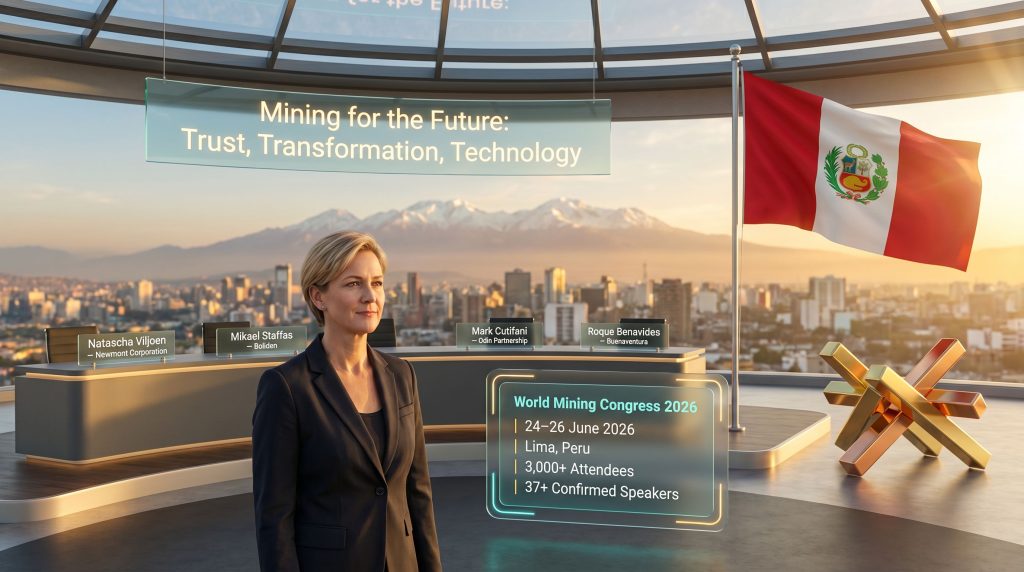
The World Mining Congress has historically served as one of the most concentrated gatherings of senior mining leadership anywhere in the world, and the 2026 edition in Lima is positioned to build on that tradition substantially. With more than 3,000 delegates expected from governments, mining corporations, academic institutions, and international organisations, WMC 2026 represents a rare convergence of decision-making authority under a single agenda.
The headline framework, "Mining for the Future: Trust, Transformation, Technology", captures three pressures simultaneously reshaping corporate strategy across the sector. Trust reflects the growing importance of social licence to operate, particularly in mineral-rich developing economies. Transformation acknowledges that legacy operational models face structural constraints from declining ore grades, energy cost inflation, and evolving ESG expectations. Technology points toward the digital tools and automation platforms increasingly required to remain competitive without simply throwing capital at new infrastructure.
| Detail | Information |
|---|---|
| Event Name | World Mining Congress 2026 |
| Dates | 24 to 26 June 2026 |
| Location | Lima, Peru |
| Expected Delegates | 3,000+ |
| Confirmed Speakers | 37+ CEOs, executives, and policymakers |
| Central Theme | Mining for the Future: Trust, Transformation, Technology |
Why Lima? South America's Growing Strategic Weight
The decision to host WMC 2026 in Lima is commercially and symbolically significant. Peru ranks consistently among the world's top producers of copper, silver, zinc, and gold, and its mining sector represents a substantial portion of national export revenue. Hosting the Congress in Lima places South America's mining identity at the centre of a global conversation precisely as the region's critical mineral endowment gains renewed strategic importance in the context of the global energy transition.
Copper, in particular, is experiencing heightened demand forecasting pressure due to its essential role in electrical infrastructure, renewable energy systems, and electric vehicle components. Peru's position as a top-tier copper producer, alongside Chile, means South American operational realities are directly relevant to the copper supply crunch discussions that will dominate the WMC 2026 agenda.
Natascha Viljoen: A Career Built on Operational Depth
What distinguishes Natascha Viljoen from many executives at her level is not simply the breadth of her experience across more than 30 years in international mining, but the foundation on which that experience rests. Her connection to the industry predates her corporate career, shaped by accompanying her father, a winding engine driver, to work during her formative years. That exposure to operational realities from the ground up has informed a leadership philosophy centred on discipline, safety, and the human dimensions of running complex extraction operations.
Her career progression traces a path through some of the sector's most demanding environments:
- Lonmin – Early operational leadership across platinum mining operations in Southern Africa
- BHP – Senior management responsibilities spanning global diversified mining portfolios
- Anglo American – Expanded executive scope across a range of commodity and geographic contexts
- Anglo American Platinum – Chief Executive Officer of the world's largest primary platinum producer, overseeing one of the most technically complex precious metals operations globally
- Newmont Corporation – Joined as Executive Vice President and Chief Operating Officer in October 2023, elevated to President and COO before assuming the role of President and CEO in January 2026
The Significance of Leading Newmont in 2026
Newmont's position as the world's leading gold company means its strategic direction carries outsized influence across the sector. When its CEO publicly prioritises operational excellence and portfolio optimisation over expansion for expansion's sake, that posture sends a signal to capital markets, to peers, and to the broader supply chain.
Viljoen assumed the top role in January 2026 following a period as President and COO, giving her direct operational oversight before inheriting full strategic leadership. That sequencing matters because it means her productivity focus at WMC 2026 is grounded in operational familiarity, not just executive positioning. Furthermore, her reputation across her career has consistently centred on three interconnected capabilities: driving operational discipline, strengthening safety performance, and leading complex global operations through transformation periods.
The Systems View Panel: What the Discussion Actually Means
The Day 2 panel, titled "Systems View: Getting More from What We Already Have", is structured around a question that sounds straightforward but carries significant strategic depth: how do mining companies unlock greater productivity and value from their existing asset base rather than defaulting to new capital deployment?
The panel brings together four senior figures representing distinct corners of the global mining industry:
| Panellist | Organisation | Role |
|---|---|---|
| Natascha Viljoen | Newmont Corporation | President and CEO |
| Mikael Staffas | Boliden | CEO |
| Mark Cutifani | Odin Partnership | Partner |
| Roque Benavides | Buenaventura | Chairman |
This lineup is notable for its diversity of commodity exposure and geographic perspective. Newmont operates primarily in gold. Boliden spans copper, zinc, lead, and gold across Scandinavian and European assets. Buenaventura is one of Latin America's largest publicly traded precious metals companies, with deep operational roots in Peru itself. Mark Cutifani brings a distinguished career spanning leadership at Anglo American and AngloGold Ashanti, along with a reputation for transformational operational thinking.
Unpacking the Systems View Concept
The systems view in mining refers to the analytical approach of examining an entire operational ecosystem rather than optimising individual components in isolation. Rather than focusing narrowly on drilling efficiency or processing throughput alone, a systems view considers how every stage of the value chain — from resource characterisation and mine planning through extraction, comminution, metallurgical processing, and logistics — interacts with every other stage.
A systems view approach asks whether the constraints on output and margin are genuinely located where they appear to be, or whether upstream and downstream inefficiencies are masking the real productivity levers. In many mature operations, the answer reveals significant untapped value that capital expenditure alone cannot unlock.
This framework is particularly relevant in the current environment for several reasons:
- Declining ore grades across many mature mining districts mean more material must be processed to deliver the same metal output, placing greater pressure on processing efficiency
- Energy cost inflation has increased the operational cost burden of energy-intensive processes like grinding and smelting, making efficiency improvements financially material
- Capital market discipline has tightened expectations around new project returns, making brownfield optimisation a more defensible investment case in many instances
- Digital enablement through sensor networks, real-time data analytics, and machine learning is making systems-level visibility practically achievable in ways that were not possible a decade ago
Newmont's Operational Priorities Under Viljoen's Leadership
At Newmont, the strategic emphasis under Viljoen centres on the interconnection between safety culture, operational excellence, and portfolio optimisation. These are not treated as separate pillars but as mutually reinforcing elements of a coherent performance framework. In addition, the move toward data-driven mining operations is increasingly underpinning how the company identifies and acts on efficiency opportunities across its global asset base.
The relationship between safety and productivity deserves particular attention because it is frequently misunderstood. In extractive industries, safety failures are not simply humanitarian concerns, though they are emphatically that. They are also operational disruptions. Fatalities, injuries, and near-miss events trigger production stoppages, regulatory interventions, workforce morale deterioration, and reputational damage that collectively impose measurable costs on output and margin.
A sustained safety culture therefore has direct financial consequences beyond its essential human dimensions. Portfolio optimisation adds another dimension. Newmont's asset base spans multiple continents and commodity contexts, meaning decisions about which assets to invest in, which to monetise, and which to operate differently can significantly alter aggregate productivity metrics without any change to the underlying geology.
Responsible Metals Delivery and the ESG Dimension
The panel's framing around delivering metals responsibly adds an ESG dimension to the productivity conversation that reflects 2026's regulatory and stakeholder landscape. Responsible sourcing frameworks, emissions reduction commitments, and community engagement obligations are no longer optional considerations layered onto operational planning. For major producers operating in multiple jurisdictions, they are integral to licence maintenance and long-term asset viability.
The ability to demonstrate that productivity gains are achieved through responsible means — rather than by cutting environmental or social corners — is increasingly a prerequisite for maintaining access to international capital markets and institutional investor support. Consequently, the mining energy transformation underway across the sector is becoming a core part of how companies like Newmont demonstrate that operational efficiency and environmental responsibility can advance together.
The Broader Productivity Challenge Facing Global Mining
The WMC 2026 productivity theme does not emerge in a vacuum. Global mining has faced a well-documented structural productivity challenge over an extended period, shaped by several converging forces:
- Ore grade decline: As higher-grade near-surface deposits have been progressively depleted, miners have moved to deeper, lower-grade, and more complex orebodies that require greater energy, water, and processing inputs per unit of metal produced
- Rising operating complexity: Deeper mines, remote locations, and more demanding metallurgy add layers of logistical and technical difficulty to operations that were once relatively straightforward
- Regulatory burden expansion: Environmental compliance, social impact assessments, and permitting requirements have lengthened project timelines and increased operational costs across most jurisdictions
- Energy price volatility: Mining operations are among the most energy-intensive industrial activities, meaning sustained energy cost inflation directly compresses margins
Against this backdrop, the appeal of the systems view framework is clear. If the productivity ceiling on many existing assets is not primarily geological but operational and analytical, then the value unlockable through better data, better process integration, and better decision-making could be substantial without requiring the capital commitment of a new mine.
Technology as the Critical Enabler
The digitalisation of mining operations has accelerated significantly over the past decade, and the technology layer is what makes the systems view practically achievable at scale. Real-time ore characterisation through sensor-based sorting allows processing parameters to be adjusted dynamically to ore type variations. Furthermore, AI-powered mining efficiency tools are increasingly enabling whole-system visibility that was simply not achievable a decade ago.
Integrated mine planning software enables simultaneous optimisation across scheduling, equipment deployment, and processing targets. Predictive maintenance systems reduce unplanned downtime by identifying equipment degradation before failure occurs. The question is not whether the technology exists, but how effectively major producers are deploying it across their portfolio and whether the organisational structures are in place to act on the insights it generates.
The next major ASX story will hit our subscribers first
Key Voices Beyond the Panel: WMC 2026's Broader Speaker Landscape
The 37-plus confirmed speakers at WMC 2026 extend well beyond the Day 2 productivity panel. The confirmed lineup includes senior figures from Antofagasta, Collahuasi, and Boliden, among others, suggesting strong representation from both copper-focused and diversified producers.
The inclusion of government and policy figures alongside corporate executives is consistent with the Congress's emphasis on trust and social licence, recognising that the future of mining is shaped as much by regulatory frameworks and community relationships as by operational innovation. The Lima setting reinforces this dynamic, given Peru's complex history of balancing mining investment with community and environmental concerns.
Frequently Asked Questions
When and Where Is the World Mining Congress 2026?
WMC 2026 takes place from 24 to 26 June 2026 in Lima, Peru. Registration is open through the official platform at wmc2026.org.
Who Is Natascha Viljoen and What Is Her Role at Newmont?
Natascha Viljoen is the President and Chief Executive Officer of Newmont Corporation, the world's leading gold company. She assumed the CEO role in January 2026 following service as Executive Vice President and COO and subsequently President and COO. She has more than 30 years of international mining industry experience, including prior service as CEO of Anglo American Platinum.
What Is the Panel Natascha Viljoen Will Join at WMC 2026?
Viljoen will participate in the Day 2 panel titled "Systems View: Getting More from What We Already Have," alongside Boliden CEO Mikael Staffas, Odin Partnership's Mark Cutifani, and Buenaventura Chairman Roque Benavides. The discussion focuses on unlocking productivity and value from existing mining assets.
What Does the Systems View Approach Mean in Mining?
The systems view refers to analysing entire operational ecosystems rather than individual components in isolation. It identifies efficiency gains and productivity improvements across the full mining value chain — from extraction through processing and logistics — without necessarily requiring new capital expenditure or greenfield development.
Why Is WMC 2026 Being Held in Lima, Peru?
Peru is among the world's leading producers of copper, silver, zinc, and gold, making Lima a strategically relevant location for global mining dialogue. South America's critical mineral endowment is central to energy transition supply chain discussions, reinforcing the region's importance as a host for the Congress.
What the Industry Should Watch at WMC 2026
Several themes warrant close attention as the Congress approaches:
- The participation of Newmont CEO Natascha Viljoen to speak at World Mining Congress in a panel explicitly focused on productivity from existing assets, rather than growth through new development, reflects a broader shift in how major producers are framing their value creation narrative to investors and peers
- The systems view framework being debated at WMC 2026 represents an emerging strategic consensus spanning diversified, precious metals, and base metals producers, suggesting it may increasingly shape capital allocation decisions across the sector
- Lima's selection as host city underscores South America's growing centrality to global mineral supply discussions, particularly as copper demand forecasts tied to electrification create intensified scrutiny of Andean production capacity
- The convergence of trust, transformation, and technology as the Congress's organising framework signals that mining leadership in 2026 is being evaluated not just on production metrics but on social credibility, operational adaptability, and digital capability
Disclaimer: This article is intended for informational purposes only and does not constitute financial or investment advice. Statements regarding industry trends, productivity forecasts, and commodity demand projections involve inherent uncertainty and should not be relied upon as predictions of future outcomes. Readers should conduct independent research before making investment or strategic decisions.
Readers seeking further information on the World Mining Congress 2026 programme, confirmed speakers, and registration details can visit the official platform at wmc2026.org. Industry coverage of WMC 2026 participants is also available through Global Mining Review at globalminingreview.com.
Want to Stay Ahead of the Next Major ASX Mining Discovery?
While the world's leading miners debate how to extract more value from existing assets, Discovery Alert's proprietary Discovery IQ model scans ASX announcements in real time, instantly identifying significant new mineral discoveries and translating complex data into actionable opportunities — explore historic discovery returns on the Discovery Alert discoveries page and begin your 14-day free trial to position yourself ahead of the broader market.