August 25, 2026
Why Surface Mining Is Becoming the New Frontier for Autonomous Vehicle Deployment
The story of autonomous vehicle technology is often told through the lens of passenger cars navigating city streets. Yet some of the most consequential advances in driverless systems are unfolding far from urban environments, inside the haul corridors and extraction faces of surface mines and quarries. These are settings where repetitive transport cycles, predictable route geometry, and constrained operational zones create near-ideal conditions for autonomous haulage technology to demonstrate its value at scale.
It is within this context that the Heidelberg Materials autonomous heavy equipment rollout represents a significant moment, not just for one of the world's largest building materials producers, but for the broader aggregates and quarrying sector that has historically lagged behind hard rock mining in adopting automation technologies.
When big ASX news breaks, our subscribers know first
Programme Scope: What the Numbers Actually Mean
The scale and structure of the programme reveal a carefully sequenced approach to industrial automation. Rather than attempting simultaneous large-scale deployment, the rollout uses a staged methodology that begins with proven sites before systematically expanding to new geographies.
The programme's headline metrics are as follows:
| Parameter | Detail |
|---|---|
| Autonomous vehicles targeted by end of 2026 | Approximately 30 vehicles |
| Active deployment sites in 2026 | 6 sites |
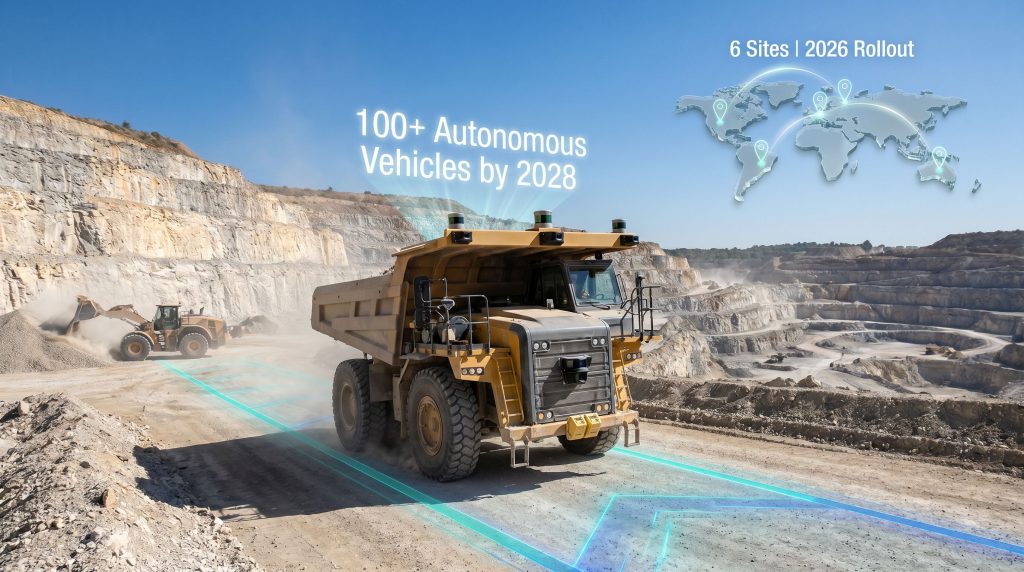
| Global autonomous vehicle target by end of 2028 | 100+ vehicles |
| Equipment categories covered | Autonomous haul trucks (AHS) and wheel loaders |
| Regions included in 2026 rollout | North America, Australia, and Europe |
| First commercial proof site | Lake Bridgeport Quarry, Texas, USA |
To reach the 100+ vehicle target by the end of 2028, the programme would need to bring approximately 35 to 40 additional vehicles online per year following its 2026 milestone. This implied deployment rate is aggressive by quarrying industry standards, though it remains modest when compared to the autonomous fleets already operating in large-scale iron ore operations. The pace will depend heavily on site qualification timelines, technology readiness at each location, and capital allocation decisions across the company's international portfolio.
Two Equipment Categories at the Core of the Rollout
A defining characteristic of this programme is its focus on two distinct equipment types, each presenting a different set of technical challenges and operational implications.
Autonomous Haulage Systems (AHS) applied to haul trucks represent the more established technology pathway in this programme. Haul trucks operating on defined quarry circuits are well-suited to AHS deployment because their routes are generally predictable, the terrain is managed, and the operational environment is relatively controlled compared to underground mining or mixed-traffic industrial sites.
Autonomous wheel loaders represent a more complex and less mature frontier. Unlike haul trucks following prescribed haulage roads, wheel loaders interact directly with material faces, process variable pile geometries, and must navigate dynamic loading zones. The wheel loader trial at a sand and gravel operation in Northern Germany is therefore technically more demanding than the haul truck deployments in North America and Australia, and its results will be closely watched by the industry.
Wheel loader autonomy is considered by many equipment specialists to be a harder problem than haul truck automation. The loading face environment is unstructured, variable, and requires the machine to make real-time judgements about bucket filling, approach angles, and material behaviour in ways that haul truck routing does not.
How the Technology Actually Works in a Quarry Environment
Autonomous heavy equipment deployed in quarrying environments relies on a combination of technologies working in concert. Understanding the architecture helps clarify both the capabilities and the limitations of current systems. Furthermore, broader mining automation trends suggest that this integrated approach is becoming the industry standard for scalable deployment.
The core technology stack for an AHS-equipped haul truck typically includes:
- LiDAR sensors that create detailed three-dimensional maps of the surrounding environment in real time
- Radar systems that provide reliable obstacle detection in conditions of dust, rain, or reduced visibility where optical sensors degrade
- High-definition camera arrays that feed computer vision models trained to identify hazards, personnel, vehicles, and infrastructure
- GPS and localisation systems that maintain precise positional awareness within the site map
- On-board AI processing that integrates all sensor feeds and executes navigation, speed, and braking decisions autonomously
- Fleet management software that coordinates multiple vehicles simultaneously, managing intersection priority, loading queue sequencing, and dump point allocation
The question of where processing occurs, whether on the machine itself or via remote servers, is a significant one. Edge computing approaches, where decisions are made directly on the vehicle hardware, are generally preferred in quarrying environments because they reduce dependence on continuous high-bandwidth connectivity, which cannot always be guaranteed across large, complex sites.
The Technology Partner Ecosystem
One of the less-discussed but strategically important aspects of the Heidelberg Materials autonomous heavy equipment rollout is its multi-vendor technology partner structure. Rather than relying on a single supplier across the entire programme, the company has assembled a portfolio of specialist technology partners.
Pronto AI is central to the autonomous haulage system deployments, providing the software and systems integration that enables haul trucks to operate without drivers across multiple sites. Pronto AI has developed particular expertise in retrofitting autonomy capabilities onto existing vehicle platforms, which aligns directly with the programme's retrofit-first philosophy.
Additional partners including Applied Intuition, Sensmore, and Epiroc contribute complementary elements to the overall autonomy stack. Applied Intuition brings simulation and validation capabilities that allow autonomous vehicle software to be tested extensively before field deployment. Sensmore provides sensor intelligence for complex industrial environments. Epiroc, already a major supplier of mining equipment and automation systems, rounds out the ecosystem with deep experience in heavy mobile equipment.
This multi-vendor approach carries a structural advantage: it reduces single-point-of-failure risk in the technology supply chain while allowing the programme to adopt best-in-class solutions for each component of the system rather than accepting compromises inherent in a single-vendor approach. In addition, data-driven mining operations are increasingly integral to how these multi-partner ecosystems are managed and optimised across sites.
Regional Breakdown: Where the Rollout Is Happening
North America
The programme's foundation is Lake Bridgeport in Texas, the quarry site that served as the initial proof-of-concept for autonomous haulage and validated the operational case for broader deployment. From this base, the North American rollout is extending to additional sites in Indiana and further locations in Texas, scaling the AHS deployment across multiple operational contexts within a familiar regulatory and infrastructure environment.
North American quarry sites offer particular advantages for early-phase AHS rollouts. Haul road infrastructure tends to be well-maintained, site geometries are often conducive to defined routing, and the US regulatory environment, while still evolving for autonomous industrial equipment, has demonstrated a degree of openness to operational trials that has supported early deployment.
Australia
The Australian component of the programme represents the first autonomous haulage deployments in the Asia-Pacific region for Heidelberg Materials, with simultaneous launches at operations in New South Wales and Western Australia.
Western Australia in particular carries contextual significance for autonomous haulage. The Pilbara region has hosted some of the largest AHS deployments in the world, with iron ore operators running fleets of hundreds of autonomous haul trucks across integrated mine systems. The regulatory frameworks, workforce familiarity with autonomous equipment, and infrastructure maturity that have developed around those iron ore programmes represent a meaningful advantage for new autonomous deployments in the Australian market. Quarrying operations in this environment can benefit from a more developed ecosystem of service providers, trained personnel, and regulatory precedent than would exist in many other geographies.
Europe
The Northern German wheel loader trial at a sand and gravel operation is the most technically novel element of the 2026 deployment programme. European regulatory frameworks for autonomous industrial equipment are still developing, with no single harmonised standard yet governing autonomous heavy machinery across EU member states. A successful trial in Germany would establish important operational data and could contribute to shaping how European regulators approach autonomous equipment permitting in the aggregates sector.
The next major ASX story will hit our subscribers first
Comparing the Programme to Autonomous Mining Deployments Elsewhere
Placing the Heidelberg Materials autonomous heavy equipment rollout in industry context reveals both its ambition and the gap it is closing.
| Company / Programme | Equipment Type | Fleet Scale (Approx.) | Primary Commodity | Automation Level |
|---|---|---|---|---|
| Heidelberg Materials (2028 target) | Haul trucks and wheel loaders | 100+ vehicles | Aggregates and quarrying | SAE Level 4 (site-specific) |
| BHP Pilbara AHS | Autonomous haul trucks | 400+ trucks | Iron ore | Full AHS |
| Rio Tinto Mine of the Future | Haul trucks and drills | 130+ trucks | Iron ore | Full AHS |
| Caterpillar Command for Hauling | Multiple OEM platforms | Deployed across multiple operators | Multiple commodities | Level 4 AHS |
The comparison illustrates a structural difference between hard rock mining automation and aggregates sector automation. Iron ore operators have deployed AHS at enormous scale because the economic case is driven by ultra-high-volume, continuous operations where even marginal productivity improvements generate substantial financial returns across very large fleets. Quarrying and aggregates operations typically involve smaller individual fleet sizes, more varied operating conditions, and tighter capital budgets, which is precisely why a retrofit-based, staged deployment model is more practical for the sector than purpose-built autonomous fleet procurement.
The Operational and Commercial Case for Automation
Productivity Mechanisms
Autonomous haul trucks deliver productivity advantages through several interconnected mechanisms that manned operations structurally cannot replicate:
- Elimination of shift changeover downtime, which in conventional operations can account for meaningful lost haulage hours across a 24-hour production cycle
- Removal of fatigue-related performance degradation, which affects cycle times and fuel consumption during late shift periods
- Consistent adherence to optimal haul road speeds and route profiles, reducing tyre wear, fuel consumption, and road maintenance costs
- Continuous operation during conditions that would require manned operator relief or cessation, such as extended night shifts or adverse weather within tolerable sensor performance parameters
Safety Outcomes
Haulage-related incidents represent a disproportionate share of serious injuries across surface mining and quarrying operations globally. Autonomous haulage systems physically remove operators from high-traffic haul corridors, addressing the exposure risk at source rather than through procedural controls alone.
Autonomous systems respond to unexpected obstacles through sensor fusion and pre-programmed response protocols that are not subject to the reaction time variability of human operators. Critically, they do not experience the attention lapses or fatigue-driven delayed responses that contribute to a significant proportion of haul road incidents in conventional operations. Consequently, the AI-powered mining efficiency gains extend well beyond productivity metrics into measurable safety improvements.
Margin Implications
The financial logic of scalable automation becomes more compelling as the number of deployed vehicles increases. Initial technology investment costs are spread across a growing fleet, while the per-unit operational savings in labour, fuel efficiency, maintenance, and reduced incident costs compound with each additional vehicle brought into the programme. This dynamic is what makes the 2028 target of more than 100 vehicles strategically significant: it is the scale at which the programme begins to deliver material operational leverage across the company's cost structure.
What the 2028 Target Signals for the Aggregates Industry
The Heidelberg Materials autonomous heavy equipment rollout matters beyond the company's own operations. As one of the largest aggregates producers globally, the programme functions as a visible proof point that AHS technology is viable and commercially sensible in quarrying environments, not just in the high-volume, purpose-built settings of iron ore mega-mines.
The retrofit-first approach is particularly significant for the broader industry. By demonstrating that existing equipment can be upgraded with autonomous capabilities rather than replaced, the programme lowers the barrier for mid-scale operators who could not justify the capital required to procure purpose-built autonomous fleets. Understanding the wider mining technology benefits of such innovations helps contextualise why the aggregates sector is accelerating its adoption of automation. If the technology partnerships and deployment methodologies developed through this programme become more widely available, the automation of quarrying fleets could accelerate substantially across the sector during the second half of this decade.
Axel Conrads, Chief Technical Officer and Member of the Managing Board of Heidelberg Materials, has described advancing automation and AI as a central pillar of the company's technical excellence strategy, with a dedicated global autonomous deployment team working alongside technology partners to scale the programme in a disciplined, results-driven manner.
The competitive dynamic this creates is worth noting. As more quarrying operators observe the operational and margin outcomes from deployments at this scale, the calculus around automation investment will shift. What begins as a strategic differentiator for early movers tends, over time, to become a baseline operational requirement. The aggregates industry is entering that transition now, and industry analysts tracking the rollout have noted that the pace of adoption is already exceeding earlier forecasts.
Frequently Asked Questions
What is an Autonomous Haulage System and how does it work in a quarry?
An AHS is a technology framework that enables haul trucks to operate without human drivers using a combination of sensors, computer vision, AI decision-making, and fleet management software. In a quarry environment, AHS-equipped trucks follow defined route networks, respond to dynamic obstacles, coordinate with other vehicles, and complete loading and dumping cycles without operator input.
Which technology companies are partnering with Heidelberg Materials on autonomous equipment?
The programme's confirmed technology partners include Pronto AI for autonomous haulage system deployment, as well as Applied Intuition, Sensmore, and Epiroc contributing additional elements of the autonomy stack.
How many autonomous vehicles will Heidelberg Materials operate by 2028?
The company's stated target is more than 100 autonomous vehicles globally by the end of 2028, scaling from approximately 30 vehicles across six sites in 2026.
What is the difference between autonomous haul trucks and autonomous wheel loaders?
Autonomous haul trucks follow defined routes between loading and dumping points and represent a more mature deployment technology. Autonomous wheel loaders must interact with variable material faces and unstructured loading environments, making them technically more complex to automate and representing a less mature area of autonomous equipment development.
Which regions are included in the 2026 autonomous equipment deployment?
The 2026 deployment covers sites in North America (Indiana and Texas), Australia (New South Wales and Western Australia), and Europe (Northern Germany).
This article contains forward-looking statements regarding deployment targets and programme timelines. These reflect plans as announced by Heidelberg Materials and are subject to change based on operational, regulatory, and technology factors. Readers should not treat deployment targets as guaranteed outcomes. For primary source information, refer to Heidelberg Materials' official press releases and Mining Outlook's ongoing coverage at mining-outlook.com.
Want to Track the Mining Companies Driving the Next Wave of Autonomous Technology Adoption?
As automation reshapes surface mining and quarrying operations globally, the companies developing and deploying these technologies represent some of the most compelling investment opportunities on the ASX. Discovery Alert's proprietary Discovery IQ model delivers real-time alerts on significant ASX mineral discoveries, turning complex mining data into actionable insights — start your 14-day free trial today and explore historic discoveries that have generated substantial returns to understand what early positioning in transformative mining trends can mean for your portfolio.