June 6, 2026
The Infrastructure Behind Energy Sovereignty: Why Layered Fuel Reserves Are Becoming Non-Negotiable
Across developed economies with high import dependence, the period following major global supply disruptions has consistently triggered a fundamental rethink of domestic energy buffer strategy. Nations that once relied on market mechanisms alone to absorb supply shocks have gradually shifted toward proactive stockpiling architectures, recognising that the cost of preparedness is fractional compared to the cost of crisis-mode procurement. Australia sits at a critical inflection point in this transition, and the South Australia diesel reserve at Port Bonython represents one of the clearest expressions yet of this recalibration at the sub-national level.
When big ASX news breaks, our subscribers know first
What the Port Bonython Facility Actually Is — and Why It Was Chosen
Port Bonython, located in South Australia's Upper Spencer Gulf, is not a newly constructed strategic asset. It is an existing bulk fuel terminal operated by commercial fuel supplier IOR, with a total storage capacity of up to 81 million litres of diesel. For much of its operational life, a significant portion of that capacity has sat underutilised — a circumstance that made it immediately attractive as the anchor point for a state-level strategic reserve without requiring the construction of new infrastructure.
This decision reflects a core principle of efficient public capital deployment: activate existing assets before committing to greenfield construction. Energy and Mining Minister Tom Koutsantonis characterised the arrangement as a practical opportunity to secure immediate diesel supply and storage using infrastructure that was not being fully used, rather than committing to a capital-heavy build programme from scratch.
The terminal's deepwater port access is equally significant. Deepwater capability allows large-volume maritime vessels carrying refined petroleum products to dock and discharge directly, bypassing the transshipment limitations that affect shallower port facilities. Combined with pipeline connectivity to regional distribution networks, this makes Port Bonython capable of receiving international diesel shipments and routing fuel rapidly into the agricultural and mining corridors of the Eyre Peninsula and Upper Spencer Gulf.
IOR CEO Drew Morland confirmed that Port Bonython's geographic positioning is central to its strategic value, describing the location as vital for supporting the agriculture and mining sectors operating across the Eyre Peninsula and Upper Spencer Gulf region. Proximity to these end-user clusters compresses deployment timeframes and reduces logistical complexity in a crisis scenario.
Structure, Scale, and the Logic of Optionality
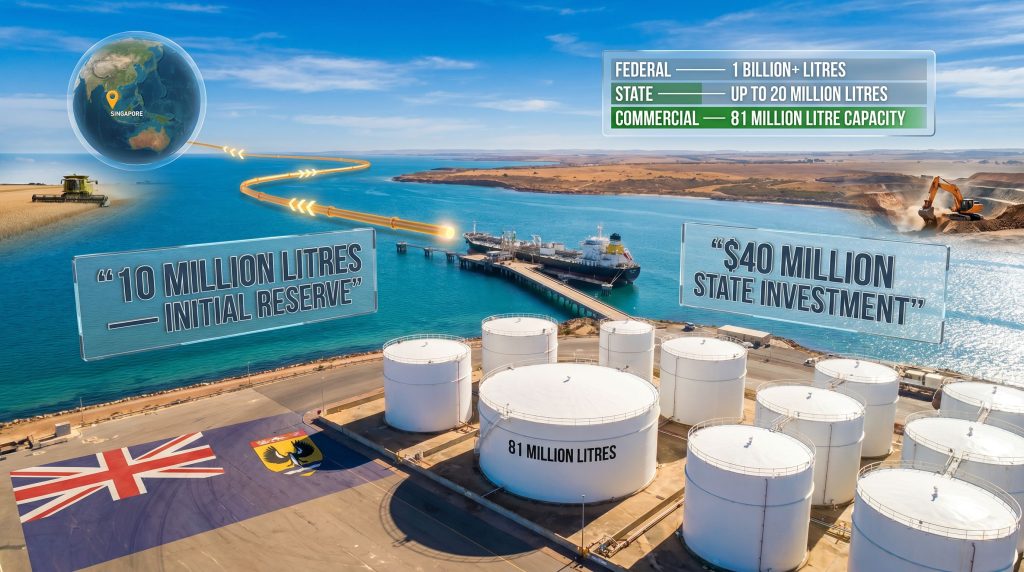
The South Australia diesel reserve at Port Bonython operates on a deliberately staged structure designed to balance immediate preparedness with fiscal prudence. The framework can be summarised as follows:
| Reserve Parameter | Detail |
|---|---|
| Initial diesel volume purchased | 10 million litres |
| Maximum reserve capacity (option) | 20 million litres |
| Total terminal storage capacity (IOR) | Up to 81 million litres |
| State investment commitment | AU$40 million |
| Fuel sourcing origin | Singapore (via deepwater port pipeline) |
| Deployment framework | National Fuel Security Plan |
The two-stage architecture — an immediate 10 million litre purchase with an option to expand to 20 million litres — serves a dual purpose. It establishes a meaningful operational buffer without requiring full capital commitment upfront, while preserving government flexibility to scale the reserve rapidly if the supply environment deteriorates further.
Critically, Premier Peter Malinauskas confirmed that the reserve is structured to add to existing supply rather than divert current stocks from Singapore-based supply chains or compete with federal procurement activity. This additive positioning avoids the perverse outcome of a state reserve inadvertently tightening the very supply market it is designed to protect against.
The fuel supply chain operates through Singapore's refining and distribution infrastructure, with product transported via maritime routes to Port Bonython's deepwater port and discharged through pipeline access into terminal storage. Singapore has long been the primary refined petroleum trading hub for the Asia-Pacific region, and its role as the sourcing origin for this reserve reflects established commercial logistics rather than an improvised arrangement.
Australia's Fuel Import Dependency: Understanding the Structural Vulnerability
To understand why a state-level diesel reserve makes strategic sense, it is necessary to understand the structural fragility of Australia's fuel supply position. Australia's resource and energy exports have long masked the country's deep reliance on imported refined petroleum for the overwhelming majority of its fuel needs. Domestic refining capacity contracted significantly over the preceding decade following the closure of several major refineries, leaving the country structurally dependent on offshore refining hubs — primarily in Asia — for its liquid fuel supply.
This dependency means that supply shocks originating in global petroleum markets transmit rapidly and directly to Australian pump prices and availability. Unlike countries with integrated domestic refining industries that can partially buffer international volatility through domestic production adjustments, Australia's exposure to supply disruptions is near-total for refined products. Furthermore, crude oil volatility trends in 2025 have underscored just how quickly international price movements can translate into domestic supply pressure.
The practical consequence of this structure is that even relatively short-duration disruptions to international supply routes — measured in days rather than weeks — can produce cascading effects across fuel-dependent industries before market rebalancing mechanisms take effect.
The reserve initiative directly responds to ongoing Middle East volatility and global supply chain uncertainty, which have continued to elevate risk premiums across petroleum markets. Indeed, oil price movements driven by geopolitical instability affect Pacific-region fuel supply both through direct production risk at source and through disruption to maritime transit corridors used by tankers serving Asia-Pacific refining hubs.
How Does Global Volatility Affect South Australian Supply Chains?
The trade war impact on oil markets has added a further layer of unpredictability to an already strained global supply picture. Moreover, oil price rally risks stemming from geopolitical escalation and tariff-driven trade disruption have reinforced the case for proactive state-level stockpiling. South Australia's proximity to Asian refining hubs offers some logistical advantage, but does not insulate the state from broader market shocks.
How the Federal and State Layers Work Together
The South Australia diesel reserve at Port Bonython does not operate in isolation. It sits within a multi-tier national fuel security architecture designed to provide overlapping layers of protection at different scales and response timeframes:
| Tier | Entity | Reserve Scale | Status |
|---|---|---|---|
| Federal | Australian Government | 1 billion+ litres (50+ day supply benchmark) | National rollout underway |
| State | South Australian Government | Up to 20 million litres | Operational (10M purchased) |
| Commercial | IOR / Port Bonython Terminal | 81 million litre capacity | Operational |
The federal government's AU$10 billion fuel resilience package is oriented toward establishing a national reserve targeting a 50-day supply benchmark of over 1 billion litres. This is a substantial and long-duration buffer, but its activation timelines and logistical complexity mean it cannot function as a rapid-response mechanism for localised, immediate supply shortfalls.
The state reserve fills precisely this gap. In the period between a supply shock emerging and the federal reserve becoming accessible, a state-level stockpile can be deployed rapidly to critical regional users under the National Fuel Security Plan. Premier Malinauskas explicitly framed the state's investment as complementary to the Commonwealth's programme rather than duplicative of it.
This layered architecture reflects sound emergency management design: each tier addresses a different response timeframe and geographic specificity, with commercial infrastructure providing the operational backbone that both government layers rely on.
The Industries This Reserve Is Designed to Protect
The geographic targeting of the South Australia diesel reserve at Port Bonython is not incidental. The Eyre Peninsula and Upper Spencer Gulf region hosts two of Australia's most diesel-intensive primary industries:
-
Agriculture: Grain and livestock operations across the Eyre Peninsula rely on continuous diesel supply for tractors, harvesters, irrigation pumping, grain handling equipment, and freight logistics. Diesel supply interruptions during planting or harvest windows carry disproportionate consequences — a few days without fuel at the wrong point in a harvest cycle can result in crop losses that take an entire season to recover from.
-
Mining: Extraction operations in the Upper Spencer Gulf region depend on diesel-powered drilling equipment, haulage fleets, processing machinery, and site logistics. Unlike agricultural operations which have some seasonal flexibility, mining operations typically run on continuous production schedules where downtime carries immediate financial costs.
A supply gap of even a few days in these sectors does not produce a linear operational impact. It can trigger cascading failures across integrated production schedules, equipment maintenance windows, and contracted logistics commitments that compound the initial disruption.
The reserve's deployment framework under the National Fuel Security Plan is designed to prioritise critical industry access, ensuring that fuel reaches the highest-consequence users first in a crisis scenario rather than being distributed on a first-come, first-served basis through standard commercial channels.
The next major ASX story will hit our subscribers first
The Economic Arithmetic of a $40 Million Reserve
Framing the AU$40 million investment requires comparing it against the alternative cost scenario: a supply crisis without a state-level reserve. Consider what a sustained diesel supply disruption across South Australia's primary production corridor would generate in economic losses:
-
Agricultural losses: Harvesting delays, spoilage of mature crops, and missed planting windows each carry per-hectare financial impacts that, aggregated across the Eyre Peninsula's grain belt, could rapidly exceed the cost of the reserve itself within a single season.
-
Mining production halts: Diesel-dependent extraction sites operating below capacity for even short periods generate direct revenue losses and potential contractual penalty exposure.
-
Emergency procurement premiums: Without a state reserve, government would be forced into spot-market diesel procurement during a crisis, when supply is constrained and pricing power lies entirely with sellers.
-
Freight network disruption: Rationing cascading from fuel shortfalls affects logistics companies, processing facilities, and distribution networks simultaneously, multiplying the initial supply shock into a broader economic disruption.
Against these potential costs, the AU$40 million reserve investment functions less like an expenditure and more like an insurance premium — with a payout that would dwarf the cost of the policy in a genuine supply crisis scenario. As reported by InDaily, the state government structured the deal specifically to ensure maximum value and deployment flexibility within a defined budget envelope.
Port Bonython as a Multi-Commodity Energy Hub
One dimension of the Port Bonython story that extends beyond diesel is the facility's broader role as an energy infrastructure hub. The site already hosts gas fractionation infrastructure in addition to bulk fuel storage, positioning it as a multi-commodity energy platform capable of supporting both liquid fuels and gas distribution across the Upper Spencer Gulf region.
This multi-commodity character is relevant context for understanding the South Australia diesel reserve at Port Bonython within a broader strategic infrastructure framework. The South Australian government has simultaneously been developing its Strategic Gas Reserve, under which Santos will supply 20 petajoules of gas per year for 10 years from 2030 — equivalent to roughly one-third of the state's total annual gas consumption across residential, commercial, and industrial users.
The parallel development of diesel and gas reserves at or near the same precinct reflects a deliberate strategy of consolidating South Australia's energy security infrastructure around existing deepwater port and pipeline assets, rather than distributing storage across multiple lower-capacity sites. This concentration approach offers operational efficiency, reduced monitoring costs, and faster deployment logistics. Petroleum Australia has noted that the Port Bonython facility is well positioned to serve as a long-term anchor for the state's evolving energy resilience strategy.
Is the Port Bonython Model Replicable Across Australia?
The structural logic underpinning the Port Bonython reserve carries lessons that extend well beyond a single state. The approach combines three elements that make it practically replicable:
-
Commercial partnership framework: Rather than building government-owned storage infrastructure, the model uses a contracted relationship with an existing bulk fuel operator, transferring operational complexity to a specialist while retaining government control over deployment decisions.
-
Activation of underutilised capacity: By identifying existing infrastructure operating below its storage potential, the approach avoids the capital intensity and construction timelines of new builds.
-
Integration with national frameworks: Alignment with the National Fuel Security Plan ensures the state reserve functions as a component of a coherent national architecture rather than an isolated initiative.
States with significant agriculture, mining, or remote community exposure to supply chain vulnerabilities face structurally similar risks to South Australia. The Port Bonython model offers a replicable template that avoids the capital intensity of building new storage assets from scratch, while delivering meaningful fuel security at a regional scale.
Western Australia, Queensland, and the Northern Territory all host resource-intensive industries with similar diesel dependency profiles. Whether comparable underutilised bulk fuel terminal capacity exists in those jurisdictions to replicate this approach is a question for state-level infrastructure assessments, but the commercial and governance framework South Australia has developed is transferable.
Frequently Asked Questions: South Australia Diesel Reserve at Port Bonython
What is the South Australia diesel reserve at Port Bonython?
It is a state government strategic fuel stockpile established at the IOR bulk fuel terminal at Port Bonython in the Upper Spencer Gulf, designed to provide a diesel buffer for South Australia's primary industries during supply disruptions.
How much diesel is being stored and at what cost?
An initial 10 million litres has been purchased, with an option to expand to 20 million litres. The total state government investment commitment is AU$40 million.
Who supplies the diesel and where does it come from?
Diesel is sourced from Singapore through established Asia-Pacific supply chains and transported via maritime routes to Port Bonython's deepwater port facility.
How does the state reserve relate to the federal fuel security package?
The state reserve is complementary to the federal government's AU$10 billion fuel resilience package, which targets a 50-plus day national supply benchmark. The state reserve operates as a faster-response, regionally specific buffer during the period between a supply disruption and federal reserve activation.
Which industries will have priority access during a supply crisis?
The reserve is specifically designed to protect South Australia's primary production sector, with agriculture across the Eyre Peninsula and mining operations in the Upper Spencer Gulf identified as priority beneficiaries.
Can the reserve volume be expanded beyond 20 million litres?
The current agreement provides for a maximum of 20 million litres under the government's option structure, within a total terminal capacity of up to 81 million litres at Port Bonython.
Is Port Bonython already used for other energy infrastructure?
Yes. Port Bonython hosts gas fractionation infrastructure in addition to bulk fuel storage, and is associated with the South Australian Strategic Gas Reserve involving Santos gas supply commitments from 2030.
From Reactive to Proactive: What This Reserve Signals About Australian Energy Policy
The establishment of the South Australia diesel reserve at Port Bonython is not simply an operational logistics decision. It represents a meaningful shift in how state governments are approaching energy sovereignty — moving from an assumption that markets will reliably self-correct supply disruptions toward a recognition that structural import dependency requires active buffer management.
The AU$40 million investment, the staged optionality structure, the commercial partnership model, and the integration with federal frameworks all reflect a mature policy architecture rather than an ad hoc crisis response. South Australia is constructing a fuel security system in layers, with the diesel reserve and the gas reserve operating as complementary components of a broader energy resilience strategy anchored at Port Bonython.
As global supply chains remain structurally exposed to geopolitical volatility, climate-related logistics disruptions, and demand concentration risks in Asian refining hubs, the calculus for state-level fuel security investment has shifted decisively. The question for other Australian states is no longer whether to build comparable reserves, but how quickly existing infrastructure can be identified and activated to replicate the Port Bonython model.
This article contains forward-looking assessments and scenario-based analysis. Projections regarding supply disruption costs, reserve deployment outcomes, and policy replication are indicative and speculative in nature. Readers should not treat this content as financial or investment advice.
Want to Invest in the Resources Driving Australia's Energy Security Story?
Discovery Alert's proprietary Discovery IQ model delivers real-time alerts on significant ASX mineral discoveries across the commodities — including those underpinning Australia's critical energy and resources infrastructure — instantly empowering subscribers to identify actionable opportunities ahead of the broader market. Explore Discovery Alert's dedicated discoveries page to understand why major mineral discoveries can generate substantial returns, and begin your 14-day free trial today to position yourself ahead of the market.