
May 13, 2026
The Engineering Logic Behind Africa's Next Major Bauxite Export Corridor
Most conversations about mining project viability centre on geology, commodity pricing, and capital availability. Yet the factor that most reliably separates a mine that produces from one that merely promises is something far more prosaic: the physical infrastructure required to move ore from the ground to a vessel at a working port. In heavy mineral export operations, rail transport architecture is not a supporting consideration. It is the backbone of commercial viability itself.
This reality sits at the heart of the Cameroon Minim Martap bauxite project locomotives from China story that has been developing throughout 2025 and 2026. The project, operated by Camalco, the Cameroonian subsidiary of ASX-listed Canyon Resources Limited, is targeting an ambitious 10 million tonnes per annum (MTPA) at full production capacity. However, achieving that output requires solving a complex, multi-layered logistics challenge across an 800-kilometre rail corridor connecting the Adamaoua region mine site to Douala Port on the Atlantic coast.
What is now unfolding at Minim Martap is a textbook example of how large-scale mining projects must engineer their transport architecture before the first commercial tonne moves. The arrival of the first locomotive fleet is not simply a procurement milestone. It is the physical manifestation of a project transitioning from a financing and contracting phase into an operational one.
When big ASX news breaks, our subscribers know first
What Makes the Minim Martap Bauxite Project Strategically Significant?
Scale, Grade, and Positioning in the Global Bauxite Supply Chain
Minim Martap is positioned to become Cameroon's first major commercial bauxite mining operation. With an estimated reserve base exceeding 1.1 billion tonnes, it represents a multi-decade supply source capable of underpinning long-term offtake agreements with alumina refiners across Asia and Europe. Its strategic significance is amplified by timing. Shifts in global bauxite supply dynamics have created a genuine opening for new Atlantic-facing producers.
| Project Parameter | Detail |
|---|---|
| Estimated Bauxite Reserves | Exceeding 1.1 billion tonnes |
| Long-Term Annual Production Target | 10 million tonnes (full ramp-up) |
| Initial Annual Capacity | Approximately 1.2 million tonnes |
| Rail Corridor Distance | Approximately 800 kilometres |
| Export Port | Douala Port, Cameroon |
| First Commercial Shipments | Targeted late Q3 2026 |
The project's initial capital threshold, operating below USD $100 million for phase-one deployment, distinguishes it from many African mineral export projects that require multi-billion-dollar commitments before a single tonne is exported. This relatively lean entry model reduces the breakeven threshold and compresses the timeline from financing decision to first revenue.
How Does Minim Martap Compare to Other African Bauxite Operations?
Guinea currently dominates African bauxite export volumes, but its position as the continent's primary supplier is facing mounting structural uncertainty. Discussions around potential Guinea export caps have intensified pressure on the bauxite and alumina market, creating a window for alternative supply sources to establish long-term relationships with alumina refiners seeking supply chain resilience.
- Guinea's bauxite export sector faces potential regulatory constraints that could disrupt established shipping routes and volumes
- Cameroon's regulatory environment, whilst complex, has a clearer framework for long-term offtake structuring compared to some West African competitors
- Indonesia and Australia remain dominant global suppliers, but their geographic orientation toward Asian markets leaves Atlantic-facing refiners exposed to supply concentration risk
- Minim Martap's reserve scale and rail-connected logistics design give it structural cost advantages that purely road-haulage operations cannot replicate at comparable volumes
Bauxite ore is not a homogeneous commodity. Alumina content, reactive silica percentages, and moisture levels determine the ore's commercial value at the refinery gate. Projects with superior ore quality can command pricing premiums and are often preferred for long-term offtake agreements where refinery feed consistency matters.
How Is the Rail Transport System Engineered for a 10 MTPA Bauxite Operation?
Breaking Down the Rolling Stock Architecture
The rolling stock programme underpinning Minim Martap is a deliberately sequenced, multi-vendor procurement strategy designed to scale in parallel with production ramp-up rather than requiring full capital deployment before first ore moves. Furthermore, this approach reflects lessons learned from comparable leading bauxite mines that have encountered costly transport bottlenecks.
Locomotive Fleet: CRRC Corporation Diesel Locomotive Supply
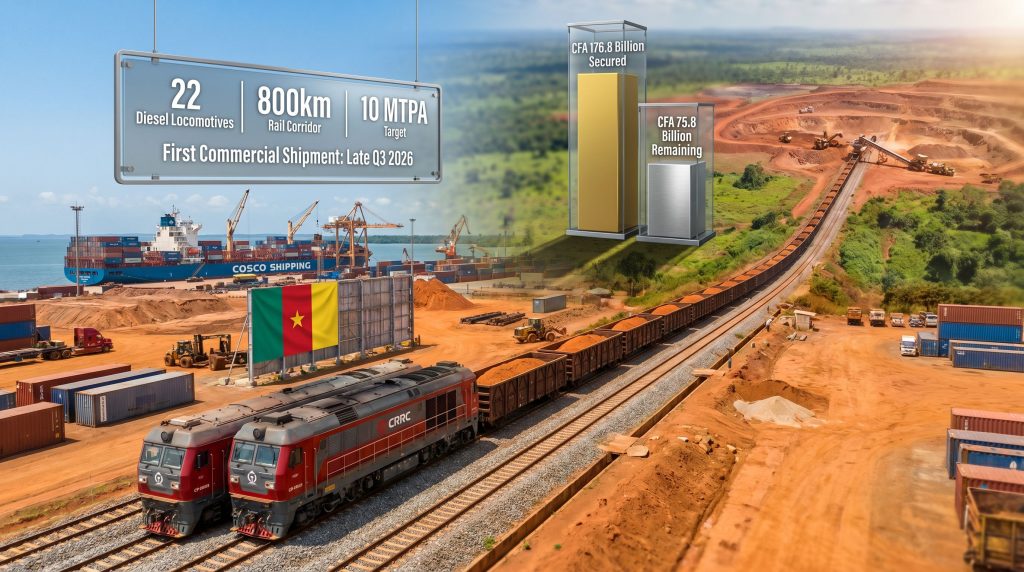
The locomotive agreement with CRRC Corporation, one of China's largest rolling stock manufacturers, covers a total fleet of 22 diesel locomotives. This fleet has been sized for the throughput demands of a full-capacity 10 MTPA operation, but delivery is structured to align with progressive production ramp-up requirements. Confirmation of the locomotive shipment has marked a pivotal moment in the project's development trajectory.
Delivery Sequencing (as of Q2 2026):
| Delivery Phase | Units | Timing |
|---|---|---|
| First shipment (initial batch) | 7 locomotives | Late Q2 2026 (in transit to Douala Port) |
| Remaining units | 15 locomotives | Q3 2026 |
| Total fleet under agreement | 22 locomotives | Fully delivered by late 2026 |
The shipment was confirmed by Cosco Shipping, a major Chinese state-owned logistics operator, which loaded 12 locomotives bound for African destinations, with seven of those units allocated to the Cameroon Minim Martap bauxite project locomotives from China consignment. This confirmation placed the rolling stock in active ocean transit to Douala Port.
It is worth noting that manufacturing lead times for heavy diesel locomotives from Chinese facilities are typically substantial, often ranging from 12 to 24 months depending on specification complexity and factory scheduling. The delays attributed to extended manufacturing timelines and Chinese New Year production downtime are consistent with industry norms for bespoke rolling stock orders at this scale. The original January 2026 delivery schedule was adjusted, but the project's first commercial shipment target in late Q3 2026 is reported as remaining achievable.
Freight Wagon Fleet: Texmaco Rail and Engineering
Complementing the Chinese locomotive fleet, the wagon programme is sourced from Texmaco Rail and Engineering, an Indian manufacturer with an established track record in heavy freight wagon production for mining and bulk commodity operations.
- Initial order: 560 open freight wagons
- Expansion provision: An additional 1,040 wagons contracted over five years
- Total committed fleet: 1,600 units across the programme lifecycle
Open-top freight wagons are the industry standard for bulk mineral transport. Their design accommodates efficient loading via conveyor systems or direct dump loading at the mine site, and their open configuration allows for rapid discharge at port stockpile facilities without the mechanical complexity of enclosed wagon designs.
At full capacity, a train consist carrying bauxite over 800 kilometres requires wagons engineered to handle repeated heavy axle loading cycles with minimal maintenance intervention, as unplanned workshop time directly erodes haulage capacity. The deliberate split between Chinese locomotive procurement and Indian wagon sourcing, consequently, reflects a practical diversification of the supply chain, reducing dependence on any single manufacturing geography for critical rolling stock components.
What Is the Total Capital Commitment to Rail Infrastructure at Minim Martap?
Dissecting the CFA 252.6 Billion Rail Equipment Budget
The financial architecture of the transport infrastructure programme reveals the degree of institutional conviction behind this project's operational ambitions. The rail equipment budget is one of the largest pre-production logistics investment commitments in Central African mining project history.
| Budget Component | Amount (CFA Billion) | USD Approximate |
|---|---|---|
| Total rail equipment budget | CFA 252.6 billion | USD 433 million |
| Capital secured (Camalco and Camrail) | CFA 176.8 billion | USD 303 million |
| Remaining to be committed | CFA 75.8 billion | USD 130 million |
The headline figure is that approximately 70% of the total rail equipment budget has been secured before commercial exports have commenced. In mining project finance, this degree of front-loaded capital commitment is analytically significant. It reduces the risk profile of the project's transport phase and provides prospective offtake partners with tangible evidence that logistics infrastructure will be operational to support contracted delivery schedules.
The 70% pre-export funding achievement is an important signal to market participants. When a project can demonstrate that the majority of its logistics capital is committed before first revenue, it substantially narrows the range of scenarios in which transport constraints delay commercial shipments.
Understanding the capital structure also requires recognising the dual-party commitment. Both Camalco (the project developer) and Camrail (the rail operator managing Cameroon's national railway network) have co-contributed to the secured CFA 176.8 billion. This joint commitment creates shared operational accountability for transport infrastructure performance, an arrangement that aligns incentives across the logistics chain in a way that purely contractor-operated rail systems sometimes cannot.
Beyond Rolling Stock: What Infrastructure Work Is Required Before First Shipment?
The Three-Layer Infrastructure Programme
The Minim Martap transport architecture requires simultaneous progress across three distinct infrastructure layers, each with its own engineering scope, contractor requirements, and critical path dependencies. In addition, Canyon Resources has developed a comprehensive mine-to-port logistics strategy that ties these layers together into a cohesive operational framework.
1. Mine-to-Network Rail Connection
Canyon Resources, through Camalco, is responsible for financing and constructing the connection link between the mine site in the Adamaoua region and Cameroon's existing national rail network. This is enabling infrastructure in the truest sense. Without it, the 22 locomotives and 1,600 wagons have no operational pathway. The construction of this connecting spur involves terrain challenges typical of the Central African interior, including gradient management, drainage engineering, and environmental clearance requirements.
2. National Rail Network Rehabilitation
Several sections of Cameroon's existing railway infrastructure require rehabilitation and upgrade to handle the increased axle loads and continuous throughput volumes associated with a 10 MTPA bauxite operation. This is a critical distinction often overlooked in project analysis.
Standard passenger and mixed-freight rail infrastructure operates under fundamentally different design parameters than heavy-haul mineral export railways. Key differences include:
- Axle load ratings: Heavy mineral export trains typically impose axle loads of 25 to 32.5 tonnes, significantly exceeding standard mixed-traffic railway designs
- Track geometry standards: Sustained high-speed heavy loading demands tighter tolerances on rail alignment, cross-level, and gauge consistency
- Ballast depth and sleeper spacing: Heavy-haul operations require deeper, higher-quality ballast and closer sleeper spacing to distribute load effectively
- Bridge and culvert capacity: Existing structures may require strengthening or replacement to safely accommodate loaded mineral trains
3. Inland Rail Facility and Douala Port Upgrades
The port-side infrastructure programme is progressing in parallel with rolling stock delivery:
- IRF tracklaying has commenced, with engineering designs finalised
- Switchgear, tracks, and sleepers were scheduled for delivery by May 2026
- Bulk earthworks at Douala Port are underway, establishing the physical footprint for ore stockpile operations
- Port dredging received approval for a January 2026 start, enabling vessels of appropriate draft to berth at the export terminal
The dredging approval is a particularly important milestone. Bauxite is typically exported on Handymax or Panamax-class bulk carriers. Adequate port depth to accommodate these vessel classes without tidal constraints is a prerequisite for efficient export scheduling and freight rate competitiveness.
What Is the Operational Sequencing Toward First Commercial Shipment?
A Phase-by-Phase Ramp-Up Timeline
The Minim Martap development team is running a parallel-track strategy across mining, rail, and port operations simultaneously rather than sequencing each phase consecutively. This approach compresses the overall timeline to first revenue but increases coordination complexity and raises the cost of any single-point delay cascading through multiple workstreams. For context, the bauxite production outlook across comparable operations underscores just how critical this parallel execution model is.
Q1 2026:  Surface miner commissioning
          Maiden ore road haulage commences
          Port ore storage operations begin

Q2 2026:  First 7 locomotives arrive at Douala Port
          IRF tracklaying reaches completion

July 2026: Initial 560 freight wagons delivered

Q3 2026:  Remaining 15 locomotives delivered
          Trial bauxite shipments commence

Late Q3 2026: First commercial bauxite export shipment targeted
Canyon Resources CEO Peter Secker has confirmed that despite the minor schedule adjustments resulting from CRRC Corporation's manufacturing delays, the overall Q3 2026 first commercial shipment timeline remains achievable. The parallel development strategy is specifically designed to absorb moderate supply chain disruptions at the component level without triggering cascading delays across the broader programme.
This is a mature project management approach, and its success depends on maintaining adequate float in each workstream. With locomotives now in active transit, the critical path uncertainty in rolling stock delivery has been substantially reduced.
The next major ASX story will hit our subscribers first
Why Does the Locomotive Arrival Represent a Genuine Project Phase Transition?
From Contracts and Financing to Physical Operations
In mining project development, experienced industry observers recognise a well-defined gap between two phases: the announcement phase, where financing is secured and contracts are signed, and the operational phase, where physical assets are deployed and ore begins moving. Many projects stall permanently in the space between these two states, held back by contractor delays, regulatory complications, or capital constraints.
The physical arrival of the Cameroon Minim Martap bauxite project locomotives from China at Douala Port carries analytical weight for several reasons:
- Irreversibility of deployment. Rolling stock delivered to Cameroon cannot be easily or cheaply redeployed to another project. This signals committed operational intent that is qualitatively different from a signed contract or announced financing arrangement.
- Supply chain activation. Port logistics teams, railway maintenance crews, and mine-site operations personnel must now coordinate in real time around physical assets rather than theoretical schedules.
- Offtake partner confidence. Tangible asset deployment reduces the perceived execution risk that prospective offtake partners and commodity traders assess when considering whether to commit to long-term purchase agreements.
- Regulatory and contractual triggers. Physical presence of rolling stock in-country may activate specific contractual obligations and government reporting requirements under Cameroon's mining framework that advance the project toward formal commercial status.
In project finance, the arrival of major capital equipment in-country is often used as a draw-down trigger for project finance facilities. The locomotive shipment may represent more than a logistics milestone; it may activate financial mechanisms that further de-risk the path to first production.
The Broader Significance: What Minim Martap Means for the Global Bauxite Supply Chain
Structural Implications for Aluminium Feedstock Markets
Bauxite occupies the foundation of the global aluminium supply chain. Every tonne of aluminium metal requires approximately four to five tonnes of bauxite, processed first into alumina and then smelted into aluminium. The reliability and geographic diversity of bauxite supply is therefore a first-order concern for aluminium producers worldwide.
Several structural dynamics make the emergence of Minim Martap as a commercial bauxite producer particularly significant in the current market environment. Furthermore, Canyon Resources' recent infrastructure investments highlight the depth of commitment underpinning the project's long-term ambitions:
- Guinea's regulatory uncertainty is creating measurable anxiety among bauxite buyers. Any meaningful export cap or shipping disruption from Guinea would remove a substantial volume from a market that has become structurally dependent on West African supply. Cameroon offers geographic and political diversification within the African bauxite corridor.
- China's dominant position in alumina refining means that Chinese industrial buyers have strong incentives to secure long-term bauxite supply agreements from jurisdictions that are accessible, reliable, and not subject to the same export cap risks as Guinea. Minim Martap's rail-to-port logistics design and its reserve longevity make it an attractive candidate for Chinese offtake.
- The 1.1 billion tonne reserve base positions Minim Martap as a potential multi-decade supply anchor. In an industry where alumina refineries are designed to operate for 30 to 40 years, the ability to sign long-duration supply agreements against a verified reserve base is commercially compelling.
- The Chinese equipment supply relationship involving CRRC locomotives and Cosco Shipping logistics is consistent with broader patterns of Chinese industrial engagement in African resource development. This creates an interconnected supply chain dynamic that has implications for geopolitical supply security analysis.
| Consideration | Implication for Buyers |
|---|---|
| Guinea export cap risk | Diversification demand for Atlantic-facing bauxite suppliers |
| Minim Martap reserve longevity | Long-duration offtake agreement feasibility |
| Rail-to-port logistics certainty | Consistent monthly shipping schedules achievable |
| Low initial capex model | Faster path to first delivery than capital-heavy competitors |
| Cameroon's regulatory framework | Clearer long-term operating environment than some regional peers |
Key Takeaways: Minim Martap Rail Infrastructure at a Glance
- 22 diesel locomotives contracted from CRRC Corporation; first 7 units in active transit to Douala Port via Cosco Shipping
- 1,600 freight wagons committed across the programme lifecycle from Texmaco Rail and Engineering
- USD 303 million of the USD 433 million total rail budget already secured, representing approximately 70% pre-production funding achievement
- 800-kilometre rail corridor connecting the Adamaoua region mine to Douala Port
- 10 MTPA long-term production target with initial capacity of approximately 1.2 MTPA
- First commercial shipment targeted for late Q3 2026, with trial shipments from September 2026
- Project has formally transitioned from the financing and contracting phase into the active operational logistics phase
Frequently Asked Questions: Minim Martap Bauxite Project Locomotives and Rail Operations
How Many Locomotives Is the Minim Martap Project Receiving from China?
The total locomotive agreement with CRRC Corporation covers 22 diesel locomotives. The first batch of seven units is currently in transit to Douala Port, with the remaining 15 units scheduled for delivery in Q3 2026.
Who Manufactures the Locomotives for the Minim Martap Project?
The locomotives are manufactured by CRRC Corporation, a major Chinese rolling stock manufacturer. Logistics for the current shipment are managed by Cosco Shipping, a Chinese state-owned logistics enterprise, which loaded 12 locomotives bound for African destinations as part of a broader consignment.
What Is the Total Rail Infrastructure Budget for Minim Martap?
The total rail equipment budget is approximately CFA 252.6 billion, equivalent to around USD 433 million. Of this, CFA 176.8 billion (approximately USD 303 million) has already been secured through combined commitments from Camalco and rail operator Camrail.
When Is the First Commercial Bauxite Shipment from Minim Martap Expected?
The project is targeting its first commercial bauxite export shipment in late Q3 2026, with trial shipments anticipated from approximately September 2026 onward.
Who Supplies the Freight Wagons for the Project?
Freight wagons are sourced from Texmaco Rail and Engineering, an Indian manufacturer. The initial order covers 560 open freight wagons, with a contractual provision for an additional 1,040 wagons over the following five years, bringing the total committed fleet to 1,600 units.
What Is Camalco's Relationship to Canyon Resources?
Camalco is the Cameroonian-registered subsidiary of Canyon Resources Limited, an Australian mining company listed on the ASX. Camalco holds the operating rights to the Minim Martap bauxite deposit in Cameroon's Adamaoua region.
Why Are Locomotives Arriving Before Ore Has Been Mined?
The parallel-track development strategy deliberately sequences rolling stock procurement ahead of first ore production to ensure transport infrastructure is ready to absorb initial production volumes without creating bottlenecks. Waiting for proven ore output before ordering rolling stock would introduce a delay of 18 to 24 months between first mine production and first commercial export.
This article contains forward-looking statements and projections regarding the Minim Martap bauxite project's development timeline, production targets, and commercial milestones. These projections are based on information available as of the date of publication and are subject to risks, uncertainties, and factors that could cause actual outcomes to differ materially from those anticipated. Readers should conduct independent due diligence and not rely solely on this article for investment decision-making purposes.
Ready to Identify the Next Major Mineral Discovery Before the Market Does?
Discovery Alert's proprietary Discovery IQ model scans ASX announcements in real time, instantly alerting subscribers to significant mineral discoveries — from bauxite to battery metals — so actionable opportunities are never missed. Explore historic discoveries and their returns to understand what early positioning in transformative projects can mean for a portfolio, then begin a 14-day free trial at Discovery Alert to gain a genuine market-leading edge.