July 29, 2026
The Uncomfortable Truth About Why Mining Electrification Economics Are Overtaking ESG
For most of the past decade, the dominant narrative around mining electrification centred on environmental obligation. Decarbonisation targets, ESG reporting frameworks, and investor pressure were treated as the primary forces pushing the industry toward battery-electric vehicles. That framing, while not entirely wrong, consistently understated a more commercially compelling argument hiding beneath it.
The real catalyst for the mining electrification journey has never been purely environmental. It has been ventilation. And once that connection becomes clear, the economics of underground mine electrification stop looking like a sustainability trade-off and start looking like a straightforward operational investment.
That shift in framing is now reshaping how mine operators, OEMs, and investors evaluate the entire technology transition.
When big ASX news breaks, our subscribers know first
Why Ventilation Is the Engine Behind Underground Electrification Economics
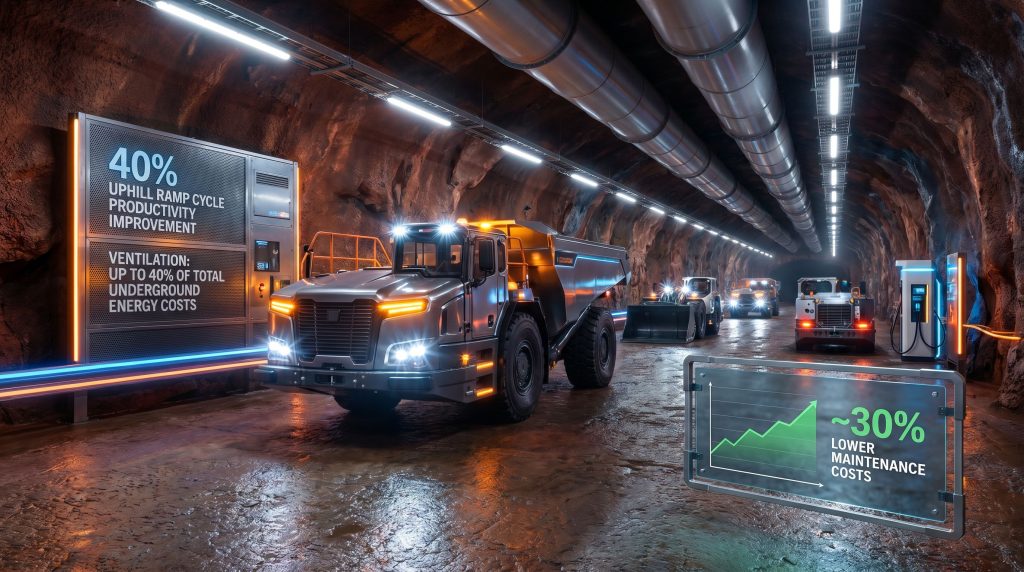
Ventilation systems in underground mining operations can account for up to 40% of total underground energy costs. Every diesel engine operating underground generates substantial heat and particulate emissions that must be actively managed through continuous airflow. As mines extend deeper, the infrastructure required to maintain safe working conditions becomes progressively more expensive and physically difficult to expand.
Battery-electric vehicles eliminate that thermal and emissions burden entirely. The removal of diesel combustion from underground environments allows mines to recalibrate their ventilation requirements, reducing energy consumption in one of their most capital-intensive infrastructure systems.
This is not a minor operational tweak. At depth, the compounding effect of ventilation savings creates a widening cost differential between diesel and electric fleets that strengthens with each additional meter of mine development. The deeper an operation goes, the more compelling the economics of electrification become.
Martin Pichette, Mine Manager at Eldorado Gold's Lamaque Complex in Québec, captured this dynamic clearly at The Electric Mine 2026 conference in Lisbon. His operational assessment was that the primary motivation for transitioning to battery-electric equipment was the underlying economics of deeper mining, with environmental benefits functioning as a secondary reinforcement rather than the primary driver. He also noted that without a credible economic case, widespread adoption across the industry would remain uncertain regardless of decarbonisation goals.
That perspective is now increasingly common among mine operators evaluating the mining electrification journey from a commercial standpoint. Furthermore, the broader push toward electrification and decarbonisation across the sector is reinforcing these economic signals at every level of operational planning.
Productivity Gains Are Rewriting the Business Case Entirely
Beyond ventilation savings, the productivity performance of battery-electric haul trucks in underground environments has become one of the most significant revaluation events in the sector's recent history.
Electric motors deliver peak torque instantaneously across their entire operating range, a characteristic that translates directly into superior ramp performance. Diesel engines, by contrast, experience progressive efficiency losses as operating depth increases due to reduced combustion air density and thermal management requirements.
At Eldorado Gold's Lamaque Complex, battery-electric haul trucks have demonstrated uphill ramp cycle productivity improvements of approximately 40% compared with equivalent diesel units. That figure does not represent a marginal improvement. It fundamentally restructures the return-on-investment calculation for underground mine operators considering electrification.
Pichette noted during his presentation at The Electric Mine 2026 that operators at the site have responded enthusiastically to the equipment, actively seeking opportunities to operate the battery-electric trucks. Workforce acceptance, long cited as a potential barrier to adoption, appears to be resolving itself as operators experience reduced noise levels, improved air quality, and more responsive vehicle performance firsthand.
Underground Electrification: Key Operational Comparisons
| Factor | Diesel Operations | Battery-Electric Operations |
|---|---|---|
| Underground air quality | Diesel particulates present | Emission-free environment |
| Noise levels | High | Significantly reduced |
| Uphill ramp productivity | Baseline | ~40% improvement reported |
| Maintenance cost comparison | Baseline | ~30% lower in integrated deployments |
| Ventilation energy requirement | High (up to 40% of total underground energy) | Reduced following diesel elimination |
| Operator preference trends | Neutral to resistant | Increasingly preferred |
What a Fully Integrated Electric Mine Actually Requires
One of the most consequential lessons from early-stage mining electrification deployments is that treating battery-electric vehicles as direct diesel replacements consistently creates operational bottlenecks. The equipment change is the most visible part of the transition, but it represents only a fraction of the systems redesign required for successful integration.
Mark Ryan of Normet, presenting at The Electric Mine 2026, described site assessment as the largest single effort in the entire electrification process. Understanding infrastructure constraints, power availability, charging cycle requirements, and ventilation reconfiguration needs before deploying equipment is what separates successful full-scale deployments from troubled commissioning periods.
At Rio Tinto's Oyu Tolgoi underground operation in Mongolia, Normet has supported the deployment of what is described as the world's largest integrated underground battery-electric logistics fleet. The operation runs 65 machines across logistics, charging, and spraying applications, supported by dedicated charging infrastructure and continuous live monitoring systems. Maintenance costs across this fleet have been reduced by approximately 30% relative to the diesel equipment it replaced.
The Oyu Tolgoi deployment illustrates what operational maturity on the mining electrification journey actually looks like at scale. The key is not simply the equipment count but the integrated systems architecture surrounding it.
The Five Operational Pillars of Mine Electrification Integration
-
Energy infrastructure planning – grid capacity assessment, substation upgrades, and power distribution network design. Grid expansions at large operations can exceed $45 million in capital cost and represent one of the most significant early investment decisions in the transition.
-
Charging strategy design – static, dynamic, and battery-swap configurations must be matched to the specific haul cycle profiles of each operation. A single charging architecture rarely optimises across all operational zones.
-
Ventilation system redesign – recalibrated airflow requirements based on reduced diesel heat and emissions loading. This is a mine planning and engineering task, not simply a hardware modification.
-
Digital monitoring and fleet management – real-time data capture across charging behaviour, energy consumption, regenerative braking, and equipment utilisation. Battery-electric fleets generate substantial operational data that fundamentally changes how underground operations can be managed.
-
Workforce transition planning – retraining programs, operator familiarisation, and maintenance capability development for electric drivetrain systems.
The lesson from operations that have successfully integrated BEV fleets is consistent: electrification requires simultaneous redesign of the systems surrounding the equipment, not sequential changes made after deployment. Early adopters that treated it as a parallel rather than sequential challenge moved through commissioning significantly faster.
How Technology Pathways Are Diverging Across Operation Types
One of the more significant strategic insights emerging from the broader mining electrification journey is that fully battery-electric fleets are not the only viable pathway, and may not be the optimal solution for every operation type or mine design.
The Electric Mine 2026 featured extensive discussion from OEMs including ABB, BluVein, Caterpillar, Siemens, Epiroc, and Sandvik around dynamic charging, trolley-assisted haulage, and hybrid systems as complementary approaches to full electrification. In addition, electric vehicles in mining continue to evolve rapidly, with new configurations entering operational trials across multiple geographies.
Modular Electrification Technology Pathways
| Technology Pathway | Best-Fit Scenario | Key Advantage |
|---|---|---|
| Full battery-electric fleet | Established underground operations with stable power supply | Maximum emissions reduction, full ventilation savings |
| Diesel-electric hybrid | Brownfield operations with limited grid capacity | Lower transition risk, familiar drivetrain components |
| Trolley-assisted haulage | Long-haul surface or deep ramp applications | Reduced battery size requirements, continuous power draw |
| Battery auto-swap systems | High-utilisation underground fleets on extended haul cycles | Continuous operations without charging downtime |
Trolley-assisted haulage systems deserve particular attention because their renewed prominence at industry forums reflects a practical engineering response to a real constraint. As haul distances increase and truck payload capacities grow, onboard battery requirements scale dramatically. Trolley infrastructure allows haul trucks to draw live power from overhead lines on ramps, reducing battery cycling and lowering the total energy storage requirement per vehicle.
Battery auto-swap systems address a different constraint: operational continuity on long haul cycles. Rather than taking equipment out of the production cycle for charging, auto-swap replaces depleted battery packs with fully charged units, matching replenishment rates to consumption profiles. This approach is particularly effective on haul cycles involving 13-kilometre routes with 15% ramps, where continuous operation is critical to productivity targets. Auto-swap systems also distribute energy demand more evenly across the grid connection, reducing peak load requirements.
Caterpillar and Sandvik both outlined modular transition strategies at the conference, acknowledging that diesel-electric and hybrid systems can serve as stepping stones that familiarise workforces with electric drivetrains and reduce operational risk during the transition period. This pragmatic acknowledgement from major OEMs represents a notable evolution from earlier positions that frequently emphasised full BEV conversion as the singular target state.
Peter Wallin of Boliden, one of the mining industry's earliest advocates for electrification, reinforced this flexibility argument at The Electric Mine 2026. The industry consensus aligning around his position is that technology pathway selection must remain site-specific, with infrastructure readiness, mine design, depth, and haul cycle geometry all influencing which combination of technologies delivers the best operational and economic outcome.
Surface Mining's Harder Economic Equation
The asymmetry between underground and surface mining electrification economics is one of the less-discussed but genuinely important dynamics in the sector's transition narrative.
Underground operations possess a compounding financial incentive for electrification that open-pit environments simply do not share: ventilation savings. The removal of diesel heat and emissions from enclosed underground workings directly reduces one of the largest ongoing cost centres in underground operations.
Surface mines must build their electrification business cases almost entirely through fuel savings, productivity improvement, and energy efficiency gains. Without the ventilation multiplier, the capital investment required for full fleet electrification must be justified over longer operational timeframes and requires larger productivity differentials to achieve comparable returns.
This distinction was clearly reflected in the programming at The Electric Mine 2026. Underground sessions focused predominantly on operational deployment, fleet scaling, and productivity optimisation. Surface mining discussions centred heavily on trolley-assisted haulage, hybrid systems, phased charging optimisation, and energy infrastructure development.
Fully battery-electric surface fleets remain commercially viable in fewer scenarios than underground equivalents at current battery energy density levels. However, renewable energy solutions are increasingly integrated into surface mine power strategies, improving the overall economics of electrification at open-pit operations. The industry's focus for large-scale surface haul truck electrification is currently gravitating toward trolley-assisted systems that reduce the onboard storage requirement and improve the energy economics of long surface haul cycles.
The next major ASX story will hit our subscribers first
Where Electrification and Automation Are Converging
The intersection of electrification and mine automation is perhaps the least appreciated aspect of the mining electrification journey from an operational strategy perspective.
Battery-electric fleets depend on advanced digital infrastructure: wireless communications networks, real-time monitoring systems, charging management software, and dynamic fleet scheduling platforms. These same foundational technologies underpin autonomous haulage systems, remote operations platforms, and integrated mine control centres. Furthermore, mining automation technologies and electrification are increasingly co-deployed, with mines building both capabilities simultaneously rather than in sequence.
Mines deploying battery-electric fleets today are simultaneously constructing the digital infrastructure that will enable autonomous operations in the next phase of their operational development. The capital and systems investment required for electrification integration and autonomous operations are highly complementary, meaning operations that treat them as parallel workstreams rather than sequential investments are positioned to capture compounding operational returns.
Codelco's El Teniente copper mine in Chile provided one of the most advanced examples of this convergence at The Electric Mine 2026. The operation has been trialling an autonomous battery-electric loader in a high-seismicity underground production environment, specifically evaluating how electrification and automation can work together to improve both productivity and safety in conditions where human exposure carries elevated risk.
According to Joaquín Bernier, Underground Mine Operations Superintendent at El Teniente, the autonomous electric loader achieved availability levels comparable to, and in some cases exceeding, diesel equipment operating in the same production area. Removing personnel from high-seismicity zones while maintaining or improving productivity metrics represents a genuinely transformative operational outcome.
The digital infrastructure built to manage battery-electric fleet charging, energy consumption, and utilisation rates becomes the technical backbone for future autonomous mine control systems. Operations investing in electrification integration today are not simply decarbonising. They are building the platform architecture for the next generation of mine operations.
The Honest Reckoning: What Early Adopters Have Learned
The growing maturity visible across the mining electrification journey is accompanied by something the industry has historically been reluctant to display openly: candid acknowledgement of where early deployments fell short.
At The Electric Mine 2026, companies spoke with unusual transparency about infrastructure constraints, extended commissioning periods, and operational setbacks during initial BEV deployments. Brownfield mine redesign requirements, particularly for charging infrastructure placement and ventilation system reconfiguration, have extended project timelines at multiple operations.
The pattern across early adopter experiences is instructive. Operations that attempted to treat BEV deployment as a simple equipment substitution consistently encountered the greatest difficulties. Those that invested in detailed site assessment, parallel infrastructure planning, and workforce preparation before equipment delivery achieved smoother integration. Consequently, data-driven mining operations are now being used to inform electrification planning from the earliest stages, reducing the risk of costly commissioning delays.
Regional Regulatory Dynamics Shaping Adoption Timelines
| Region | Regulatory Driver | Adoption Pressure Level |
|---|---|---|
| Canada | Zero-emission vehicle legislative frameworks, underground mining ventilation requirements | High |
| Australia | ESG reporting obligations, corporate carbon reduction commitments | Moderate, market-led |
| South America | National decarbonisation targets, copper sector operational pressures | Moderate, major operations trialling BEV fleets |
| Europe | EU industrial emissions regulation, OEM product development mandates | High |
Battery energy density limitations remain a genuine constraint for certain applications, particularly large-payload surface haul trucks and deep ramp operations with extended cycle times. Supply chain maturity for mining-grade battery systems, high-voltage components, and electric drivetrain replacement parts continues to develop, with component availability representing a practical operational risk in remote mine locations.
These are not reasons to slow the transition. They are engineering and logistics challenges that the industry is actively resolving. However, the speed at which they are resolved will influence how quickly individual operations can move from pilot-scale deployment to full fleet electrification. For instance, Australia's path to mine electrification illustrates how regulatory frameworks and operational readiness are converging to accelerate adoption timelines across the region.
A Practical Roadmap for Operations Navigating the Transition
Given the complexity of mine electrification, a phased approach structured around validated operational data consistently produces better outcomes than attempting full-fleet conversion in a single program.
Phase 1: Assessment and Infrastructure Planning
- Conduct comprehensive site assessment of power availability, haul cycle profiles, and ventilation system requirements before specifying equipment
- Evaluate grid upgrade requirements and associated capital costs, including whether grid expansion exceeding $45 million is required at large operations
- Identify equipment categories that offer the strongest initial return on investment, typically underground production or logistics applications
Phase 2: Pilot Deployment and Data Collection
- Deploy initial BEV units in the highest-benefit operational zones
- Capture granular data on charging behaviour, energy consumption, regenerative braking performance, and equipment utilisation rates
- Use operational data to refine charging strategy, infrastructure investment sequencing, and maintenance workflow design
Phase 3: Fleet Scaling and Systems Integration
- Expand the BEV fleet based on validated pilot phase data rather than vendor projections
- Integrate electric fleet management platforms with mine-wide digital infrastructure
- Begin parallel evaluation of autonomous haulage and remote operations capability using the digital infrastructure built for electric fleet management
Phase 4: Full Operational Optimisation
- Reconfigure ventilation infrastructure to reflect the reduced diesel heat and emissions load from the electrified fleet
- Optimise energy management systems to minimise peak grid demand and reduce electricity costs
- Evaluate trolley-assisted or dynamic charging infrastructure for high-utilisation haulage routes where battery cycling represents a productivity or cost constraint
A practical path to mine electrification often begins with small-scale pilots that generate the operational data needed to justify and guide broader fleet transitions. Starting small and scaling smart remains one of the most consistently validated approaches across early adopter case studies.
Frequently Asked Questions: Mining Electrification Journey
What is the primary economic driver of underground mining electrification?
While decarbonisation goals are significant, the most compelling economic argument for underground operations is ventilation cost reduction. Diesel engines generate heat and emissions that require expensive ventilation infrastructure to manage. Battery-electric equipment eliminates this load, allowing mines to reduce energy consumption in systems that can account for up to 40% of total underground energy costs, with the financial case strengthening as operations extend to greater depths.
How much does it cost to electrify a mine?
Capital requirements vary significantly depending on mine type, scale, and existing infrastructure condition. Grid expansion alone can exceed $45 million at large operations. However, the combination of ventilation savings, lower maintenance costs (approximately 30% lower in mature BEV deployments), and productivity improvements can generate compelling long-term returns, particularly in underground environments where the ventilation multiplier strengthens the investment case.
Are battery-electric mining vehicles as productive as diesel equipment?
In many underground applications, battery-electric equipment now matches or exceeds diesel productivity. Uphill ramp cycle performance improvements of approximately 40% have been documented at operations running electric haul trucks underground, driven by superior torque delivery and consistent performance at depth compared to diesel engines that degrade in efficiency as operating conditions intensify.
What is battery auto-swap and why does it matter for mining?
Battery auto-swap systems replace depleted battery packs with fully charged units without requiring vehicles to leave the production cycle. This approach is valuable on long haul cycles where conventional charging would create operational downtime, and also distributes energy demand more evenly across the grid connection, reducing peak load requirements at the point of grid supply.
Will all mines eventually transition to fully electric fleets?
The industry consensus as of 2026 is that no single electrification pathway will suit every operation. Some mines will transition to fully battery-electric fleets, while others will rely on trolley-assisted haulage, hybrid systems, or technology combinations for the foreseeable future. The strategic direction toward electrification is broadly accepted across the industry; the specific technology mix will remain site-dependent and influenced by mine design, depth, haul cycle geometry, and power infrastructure availability.
The Next Phase: What Comes After Proof of Concept
The mining electrification journey has passed a threshold that is difficult to reverse. The conversation at the industry's leading dedicated forum has definitively moved from whether battery-electric equipment can perform to how operations can be redesigned around it.
What the next phase demands is not primarily technological advancement, though that continues to matter. It demands operational sophistication: the ability to integrate electrification across ventilation, energy, scheduling, maintenance, and digital systems simultaneously rather than sequentially.
The operations that will define what successful mine electrification looks like at scale are those that treat electrification not as an equipment procurement exercise but as a comprehensive systems redesign. The economic case, built on ventilation savings, productivity gains, and reduced maintenance costs, has become strong enough that the question is no longer whether the transition is worthwhile. It is whether individual operations have the planning capability to execute it well.
That shift, from feasibility debate to implementation capability, is the definitive sign that mining electrification has entered its operational maturity phase.
This article draws on reporting from The Electric Mine 2026 conference in Lisbon, Portugal, covered by The Intelligent Miner. Statements attributed to conference speakers reflect presentations and remarks made during the event. Operational performance figures cited represent results from specific mine deployments and may not be universally applicable across all operation types, mine designs, or geographies. This article does not constitute financial or investment advice. Readers should conduct independent due diligence before making any investment or operational decisions.
Ready to Identify the Mining Companies Leading the Electrification Transition?
As underground electrification economics reshape operational strategies across the sector, the ASX-listed companies best positioned to capitalise on this transformation may already be signalling their potential through significant mineral discoveries. Discovery Alert's proprietary Discovery IQ model delivers real-time alerts on significant ASX mineral discoveries, instantly translating complex data into actionable insights for investors — start your 14-day free trial today and explore historic discovery returns that demonstrate just how transformative early positioning can be.