May 14, 2026
The Reshoring Imperative: How Underground Mining's Most Overlooked Consumables Are Driving a Manufacturing Revolution
Supply chain fragility rarely announces itself until it becomes a crisis. For underground mining operators, that moment often arrives not when a longwall shearer fails or a shaft hoist goes offline, but when a routine shipment of rock bolts or resin capsules is delayed by weeks, held at a port, or repriced overnight due to shifting trade conditions. These are not glamorous products. They do not feature in earnings call headlines or equipment procurement announcements. Yet without a continuous, reliable supply of ground support consumables, underground mines cannot operate safely or at full production capacity.
This quiet vulnerability is now reshaping how global mining equipment manufacturers think about their North American production footprint. Swedish engineering group Sandvik's decision to establish Sandvik local manufacturing in the U.S. through a joint venture with Alpha Metallurgical Resources (NYSE: AMR) represents one of the most structurally significant moves in the mining consumables sector in recent memory. The arrangement is not simply a supply agreement dressed in equity clothing. It signals a fundamental rethinking of where critical underground mining inputs get made, and who bears the risk when global supply chains fracture.
When big ASX news breaks, our subscribers know first
Ground Support Fundamentals: Why Rock Bolts and Resin Capsules Are Non-Negotiable Underground
To understand why this manufacturing investment matters, it helps to understand what rock bolts and resin capsules actually do, and why product consistency in this category is not a quality preference but a safety imperative.
Underground excavations, whether in coal, potash, hard rock metals, or other commodities, create openings in the earth where rock stress redistributes around the void. Without mechanical intervention, roof spans and rib walls in room-and-pillar or longwall coal mines can fail catastrophically. Rock bolt systems counter this by reinforcing the rock mass itself, converting loose or fractured rock into a load-bearing structure.
The two-component resin capsule is the anchoring mechanism for many bolt systems. When a bolt is inserted into a borehole containing a resin capsule, the rotation of the bolt shears the capsule packaging and mixes the two chemical components, triggering a rapid polymerisation reaction. The resulting solid anchor bonds the bolt to the surrounding rock with considerable tensile force.
Cure time, mix ratio, temperature sensitivity, and chemical formulation consistency are all critical variables. An undercured or improperly mixed resin can fail to develop full anchorage capacity, with severe safety consequences in a loaded roof environment.
This safety-critical chemistry is why operators cannot simply switch suppliers on short notice or accept inconsistent product specifications. Ground support consumables require validated, consistent formulations that are tested to the specific rock mechanics conditions of each operation. Local manufacturing, with proximity to the operations it serves, enables exactly this kind of application-specific engineering support.
The West Virginia Joint Venture: Structure, Scale, and Commercial Logic
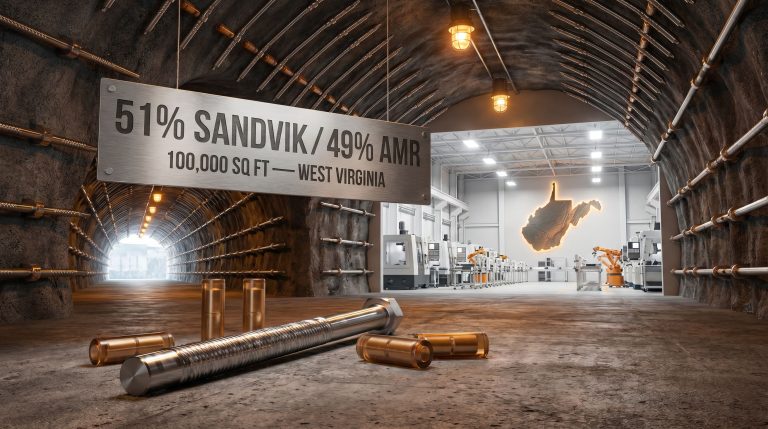
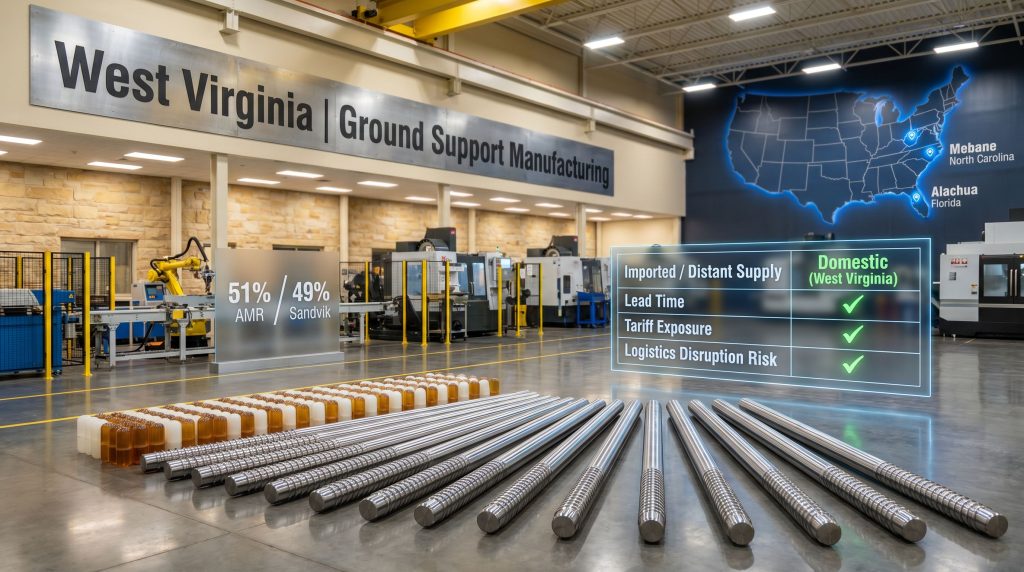
The arrangement between Sandvik and Alpha Metallurgical Resources, reported by Canadian Mining Journal on May 13, 2026, establishes a joint venture in which Sandvik holds a 51% controlling stake and Alpha retains the remaining 49%. The facility, planned at approximately 9,300 square metres (100,000 square feet), will primarily manufacture rock bolts and resin capsules, with the site designed to accommodate future capacity expansion.
The ownership structure is worth examining closely, because it departs from the two most obvious alternatives: a simple long-term supply contract, or a wholly-owned Sandvik subsidiary.
A standard supply contract would have given Alpha procurement certainty without capital exposure. A wholly-owned facility would have given Sandvik full operational control but required it to absorb all startup risk without a guaranteed anchor customer. The joint venture structure achieves something neither alternative can: it aligns both parties' financial interests with the venture's commercial success while securing a captive demand base through the long-term exclusive supply agreement under which Alpha commits to sourcing ground support materials from the new facility.
Beyond Alpha's captive demand, the venture is structured to sell products to third-party underground mining customers across the U.S., expanding the total addressable market well beyond a single operator. This is strategically important because it means the facility's financial performance is not wholly dependent on Alpha's production volumes, which fluctuate with metallurgical coal market conditions.
| Structural Element | Detail |
|---|---|
| Sandvik Ownership | 51% (controlling) |
| Alpha Ownership | 49% |
| Facility Size | ~9,300 m² (100,000 sq ft) |
| Primary Products | Rock bolts, resin capsules |
| Anchor Supply Agreement | Long-term exclusive with Alpha |
| Third-Party Market | Open to external underground mining customers |
| Expansion Capability | Built into facility design |
The Operational Case for Domestic Ground Support Manufacturing
The decision to locate this facility in West Virginia is not arbitrary. Central Appalachia hosts some of the most ground-support-intensive underground coal mining operations in North America. Room-and-pillar mining methods, which dominate the region's coal extraction, require systematic bolting of roof and ribs throughout the working sections.
Continuous miners advance headings that must be bolted immediately behind the cutting drum to maintain safe working conditions. The consumption of rock bolts and resin capsules in active room-and-pillar sections is effectively continuous.
Alpha Metallurgical Resources operates exclusively in this region as a producer of metallurgical coal, the high-value coking coal grade used in steelmaking. Its operations represent a concentrated and predictable demand base for ground support consumables, making it an ideal anchor customer for a domestic manufacturing venture. Furthermore, the broader supply chain disruption risk affecting globally sourced consumables has made this regional arrangement even more compelling.
For underground mines in Central Appalachia, dependence on imported or distant-sourced ground support consumables introduces procurement lead times that can directly constrain production scheduling. Domestic manufacturing fundamentally restructures this exposure by collapsing the supply chain to a regional scale.
The supply chain contrast between offshore-sourced and domestically manufactured ground support products is stark across multiple dimensions:
| Factor | Imported or Distant Supply | Domestic West Virginia Facility |
|---|---|---|
| Lead Time | Weeks to months | Days |
| Tariff Exposure | Subject to trade policy shifts | Eliminated |
| Logistics Disruption Risk | Port delays, freight constraints, customs | Minimal |
| Product Customisation | Limited by standardised offshore production | Engineered to operator specification |
| Application Engineering Support | Remote or limited | Proximity-enabled field support |
| Regional Economic Impact | Minimal local benefit | Direct employment and local spending |
Sandvik's North American Manufacturing Footprint in Context
This West Virginia investment does not emerge from a blank slate. Sandvik already operates a meaningful North American manufacturing base, and the new facility represents a deliberate extension of that network into the ground support consumables segment. In addition, the broader context of U.S. mining policy shifts has created a more favourable environment for this kind of domestic industrial investment.
| Facility Location | Primary Function |
|---|---|
| Alachua, Florida | Rotary and down-the-hole blast hole drill manufacturing |
| Mebane, North Carolina | Machining solutions production |
| West Virginia (planned, 2026) | Rock bolt and resin capsule manufacturing |
The distinction between Sandvik's capital equipment divisions and its Ground Support consumables business matters here. Capital equipment, such as drill rigs and loaders, involves long sales cycles, high per-unit value, and infrequent replacement. Ground support consumables, by contrast, are repurchased continuously, in high volumes, with tight delivery windows. The localisation logic for each category is fundamentally different.
For capital equipment, a manufacturer can tolerate longer supply chains because procurement timelines are planned months in advance. For consumables consumed daily at the face of an underground mine, supply chain disruption translates almost immediately into production constraint. This is why Sandvik local manufacturing in the U.S. for ground support products requires a different geographic model than the company's capital equipment production.
A Sector-Wide Signal: Mining Consumables Localisation Is Accelerating
Sandvik's joint venture does not exist in isolation. The timing of this announcement coincides with broader movement among mining equipment and consumables suppliers toward U.S.-based domestic manufacturing. Canadian Mining Journal reported on May 12, 2026, that BulkOne debuted as a cross-border player in mining explosives with a parallel move toward domestic manufacturing, indicating that the localisation trend is active across multiple consumables categories simultaneously.
This convergence reflects a shared diagnosis among mining operators and their suppliers: the era of optimising supply chains purely for cost efficiency, often at the expense of resilience, is giving way to a model that explicitly prices in supply security. The introduction of steel and aluminium tariffs has further accelerated this rethinking, making domestically produced inputs increasingly attractive relative to imported alternatives.
For foreign-headquartered manufacturers like Sandvik, joint venture structures with established U.S. operators offer the most capital-efficient path into domestic production, sharing startup risk while securing demand certainty through equity-aligned supply agreements.
For Alpha Metallurgical Resources specifically, the 49% equity stake in the manufacturing venture represents something more valuable than a supply contract could provide. As a co-owner of the production facility, Alpha gains operational influence over the products it depends on, upside participation in the venture's third-party commercial success, and a degree of supply chain control that no purchase agreement can replicate.
The joint venture model is emerging as the preferred mechanism for foreign OEMs entering U.S. domestic manufacturing because it converts the anchor customer from a passive buyer into an invested co-owner, fundamentally aligning interests in ways that pure supply contracts cannot achieve.
Consequently, this model is likely to influence how other equipment and consumables manufacturers approach the U.S. market. The broader mining industry transformation underway is creating conditions where domestic production capacity is no longer optional but strategically essential. Similarly, shifts in the green steel market dynamics are reshaping downstream demand for metallurgical coal, further reinforcing the importance of supply chain resilience for producers like Alpha.
The next major ASX story will hit our subscribers first
Frequently Asked Questions: Sandvik Local Manufacturing in the U.S.
What products will the West Virginia facility manufacture?
The facility will primarily produce rock bolts and resin capsules, the two highest-volume consumable categories in underground mining ground support systems. The site is designed with infrastructure capacity to accommodate future product line expansion as demand grows.
What is the ownership structure of the joint venture?
Sandvik holds a 51% controlling majority stake in the joint venture. Alpha Metallurgical Resources holds the remaining 49%. The arrangement includes a long-term exclusive supply agreement for Alpha's Central Appalachian operations, alongside open-market sales to third-party underground mining customers.
How large is the planned West Virginia facility?
The facility is planned at approximately 9,300 square metres, equivalent to roughly 100,000 square feet, representing a substantial ground support manufacturing operation by U.S. industry standards, with built-in capacity for future expansion.
Why is the facility located in West Virginia?
West Virginia sits at the geographic centre of Central Appalachian underground coal mining activity, providing direct proximity to Alpha's operations and the broader regional customer base. The region also benefits from an established mining-industrial workforce and prior experience in manufacturing-adjacent industries.
Does the venture supply only Alpha Metallurgical Resources?
No. While Alpha holds an exclusive long-term supply agreement as the anchor customer, the joint venture is structured to sell products to third-party underground mining operators across the U.S., including coal, hard rock metals, potash, and trona mining segments.
How does this fit within Sandvik's broader U.S. manufacturing network?
Sandvik already operates manufacturing facilities in Alachua, Florida (blast hole drill equipment) and Mebane, North Carolina (machining solutions). The West Virginia facility expands Sandvik local manufacturing in the U.S. specifically into ground support consumables, a category not previously served by domestic Sandvik production.
Key Takeaways for the Mining Sector
-
Ground support consumables, long overlooked in favour of capital equipment announcements, are emerging as a strategically significant category where domestic production delivers measurable operational and safety advantages
-
Joint venture structures are proving to be the preferred model for foreign OEMs entering U.S. domestic manufacturing, aligning anchor customer demand with shared equity in the production asset
-
West Virginia and Central Appalachia are re-emerging as viable locations for mining-industrial manufacturing, supported by operator demand concentration and workforce availability
-
Supply chain localisation across the mining sector is no longer driven solely by cost considerations but by explicit recognition that procurement resilience has operational and financial value in its own right
-
Sandvik's U.S. manufacturing network now spans capital equipment in Florida, precision machining in North Carolina, and ground support consumables in West Virginia, forming a more complete domestic industrial presence than any single facility could represent
This article is based on information reported by Canadian Mining Journal (May 13, 2026) and draws on publicly available industry information. Statements regarding facility specifications, ownership structures, and commercial terms reflect information available at the time of reporting. Readers should conduct independent verification before drawing conclusions for operational or investment purposes.
Want To Be First When The Next Major Mining Discovery Hits The ASX?
Discovery Alert's proprietary Discovery IQ model delivers real-time alerts the moment significant mineral discoveries are announced on the ASX, transforming complex data across more than 30 commodities into clear, actionable investment insights — ideal for both traders seeking rapid market advantages and long-term investors building positions in transformative discoveries. Explore historic examples of major discovery returns and begin a 14-day free trial to ensure you're positioned ahead of the broader market.