May 22, 2026
The Rare Earth Financing Problem That Governments Are Solving With Sovereign Capital
For most of the past two decades, rare earth projects outside China followed a predictable pattern: promising geology, early-stage enthusiasm, then a long stall at the point where serious capital was needed. The processing stage, where ore becomes refined oxide suitable for magnet manufacturing, proved to be the graveyard of Western ambitions. Commercial lenders balked at the complexity. Equity markets grew impatient. Projects languished.
What has changed is not the geology or the processing chemistry. What has changed is the willingness of sovereign institutions to treat the rare earth supply chain as infrastructure rather than speculation. The Arafura Nolans rare earth project funding structure, assembled across multiple tranches and multiple nations, is the clearest expression yet of this strategic pivot.
When big ASX news breaks, our subscribers know first
What Makes Nolans Structurally Different From Other Rare Earth Projects
Located in the Northern Territory of Australia, the Nolans project is designed to do something most Western rare earth developments have never achieved: process ore all the way through to finished neodymium-praseodymium (NdPr) oxide within a single, domestically integrated operation. Most competing projects either stop at concentrate, which then travels offshore for processing, often to China, or they rely on tolling arrangements that preserve the bottleneck rather than eliminating it.
NdPr oxide sits at the centre of the permanent magnet supply chain. It is the critical input for the high-strength sintered magnets used in electric vehicle traction motors, direct-drive wind turbines, and certain defence applications including precision guidance and radar systems. Without a reliable non-Chinese source of NdPr oxide, Western manufacturers remain structurally exposed regardless of how many mining licences they hold.
At full capacity, the Nolans project is projected to produce approximately 4,440 tonnes of NdPr oxide per year, representing roughly 4% of current global NdPr supply. That figure may sound modest, but in a market where Chinese producers control an estimated 85 to 90% of global rare earth processing capacity, a single project delivering 4% from a jurisdiction with rule of law, transparent permitting, and allied-nation relationships is genuinely significant.
The deeper point is that Nolans is not competing with China on cost. It is competing on reliability, jurisdiction, and supply chain certainty for buyers who can no longer afford single-source dependency.
The Capital Architecture Behind the Arafura Nolans Rare Earth Project Funding
The total capital requirement for the Nolans build sits at approximately A$1.6 billion. Assembling financing of this scale for a rare earth project with no operating precedent in Australia required a fundamentally different approach to capital formation than a conventional mining project.
The structure combines senior debt facilities, sovereign equity participation, strategic industrial investment, and domestic institutional capital across several distinct layers:
| Financing Component | Source | Value |
|---|---|---|
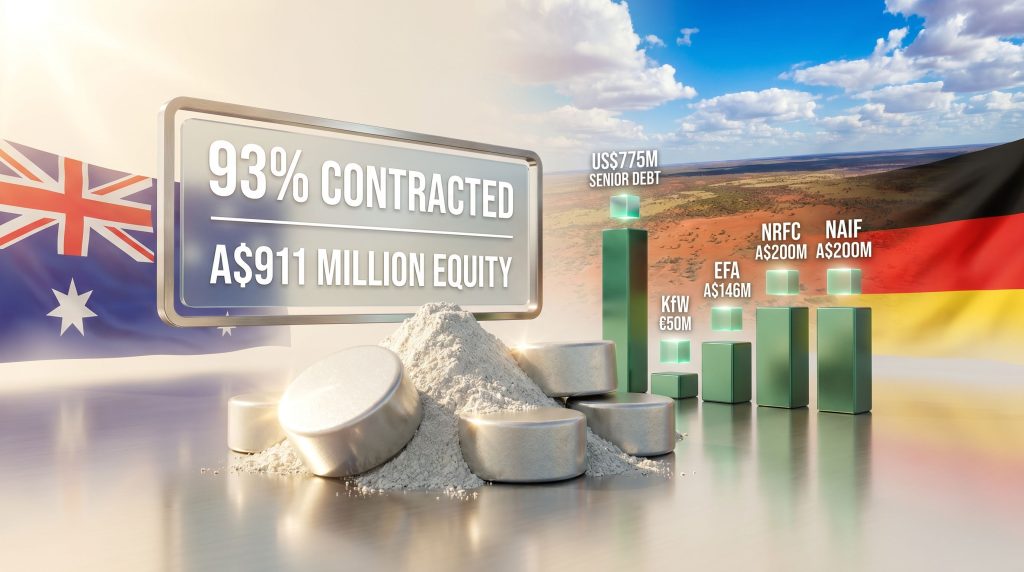
| Senior Debt Facilities | Export Finance Australia (EFA) | US$775 million |
| Cost Overrun Facility | EFA | US$80 million |
| Standby Liquidity Facility | EFA | US$200 million |
| Equity – German Raw Materials Fund (KfW) | German sovereign fund | €50 million (~A$84 million) |
| Equity – Export Finance Australia | Critical Minerals Facility | A$146 million (~US$100 million) |
| Equity – National Reconstruction Fund Corporation | Australian federal body | A$200 million (convertible notes) |
| Equity – Q4 2025 Raise | Institutional markets | A$481 million |
| Equity – May 2026 Placement | Institutional including Hancock | A$350 million |
| Share Purchase Plan | Existing shareholders | Up to A$25 million |
Upon completion of all fundraising activity, Arafura expects to carry a projected cash balance of A$911 million, confirming that the equity component of the Nolans development is fully funded ahead of construction.
Why EFA Plays a Dual Role in This Structure
Export Finance Australia's involvement is particularly notable because it operates on both sides of the capital stack simultaneously. On the debt side, EFA has anchored senior facilities totalling US$775 million, with additional overrun and liquidity facilities of US$80 million and US$200 million respectively. On the equity side, EFA contributes A$146 million through Australia's Critical Minerals Facility.
This dual positioning is not accidental. When a sovereign export credit agency sits in both the debt and equity layers of a project, it sends a clear signal to commercial co-lenders that the project carries implicit sovereign credit support. This substantially reduces the perceived risk premium for other participants and enables more aggressive debt structuring than would otherwise be possible for a first-of-kind processing facility.
How the Equity Raise Was Sequenced
The equity component of the Arafura Nolans rare earth project funding was assembled in stages rather than through a single transaction, a deliberate approach that allowed the company to layer in different categories of investor at appropriate points in the project's de-risking journey.
The progression followed this sequence:
-
Q4 2025 foundation raise of A$481 million from institutional equity markets, establishing the initial capital base.
-
German Raw Materials Fund commitment of €50 million (~A$84 million) via KfW, Germany's state-owned development bank, with shares issued at A$0.2447 per share.
-
Export Finance Australia equity commitment of A$146 million under Australia's Critical Minerals Facility.
-
National Reconstruction Fund Corporation binding term sheet for A$200 million in convertible notes, reflecting the NRFC's mandate to rebuild domestic industrial processing capability.
-
May 2026 institutional placement of A$350 million at A$0.26 per share, structured across two tranches of A$175 million each.
-
Share Purchase Plan targeting up to A$25 million from eligible existing shareholders at the same A$0.26 placement price.
Hancock Prospecting's Deepening Commitment
Within the May 2026 institutional placement, Hancock Prospecting, chaired by Gina Rinehart, committed A$85 million, lifting its total shareholding to 17.5% upon placement completion. Hancock is already Arafura's largest single shareholder, and the decision to participate at this scale in a dilutive placement reflects a conviction that extends well beyond passive index exposure.
For context, Hancock's involvement in rare earth development aligns with a broader thesis held by certain Australian industrial investors: that the window to establish sovereign rare earth processing outside China is time-limited, and that the capital required to do so must be deployed before the geopolitical window narrows.
The Offtake Position That Transforms Nolans Into a Bankable Asset
One of the least-discussed but most important aspects of the Arafura Nolans rare earth project funding story is the offtake position. Furthermore, the Arafura offtake agreement coverage of 93% of Nolans' projected production represents an exceptional commercial achievement for a project that has not yet produced a tonne of oxide.
In project finance, offtake coverage functions as a revenue certainty proxy. Lenders underwriting long-dated debt facilities use contracted sales volumes to stress-test cash flow models under adverse price scenarios. A 93% contracted position at this stage effectively transforms Nolans from a commodity price speculation into something closer to a tolling or infrastructure asset with predictable throughput.
For equity investors, high offtake coverage does something equally important: it dramatically reduces the probability of stranded capacity, the scenario where a project is built but cannot find buyers at economically viable prices.
The identities of Nolans' offtake counterparties have not been fully disclosed publicly, but the end-user segments of interest are EV motor manufacturers, wind turbine producers, and allied-nation defence contractors. Consequently, all of these buyers face growing pressure from procurement regulators and boards to diversify away from Chinese-sourced rare earth materials. This is also reflected in the broader rare earth supply deal activity unfolding across the sector.
The China Concentration Problem in Numbers
Understanding why so much sovereign capital is flowing into Arafura Nolans rare earth project funding requires understanding the degree of concentration that currently exists in the global rare earth market. Indeed, the scale of dependence on China becomes stark when presented in numerical terms.
| Market Segment | China's Estimated Share |
|---|---|
| Global rare earth mining output | ~60% |
| Global rare earth processing capacity | ~85-90% |
| NdPr magnet production | ~90%+ |
| Nolans projected contribution to global NdPr | ~4% |
The asymmetry is stark. China does not merely mine rare earths at scale. It processes them, separates them, alloys them into magnets, and integrates them into finished components. Western mining activity without matching processing capability does not solve the dependency problem. It merely shifts the chokepoint upstream by one stage.
Nolans addresses this directly by proposing a complete ore-to-oxide pathway within Australian borders. The Northern Australia Infrastructure Facility (NAIF) has also committed up to A$200 million specifically for enabling infrastructure associated with the project, recognising that a remote Northern Territory operation of this scale requires significant logistical and utilities investment alongside the processing plant itself.
The next major ASX story will hit our subscribers first
Production Timeline and Key Development Milestones
Following the positive Final Investment Decision, the Nolans project moves into its construction and commissioning phase. The key milestones from this point forward are as follows:
| Milestone | Status or Target |
|---|---|
| Final Investment Decision | Confirmed positive |
| Equity Component Fully Funded | Confirmed – A$911M projected cash balance |
| Senior Debt Facilities | US$775M secured via EFA |
| Offtake Agreements | 93% of production contracted |
| First NdPr Oxide Production | Targeted second half of 2029 |
| Steady-State Annual NdPr Output | ~4,440 tonnes per year |
The H2 2029 production target places Nolans among the earliest potential contributors to a non-Chinese NdPr supply chain during a period when automotive and energy transition demand for permanent magnets is forecast to grow substantially. Industry observers note that the timing is not coincidental: allied-nation procurement timelines for domestic rare earth supply are increasingly concentrated in the late 2020s window.
What the Nolans Funding Model Signals for the Broader Critical Minerals Sector
Perhaps the most consequential aspect of the Arafura Nolans rare earth project funding architecture is what it demonstrates for other projects attempting to replicate the model. The surge in critical minerals demand is a key driver behind several features that distinguish this structure from conventional mining finance:
-
Multi-sovereign equity participation from both Australian and German state institutions removes the binary risk of relying on a single government's policy continuity.
-
Convertible note structures from bodies like the NRFC provide flexibility for the issuing company while giving the investing institution a pathway to equity upside if the project performs.
-
Layered debt with overrun and liquidity facilities addresses one of the primary reasons rare earth projects historically failed to reach financial close: construction cost uncertainty on first-of-kind processing infrastructure.
-
High offtake coverage achieved pre-FID signals to lenders that demand risk has been substantially mitigated, allowing debt pricing to reflect infrastructure-like credit characteristics rather than resource exploration risk.
This template is being observed closely by rare earth developers in Canada, the United States, and across the European Union, where similar supply chain vulnerabilities exist but comparable financing frameworks are still being developed.
The Nolans funding structure may ultimately prove more influential as a financing blueprint than as an individual supply source. If it can be replicated across three or four additional projects in allied jurisdictions before 2030, the cumulative impact on Chinese processing dominance becomes structurally meaningful rather than symbolic.
Frequently Asked Questions: Arafura Nolans Rare Earth Project Funding
How much total capital has been assembled for the Nolans project?
The total project capital requirement is approximately A$1.6 billion. The equity component, projected to reach a cash balance of A$911 million, is considered fully funded. Senior debt facilities of US$775 million have been secured through Export Finance Australia, with additional overrun and liquidity facilities totalling US$280 million.
Who are the major investors in the Nolans project?
Key investors include Hancock Prospecting (A$85 million, lifting its stake to 17.5%), KfW via the German Raw Materials Fund (€50 million / ~A$84 million), Export Finance Australia (A$146 million equity plus senior debt), the National Reconstruction Fund Corporation (A$200 million in convertible notes), and the Northern Australia Infrastructure Facility (up to A$200 million for enabling infrastructure).
Why is KfW investing in an Australian rare earth project?
Germany's industrial economy, particularly its automotive manufacturing sector, is heavily dependent on rare earth permanent magnets for electric vehicle production. KfW's investment through the German Raw Materials Fund reflects a national strategy to secure long-term supply from non-Chinese jurisdictions, directly analogous to Germany's approach to energy diversification following the 2022 gas supply crisis.
When will Nolans begin producing NdPr oxide?
First production is targeted for the second half of 2029, following construction and commissioning of the integrated ore-to-oxide facility in the Northern Territory.
What percentage of production is already contracted?
Arafura has secured binding offtake agreements covering 93% of Nolans' projected annual production, which represents an unusually strong pre-production commercial position and a key factor in the project's ability to attract long-dated debt financing.
What is NdPr oxide used for?
NdPr oxide is the primary input for neodymium-iron-boron permanent magnets, the strongest commercially available permanent magnets. These are essential components in the motors of battery electric vehicles, the generators of direct-drive wind turbines, and various defence and aerospace systems requiring compact, high-strength magnetic fields.
Disclaimer: This article contains forward-looking statements and projections regarding production timelines, capital costs, and market conditions. These are based on publicly available information and management guidance as of the date of publication. Actual outcomes may differ materially from projections due to construction risk, commodity price movements, regulatory changes, and other factors. This article does not constitute financial advice. Investors should conduct their own due diligence before making investment decisions.
Want To Identify The Next Major Critical Minerals Discovery Before The Market Does?
Discovery Alert's proprietary Discovery IQ model delivers real-time alerts on significant ASX mineral discoveries — including the critical minerals driving the global energy transition — transforming complex geological data into actionable investment insights for traders and long-term investors alike. Explore how historic discoveries have generated extraordinary returns on the Discovery Alert discoveries page, and begin your 14-day free trial today to position yourself ahead of the market.