May 22, 2026
The Geopolitics of Ground-Level Wealth: Why Resource Nationalism Is Rewriting Global Supply Chains
Across the past three decades, the dominant model for emerging market resource development followed a predictable template: extract raw materials, export them cheaply, and import finished goods at a premium. That cycle is now breaking down. From Jakarta to Harare to Brasília, resource-rich governments are increasingly refusing to participate in supply chains where they capture the least value. The country engineering perhaps the most consequential version of this shift is Brazil, and the architect is President Luiz Inácio Lula da Silva.
Understanding the Lula Brazil oil and rare earths strategy requires moving beyond the headlines about fossil fuel expansion and environmental criticism. What is actually underway is a deliberate, multi-decade repositioning of Latin America's largest economy within global commodity and industrial supply chains, built on two simultaneously expanding asset bases: world-class offshore hydrocarbons and the planet's second-largest known rare earth reserves.
When big ASX news breaks, our subscribers know first
Brazil's Dual Resource Position: A Convergence No Other Nation Matches
Very few countries hold transformational-scale endowments in both energy and critical minerals. Brazil does, and the strategic implications of that dual position are still being underestimated by most international observers. Furthermore, the convergence of these two asset classes creates a uniquely powerful negotiating position in global supply chain discussions.
| Resource Category | Brazil's Global Ranking | Key Metric |
|---|---|---|
| Rare Earth Reserves | 2nd Largest Globally | Only ~30% of territory formally mapped |
| Niobium Production | Dominant Global Supplier | Critical for aerospace steel and advanced alloys |
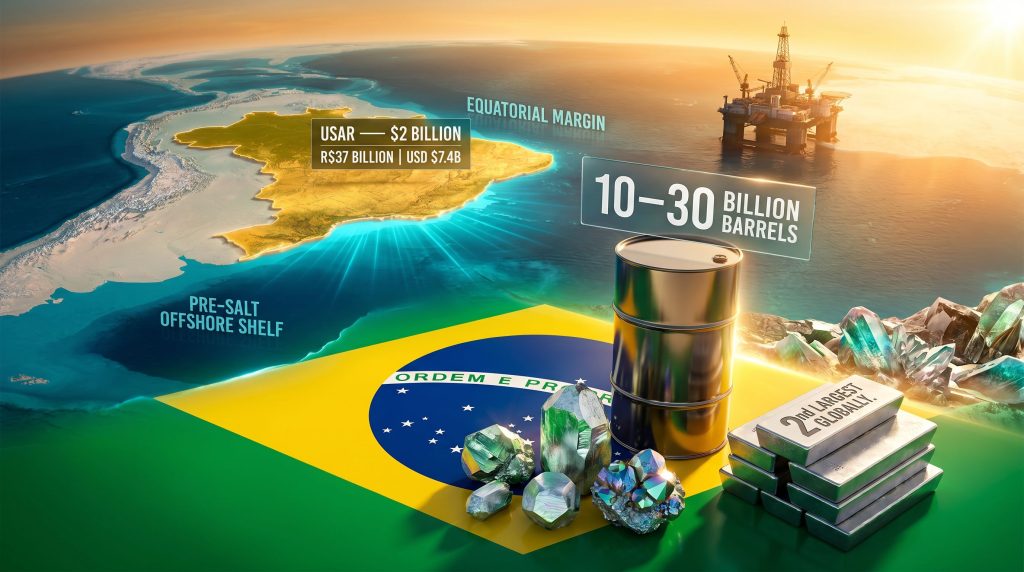
| Offshore Oil (Pre-Salt + Equatorial Margin) | Top 10 Global Producer | Equatorial Margin estimated at 10-30 billion recoverable barrels |
| Petrobras Investment Pipeline | National Champion | R$37 billion (~USD $7.4 billion) committed through 2030 |
What makes Brazil structurally distinct from other large-reserve nations is not any single commodity, but the combination. Brazil's niobium dominance deserves particular attention because it rarely receives it. Niobium is a relatively obscure transition metal used in high-strength, low-alloy steel for aerospace applications, automotive manufacturing, and next-generation infrastructure construction. Brazil accounts for the overwhelming majority of global niobium supply, giving it a strategic lever that most rare earth supply chains discussions entirely overlook.
Critically, only approximately 30% of Brazilian territory has been formally mapped for mineral resources. This means current reserve estimates represent a floor, not a ceiling. The actual endowment could be substantially larger, a point that fundamentally changes how investors and policymakers should assess Brazil's long-term strategic position.
The Three Pillars Behind Lula's Resource Sovereignty Framework
Lula's policy architecture deliberately occupies the space between full nationalisation and unrestricted raw material export. Neither the Venezuelan model nor the colonial commodity model serves Brazil's interests, and his administration has been explicit about rejecting both extremes.
Pillar 1: Mandatory Domestic Processing
The most commercially significant element of the framework is its non-negotiable insistence on onshore processing. Foreign companies seeking access to Brazilian rare earth reserves are required to refine and process materials within Brazilian territory and to transfer relevant technologies as a condition of market access. Raw mineral extraction alone does not qualify for approval.
This mirrors the approach Indonesia's nickel strategy successfully deployed, where an export ban on unprocessed ore compelled global battery manufacturers and steel producers to build smelting and processing capacity inside Indonesian borders. Indonesia's GDP impact from that policy shift has been substantial, and Brazil is watching that precedent closely.
Pillar 2: Petrobras as a Sovereign Instrument
Petrobras remains a public asset under the current administration, with the divestment of key assets halted as of early 2026. The state-controlled model is not framed as ideology but as national security: oil revenues are deployed as a sovereign buffer, used to subsidise domestic fuel costs during global supply disruptions, fund public services, and generate employment at scale.
The R$37 billion (~USD $7.4 billion) Petrobras investment commitment through 2030 spans multiple objectives:
| Investment Category | Strategic Purpose |
|---|---|
| Exploration and Production Expansion | Extend production plateau beyond 2030 via Equatorial Margin |
| Port Infrastructure (Port of Santos) | Reduce export bottlenecks for oil and minerals |
| Refining Modernisation | Decrease dependency on imported refined products |
| Biorefining and Renewable Fuels | Sustainable aviation fuel and renewable diesel development |
| Job Creation | Approximately 38,000 direct and indirect positions |
Pillar 3: Strategic Non-Alignment
Perhaps the most geopolitically sophisticated element of the Lula Brazil oil and rare earths strategy is its deliberate refusal to choose sides in the U.S.-China competition for critical mineral access. Investment from the United States, China, Germany, France, and Japan is stated as equally welcome. There are no vetoes and no preferences based on geopolitical bloc membership.
This posture maximises Brazil's negotiating leverage. Both superpowers need what Brazil has, and neither can assume preferential access. For Western nations building China-independent rare earth supply chains, this is an uncomfortable reality: Brazil cannot be treated as a guaranteed ally. It must be competed for on commercial terms.
The Equatorial Margin: Understanding Brazil's Most Consequential Offshore Frontier
Brazil's pre-salt basin has been one of the defining offshore oil stories of the past two decades. However, that story has a structural endpoint: current pre-salt production is expected to peak and enter decline around 2030. The Equatorial Margin is the designated successor.
The Equatorial Margin is a deepwater offshore zone along Brazil's northern coastline, and its estimated recoverable reserves of between 10 billion and 30 billion barrels place it among the most significant untapped offshore frontiers anywhere in the world. Geological analysis has drawn direct comparisons to neighbouring Guyana and Suriname, both of which yielded transformational discoveries that reshaped their national economies within a decade.
The tension between Brazil's international climate commitments and its domestic fossil fuel expansion is real and unresolved. Lula's argument that oil revenue funds the clean energy transition has internal coherence, but remains contested by environmental scientists and progressive political factions within Brazil. The execution risk, specifically whether hydrocarbon revenues actually flow into clean energy infrastructure or are absorbed by fiscal and subsidy pressures, is the critical unresolved variable.
Lula has linked oil exploration to national sovereignty, framing Equatorial Margin development as a defensive act rather than purely an economic one. The argument is that failure to actively develop the region creates a vacuum that external powers could exploit, both commercially and geopolitically.
Notably, the fossil-funds-transition logic Lula employs is not without precedent. Norway's sovereign wealth fund, now exceeding USD $1.7 trillion in value, was built entirely on North Sea oil revenues and is frequently cited as the model for this approach. The critical distinction is disciplined institutional design: Norway created a legally ring-fenced mechanism to ensure oil wealth accumulated as long-term national capital rather than being consumed by short-term fiscal demands. Whether Brazil builds an equivalent institutional structure will determine whether Lula's argument holds up over time.
The PNMCE: Brazil's Legislative Architecture for Critical Mineral Development
Ahead of discussions between the Lula and Trump administrations on critical mineral investment, Brazil's lower house passed the National Policy on Critical and Strategic Minerals, known as the PNMCE. This legislation establishes a formal regulatory architecture for strategic mineral extraction, processing, and export.
The PNMCE's key financial mechanisms include:
- A ~$2 billion guarantee fund designed to de-risk private investment in domestic processing infrastructure
- Approximately $5 billion in tax credits over five years to incentivise onshore refining and manufacturing operations
- Explicit technology transfer requirements embedded in all foreign investment approvals
The PNMCE is one of the most architecturally comprehensive critical mineral policy frameworks enacted by a non-OECD nation, combining financial incentives, processing mandates, and sovereign oversight into a single legislative instrument. Its closest international comparisons are Indonesia's downstream processing legislation and the European Union's Critical Raw Materials Act, though Brazil's framework is applied at a reserve scale that neither of those comparators fully matches.
In addition, the broader global context matters here. The surge in critical minerals demand driven by the energy transition makes the timing of Brazil's legislative framework strategically astute, as governments worldwide scramble to secure reliable upstream supply.
Foreign Capital Competition: Who Is Competing for Brazil's Rare Earth Opportunity?
The U.S. Position
The most prominent near-term commercial development in Brazil's rare earth sector is USA Rare Earth's (NASDAQ: USAR) proposed $2 billion acquisition of Serra Verde, currently Brazil's only operating commercial-scale rare earth producer. Serra Verde focuses on ionic clay-type rare earth deposits, a geological formation that is significant because ionic clay deposits tend to yield heavy rare earth elements including dysprosium and terbium, both of which are critical for permanent magnets used in electric vehicle motors and wind turbines.
This geological distinction matters commercially: heavy rare earths command substantially higher prices and are far less abundant globally than light rare earths. China's dominance in heavy rare earth processing is the specific vulnerability that Western supply chain strategies are most urgently trying to address, which makes Serra Verde's deposit type strategically significant beyond its headline reserve figures.
China, Europe, and Asia
Chinese interest in Brazilian rare earths is substantial given China's need to secure upstream supply for its own processing industry. However, Brazil's non-alignment policy means Chinese companies face identical processing-onshore requirements to American or European investors. The competitive dynamic between U.S. and Chinese capital in Brazil's minerals sector mirrors broader geopolitical tensions playing out across Africa, Southeast Asia, and Central Asia simultaneously.
European engagement is driven primarily by the EU's Critical Raw Materials Act and the bloc's stated goal of reducing Chinese dependency in key technology supply chains. Furthermore, Germany, France, and Japan have each been explicitly named by the Lula administration as welcome investors, reflecting their own strategic diversification imperatives.
The next major ASX story will hit our subscribers first
How Brazil's Model Compares Across Global Resource Strategies
| Country | Strategy Model | Processing Onshore? | Geopolitical Alignment | Key Mineral |
|---|---|---|---|---|
| China | State-dominated, vertically integrated | Yes (dominant) | Self-aligned | REEs, Lithium, Cobalt |
| Australia | Export-oriented, Western-aligned | Partial (growing) | U.S./NATO aligned | Lithium, REEs |
| Indonesia | Export ban with onshore processing mandate | Yes (enforced) | Non-aligned | Nickel |
| Brazil | Open investment with onshore processing mandate | Yes (required) | Non-aligned | REEs, Niobium, Oil |
| DRC | Raw export dependent | Limited | Contested | Cobalt |
| United States | Domestic revival plus allied sourcing | Building capacity | Self-aligned | REEs, Lithium |
Brazil's approach most closely resembles Indonesia's resource nationalism playbook, but applied at a significantly larger reserve scale, across multiple commodity categories simultaneously, and within a democratic governance structure that reduces the sovereign risk profile relative to many large-reserve competitors. Recent research on mineral governance underscores how institutional quality shapes whether resource nationalism delivers lasting economic gains or simply redistributes rent-seeking behaviour.
Scenario Analysis: Three Plausible Futures for Brazil's Resource Strategy
Scenario 1: The Industrial Leap
Foreign investment flows competitively from U.S., Chinese, and European capital into Brazilian rare earth processing facilities. Domestic refining capacity scales within the 2030 window. The Equatorial Margin yields commercially viable reserves at the upper end of estimates, extending Brazil's oil production horizon materially. Brazil successfully transitions from raw mineral exporter to processed material supplier in global supply chains.
Probability driver: Sustained elevated global demand for critical minerals and continued geopolitical fragmentation that preserves Brazil's non-aligned status as genuinely valuable to multiple competing blocs.
Scenario 2: The Processing Bottleneck
Foreign companies commit capital but encounter infrastructure deficits, permitting complexity, and technology transfer friction that prevent processing facilities from scaling at the required pace. Brazil retains resource sovereignty but does not fully capture mid-stream value within the target timeframe. Oil revenue continues absorbing fiscal pressure through subsidy commitments rather than accumulating as transition capital.
Probability driver: Institutional capacity constraints that are a known structural feature of large-scale industrial policy execution in emerging markets.
Scenario 3: The Geopolitical Squeeze
U.S.-China rivalry escalates to the point where Brazil's non-aligned posture becomes diplomatically untenable. Investment from one or both blocs is conditionally restricted. Environmental opposition to Equatorial Margin exploration succeeds in blocking key licences through domestic or international legal mechanisms. Future electoral cycles produce policy discontinuity.
Probability driver: Accelerating great-power competition and the structural fragility of multi-administration industrial policy continuity in democratic systems.
What the Broader Template Means for Global Supply Chains
If Brazil successfully executes its processing-onshore mandate, it will demonstrate that a developing nation with democratic institutions can capture mid-stream and downstream value in critical mineral supply chains without resorting to full nationalisation. That proof of concept would be enormously influential.
Countries including Zimbabwe with lithium, Namibia with uranium, and Tanzania with graphite are watching the Lula Brazil oil and rare earths strategy closely as they develop their own resource sovereignty frameworks. A successful Brazilian execution would accelerate the global trend toward commodity processing nationalism and fundamentally redraw the geography of industrial supply chains over the next decade.
For investors, the strategic variables to monitor are not the headline reserve figures but the institutional execution details: whether the PNMCE's processing requirements are actually enforced, whether the guarantee fund successfully attracts processing investment rather than merely extraction investment, and whether Petrobras's capital allocation genuinely flows toward the Equatorial Margin at the scale the investment numbers imply.
Disclaimer: This article is intended for informational and educational purposes only. It does not constitute financial, investment, or legal advice. Forward-looking statements, scenario analyses, and reserve estimates involve uncertainty and should not be relied upon as predictions of future outcomes. Readers should conduct their own due diligence before making any investment decisions.
Want to Track the Next Major Mineral Discovery Before the Market Moves?
Discovery Alert's proprietary Discovery IQ model delivers real-time alerts on significant ASX mineral discoveries across critical minerals, rare earths, and beyond — instantly turning complex geological data into actionable investment insights for traders and long-term investors alike. Explore how historic discoveries have generated substantial returns on Discovery Alert's dedicated discoveries page, and begin your 14-day free trial today to position yourself ahead of the broader market.