May 21, 2026
The Processing Bottleneck That Mining Alone Cannot Solve
For decades, the dominant assumption in Western critical minerals policy was that securing access to ore in the ground would solve the rare earth dependency problem. That assumption has proven dangerously incomplete. The United States can identify, permit, and extract rare earth ore from domestic deposits, yet without the industrial infrastructure to separate individual elements from mixed feedstocks, that ore must still travel overseas for processing, predominantly to China, before returning as refined material or finished components. The bottleneck was never in the mine. It has always been in the processing plant.
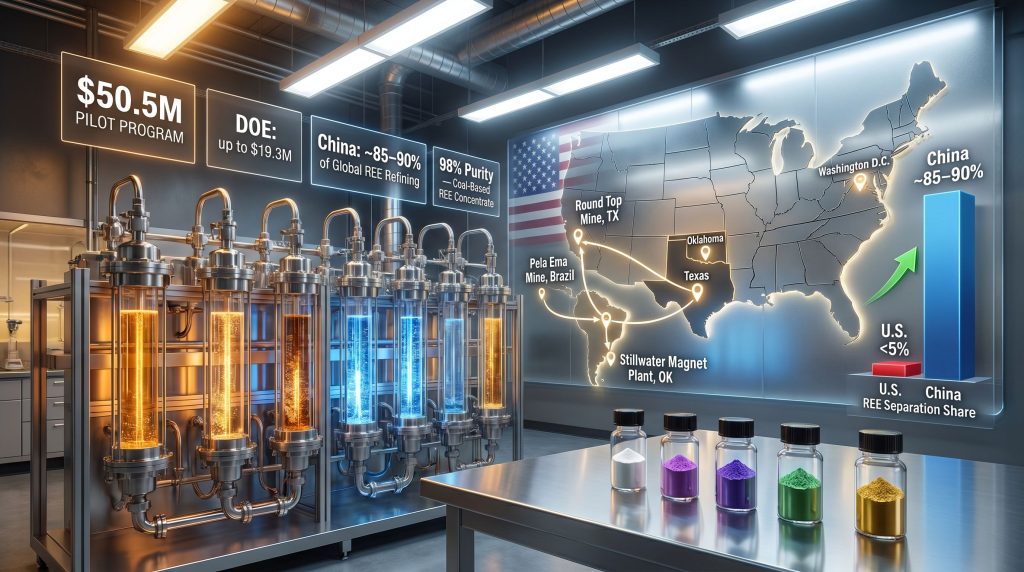
This is the structural reality that makes the DOE backs USA Rare Earth processing pilot announcement so strategically significant. The U.S. Department of Energy has selected USA Rare Earth for up to $19.3 million in funding under its Critical Materials Innovation, Efficiency and Alternatives program, directed specifically at developing and operating a pilot-scale continuous ion-exchange rare earth element separation facility. The total program value reaches $50.5 million, with approximately $31.2 million expected to come from private capital under a cost-sharing model.
The separation challenge sits at the precise point where domestic supply chain ambitions have historically stalled.
When big ASX news breaks, our subscribers know first
Why Rare Earth Separation Remains the Most Critical Unresolved Gap
China's dominance over rare earth supply chains is not primarily a mining story. It is a processing story. While China accounts for roughly 60% of global rare earth mining output, its grip on separation and refining capacity is far more absolute, controlling an estimated 85-90% of global rare earth processing infrastructure. Even ore mined in the United States, Australia, or Brazil typically requires Chinese processing before it can be converted into the refined oxides, metals, and alloys that manufacturers actually need.
| Metric | United States | China | Rest of World |
|---|---|---|---|
| Share of global REE mining | ~15% | ~60% | ~25% |
| Share of global REE separation/refining | <5% | ~85-90% | ~5-10% |
| Operational magnet manufacturing | Emerging (2026) | Dominant | Limited |
| Domestic ion-exchange separation | Pilot stage | Commercial scale | Limited |
The downstream applications that depend on separated rare earth materials span virtually every high-priority technology sector:
- Defence systems: guided munitions, radar arrays, sonar equipment, and jet engine components
- Electric vehicle drivetrains: neodymium-iron-boron permanent magnets powering traction motors
- Wind turbines: large-format permanent magnets in direct-drive generators
- Semiconductors and advanced electronics: europium and terbium for display phosphors, lanthanum in optical glass
- Clean energy storage and conversion: cerium-based catalysts, lanthanum in nickel-metal hydride batteries
The rare earth elements considered most strategically critical reflect the specific supply chain risks embedded in each application. Neodymium (Nd) and praseodymium (Pr) form the core of permanent magnet alloys, while dysprosium (Dy) and terbium (Tb) provide thermal stability in high-performance magnets used in both EV motors and defence equipment. Furthermore, these heavy rare earth elements carry disproportionate strategic weight because their natural concentrations are geographically concentrated and their Chinese processing share approaches near-total dominance.
Understanding Continuous Ion-Exchange: The Technology at the Centre of the Program
How Ion-Exchange Separation Actually Works
Ion-exchange separation exploits the chemically distinct behaviour of individual rare earth elements when passed through specialised resin systems. Each element interacts differently with the resin matrix, allowing selective retention and elution that effectively isolates target elements from a complex mixed solution. The result is individual rare earth streams at commercially useful purity levels, without requiring the extensive solvent chemistry that dominates conventional separation plants.
What makes continuous ion-exchange distinct from its historical predecessors is operational architecture. Conventional ion-exchange systems operate in batch cycles, loading resin beds, washing, eluting, and then regenerating before the next cycle begins. This produces throughput limitations that have historically made batch ion-exchange uncompetitive with solvent extraction at commercial scale. Continuous systems, however, maintain uninterrupted flow through multiple resin zones simultaneously, dramatically improving throughput rates and making the economics more viable for industrial deployment.
The foundational science is not new. Ion-exchange technology was first developed during the Manhattan Project in the 1940s, when researchers needed methods to isolate individual rare earth elements and radioactive isotopes with precision that chemical precipitation could not achieve. That early work produced high-purity separations at laboratory scale. The challenge that has persisted for eight decades is translating that selectivity into a continuous, high-throughput system capable of operating reliably at commercial volumes.
How Continuous Ion-Exchange Compares to Conventional Methods
| Separation Method | Process Type | Key Advantage | Primary Limitation |
|---|---|---|---|
| Solvent Extraction (SX) | Batch/Continuous | Proven at scale | High chemical waste, complex stages |
| Conventional Ion-Exchange | Batch | High selectivity | Low throughput, slow cycle times |
| Continuous Ion-Exchange | Continuous | High selectivity + throughput | Commercial scale not yet validated |
Solvent extraction remains the global industry standard for large-scale rare earth separation precisely because it has been engineered and optimised over decades of Chinese industrial development. Its limitations are well-documented: high volumes of organic solvents, significant aqueous waste streams requiring treatment, and complex multi-stage mixer-settler circuits that require substantial capital and operational expertise. For a country attempting to build processing capacity rapidly, replicating solvent extraction infrastructure also risks replicating its environmental and regulatory challenges.
Continuous ion-exchange offers a theoretically cleaner separation pathway with reduced solvent dependency. However, the critical qualifier remains pilot-scale validation, as the rare earth processing challenges involved mean that performance metrics achieved in laboratory settings do not automatically translate to industrial reliability.
How the DOE's Critical Materials Innovation Program Structures Its Investments
Federal Funding Architecture and Cost-Sharing Logic
The DOE's Critical Materials Innovation, Efficiency and Alternatives program operates on a cost-sharing model that deliberately leverages private capital alongside federal investment. The structure serves multiple purposes: it reduces Treasury exposure per project, it signals that private markets have sufficient confidence in the technology to co-invest, and it creates alignment between federal objectives and commercial incentives.
The broader DOE critical minerals funding ecosystem approaches $1 billion across multiple program tracks, addressing different stages of the processing stack:
- Battery materials development and manufacturing scale-up
- Rare earth element demonstration facilities targeting extraction from unconventional feedstocks
- Byproduct recovery from mining waste and industrial residues
- Technology commercialisation support for processing innovations
Within this broader portfolio, a separate $135 million demonstration facility opportunity targets extraction and separation specifically from unconventional feedstocks, carrying a 50% cost-share requirement and academic partnership conditions. The $19.3 million ion-exchange pilot selection sits within the same programmatic framework but focuses specifically on continuous separation technology validation.
Program Funding Snapshot:
Total pilot program value: $50.5 million
DOE funding allocation: up to $19.3 million
Private capital required: approximately $31.2 million
Program type: Cost-shared pilot-to-commercial validation under Critical Materials Innovation, Efficiency and Alternatives
DOE Assistant Secretary of Energy Audrey Robertson has described the federal backing as part of a broader effort to ensure that minerals extracted within U.S. borders can be processed domestically rather than exported for refining overseas, strengthening supply chains from extraction through to finished materials. The US critical minerals strategy underpinning these investments reflects a sustained policy commitment to closing the processing gap that has long left domestic mining ambitions incomplete.
In addition, DOE funding announcements from the Office of Critical Minerals and Energy Innovation confirm the scale of federal commitment to domestic processing infrastructure across multiple technology pathways.
USA Rare Earth's Vertical Integration Strategy: Building from the Magnet Down
A Reverse-Integration Approach to Supply Chain Assembly
Most mining-oriented rare earth ventures begin with ore and work toward processing. USA Rare Earth deliberately inverted this sequence. Recognising in 2022 that domestic mining capacity would remain strategically incomplete without downstream processing and manufacturing, the company began construction of its rare earth magnet facility in Stillwater, Oklahoma, whilst simultaneously assembling upstream supply capacity.
That Stillwater facility achieved initial commercial production in March 2026, marking a meaningful milestone for U.S. rare earth manufacturing. The company has since assembled multiple supply chain layers through strategic acquisition and development:
- Round Top Project, Texas: A large deposit enriched with rare earths and other critical minerals, providing the domestic hard rock mining foundation
- Less Common Metals (UK): An established producer of rare earth metals and alloys, providing intermediate processing capability in a geopolitically aligned jurisdiction
- Serra Verde Group (Brazil): Owner of the Pela Ema ionic clay rare earths mine, acquired in a $2.8 billion deal completed in April 2026, providing lower-grade but processing-friendly ionic clay feedstock diversity
- Stillwater Magnet Plant (Oklahoma): Commercial production commenced March 2026, anchoring the downstream end of the chain
Ionic clay deposits like Pela Ema carry distinct processing advantages that are not widely appreciated outside specialist circles. Unlike hard rock deposits requiring crushing, grinding, and aggressive chemical leaching, ionic clay rare earths are often adsorbed onto clay mineral surfaces and can be liberated using simple ion-exchange solutions at ambient temperatures. This translates to lower energy intensity and reduced chemical consumption during extraction, though the grade profiles are typically lower than hard rock sources.
Where Separation Fits in the Integrated Architecture
SUPPLY CHAIN INTEGRATION MAP

[Round Top Mine, TX] + [Pela Ema Mine, Brazil]
           |
           v
[Rare Earth Separation - Continuous Ion-Exchange Pilot]  <- DOE-funded
           |
           v
[Less Common Metals, UK - Metals & Alloys Production]
           |
           v
[Stillwater Magnet Plant, OK - Commercial Production]
The separation plant represents the structural link that transforms ore concentrate into the individual rare earth oxides that downstream metals producers and magnet manufacturers require. Without domestic separation, even a complete mine-to-magnet company retains a critical offshore dependency at precisely the point where Chinese industrial capacity is most concentrated.
Evidence That Federally Supported REE Processing Programs Deliver Results
Existing Pilot Programs Demonstrate Commercial-Relevant Outcomes
Scepticism about government-funded technology pilots is reasonable, but the track record of DOE-backed rare earth processing programs provides substantive evidence of technical progress. The University of Kentucky, working with NETL support, achieved mixed rare earth oxide concentrates reaching 98% purity from coal and coal by-product feedstocks, dramatically exceeding the original 2% purity target that the program began with. This result matters not only as a technical achievement but as a demonstration that unconventional feedstocks, previously treated as industrial waste, can serve as viable rare earth sources.
In 2024, the DOE allocated $17.5 million across four separate projects targeting rare earth and critical mineral recovery from coal, coal wastes, and coal by-products. Participating institutions included the University of Kentucky, West Virginia University, Penn State, and Microbeam Technologies, reflecting a deliberate strategy of distributing research risk across multiple technical approaches and institutional capabilities.
Two parallel domestic rare earth processing milestones also signalled accelerating momentum in early 2026:
- Aclara inaugurated its Virginia rare earth element pilot plant in March 2026, advancing ionic clay processing technology toward commercial validation
- Ucore cleared a Pentagon rare earths qualification process in February 2026, signalling growing alignment between defence procurement requirements and domestic processing capacity
What Pilot-Scale Validation Actually Requires
The progression from laboratory demonstration to pilot scale to commercial deployment represents distinct technical and financial thresholds, each requiring independent validation:
- Laboratory demonstration: Proves the separation chemistry works under controlled conditions with small feedstock volumes
- Pilot scale: Tests the engineering systems, materials handling, resin longevity, and operational consistency under realistic throughput conditions
- Commercial deployment: Validates that cost-per-kilogram benchmarks, product purity specifications, and operational reliability meet market requirements
Pilot programs must demonstrate specific performance metrics before commercial investment can be responsibly justified, including purity thresholds for each separated element, sustained throughput rates, resin performance over extended operating cycles, and waste stream manageability. The DOE cost-sharing structure is designed specifically to de-risk this capital-intensive intermediate phase where technology risk remains elevated but commercial proof is within reach.
The next major ASX story will hit our subscribers first
Unconventional Feedstocks: The Hidden Dimension of U.S. Processing Strategy
Why Processing Waste Streams Matters as Much as Mining New Deposits
One of the less-discussed dimensions of the U.S. rare earth processing strategy is the deliberate targeting of unconventional and secondary feedstocks. Consequently, whilst hard rock mining and ionic clay deposits receive most public attention, DOE's broader program architecture explicitly prioritises:
- Coal and coal combustion by-products containing trace rare earth concentrations
- Acid mine drainage from legacy metal mining operations
- Mine tailings and waste rock from historical extraction activities
- Electronic waste streams containing rare earth components from end-of-life products
Why Unconventional Feedstocks Carry Strategic Dual-Use Value:
Processing rare earths from waste streams simultaneously addresses critical minerals supply security and legacy environmental liabilities. Acid mine drainage remediation, for instance, can generate rare earth concentrates whilst treating contaminated water, turning an environmental compliance cost into a revenue-generating operation. DOE's demonstration facility programs explicitly require projects to prove viability using these non-traditional inputs.
From an investment perspective, waste-stream processing projects carry a regulatory advantage that is often underappreciated: remediation projects frequently encounter less permitting resistance than greenfield mining operations, because the primary regulatory objective (environmental cleanup) aligns with the commercial activity rather than competing with it. This dynamic is particularly relevant given the broader context of critical minerals demand driven by the energy transition, which is placing unprecedented pressure on supply chains to find every viable processing pathway available.
Strategic Risk Factors and the Path to Commercial Scale
Short-Term Milestones and Long-Term Outcomes
Short-Term (2025-2027):
- Pilot-scale validation of continuous ion-exchange separation performance under realistic operational conditions
- Generation of purity, throughput, and cost data sufficient to support commercial-scale investment decisions
- Incremental reduction in U.S. dependency on offshore separation for domestically mined ore
Long-Term (2028-2035):
- Potential commercial-scale deployment of validated continuous ion-exchange systems integrated into domestic supply chains
- Connection of upstream ore supply to downstream metals and magnet production through fully domestic separation capacity
- Meaningful reduction in strategic exposure to Chinese processing dominance for defence and clean energy industries
Critical Risk Factors That Could Delay Progress
No honest assessment of rare earth processing development can ignore the risks that routinely extend timelines and inflate costs:
- Technology scale-up degradation: Performance characteristics demonstrated at pilot scale do not always survive the transition to commercial volumes, particularly for resin-based systems where flow dynamics change significantly with scale
- Private capital formation: Securing approximately $31.2 million in private co-investment at a pre-revenue stage requires investor confidence in both the technology and the broader policy environment's durability
- Feedstock consistency: Continuous ion-exchange systems require reliable, consistent feedstock chemistry; variability in ore concentrate composition can destabilise separation performance
- Regulatory and permitting timelines: Any physical facility construction or expansion associated with the pilot program will require navigation of environmental, zoning, and potentially nuclear regulatory frameworks, given that some rare earth feedstocks contain naturally occurring radioactive materials (NORM)
The NORM issue is particularly relevant and underappreciated in public discourse. Monazite-rich ore concentrates contain thorium as a co-occurring element, which places certain processing operations under Nuclear Regulatory Commission oversight in the United States. This regulatory layer adds both complexity and cost that separates the U.S. permitting environment from some international comparators, and represents a genuine technical and administrative challenge for any domestic separation facility working with thorium-bearing feedstocks.
Frequently Asked Questions: DOE Rare Earth Processing Funding
What is the DOE's Critical Materials Innovation program?
A federal funding mechanism administered by the U.S. Department of Energy designed to accelerate the development, efficiency improvement, and commercialisation of technologies that support domestic critical materials supply chains, including rare earth elements essential for clean energy and defence applications.
What is continuous ion-exchange rare earth separation?
A processing technology that uses specialised resin systems to continuously and selectively isolate individual rare earth elements from mixed solution feedstocks. Unlike conventional batch ion-exchange methods, continuous systems maintain uninterrupted operation across multiple resin zones, improving throughput and commercial scalability whilst reducing solvent dependency compared to conventional extraction methods.
How much federal funding has been allocated to U.S. rare earth processing?
DOE's broader critical minerals investment portfolio approaches $1 billion across multiple programs. Within this, specific rare earth initiatives include the $19.3 million ion-exchange pilot selection, a $135 million demonstration facility opportunity targeting unconventional feedstocks, and a $17.5 million allocation across four coal-based rare earth recovery projects announced in 2024.
Why does the U.S. need domestic rare earth separation capacity?
Even where domestic mining exists, without domestic separation infrastructure, ore concentrates must be processed overseas, predominantly in China, which controls approximately 85-90% of global rare earth refining capacity. Domestic separation is the critical link between mining and the manufacture of finished products such as permanent magnets used in EVs, wind turbines, and defence systems. This challenge sits at the heart of the broader effort to source green transition raw materials from allied and domestic supply chains rather than adversarial ones.
What rare earth elements carry the highest strategic priority?
Neodymium (Nd) and praseodymium (Pr) for permanent magnets; dysprosium (Dy) and terbium (Tb) for high-temperature magnet performance; lanthanum (La) and cerium (Ce) for catalysts and optics. Heavy rare earth elements generally carry higher strategic priority due to their relative scarcity and concentration within Chinese-controlled supply chains.
Key Takeaways: What the DOE-USA Rare Earth Pilot Means in Strategic Context
- The $50.5 million continuous ion-exchange pilot program, with $19.3 million in DOE backing, targets the most critical unresolved bottleneck in the U.S. rare earth supply chain: the separation step between ore concentrate and refined individual elements
- Continuous ion-exchange technology offers meaningful theoretical advantages over conventional solvent extraction, particularly in selectivity and reduced chemical waste, but requires rigorous pilot-scale validation before commercial deployment is justifiable
- The broader DOE critical minerals funding ecosystem, approaching $1 billion, reflects sustained federal commitment to addressing the full processing stack rather than simply incentivising upstream mining
- Existing DOE-backed processing programs have generated commercially relevant results, including 98% purity rare earth oxide concentrates derived from coal-based feedstocks at the University of Kentucky, demonstrating that federally supported pilots can exceed their technical targets substantially
- The strategic objective is domestic integration from ore to finished magnet, a capability that currently exists at meaningful scale only within China's industrial system, and that the combination of USA Rare Earth's vertical integration strategy and DOE processing investment is designed to replicate on U.S. soil
This article contains forward-looking statements and projections regarding technology development timelines, program outcomes, and supply chain developments. Such statements involve inherent uncertainty and should not be interpreted as guarantees of future results. Readers should conduct their own due diligence before making any investment decisions based on information contained herein.
Want to Identify the Next Major Critical Minerals Discovery Before the Market Does?
Discovery Alert's proprietary Discovery IQ model delivers real-time alerts on significant ASX mineral discoveries — including critical minerals powering the energy transition and defence supply chains — instantly translating complex data into actionable opportunities for both short-term traders and long-term investors. Explore historic discoveries and their returns or start your 14-day free trial today to position yourself ahead of the market.