May 21, 2026
The Strategic Mechanics Behind Western Rare Earth Supply Chain Diversification
The global energy transition has created an uncomfortable paradox for Western industrial economies. The technologies most critical to decarbonisation goals, from electric vehicle drivetrains to offshore wind turbines, depend on a class of materials that remain almost entirely under the production and processing control of a single nation. The Arafura Nolans rare earth project sits at the heart of efforts to resolve this paradox, and the industrial and geopolitical consequences of this dependency are now reshaping how allied governments approach critical mineral investment.
Understanding why NdPr occupies such a uniquely strategic position requires a brief examination of the physics involved. Permanent magnets containing neodymium and praseodymium generate extraordinarily powerful magnetic fields relative to their size and weight, a property that makes them irreplaceable in compact, high-torque electric motors and in the direct-drive generators used in modern wind turbines. No commercially viable substitute material currently exists for high-performance applications in these categories.
This is not a gap that engineering innovation is expected to close within a meaningful policy timeframe, which is precisely why governments across the United States, European Union, Australia, South Korea, and Germany have classified NdPr as a critical mineral requiring active rare earth supply chains intervention.
When big ASX news breaks, our subscribers know first
Why NdPr Demand Is Structurally Different From Conventional Commodity Cycles
The demand trajectory for NdPr oxide bears little resemblance to cyclical commodity markets driven by construction activity or consumer spending fluctuations. The primary consumption driver is policy-mandated industrial transformation. Each battery-electric vehicle produced requires between 0.5 and 1.5 kilograms of NdPr oxide embedded in its traction motor magnets, depending on motor architecture. A single 3-megawatt offshore wind turbine using a direct-drive generator can contain up to 700 kilograms of rare earth permanent magnet material.
As global EV penetration accelerates and offshore wind capacity expands under national decarbonisation commitments, the demand curve for NdPr becomes less cyclical and more structural in nature.
"NdPr oxide is not a commodity in the traditional sense. It is a strategic industrial input with no viable substitute in high-performance permanent magnet applications. The supply chain risk it creates is asymmetric and increasingly priced into allied government policy frameworks."
The concentration risk embedded within the NdPr supply chain amplifies this structural demand pressure considerably. China currently controls approximately 60% of global rare earth mining output, roughly 85% of global separation capacity, and over 90% of permanent magnet manufacturing. The separation stage is particularly significant because this is where raw ore is chemically processed into the oxide forms used by magnet manufacturers.
The bottleneck is not in the ground but in the chemical plants, and outside of China, very few facilities capable of performing rare earth separation at commercial scale currently exist or are under development. Consequently, even if new mines were brought online rapidly across Western jurisdictions, the absence of separation infrastructure would prevent the supply chain from functioning independently of Chinese processing. These rare earth processing challenges remain among the most pressing obstacles facing allied governments today.
How Supply-Demand Imbalance Is Forming Through 2030
The structural deficit forming in non-China NdPr supply is not a theoretical projection. It is a function of known demand growth rates, existing production capacity, and the multi-year lead times required to bring new mines and processing facilities into production. The energy transition is accelerating faster than new supply development can match outside of Chinese-controlled operations.
Furthermore, the policy response from allied governments has shifted from declaratory statements to direct capital intervention in mining and processing projects. This shift from rhetoric to capital commitment represents a fundamental change in how Western governments engage with rare earth geopolitics, and the Arafura Nolans rare earth project is among the most significant examples of that transition moving from paper to ground.
What the Arafura Nolans Rare Earth Project Actually Is
The Arafura Nolans project is an integrated ore-to-oxide operation located 135 kilometres north of Alice Springs in Australia's Northern Territory. The deposit itself was discovered approximately three decades ago, making its path to a Final Investment Decision (FID) in May 2026 a story of sustained technical development, permitting work, and financing architecture construction over an extended period.
What distinguishes Nolans from most rare earth development projects globally is its fully integrated design. The operation encompasses ore extraction, beneficiation, hydrometallurgical extraction, and rare earth separation all within a single site footprint in the Northern Territory. This vertical integration at the site level eliminates the logistical and geopolitical vulnerabilities created when mining and processing occur in separate jurisdictions, a configuration that has historically left many non-Chinese rare earth producers dependent on Chinese processing facilities at some stage of their supply chain.
| Parameter | Detail |
|---|---|
| Location | 135 km north of Alice Springs, NT |
| Primary Product | NdPr Oxide |
| Annual Production Capacity | 4,440 metric tonnes NdPr oxide |
| Mine Life | Approximately 38 years |
| Total Capital Cost | A$1.6 billion |
| Construction Start | September 2026 |
| First Production Target | Mid-2029 |
| Construction Workforce | Approximately 600 workers |
| Operational Workforce | Approximately 350 workers |
From Discovery to Final Investment Decision
The three-decade journey from deposit discovery to FID reflects the genuine complexity of bringing a fully integrated rare earth operation to bankable status. The project required sustained investment in feasibility studies, environmental approvals, permitting processes, metallurgical test work, and the development of a financing structure that satisfied the risk criteria of multiple sovereign export credit agencies simultaneously.
At the point of FID in May 2026, the Nolans project was described as fully permitted and construction-ready, with construction scheduled to commence in September 2026 and first production targeted for mid-2029.
The phosphate content of the Nolans ore body represents a technical characteristic that distinguishes this project from pure-play NdPr operations. The ore body contains significant phosphate mineralisation alongside rare earth values, creating the potential for a phosphate by-product revenue stream that could improve project economics meaningfully over the 38-year mine life. This by-product optionality is rarely discussed in coverage of the project but represents a genuine differentiating factor relative to single-product rare earth developers globally.
The A$1.6 Billion Financing Architecture and What It Signals
The financing structure assembled for the Nolans project is arguably as strategically significant as the project itself. The total funding package of A$1.6 billion, which includes a meaningful contingency buffer, was assembled through a multi-sovereign debt syndicate involving export credit agencies from four allied nations: the United States, Canada, Germany, and South Korea.
The debt component includes approximately US$775 million in senior debt with conditional approvals in place, supported by a cost overrun facility of approximately US$80 million and a standby liquidity facility of approximately US$200 million. This layered liquidity structure addresses the execution risks inherent in large-scale remote infrastructure construction in Australia's Northern Territory.
| Financing Component | Approximate Size |
|---|---|
| Senior Debt (ECA-backed) | ~US$775 million |
| Cost Overrun Facility | ~US$80 million |
| Standby Liquidity Facility | ~US$200 million |
| NAIF Project Finance | Up to A$200 million |
| Hancock Prospecting Equity | 15.5% stake |
Why Four Sovereign Export Credit Agencies Co-Invested in One Australian Mine
The participation of export credit agencies from the United States, Canada, Germany, and South Korea in a single Australian mining project is without clear precedent in the critical minerals sector. Export credit agencies typically exist to support the export industries of their home nations, not to finance foreign mining operations. Their involvement in Nolans reflects a deliberate policy calculation by each government that securing NdPr supply for their domestic industrial manufacturers justifies direct participation in upstream production financing.
For South Korea, the industrial logic is direct: Hyundai and Kia are among the largest EV manufacturers in the world, and their competitive position in the global EV market is contingent on securing reliable non-Chinese NdPr supply. For Germany, Siemens Gamesa RE's wind turbine manufacturing ambitions face a similar dependency problem. For the United States and Canada, the motivation sits at the intersection of industrial policy and national security, given the documented strategic importance of rare earth permanent magnets to defence systems.
"The Nolans financing syndicate represents one of the most geographically diverse critical mineral funding structures assembled for a single project in the sector's history. The combined participation of four allied nation ECAs effectively reframes a commercial mining investment as a multi-government strategic infrastructure commitment."
The domestic capital dimension adds further credibility to the project's risk profile. The Northern Australia Infrastructure Facility committed up to A$200 million in project finance, with that investment decision made in January 2024. Hancock Prospecting, controlled by Gina Rinehart, holds a 15.5% equity stake in the project. The presence of Australia's wealthiest individual as an anchor equity investor carries significant signalling value for international lenders assessing sovereign and operational risk.
Offtake Partners and the Supply Chain Architecture
The commercial structure underlying the Nolans project reflects a deliberate strategy of geographic and sector diversification among offtake partners. The project has secured binding agreements with a group of end-users whose geographic distribution mirrors the ECA participation in the financing syndicate almost exactly.
| Offtake Partner | Country | Application Sector |
|---|---|---|
| Hyundai Motor Group | South Korea | Electric Vehicles |
| Kia Corporation | South Korea | Electric Vehicles |
| Siemens Gamesa RE | Germany | Wind Turbine Generation |
| Traxys (Lux and US units) | Luxembourg / USA | Commodity Trading and Distribution |
| Australian Strategic Minerals Reserve | Australia | National Security Stockpile |
The Arafura Traxys deal provides commercial flexibility that pure manufacturer-to-manufacturer offtake structures typically cannot offer. Trading house participation creates a secondary market mechanism that can absorb production volumes outside direct supply agreements and provides price discovery benefits across the mine life.
Australia's Strategic Minerals Reserve Allocation
Among the least-discussed but arguably most strategically significant elements of the Nolans offtake structure is the commitment to supply 500 metric tonnes of NdPr oxide to Australia's strategic minerals reserve. This reserve was expected to be operational by the end of 2026 and forms part of Australia's broader positioning as a reliable allied supplier of critical minerals in scenarios where Chinese export restrictions could disrupt global supply chains.
The historical precedent for such disruptions is well established. Between 2010 and 2011, China imposed export quotas on rare earths that caused NdPr prices to spike by more than 700% within twelve months, creating severe supply disruptions for Japanese, European, and American manufacturers. More recently, China's imposition of export controls on gallium and germanium in 2023 demonstrated that Beijing retains both the willingness and the mechanism to weaponise mineral exports in response to geopolitical pressure. Australia's stockpile strategy represents an institutional response to precisely this category of supply chain risk.
Australia's Rare Earth Production Hierarchy
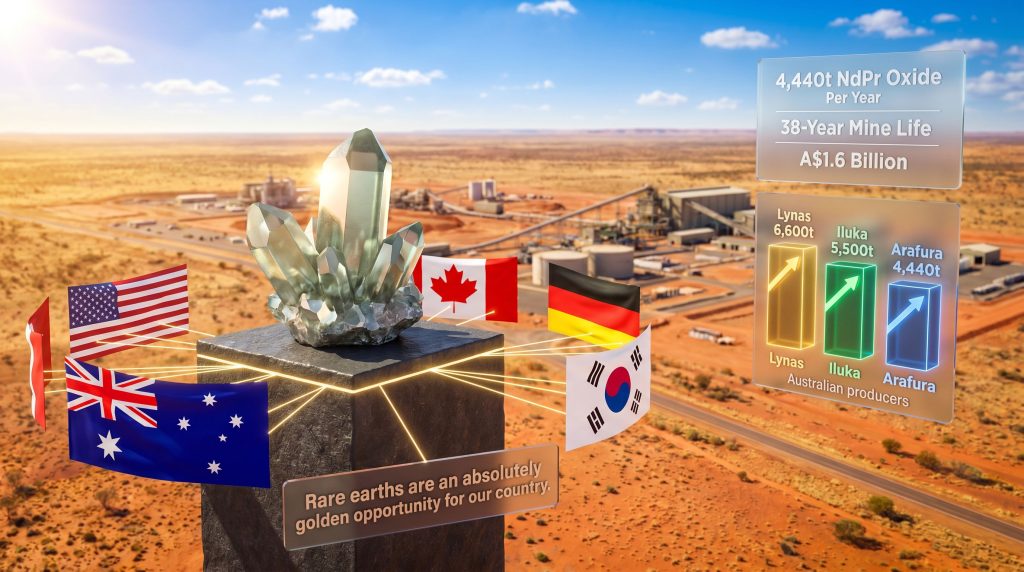
Upon reaching full production, the Arafura Nolans rare earth project will position Australia as the only country outside China with three significant NdPr oxide producers operating simultaneously within a single jurisdiction.
| Producer | Annual NdPr Capacity | Production Status |
|---|---|---|
| Lynas Rare Earths | 6,600 metric tonnes | Operating |
| Iluka Resources | 5,500 metric tonnes | Commissioning (2026) |
| Arafura Nolans | 4,440 metric tonnes | Construction (2026-2029) |
Lynas Rare Earths currently holds the position of the world's largest NdPr producer outside China, having produced 6,600 metric tonnes of NdPr in its most recent financial year. Iluka Resources, with 5,500 metric tonnes of NdPr capacity and production expected to commence in 2026, represents the second entrant in Australia's emerging rare earth production cluster. Arafura's 4,440 metric tonnes of annual capacity upon full commissioning would complete a combined Australian output of approximately 16,500 metric tonnes per year from these three producers alone.
To contextualise that figure, Australian government projections indicate that Nolans alone could satisfy approximately 5% of global NdPr demand at full production. The combined output of all three Australian producers would represent a material reduction in China's current share of global NdPr supply and would constitute the most significant geographic diversification of rare earth production capacity achieved outside China since the rare earth price spike of 2010-2011.
Australian Treasurer Jim Chalmers described rare earths as an "absolutely golden opportunity" for the country and characterised the Nolans FID as "an important step forward for the Australian rare earths industry", framing the development in terms of both economic and national security significance. This framing reflects a broader policy ambition to establish Australia as the primary rare earth supplier to allied industrial economies.
The next major ASX story will hit our subscribers first
Technical Distinctiveness: The Integrated Processing Advantage
The majority of rare earth projects developed outside China have historically relied on Chinese processing facilities at some stage of the production chain, even when the mining operation itself is located in a Western jurisdiction. This dependency at the processing stage represents the most acute vulnerability in non-Chinese rare earth supply chains, and it is the specific problem that the Nolans integrated design addresses.
The Nolans flowsheet moves from ore extraction through beneficiation, hydrometallurgical extraction, and ultimately through rare earth separation, all within the Northern Territory site. This end-to-end integration means that the NdPr oxide delivered to offtake partners such as Hyundai, Kia, and Siemens Gamesa RE is produced entirely outside Chinese processing infrastructure. This is a commercially and geopolitically significant distinction that relatively few non-Chinese projects have achieved or are positioned to achieve.
Engineering contractor Hatch has been engaged to support project development and construction management. Hatch's involvement carries meaningful credibility signalling for lenders and offtake partners assessing project execution risk, given the firm's established track record in large-scale mining and metallurgical project delivery across challenging geographic environments.
Geopolitical Realignment and the China Dependency Problem
The Nolans financing structure did not emerge in a policy vacuum. It reflects the culmination of sustained policy work by allied governments to translate declarations about critical mineral security into actual capital deployment. The United States Inflation Reduction Act, the European Union's Critical Raw Materials Act, and Australia's own Critical Minerals Strategy all create policy frameworks that incentivise exactly the kind of multi-sovereign co-investment that characterises the Nolans syndicate.
What makes the Nolans case analytically interesting is that it represents one of the first instances where these policy frameworks have converged around a single project at sufficient scale to produce a genuinely transformative outcome. Four allied nation ECAs, a domestic infrastructure lender, a high-profile equity anchor, and binding offtake agreements from manufacturers in South Korea and Germany all aligned around a single Northern Territory mine.
Scenario analysis across production pathway outcomes:
| Scenario | Core Assumption | Strategic Implication |
|---|---|---|
| Base Case | Nolans reaches 4,440t NdPr by 2030 | Allied supply chain adds approximately 5% of global NdPr capacity outside China |
| Upside Case | Lynas, Iluka, and Nolans all operate at full capacity simultaneously | Combined approximately 16,500t from Australia alone; material erosion of China's market share |
| Downside Case | Construction delays push first production beyond 2030 | Supply gap widens; EV and wind OEMs face continued price and availability pressure |
China's Potential Policy Response
A speculative but analytically necessary consideration is how China might respond as Western NdPr capacity scales up. Historical precedent suggests several possible mechanisms. China could use pricing leverage to undercut emerging producers during their ramp-up phases, accepting short-term margin compression to prevent Western manufacturers from locking in long-term supply agreements outside Chinese channels.
Alternatively, China could escalate export restrictions in a manner designed to create short-term supply disruptions that undermine confidence in the reliability of non-Chinese supply chains. Neither scenario is certain, but both have historical analogues, and investors and policymakers monitoring the Nolans project should treat Chinese policy response as a live risk variable rather than a remote possibility.
Key Risk Factors and Execution Challenges
No analysis of the Arafura Nolans rare earth project would be complete without a disciplined assessment of the execution risks that stand between FID and first production.
Construction execution in remote Australia is the most immediate risk category. The Alice Springs region presents significant logistical challenges for large-scale industrial construction, including distance from major port infrastructure, extreme temperature variations, limited local workforce availability requiring fly-in fly-out models, and the complexity of managing a supply chain for approximately 600 construction workers in a remote location over a multi-year build period.
NdPr price volatility represents the primary financial risk over the project's operating life. NdPr oxide prices have historically exhibited extreme volatility, with the 2010-2011 spike followed by a multi-year price collapse that rendered several non-Chinese rare earth projects commercially marginal. The long-term offtake agreements with Hyundai, Kia, Siemens Gamesa RE, and Traxys provide a degree of revenue floor certainty, but the pricing mechanisms embedded within those agreements will ultimately determine how much of the NdPr market price upside the project captures during periods of demand strength.
Debt drawdown conditionality is a technical but important risk. The approximately US$775 million in conditional senior debt approvals carries covenant and milestone compliance requirements that must be maintained throughout construction. Any offtake agreement compliance failures or construction milestone slippage could affect drawdown eligibility, creating refinancing risk at precisely the point of maximum capital deployment.
Investors considering exposure to the Arafura Nolans rare earth project or the broader Australian rare earth sector should note that this article does not constitute financial advice. All forecasts, projections, and scenario analyses presented here involve inherent uncertainty, and past performance or stated project parameters are not guarantees of future outcomes.
Strategic Implications: A New Template for Allied Critical Mineral Finance
The Arafura Nolans rare earth project's Final Investment Decision carries implications that extend well beyond a single mine approval in the Northern Territory. The financing architecture assembled for this project — combining four allied nation export credit agencies, a domestic infrastructure lender, a high-profile equity anchor, and diversified manufacturing offtake partners — represents a replicable framework for other critical mineral projects seeking to achieve bankability without relying on Chinese capital or Chinese processing partnerships.
The structural elements that enabled this outcome, including a fully permitted integrated processing operation, credible long-term offtake from investment-grade counterparties, domestic anchor equity, and a project scale sufficient to justify sovereign ECA attention, are transferable to other advanced rare earth, lithium, and cobalt projects in allied jurisdictions. Furthermore, the project's FID milestone may prove as influential for future critical mineral project finance as the project itself is for NdPr supply.
Australia's trajectory toward becoming the dominant non-China supplier of NdPr oxide to allied industrial economies is now structurally supported by three major operations approaching simultaneous production. The compounding effect of Lynas, Iluka, and Arafura operating within the same jurisdiction creates a critical mass of processing expertise, regulatory experience, and supply chain infrastructure that reinforces each project's viability and strengthens Australia's negotiating position as a preferred supplier nation.
"The Arafura Nolans Final Investment Decision marks more than a single project milestone. It is evidence that Western governments and industrial manufacturers have moved beyond policy declarations into direct capital commitment in the race to build rare earth supply chains outside Chinese control. With 4,440 metric tonnes of annual NdPr capacity, a 38-year mine life, and a financing architecture involving four allied nations, Nolans is positioned to become one of the most strategically consequential critical mineral operations commissioned this decade."
Frequently Asked Questions About the Arafura Nolans Rare Earth Project
What is the Arafura Nolans rare earth project?
The Arafura Nolans rare earth project is a fully integrated NdPr oxide mine and processing facility located 135 kilometres north of Alice Springs in Australia's Northern Territory. It is designed to produce 4,440 metric tonnes of NdPr oxide annually over an approximately 38-year mine life, covering the full production chain from ore extraction through to refined oxide output within a single site.
When will the Nolans project begin production?
Construction is scheduled to commence in September 2026, with first production targeted for mid-2029.
How much does the Nolans project cost?
The total capital cost is A$1.6 billion, inclusive of a contingency buffer.
Who is funding the Nolans rare earth project?
Funding comes from a multi-sovereign export credit agency syndicate involving the United States, Canada, Germany, and South Korea, alongside the Northern Australia Infrastructure Facility (up to A$200 million), Hancock Prospecting (15.5% equity), and global trading houses and manufacturers.
Who are the offtake partners for Nolans?
Binding offtake agreements have been secured with Hyundai Motor Group and Kia Corporation for EV motor applications, Siemens Gamesa RE for wind turbine generation, and Traxys for commodity trading and distribution. In addition, 500 metric tonnes per year has been allocated to Australia's national strategic minerals reserve.
How significant is Nolans to global rare earth supply?
Australian government projections indicate that Nolans could satisfy approximately 5% of global NdPr demand at full production capacity.
Is the Nolans project fully permitted?
Yes. At the time of the May 2026 Final Investment Decision, the project was described as fully permitted and construction-ready.
Want to Track the Next Major ASX Mineral Discovery Before the Market Moves?
Discovery Alert's proprietary Discovery IQ model delivers real-time alerts the moment significant mineral discoveries — including critical and rare earth minerals — are announced on the ASX, transforming complex geological data into actionable investment insights for both short-term traders and long-term investors. Explore Discovery Alert's dedicated discoveries page to understand how historic finds have generated extraordinary returns, and begin your 14-day free trial today to position yourself ahead of the broader market.