May 21, 2026
The Hidden Bottleneck Strangling Western Rare Earth Supply Chains
The global transition to clean energy and advanced defence systems rests on a foundation of rare earth elements (REEs) that most Western nations cannot independently process. This is not a mining problem. Deposits of neodymium, praseodymium, dysprosium, and other critical REEs exist across Australia, the United States, and Canada. The fundamental vulnerability sits further downstream, at the refining and separation stage, where a single nation exercises near-total control over global output.
Understanding why this bottleneck exists, and how emerging technology partnerships are working to dismantle it, is essential context for anyone tracking the future of rare earth supply chains.
When big ASX news breaks, our subscribers know first
China's 90% Refining Grip: The Structural Risk Western Markets Can No Longer Absorb
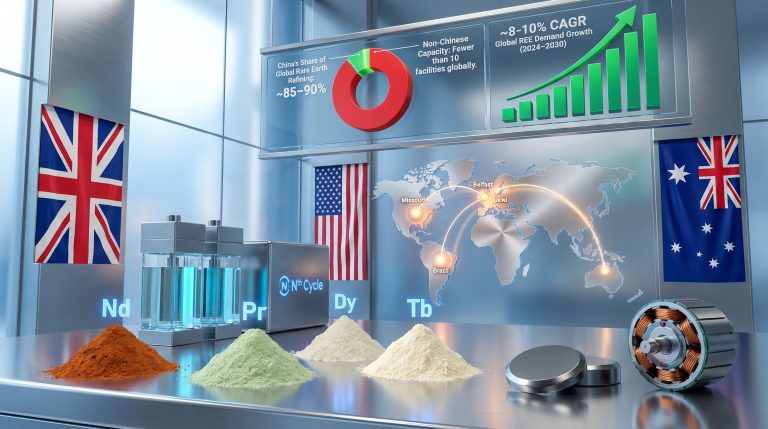
China currently processes approximately 90% of the world's rare earth materials, according to widely cited industry data. This dominance is not simply a matter of geography or ore grade. It reflects decades of deliberate investment in separation chemistry, solvent extraction infrastructure, and vertically integrated processing capacity that Western nations largely dismantled or never fully developed.
The consequence is a supply chain architecture where a country can mine REEs but remain entirely dependent on a geopolitical rival to convert them into usable oxides. When China began implementing export restrictions on heavy rare earths, including dysprosium and terbium, the fragility of this arrangement became impossible to ignore.
Western nations face a structural paradox: they possess significant rare earth mineral endowments but lack the downstream processing infrastructure to convert those resources into the high-purity oxides required by magnet manufacturers, defence contractors, and clean energy equipment producers.
The gap between mining and finished product is wide, and the most technically demanding portion of that gap is the separation and refining step. This is precisely where the IonicRE and Nth Cycle rare earth refining partnership is positioned to intervene.
What the IonicRE and Nth Cycle Partnership Actually Involves
IonicRE, an Australian-listed rare earths company, has entered into a joint development and licensing agreement with Nth Cycle, a US-based electro-extraction technology company. The structure of the agreement gives IonicRE access to Nth Cycle's proprietary processing platform while creating a collaborative development pathway for integrating that technology into IonicRE's own long-loop recycling system.
The central objective is to produce high-purity rare earth oxides (REOs) from recycled feedstocks using an electro-extraction process, bypassing several of the chemical-intensive steps that define conventional rare earth refining. The agreement also contemplates applying the combined technology to primary mixed rare earth carbonate (MREC) separation and refining, furthermore broadening its commercial scope beyond recycling alone.
The Oyster System: A Different Approach to REE Separation
Nth Cycle's core technology platform, known as the Oyster system, replaces the traditional reliance on oxalic acid precipitation with an electricity-driven extraction mechanism. In conventional REE refining, oxalic acid is used to precipitate rare earth oxalates from solution, which are then calcined to produce oxides. This process requires a continuous external supply of oxalic acid, a chemical that is itself subject to supply chain concentration risks.
The Oyster system instead uses electrical energy to drive the separation process, continuously regenerating hydrochloric acid within a closed loop rather than consuming it as a single-use input. The practical implications of this shift are significant.
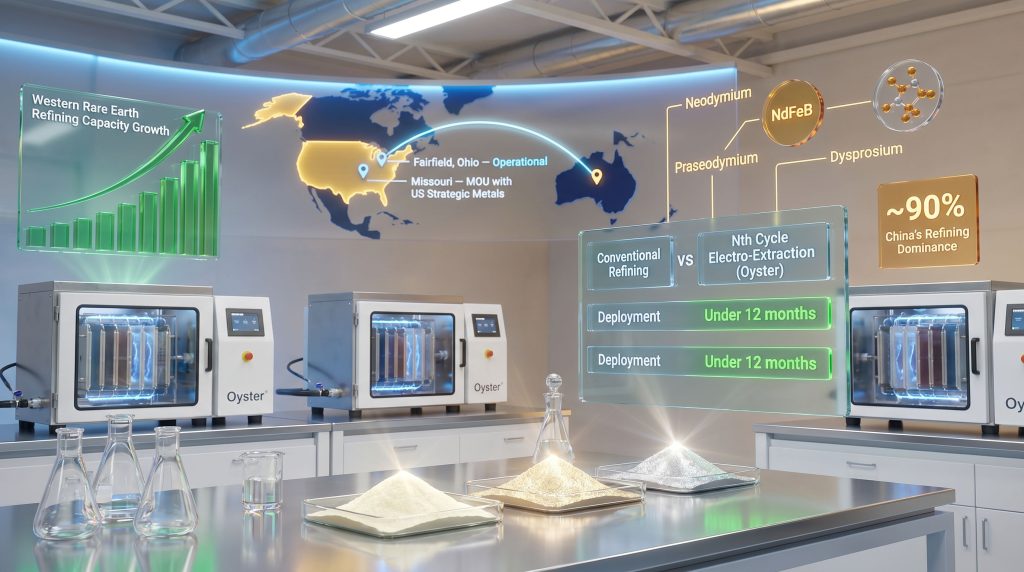
| Feature | Conventional Rare Earth Refining | Nth Cycle Oyster Electro-Extraction |
|---|---|---|
| Primary chemical reagent | Oxalic acid (externally sourced) | Electricity-driven; HCl regenerated in-loop |
| Facility scale requirement | Large centralised plants | Modular; deployable in under 12 months |
| Carbon footprint | High (chemical-intensive) | Lower (electro-driven process) |
| Feedstock flexibility | Primarily primary ore | Scrap, e-waste, and mined feedstocks |
| Geographic flexibility | Fixed infrastructure | Distributed deployment model |
By removing the need to procure and transport oxalic acid, the system reduces both per-unit operating costs and exposure to reagent supply disruptions. It also meaningfully lowers the carbon intensity of the refining process, an increasingly important consideration for downstream customers in the EV and defence sectors who face their own sustainability reporting obligations.
Why Oxalic Acid Dependency Is a Less-Discussed but Critical Risk
The rare earth supply chain discussion frequently centres on mining concentration and export restrictions. Far less attention is paid to the reagent inputs that make refining possible. The rare earth processing challenges around oxalic acid are one such example, and its supply is itself heavily concentrated in Asia.
In conventional refining, oxalic acid precipitation is a core step in producing rare earth oxalates, the intermediate form that gets calcined into finished oxides. A refinery that eliminates this dependency effectively removes an entire tier of supply chain exposure. When the Oyster system regenerates hydrochloric acid within its own process loop, it converts a consumable cost centre into a recyclable internal input, changing the fundamental economics of the operation.
Eliminating external chemical inputs like oxalic acid does more than reduce operating expenditure. It removes a structural dependency that could, under adverse geopolitical conditions, shut down an otherwise functional refinery just as effectively as a mining disruption.
This is a dimension of REE supply chain risk that receives relatively little coverage in mainstream analysis but carries substantial operational significance for any Western refining project attempting to achieve genuine supply independence.
The Target Elements: Why Neodymium, Praseodymium, and Dysprosium Are the Strategic Priority
Not all rare earth elements carry equal strategic weight. The IonicRE and Nth Cycle initiative is focused on a specific cluster of REEs that sit at the intersection of clean energy demand and geopolitical sensitivity.
- Neodymium (Nd) and praseodymium (Pr), collectively referred to in the market as NdPr, are the primary inputs for neodymium-iron-boron (NdFeB) permanent magnets, the highest-performance magnet type used in EV drivetrains and direct-drive wind turbines.
- Dysprosium (Dy) is a heavy rare earth added to NdFeB magnets to maintain coercivity (resistance to demagnetisation) at elevated operating temperatures. Its applications in defence-grade and aerospace permanent magnets make it particularly sensitive to export restriction risk.
- Other heavy rare earths targeted by the initiative include elements affected by China's 2023 and subsequent export licensing controls, which created immediate price and availability disruptions in Western magnet supply chains.
The distinction between light rare earths (like neodymium and praseodymium) and heavy rare earths (like dysprosium and terbium) is important for investors and supply chain analysts. Heavy REEs are far more geographically concentrated in their mineral occurrence and are disproportionately sourced from ionic clay deposits in southern China, making them significantly more exposed to export restriction risk than their light counterparts.
IonicRE's Vertical Integration Strategy: From Scrap to High-Purity Oxide
The Nth Cycle partnership sits within a broader strategic architecture that IonicRE is constructing around domestic rare earth recycling in the United States. The company has signed a memorandum of understanding with US Strategic Metals in Missouri, creating a framework for developing vertically integrated REE production using recycled feedstocks at that facility.
This approach targets end-of-life materials such as spent magnets from industrial equipment, EV motors, and electronic waste as the primary input stream. The logic is straightforward: recycled REE feedstocks are geographically dispersed across Western industrial centres, do not require new mining permits or environmental impact assessments, and can often be processed with a smaller physical infrastructure footprint than primary ore beneficiation.
From E-Waste to Strategic Output: The Urban Mining Opportunity
The volumes of REEs embedded in the existing stock of Western industrial equipment are substantial and growing. As the first generation of large-scale EV deployment approaches end-of-life timelines, the urban mining opportunity from recoverable NdFeB magnet material is expected to increase materially over the coming decade.
Closed-loop refining systems that can economically recover neodymium, praseodymium, and dysprosium from this scrap stream serve a dual function: they satisfy near-term demand without requiring new primary mine supply, and they establish the processing infrastructure that can later be scaled to handle primary ore concentrates as domestic mine production expands.
The next major ASX story will hit our subscribers first
Nth Cycle's Commercial Track Record: Validation Before Rare Earth Scale-Up
A critical element of the IonicRE and Nth Cycle rare earth refining partnership's credibility is that the electro-extraction technology is not at an early laboratory stage. Nth Cycle has already commissioned its first commercial-scale system in Fairfield, Ohio, where it produces nickel cobalt mixed hydroxide precipitate (MHP) from recycled feedstocks.
| Deployment Stage | Location | Output | Status |
|---|---|---|---|
| First commercial system | Fairfield, Ohio | Nickel cobalt MHP | Operational |
| Rare earth refining integration | US (IonicRE partnership) | High-purity REOs | Development phase |
| European expansion | TBC | Transition metals + REEs | Planned |
This operational Ohio facility provides a commercially validated reference point for the technology's performance characteristics before the rare earth application is fully scaled. It also demonstrates that the Oyster system can handle the physicochemical complexity of critical mineral separation at industrial throughputs, an important risk-reduction milestone for any project moving toward investment-grade assessment.
The company has, furthermore, attracted follow-on funding and is pursuing expansion across both US and European markets, indicating investor confidence in the platform's commercial viability beyond the initial nickel cobalt application.
Modular vs. Centralised Refining: Why the Architecture Matters
One of the least-discussed dimensions of the rare earth processing challenge is the infrastructure model question. Western governments and companies have periodically announced ambitions to build large, centralised rare earth refineries. The timelines associated with these projects, often measured in years to decades, and the capital requirements, frequently in the hundreds of millions of dollars, have historically created barriers that prevent these ambitions from translating into operational capacity.
The modular, distributed model enabled by the Oyster system represents a fundamentally different strategic pathway. However, understanding why this matters requires looking at the architecture in more detail.
| Dimension | Centralised Refining Model | Distributed Modular Model |
|---|---|---|
| Capital expenditure | Very high | Moderate to low |
| Time to deploy | 5 to 10+ years | Under 12 months |
| Geopolitical risk exposure | High (single-point dependency) | Low (geographically dispersed) |
| Feedstock flexibility | Limited | High (scrap + primary ore) |
| Environmental compliance | Complex, large-scale permitting | Smaller footprint, faster approvals |
| Supply chain resilience | Vulnerable to disruption | Inherently redundant |
The ability to deploy a rare earth refining module in under 12 months rather than a decade fundamentally changes the risk-adjusted calculus for Western governments and industrial consumers. Consequently, those who need processing capacity on a timeline aligned with electrification and defence modernisation programmes, rather than bureaucratic infrastructure cycles, stand to benefit considerably from this approach.
The US-Australia Critical Minerals Framework: Relevant Policy Context
The IonicRE and Nth Cycle partnership is commercially aligned with the US-Australia Framework for Critical Minerals, a bilateral agreement established in October 2025 under US President Donald Trump and Australian Prime Minister Anthony Albanese. This framework creates a formal cooperative structure for developing non-Chinese processing capacity across defence-relevant and clean energy mineral supply chains.
It is important to note that alignment with a policy framework does not constitute project-specific government endorsement, funding, or accelerated permitting. The framework establishes cooperative principles and potentially creates a more favourable environment for private-sector initiatives in this space. However, each project's commercial progression depends on its own technical and financial merits.
What the framework does signal is that the geopolitical context in which the IonicRE and Nth Cycle rare earth refining partnership operates is one where Western governments have formally identified REE processing independence as a strategic priority. This is particularly relevant given surging critical minerals demand across clean energy and defence sectors, creating a policy tailwind that may support future offtake arrangements and financing structures as the technology matures.
Frequently Asked Questions: IonicRE and Nth Cycle Rare Earth Refining Partnership
What is the IonicRE and Nth Cycle partnership designed to achieve?
The partnership combines IonicRE's long-loop recycling technology with Nth Cycle's electro-extraction platform to produce high-purity rare earth oxides from recycled feedstocks, with the potential to also process primary rare earth concentrate. The primary goal is to create a commercially viable Western refining pathway that reduces dependence on Chinese processing infrastructure.
How does Nth Cycle's electro-extraction technology differ from conventional rare earth refining?
Rather than using externally sourced oxalic acid to precipitate rare earth oxalates, the Oyster system drives separation using electrical energy and regenerates hydrochloric acid within a closed loop. This eliminates a key reagent supply dependency, reduces operating costs, and lowers the carbon intensity of the refining process.
Which rare earth elements does the IonicRE and Nth Cycle process target?
The initiative focuses on neodymium, praseodymium, dysprosium, and other heavy rare earths that are central to permanent magnet production and disproportionately affected by Chinese export restrictions.
What is the current status of Nth Cycle's commercial deployments?
Nth Cycle's first commercial system is operational in Fairfield, Ohio, producing nickel cobalt MHP. The rare earth refining application under the IonicRE partnership is currently in the development phase, with European expansion planned.
Why is reducing oxalic acid dependency significant for rare earth refining economics?
Oxalic acid is a consumable reagent whose supply is concentrated in Asia. Eliminating it from the process loop reduces per-unit operating costs and removes a reagent supply vulnerability that could disrupt refinery operations independently of mining or ore supply issues.
What feedstocks can the Nth Cycle Oyster system process?
The system is designed for flexibility across multiple feedstock types, including end-of-life scrap materials, e-waste, and mined ore concentrates, making it adaptable to both urban mining and conventional primary production inputs.
Key Takeaways: Strategic, Technical, and Commercial Significance
The IonicRE and Nth Cycle rare earth refining partnership addresses several intersecting dimensions of Western critical mineral supply chain vulnerability simultaneously.
- China refines approximately 90% of global rare earths, creating the primary structural risk that this initiative targets through domestic Western processing capacity.
- Electro-extraction eliminates oxalic acid dependency, reducing both operating expenditure and exposure to a less-discussed but operationally critical reagent supply concentration.
- Modular deployment in under 12 months offers a fundamentally faster route to operational refining capacity than the decade-scale timelines associated with centralised refinery construction.
- Target REEs include neodymium, praseodymium, and dysprosium, the highest-value and most geopolitically sensitive elements in the permanent magnet supply chain.
- Nth Cycle's operational Ohio facility provides commercial-scale validation for the electro-extraction technology before the rare earth application is fully developed.
- IonicRE's Missouri MOU with US Strategic Metals signals a vertically integrated strategy connecting recycled feedstock collection through to high-purity REO production.
- Alignment with the US-Australia Critical Minerals Framework positions the partnership within a relevant policy environment, though this does not represent project-specific government funding or formal designation.
- Closed-loop recycling from e-waste and scrap magnets offers a near-term feedstock pathway that does not require new mining approvals or primary ore development, reducing both capital intensity and regulatory complexity.
Disclaimer: This article contains forward-looking statements and analysis based on publicly available information. It does not constitute financial or investment advice. Readers should conduct their own due diligence before making investment decisions. Projections regarding deployment timelines, commercial outcomes, and technology performance are subject to change based on technical, regulatory, and market factors.
Want to Track the Next Major Rare Earth Discovery Before the Market Moves?
Discovery Alert's proprietary Discovery IQ model scans ASX announcements in real time, instantly identifying significant mineral discoveries across rare earths and 30+ other commodities — turning complex data into clear, actionable insights for investors at every level. Explore how historic discoveries have generated substantial returns on Discovery Alert's dedicated discoveries page, and begin your 14-day free trial today to position yourself ahead of the market.