May 21, 2026
The Refining Bottleneck Nobody Talks About
The global conversation around rare earth supply chains almost always gravitates toward mining. Which country has the largest deposits? Which junior explorer just hit mineralisation? Yet the mining layer of this supply chain is, paradoxically, the least strategically constrained. The real chokepoint sits one step downstream, inside the hydrometallurgical processing plants and electrochemical separation facilities where raw rare earth concentrates are transformed into the high-purity oxides and alloys that actually power electric motors, wind turbines, and precision defence systems.
This distinction matters enormously for investors and policymakers alike. A Western nation could theoretically double its rare earth mining output tomorrow and still remain entirely dependent on Chinese processing infrastructure to convert that ore into usable materials. Understanding this dynamic reframes the significance of Ionic Rare Earths in US refining deal with Nth Cycle from a bilateral technology agreement into something considerably more structural.
When big ASX news breaks, our subscribers know first
Why Refining Independence Is Harder Than It Looks
The Chemistry Problem Behind the Geopolitics
The rare earth processing challenges are formidable. Rare earth elements share remarkably similar chemical properties, which is precisely what makes separating them from one another so technically demanding. Conventional separation relies on solvent extraction, a multi-stage process involving organic solvents, aqueous solutions, and carefully controlled pH gradients repeated across hundreds of sequential mixer-settler units. China did not come to dominate this process arbitrarily. Decades of state-coordinated industrial development, tolerance for environmental externalities that Western regulators would not permit, and the accumulation of tacit engineering knowledge gave Chinese processors an advantage that cannot simply be replicated by building a new plant with Western capital.
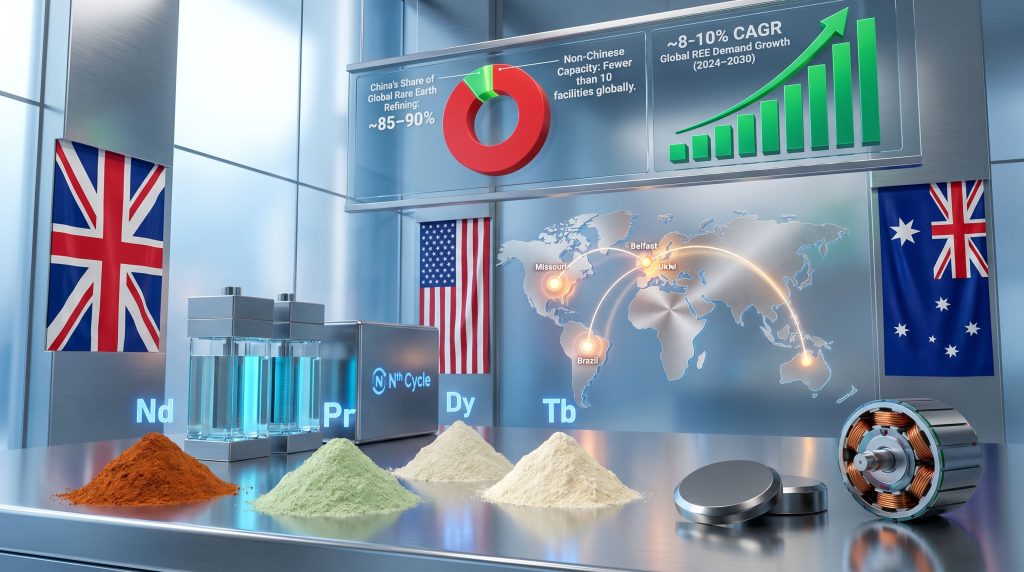
The elements most critical to permanent magnet performance, specifically neodymium (Nd), praseodymium (Pr), dysprosium (Dy), and terbium (Tb), require different separation strategies and carry different supply risk profiles. Light rare earths like NdPr are more widely distributed globally, but heavy rare earths including dysprosium and terbium are geologically concentrated in ion adsorption clay deposits found predominantly in southern China. This geological reality compounds the processing dependency into something approaching strategic vulnerability for Western defence and industrial supply chains.
The Three Layers Any Western Solution Must Address
Building a credible non-Chinese rare earth refining pathway requires simultaneously solving three distinct capability gaps:
- Feedstock access – securing reliable, non-Chinese ore concentrates or secondary materials at sufficient volume and grade
- Separation technology – deploying technically validated processes capable of achieving the purity specifications demanded by defence and automotive buyers
- Downstream oxide or alloy production – converting separated rare earth compounds into the specific product forms required by magnet manufacturers
Most Western initiatives address one or two of these layers. The strategic significance of IonicRE's emerging architecture is that its multi-partnership approach explicitly targets all three, through a distributed model spanning multiple geographies and technology providers.
"The rare earth supply chain challenge is fundamentally a processing problem, not a mining problem. Whichever nations establish credible, scalable refining infrastructure during this decade will hold the structural advantage in advanced manufacturing and defence materials for the following two."
Breaking Down the Nth Cycle Joint Development Agreement
Electro-Extraction: What Is It and Why Does It Change the Calculus?
The centrepiece of the IonicRE and Nth Cycle partnership is Nth Cycle's proprietary electro-extraction technology. Unlike solvent extraction, which relies on chemical selectivity between organic and aqueous phases, electro-extraction applies electrochemical potential to selectively drive target metal ions through a membrane or onto an electrode surface. The result is metal recovery without the large reagent volumes, organic solvent inventories, and associated waste streams that characterise conventional SX circuits.
For Western buyers, particularly US defence contractors and tier-one automotive manufacturers, this distinction carries commercial weight beyond simple cost comparisons. The ability to document and verify processing conditions, reagent inputs, and environmental performance is increasingly embedded in procurement specifications. Traceable, lower-carbon rare earth materials are transitioning from a marketing advantage into a compliance requirement.
Key potential advantages of electro-extraction over conventional solvent extraction include:
- Significantly reduced organic solvent consumption, lowering both operational cost and environmental footprint
- Modular deployment capability, enabling scaling without the capital commitment of a full SX plant
- Reduced aqueous waste generation, addressing one of the principal permitting challenges for Western rare earth processors
- Enhanced process traceability, supporting chain-of-custody documentation requirements from defence and industrial buyers
- Compatibility with secondary feedstocks, including recycled magnet material that conventional SX circuits can struggle to process efficiently
The Belfast Facility as a Proof-of-Concept Platform
The integration target of Q4 2026 at IonicRE's Belfast demonstration facility represents a milestone that the broader Western rare earth refining community will be watching closely. Belfast is not positioned as a commercial production facility at this stage. Its role is to validate the combined technology platform under real processing conditions using actual recycled NdFeB feedstocks.
| Facility Attribute | Detail |
|---|---|
| Location | Belfast, Northern Ireland |
| Operational Role | Rare earth recycling demonstration plant |
| Technology Being Integrated | Nth Cycle electro-extraction system |
| Integration Target | Q4 2026 |
| Primary Input Material | Recycled NdFeB and heavy rare earth materials |
| Target Output | High-purity rare earth oxides (REOs) |
If Belfast demonstrates technically viable separation of heavy rare earths from recycled feedstocks using electro-extraction, it would represent one of the first documented proofs of concept for this specific combination globally — a commercially meaningful milestone in the context of a Western processing sector that currently operates fewer than ten credible rare earth separation facilities worldwide.
IonicRE's Multi-Geography Refining Architecture
Building a Distributed Rather Than Centralised Model
One of the less-discussed strategic dimensions of IonicRE's approach is its deliberate rejection of a single-point market entry strategy. Rather than concentrating capital and technology in one jurisdiction, the company is assembling a geographically distributed refining architecture, each node serving different market access and regulatory environments while sharing common technology and processing knowledge.
This distributed model carries meaningful risk-mitigation logic. A single large refinery in one jurisdiction is exposed to that jurisdiction's regulatory, political, and logistics risks. A multi-geography network can route feedstocks and outputs more flexibly in response to trade policy changes — a consideration that has become considerably more material given the volatility of US-China trade relations and the proliferation of China's export restrictions since 2023.
The Missouri MOU: Establishing a US Footprint
In November 2025, IonicRE formalised a Memorandum of Understanding with US Strategic Metals (USSM) targeting magnet recycling and high-purity rare earth oxide production in Missouri. The focus on NdFeB and samarium-cobalt (SmCo) magnets is strategically deliberate. SmCo magnets, often overlooked in public commentary that focuses almost exclusively on NdFeB, are used extensively in high-temperature defence applications including missile guidance systems and aerospace actuators where NdFeB magnets would demagnetise. A US-based SmCo recycling capability therefore addresses a defence supply chain gap that even the most widely cited Western rare earth initiatives have not specifically targeted.
IonicRE's Global Refining Pipeline at a Glance
| Initiative | Partner / Location | Focus Area | Current Status |
|---|---|---|---|
| Nth Cycle JDA | Nth Cycle / Belfast, UK | Electro-extraction technology integration | Q4 2026 target |
| Missouri Magnet Recycling | US Strategic Metals / Missouri, USA | NdFeB and SmCo recycling, high-purity REOs | MOU signed Nov 2025 |
| Brazil Joint Venture | Undisclosed / Brazil | REO refinery and magnet recycling | Development stage |
| Standalone Heavy REE Refinery | IonicRE-led | Heavy rare earth separation and refining | Planning stage |
The Brazil joint venture deserves particular attention from an investor perspective. Brazil hosts some of the world's largest rare earth deposits, including the Araxá carbonatite complex which contains substantial niobium and rare earth mineralisation. Furthermore, a South American refining node could position IonicRE to service both European and North American markets from a jurisdiction that sits outside the US-China trade confrontation while maintaining allied-nation credentials.
The US Market Opportunity: Defence, EVs, and the Premium Pricing Dynamic
Why Defence Procurement Transforms the Economics
Commercial rare earth markets are notoriously price-volatile, with Chinese state-influenced supply capable of undercutting Western producers whenever geopolitical incentives align with economic ones. This dynamic has historically undermined the business case for non-Chinese refining investment. The structural shift now underway centres on the growing weight of US defence procurement as a demand anchor, a development that is fundamentally reshaping America's rare earth supply chain.
Multiple National Defense Authorization Acts have progressively tightened restrictions on Chinese-sourced materials in defence supply chains. The practical effect is the emergence of a captive, price-insensitive demand segment for supply-chain-verified, non-Chinese rare earth materials. Defence contractors procuring materials for precision-guided munitions, naval electric drive systems, and advanced radar cannot substitute Chinese supply regardless of price differentials. This fundamentally alters the commercial economics of Western refining by creating a base-load demand tier that does not compete on commodity pricing.
EV and Wind Energy: Volume at Scale
Beyond defence, the sheer volume mathematics of clean energy technology deployment create a demand trajectory that recycling-based producers are uniquely positioned to serve over the medium term. The rapidly expanding critical minerals demand driven by energy transition is compounding these pressures further.
| Application | Approximate Rare Earth Magnet Content |
|---|---|
| Electric vehicle traction motor | 1 to 2 kg NdFeB per motor |
| Offshore wind turbine (direct drive) | 600 kg or more NdFeB |
| EV power steering motor | 0.1 to 0.3 kg NdFeB |
| Industrial servo motor | 0.05 to 0.5 kg NdFeB |
As the global EV fleet expands toward hundreds of millions of vehicles over the coming decade, the volume of end-of-life rare earth magnet material available for recycling will grow proportionally. Unlike primary mining supply, which requires new project development to expand, recycling feedstock availability is a function of the installed product base — which is currently growing at compound rates driven by EV adoption and wind energy deployment.
"Global rare earth demand is projected to grow at approximately 8 to 10 percent annually through 2030, driven primarily by EV motors and wind turbines. The recycled rare earth sector sits at the intersection of this demand growth and the simultaneous accumulation of recyclable end-of-life material."
The Recycling Advantage: A Structurally Different Risk Profile
Why Secondary Feedstocks Change the Investment Case
The conventional rare earth investment thesis involves exploration risk, permitting timelines measured in decades, capital expenditures running into hundreds of millions of dollars, and the perpetual threat of Chinese price competition during the ramp-up period. IonicRE's recycling-based model sidesteps most of these structural risks.
The competitive differentiation of recycling versus primary production includes:
- No exploration capital required; feedstock sources are identifiable industrial waste streams
- Permitting burden substantially lower than greenfield mining operations in most Western jurisdictions
- Feedstock volume scales automatically with the growing installed base of magnet-containing products
- Circular economy credentials increasingly valued by ESG-focused institutional investors and corporate procurement teams
- Processing outputs carry inherent chain-of-custody traceability that primary mining supply chains cannot easily replicate
Heavy Rare Earths: The Segment That Defines the Strategic Premium
While NdPr captures most public attention, the genuine strategic vulnerability in the Western rare earth supply chain centres on heavy rare earths, specifically dysprosium and terbium. These elements are added to NdFeB magnets in small but critical quantities — typically two to three percent by weight for dysprosium — to maintain coercivity at elevated operating temperatures. Without HREE additions, NdFeB magnets would demagnetise inside EV motors and wind turbine generators during normal operation.
Chinese control over HREE supply is even more concentrated than for light rare earths. Ion adsorption clay deposits, which account for the majority of global HREE production, are geographically concentrated in China's Jiangxi, Fujian, and Guangdong provinces. Developing non-Chinese HREE supply chains is therefore an order of magnitude more strategically urgent than developing NdPr alternatives, yet it receives considerably less investor attention due to the smaller market volumes involved.
IonicRE's standalone heavy rare earth refinery development pipeline directly targets this underserved segment, which carries the highest strategic premium pricing and the greatest supply chain anxiety among Western defence and industrial buyers.
The next major ASX story will hit our subscribers first
Key Risks Investors Should Understand
Technology, Feedstock, and Competitive Risks
No assessment of this sector is complete without acknowledging the material uncertainties involved.
Technology commercialisation risk is real. Electro-extraction has demonstrated promising results at laboratory and pilot scale, but the transition from pilot to commercial throughput involves engineering challenges that are not yet fully resolved. The Q4 2026 Belfast integration is a proof-of-concept milestone, and investors should not extrapolate from demonstration success to commercial production without additional validation data.
Feedstock availability risk represents a structural constraint on near-term recycling volumes. Current magnet collection and recycling infrastructure in both the US and Europe remains underdeveloped. Collection rates for end-of-life NdFeB magnets are estimated at below five percent in most Western markets, reflecting the absence of standardised end-of-life product take-back programmes. This is a medium-to-long-term constraint that is expected to ease as regulatory frameworks mature, however it limits near-term production volumes.
Geopolitical and competitive risks also warrant acknowledgement. China retains the capacity to strategically price rare earth oxides at levels that undermine Western refining economics, a tactic that has been employed historically at moments of geopolitical tension. The durability of US policy support for domestic critical mineral processing is also subject to political and budgetary variability.
The Western Refining Landscape: Where IonicRE Fits
A Complementary Rather Than Competing Position
Understanding IonicRE's market positioning requires mapping it against the other credible non-Chinese rare earth processing initiatives currently operating or under development. The company's US expansion plans via Viridion JV further illustrate how IonicRE is staking a distinctive claim across multiple jurisdictions.
| Company | Primary Focus | Geography | REE Segment |
|---|---|---|---|
| MP Materials | Primary mining and magnet production | USA (Mountain Pass) | Primarily light REEs |
| Lynas Rare Earths | Primary production and separation | Australia, Malaysia, USA | Light and some heavy REEs |
| Pensana | Separation hub development | UK (Humberside) | Light REEs, European market focus |
| IonicRE | Recycling, secondary processing, HREE refining | UK, USA, Brazil (multi-geography) | Light and heavy REEs from secondary sources |
IonicRE occupies a genuinely complementary niche within this landscape. It is not competing for the same ore deposits as primary producers, and its recycling-based model does not depend on the mine development timelines that constrain capacity growth for Lynas or MP Materials. Consequently, no single Western company currently offers a commercially demonstrated, fully integrated recycling-to-refining-to-oxide pathway covering both light and heavy rare earths — and that gap is precisely what IonicRE's multi-partnership strategy is designed to address.
Milestones That Will Define the Next Two Years
Near-Term Catalysts for Investors to Monitor
The period between now and 2028 will be materially informative for assessing whether Ionic Rare Earths in US refining deal ambitions — and the broader multi-geography architecture — can transition from development-stage ambition to operational reality.
Key milestones to track include:
- Q4 2026 – Nth Cycle electro-extraction integration at Belfast, delivering the first operational data on combined technology performance with recycled rare earth feedstocks
- 2026 to 2027 – Feasibility outcomes from the Missouri magnet recycling initiative under the USSM MOU, which will determine whether a US production facility moves toward capital commitment
- 2027 to 2028 – Brazil joint venture development progress, including potential partner disclosure and first indicative production timelines
- Ongoing – US federal policy developments affecting critical mineral processing incentives, defence procurement rules, and allied-nation supply chain frameworks
The long-term structural case is built on a straightforward trajectory. As EV adoption expands the global installed base of rare earth magnet-containing vehicles, the volume of end-of-life material available for recycling grows exponentially. Companies that establish technology validation, partnership networks, and regulatory relationships during the current development phase will hold first-mover advantages when feedstock volumes reach commercially meaningful scale — a transition most analysts project to accelerate meaningfully through the early 2030s.
This article contains forward-looking analysis and references to projected market conditions. All projections and estimates regarding demand growth, feedstock availability, and technology performance involve material uncertainty. Readers should conduct independent due diligence before making any investment decisions. Past performance of companies or technologies referenced does not guarantee future results.
Want to Identify the Next Major Mineral Discovery Before the Broader Market?
Discovery Alert's proprietary Discovery IQ model delivers real-time alerts on significant ASX mineral discoveries, transforming complex data across more than 30 commodities into clear, actionable insights for both short-term traders and long-term investors — explore historic discoveries and their returns to understand the scale of opportunity, then begin your 14-day free trial at Discovery Alert to position yourself ahead of the market.