May 22, 2026
The Hidden Architecture of Rare Earth Price Formation
Commodity markets function on a foundational assumption: that prices reflect genuine supply and demand dynamics between willing buyers and sellers, operating with reasonable transparency. For most industrial metals, this assumption broadly holds. For rare earth elements, particularly those traded outside China, it does not. The pricing signals that European project developers, lenders, and manufacturers rely upon are derived from a market structure that operates under fundamentally different conditions, creating a growing tension between the EU's industrial ambitions and the financial realities of developing domestic supply chains.
Understanding why a credible Europe rare earth pricing index matters requires examining not just what prices are, but how they are formed, who controls that formation, and what the downstream consequences are for investment, policy, and supply security.
When big ASX news breaks, our subscribers know first
Why the Current Rare Earth Pricing System Fails Western Markets
China's Role as Price Setter, Not Just Price Participant
China's dominance over rare earth supply chains is well documented, but its role as the de facto global price setter is less frequently analysed in detail. China accounts for the overwhelming majority of global rare earth mining output, separation capacity, and downstream processing into oxides, metals, and alloys. This vertical integration means that price formation occurs within a domestic market that is shaped by state industrial policy, export quota management, and trading conditions that restrict external participation.
The consequence is that the benchmarks referenced by Western buyers, developers, and financiers are not products of transparent, arm's-length market activity. Bernd Schaefer, CEO of EIT RawMaterials, has publicly stated that what is received from China constitutes neither a representative price nor, in strict microeconomic terms, a genuine market price, as reported by Reuters (May 2026). This is not a rhetorical point. It reflects a structural deficiency in the global rare earth pricing architecture.
What Opaque Benchmarks Mean in Practice
For a European mining or processing project seeking debt financing, the lender's financial model requires defensible revenue assumptions. Those assumptions are anchored to a price. If the price being used reflects Chinese domestic conditions — including state-influenced trading, restricted external access, and periodic policy-driven supply interventions — then the model is built on a foundation that does not represent the commercial reality of the project being evaluated.
The practical effects compound across the investment lifecycle:
- Project net present value calculations become unreliable, widening the range of outcomes to the point where lenders demand excessive risk premiums
- Off-take contract negotiations lack a credible neutral reference point, disadvantaging European producers in bilateral deal structures
- Policy assessments of whether European supply chain targets are achievable become methodologically compromised
- Institutional investors cannot construct defensible hedging strategies without a liquid, transparent benchmark
Structural insight: The core problem is not price levels being too low. It is that the prices being used as benchmarks are neither representative of non-Chinese cost structures nor verifiable through transparent trading. This distinction matters enormously for investment decisions.
Building a European Rare Earth Index: The Technical and Market Challenges
What Makes a Commodity Index Credible
A functioning commodity price index is not simply an aggregation of reported transactions. It requires a minimum threshold of traded volume, sufficient diversity among market participants, transparent and verifiable transaction reporting, and consistent methodology across price assessment periods. Established indices for oil, base metals, and agricultural commodities have taken decades to mature into the benchmark instruments that underpin trillions of dollars in financial contracts.
Rare earths outside China currently exhibit none of these characteristics at scale. Trading remains fragmented, dominated by bilateral contracts with confidential pricing, and spread across a relatively small number of active counterparties. Existing price reporting services, including Argus, Fastmarkets, and Shanghai Metals Market, publish indicative prices, but no universally recognised European benchmark with sufficient market depth currently exists.
The Minimum Volume Problem
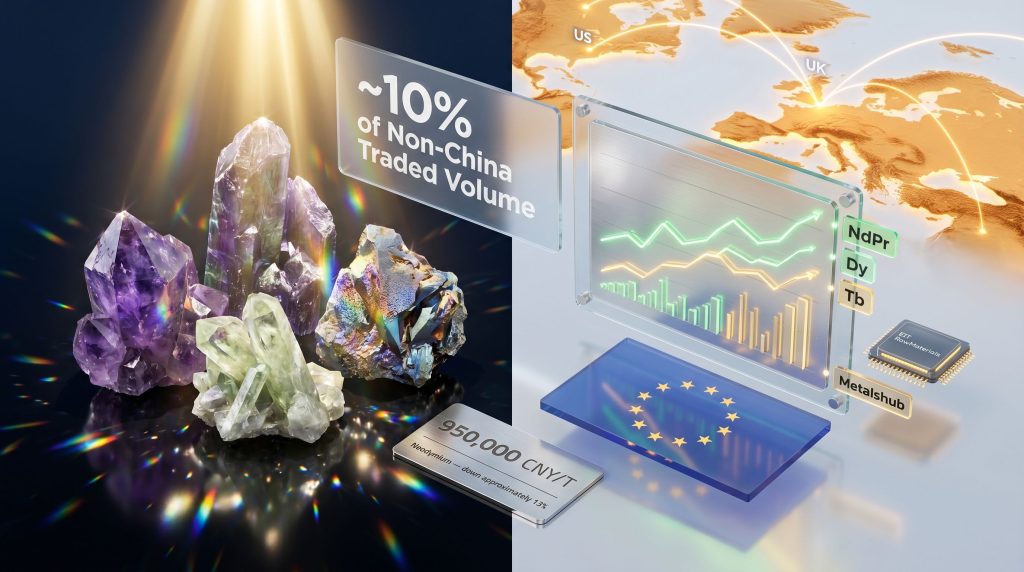
EIT RawMaterials and digital metals trading platform Metalshub are collaborating to develop a European pricing index for rare earths and specialty metals. The initiative acknowledges directly that building a representative index will take considerable time. Industry leadership has indicated that reaching index representativeness would require trading volumes of at least 10% of total non-Chinese traded volume, and this threshold varies materially by individual material.
| Requirement | Current Status |
|---|---|
| Minimum ~10% of non-China traded volume | Not achieved across most rare earths |
| Transparent, arm's-length transaction data | Largely unavailable outside China |
| Diverse buyers, sellers, and traders | Limited in European context |
| Independent price reporting infrastructure | Under active development |
| Futures or forward market instruments | Not yet operational |
This volume threshold is not arbitrary. Below it, a small number of atypical transactions can distort the index, making it unrepresentative and potentially manipulable. Reaching and sustaining this threshold requires parallel development of European mining, separation, and refining capacity — because without physical production there is no trading, and without trading there is no index.
The Transatlantic Extension Case
One of the less widely discussed dimensions of this initiative is its potential geographic scope. The index being developed is not conceived as exclusively European. There is deliberate intent to incorporate trading participation from the United States, Australia, Canada, and the United Kingdom. This reflects a recognition that European non-Chinese trading volumes alone may be insufficient in the near term to generate statistically robust price signals for all relevant materials.
A coordinated allied-nation benchmark would carry substantially greater market weight than a purely European construct, and would align with the broader critical minerals partnership frameworks being developed among G7 economies. The geopolitical logic is straightforward: shared price discovery infrastructure reduces individual nation exposure to Chinese benchmark dependency and creates collective leverage in supply negotiations.
European Rare Earth Market Data: Prices, Volumes, and Supply Concentration
What the Numbers Reveal
Recent European rare earth market data paints a picture of declining prices against a backdrop of persistent supply concentration risk. Furthermore, China's rare earth export restrictions have added additional pressure on Western buyers seeking price certainty.
| Metric | Data Point |
|---|---|
| EU rare earth import price change (2023) | Approximately 15% year-on-year decline |
| Share of EU imports from China, Malaysia, and Russia combined (2023) | Approximately 94% |
| Neodymium price (May 2026) | ~950,000 CNY/T, down approximately 13% over prior month |
| EU import volume trend | Rose in 2022, stabilised in 2023, declined sharply in 2024 |
Neodymium and praseodymium, the rare earth elements most critical to permanent magnet production for EV motors and wind turbines, have seen significant price softening since the post-2022 peak. This reflects a combination of Chinese domestic oversupply, slower-than-forecast EV demand growth in certain markets, and deliberate management of Chinese output timing. For current neodymium price data, Benchmark Minerals provides regularly updated market pricing across key rare earth elements.
Critically, this price weakness does not signal reduced supply chain risk. It signals the opposite: lower prices make it harder to justify investment in higher-cost European projects at precisely the moment when supply diversification is most strategically necessary.
The Investment Paradox of Low Prices
European rare earth projects face a cost structure that is structurally higher than Chinese equivalents due to labour costs, environmental compliance requirements, permitting processes, and infrastructure investment. When the reference price used to evaluate project economics is derived from a market with fundamentally lower cost inputs and state support, European projects systematically appear uneconomic on a straight comparison.
This creates a perverse incentive structure. The periods when rare earth prices are soft — often because China is managing supply to suppress Western investment — are precisely the periods when Western project financing is most difficult to secure. A domestically anchored pricing index, reflecting the true cost-of-supply economics of non-Chinese production, would help break this cycle.
EU Policy Architecture: Commitments and the Execution Gap
The Targets on Paper
The EU has established a clear set of commitments under its critical raw materials transition agenda:
- 10% domestic mining target by 2030 for strategic raw materials
- 65% single-country dependency cap ensuring no more than 65% of EU annual needs for any strategic material comes from a single third country
- EUR 3 billion RESourceEU Action Plan announced in December 2024 to accelerate supply chain diversification
Where Progress Has Stalled
Despite the clarity of the targets, execution has been uneven. The most concrete progress has been through a pilot joint EU strategic stockpile, led by Italy, France, and Germany, which has shortlisted tungsten and gallium as the first materials for storage. This is meaningful but narrow.
| Policy Commitment | Implementation Status |
|---|---|
| Domestic mining capacity | Early-stage; permitting timelines remain a constraint |
| Processing and refining infrastructure | Largely absent; critical downstream gap |
| Joint EU strategic stockpile | Pilot underway; tungsten and gallium shortlisted |
| Transparent pricing infrastructure | Under development; no operational index |
| Volume and growth data transparency | Acknowledged as insufficient |
Gallium is particularly significant given that China implemented export controls on gallium and germanium in 2023, demonstrating both the willingness and capability to use critical mineral supply as a geopolitical instrument. Tungsten is a similar case, with supply concentration in China creating acute strategic exposure for European defence and industrial applications.
Industry observers have noted that assessing whether the EU will meet its 2030 critical mineral diversification targets is currently impossible due to insufficient transparent data on traded volumes and demand growth projections. This is itself a symptom of the pricing infrastructure problem: without transparent markets, reliable data does not exist.
Critical Materials Driving European Strategic Demand
The Magnet Supply Chain as the Core Vulnerability
The rare earth elements most critical to European industrial and defence applications share a common thread: they are essential inputs to permanent magnet technology, which underpins EV motors, offshore wind turbine generators, and advanced defence systems. Moreover, Europe's critical minerals supply chain remains heavily exposed to single-source dependency across several of these key materials.
| Element | Primary Application | Supply Risk |
|---|---|---|
| Neodymium (Nd) | Permanent magnets for EV motors and wind turbines | Very High |
| Praseodymium (Pr) | NdPr magnet alloys | Very High |
| Dysprosium (Dy) | High-temperature magnet coercivity | Extreme |
| Terbium (Tb) | High-performance magnet applications | Extreme |
| Gallium | Semiconductors, defence electronics | High (export controls active) |
| Tungsten | Defence, cutting tools, industrial manufacturing | High (EU stockpile priority) |
Dysprosium and terbium are less publicly discussed than neodymium but arguably represent a more acute supply risk. Both are heavy rare earth elements, produced in far smaller volumes, with even more concentrated supply sources. Their role in maintaining magnet performance at elevated operating temperatures makes them irreplaceable in demanding applications such as traction motors and aerospace systems.
The next major ASX story will hit our subscribers first
The Feedback Loop That Determines Europe's Supply Chain Future
Why Pricing and Processing Must Develop Together
The pathway to genuine European rare earth supply chain independence is a multi-condition problem, not a single policy intervention. Transparent pricing infrastructure and domestic processing capacity are mutually dependent: without processing capacity there is insufficient trading activity to sustain a credible index, and without a credible index there is insufficient investment certainty to justify building processing capacity.
The investment-pricing feedback loop works as follows:
- Transparent price benchmarks enable credible revenue assumptions in financial models
- Credible models unlock project financing for mining and processing
- New production creates physical trading volumes
- Increased trading activity supports index representativeness
- A more robust index attracts further investment and hedging activity
- Greater market depth improves price discovery and reduces volatility
Breaking into this cycle requires deliberate infrastructure investment, regulatory incentivisation of transparent price reporting, and allied-nation coordination to accelerate volume thresholds. It cannot be achieved through market forces alone.
The Re-Export Risk: Why Processing Matters as Much as Mining
A risk that receives insufficient attention in European policy discussions is the re-export dynamic. If Europe develops new mining capacity without concurrent investment in separation and refining infrastructure, the raw material output is highly likely to flow back into Chinese supply chains. Chinese processors hold established offtake relationships, logistics networks, and the dominant global processing capacity.
Consequently, European mining investment without downstream processing investment does not deliver supply chain independence. It delivers a different form of Chinese dependency. The rare earth processing challenges involved in building this capacity are substantial, and a functioning Europe rare earth pricing index, combined with domestic processing capacity, is a necessary condition for changing this dynamic.
Frequently Asked Questions: Europe Rare Earth Pricing Index
What is a rare earth pricing index and how does it work?
A rare earth pricing index aggregates verifiable transaction data from a representative volume of arm's-length trades to produce a market price for a given material. It functions analogously to commodity indices for crude oil or copper, providing a transparent reference point for contract pricing, financial modelling, and investment analysis. For the index to be credible, it must reflect genuine market activity rather than indicative or estimated prices.
Why is there no established European rare earth benchmark today?
The primary barriers are low traded volumes outside China, an absence of transparent transaction reporting infrastructure, and a limited pool of active market participants in European rare earth trading. The market is currently dominated by bilateral confidential contracts, which do not generate the public price data necessary for index construction.
How would a European index affect project financing?
Lenders and institutional investors require defensible price assumptions to underwrite project finance for mining and processing projects. A transparent European benchmark would provide a credible, independently verifiable reference for revenue projections, reducing the uncertainty premium currently embedded in financing terms and enabling capital to flow toward projects that would otherwise be considered too speculative.
Which elements are most urgently in need of transparent European pricing?
NdPr remains the highest-priority material given its central role in EV and wind turbine permanent magnets. Dysprosium and terbium are arguably more acute in terms of supply vulnerability, given their smaller production volumes and higher concentration of supply. Gallium and tungsten are priorities for defence and semiconductor supply chains.
What is the realistic timeline for a functioning European index?
No confirmed operational date has been established. The collaboration between EIT RawMaterials and Metalshub represents the most concrete initiative currently underway, but building a representative index will require sustained development of European processing capacity and traded volumes over multiple years. The 10% non-Chinese traded volume threshold for index representativeness is not achievable in the near term for most materials.
Readers seeking broader context on European critical mineral supply chain policy and rare earth market developments may find additional coverage at Mining Weekly (miningweekly.com), which tracks rare earth market dynamics, EU regulatory frameworks, and global critical mineral trade.
This article contains forward-looking statements and analysis based on publicly available information as of May 2026. It does not constitute financial or investment advice. Investors should conduct independent due diligence before making investment decisions related to rare earth or critical mineral markets.
Want To Be First When A Major Rare Earth Discovery Hits The ASX?
Discovery Alert's proprietary Discovery IQ model scans ASX announcements in real time, instantly identifying significant mineral discoveries across rare earths and other critical commodities — translating complex data into clear, actionable opportunities for investors at every level. Explore historic discoveries and their extraordinary returns, then begin your 14-day free trial at Discovery Alert to position yourself ahead of the market.