May 11, 2026
The Fragile Architecture of Global Oil: Why One Chokepoint Can Erase a Billion Barrels
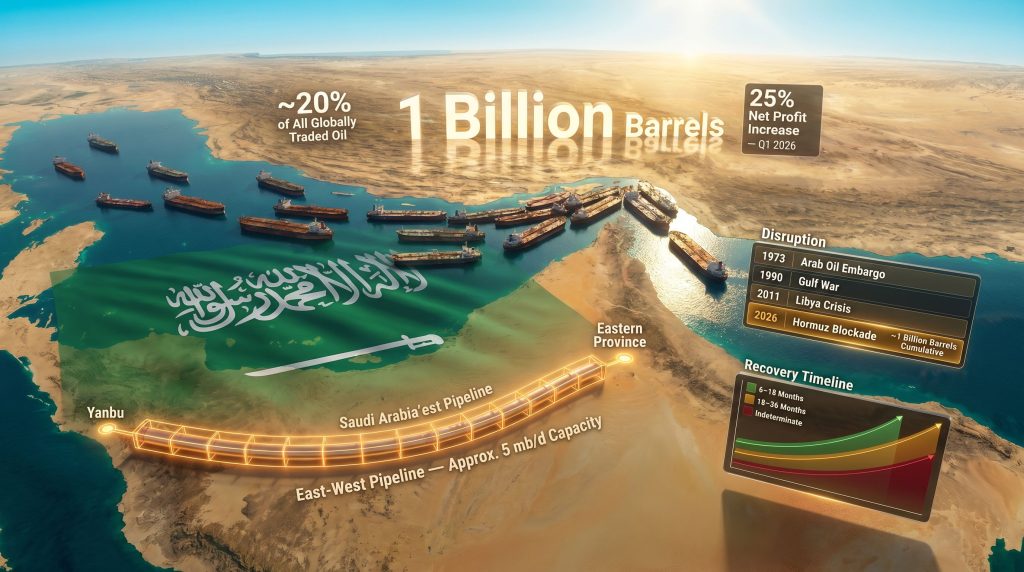
Consider the physics of a global system where roughly one-fifth of all oil traded internationally passes through a waterway approximately 33 kilometres wide at its narrowest navigable point. No redundant pipeline network, no combination of strategic reserve releases, and no alternative shipping corridor can fully compensate when that single passage closes. The Strait of Hormuz is not merely a geographic feature — it is the structural load-bearing wall of the global energy economy, and when it fails, the entire edifice strains.
That structural reality moved from theoretical risk to lived consequence in 2026, when Iran's blockade of the Strait, precipitated by the broader U.S.-Israeli conflict in the region, removed approximately 1 billion barrels of oil from global markets over a two-month period. Saudi Aramco CEO Amin Nasser made clear that the scale of this loss carries consequences far beyond the duration of the blockade itself. According to Reuters, restoring shipping routes is fundamentally different from restoring a market deprived of supply at that magnitude. The Aramco CEO warns 1 billion barrels lost will slow oil market recovery — and the mechanics behind that warning deserve careful examination.
When big ASX news breaks, our subscribers know first
Why Closing One Passage Creates a System-Wide Problem
The Strait of Hormuz functions as what energy security analysts describe as a single-point-of-failure chokepoint — a node in a network where disruption cannot be rerouted at equivalent scale. Approximately 20% of all globally traded oil moves through this passage, representing the daily export flows of Saudi Arabia, Iraq, Kuwait, the UAE, Bahrain, and Qatar, along with a significant portion of global LNG trade. Furthermore, the crude oil price trends associated with Hormuz disruptions have historically validated just how severe the downstream consequences can be.
What distinguishes Hormuz from other critical shipping lanes is the absence of genuine equivalent alternatives. The Suez Canal can absorb rerouted Atlantic basin flows. The Malacca Strait, while critical for Asian trade, has multiple bypass options. Hormuz does not. The East-West Pipeline corridor and limited overland routes provide partial mitigation, but no existing infrastructure can fully replace the volume throughput that Hormuz facilitates at scale.
The Arithmetic of a Two-Month Supply Removal
Global oil demand in 2026 operates at approximately 100 to 103 million barrels per day. A cumulative loss of 1 billion barrels over sixty days implies a disruption rate of roughly 16 to 17 million barrels per day removed from available supply during the blockade period. To contextualise that figure: it exceeds the entire daily production output of the United States, currently the world's largest oil producer.
The critical distinction that markets and policymakers must grasp is the difference between a supply interruption and a supply deficit. An interruption is temporary and self-correcting once restored. A deficit is cumulative and requires active remediation through sustained production surpluses. When inventory drawdowns reach billion-barrel scale, the system does not simply snap back to equilibrium the moment shipping lanes reopen. The hole must be refilled barrel by barrel, over months or years, depending on available spare production capacity and OPEC+ strategic decisions.
Restoring physical access to a shipping route addresses the flow problem. It does not address the stock problem — and in commodity markets, it is the stock problem that drives price behaviour over extended timeframes.
How Underinvestment Left Global Inventories Without a Safety Net
The Hormuz blockade did not strike a market operating with healthy inventory buffers. It struck a market already weakened by a decade of suppressed upstream capital expenditure. Between 2015 and 2020, global upstream oil and gas investment declined substantially as a combination of price volatility, ESG-driven divestment pressure, and accelerating energy transition narratives reduced the economic and reputational incentive to deploy capital into new exploration and production.
The compounding effect of this underinvestment cycle is lower spare production capacity globally and reduced ability to rapidly ramp output in response to supply shocks. When a disruption of Hormuz's magnitude occurs against this backdrop, the system has fewer shock absorbers available than it would have possessed in prior decades. In addition, the oil price shock risks that analysts had flagged in earlier years are now materialising with full force.
Historical Disruption Comparison
The current crisis sits in a particularly vulnerable inventory context relative to prior disruptions:
| Disruption Event | Estimated Supply Loss | Pre-Crisis Inventory Buffer | Price Impact |
|---|---|---|---|
| 1973 Arab Oil Embargo | ~3 mb/d over months | Moderate | +400% over 12 months |
| 1990 Gulf War | ~4.3 mb/d short-term | Adequate (IEA SPR release) | +100% short-term, subsequently reversed |
| 2011 Libya Crisis | ~1.3 mb/d | Comfortable | Moderate, contained |
| 2026 Hormuz Blockade | ~1 billion barrels cumulative | Critically low | Significant spike, ongoing |
mb/d = million barrels per day. Table for comparative illustrative analysis. Historical data sourced from publicly available IEA and EIA records. This is not financial advice.
The 2026 scenario is distinct not merely in scale but in context. Previous major disruptions occurred against inventory backgrounds that provided meaningful buffer time for diplomatic and production responses to take effect. The current crisis arrived at a moment of structural fragility, amplifying both the price response and the recovery timeline.
The East-West Pipeline: Infrastructure Redundancy as Strategic Advantage
While the broader market grappled with the Hormuz closure, Saudi Aramco demonstrated the operational value of having invested in bypass infrastructure decades earlier. The East-West Pipeline, known as Petroline, routes crude oil overland from the Eastern Province oil fields westward across Saudi Arabia to the Red Sea port of Yanbu, bypassing the Strait of Hormuz entirely.
With an operational capacity of approximately 5 million barrels per day at full utilisation, the pipeline represents a significant but partial mitigation tool. Amin Nasser described it as a critical lifeline during the current supply crisis, and its activation has allowed Aramco to maintain export volumes to key customers, particularly in Asia, while competitors reliant on Hormuz-dependent routing face significantly constrained throughput options.
What Petroline Reveals About Energy Security Investment Philosophy
The East-West Pipeline embodies a strategic investment principle that much of the global energy security architecture has underweighted: redundant export infrastructure as geopolitical risk insurance. The pipeline's value is not measured in routine operations — it is measured precisely in moments like the current crisis, where its existence is the difference between maintained supply relationships and catastrophic disruption.
Several key observations emerge from this dynamic:
- Producers with dual or multiple export routing options possess a structural competitive advantage during geopolitical supply disruptions
- Nations heavily dependent on Hormuz routing with no bypass alternatives — including Iraq, Kuwait, and a substantial portion of UAE exports — face a fundamentally different risk profile
- The insurance value of bypass infrastructure has historically been difficult to quantify in capital allocation decisions, leading to systematic underinvestment in redundancy
- Red Sea routing itself carries elevated risk given Houthi capabilities demonstrated from 2023 onward, creating a secondary vulnerability layer for Petroline-dependent export flows
The Dual-Disruption Scenario: A Non-Negligible Tail Risk
The scenario where both Hormuz and Red Sea routing face simultaneous disruption represents a genuine, if lower-probability, tail risk in the current geopolitical environment. Under such conditions, Saudi Arabia's primary alternative to Hormuz-routed exports would itself be compromised, reducing global accessible supply by a volume that existing strategic petroleum reserve systems are not dimensioned to replace.
This scenario is not merely theoretical. Houthi forces have demonstrated both the intent and the operational capability to target Red Sea shipping and associated infrastructure. Any escalation that draws Saudi energy infrastructure into direct targeting would force a fundamental reassessment of global energy security architecture at a speed that policy responses cannot match.
Aramco's Q1 2026 Earnings: Crisis Profitability and Its Market Implications
Saudi Aramco reported a 25% increase in net profit for the first quarter of 2026, a result that on the surface appears paradoxical given the geopolitical disruption simultaneously roiling global energy markets. In reality, it reflects the precise mechanism by which supply shocks translate into producer windfalls: scarcity drives prices, prices drive margins, and producers with maintained volume access capture the full benefit.
Aramco's position is particularly advantaged. Its East-West Pipeline access means it has not been constrained to the same volume reductions affecting Hormuz-dependent producers. It is therefore capturing elevated spot prices on largely maintained export volumes — a combination that naturally produces outsized profit growth. Monitoring the current crude oil prices in this environment reveals just how dramatically the supply shock has been priced into global benchmarks.
When the world's largest oil producer reports record-adjacent quarterly profits during a supply crisis that it is simultaneously warning will take extended time to resolve, it creates an important question about incentive alignment: do the same market conditions that generate urgency among importing nations create equivalent urgency among producing nations to normalise supply?
This is not a cynical observation — it is a structural feature of commodity markets. Producers operating at positive margin expansion during price spikes face genuinely different incentives regarding production ramp-up timing compared to periods of price stress. Historical OPEC+ behaviour during elevated-price environments suggests that supply normalisation is not always prioritised at maximum possible speed when prices remain comfortably above producer break-even thresholds.
Three Recovery Scenarios and Their Market Implications
Understanding recovery timelines requires moving beyond the binary question of whether Hormuz reopens and into scenario-based analysis that accounts for inventory rebuild dynamics, OPEC+ production posture, and Asian demand responses.
| Scenario | Probability Assessment | Price Outlook | Recovery Timeline |
|---|---|---|---|
| Rapid Reopening + Gradual Normalization | Moderate | Elevated but gradually declining | 6 to 18 months |
| Prolonged Disruption + Alternative Routing Expansion | Moderate to High | Persistently elevated | 18 to 36 months |
| Escalation + Broader Infrastructure Disruption | Lower but non-negligible | Severe spike | Indeterminate |
Probability assessments are analytical estimates for educational and informational purposes only. This does not constitute investment advice.
Scenario 1 assumes diplomatic resolution and cessation of active hostilities. Even under this most optimistic pathway, the 1 billion barrel inventory deficit requires months of sustained production surplus to meaningfully rebuild. With global spare production capacity constrained by the underinvestment cycle described above, the production surplus required to rebuild inventories while simultaneously meeting ongoing demand growth is not easily achieved.
Scenario 2 involves continued or intermittent Hormuz disruption that accelerates investment in bypass infrastructure while Asian importing nations aggressively diversify procurement toward West African, Latin American, and alternative suppliers. This scenario extends the period of above-trend oil prices and may permanently alter Middle Eastern market share dynamics in Asia if alternative supply relationships become entrenched.
Scenario 3 represents the tail risk of conflict expansion to broader energy infrastructure including the East-West Pipeline and Red Sea port facilities. Under this scenario, the LNG market faces contagion effects as regional stability deteriorates, and the global economy approaches threshold levels for recession risk driven by sustained energy price shock.
The next major ASX story will hit our subscribers first
Asia's Demand Anchor Role in Shaping the Recovery Trajectory
No analysis of Hormuz disruption consequences is complete without examining the Asian demand dimension. Asia-Pacific nations collectively represent the majority of Middle Eastern crude exports, with China, India, Japan, and South Korea functioning as the four dominant demand centres for Gulf oil. The structural dependency of these economies on Hormuz-transiting crude is not a short-term procurement pattern — it is the foundational architecture of their energy import relationships built over decades.
Amin Nasser explicitly reaffirmed that Asia remains a central priority for Aramco's supply strategy despite the current shipping disruptions, a statement that reflects commercial realities as much as strategic intent. Losing Asian market relationships under crisis conditions would represent a permanent market share loss that no temporary price premium could offset.
The Demand-Side Feedback Loop
A dynamic that receives insufficient attention in supply-side focused analysis is the potential for demand destruction to paradoxically complicate recovery timelines. If sustained elevated oil prices begin suppressing industrial activity and transport fuel consumption across Asian economies, the demand reduction may slow the inventory replenishment process by reducing the total volume throughput needed. This creates a feedback loop where:
- Supply disruption reduces availability and raises prices
- Higher prices reduce consumption among price-sensitive demand segments
- Reduced consumption slows the pace at which producers can run sustained surpluses above demand to rebuild inventories
- Extended inventory rebuild period maintains elevated prices longer than expected
- Elevated prices continue suppressing demand, cycling back to step 3
Breaking this cycle requires either a demand recovery driven by price normalisation or a production surge sufficient to overwhelm the suppressed demand baseline.
What Global Energy Security Architecture Must Learn From This Crisis
The 2026 Hormuz blockade is not an unprecedented event in historical terms. The Strait has been subject to closure threats, mining incidents, and transit disruptions across multiple decades of Middle Eastern geopolitical cycles. What is unprecedented is the severity of the inventory deficit that existed before the current disruption began, and the degree to which underinvestment has reduced the global system's capacity to absorb shocks of this magnitude.
Several structural lessons emerge with particular clarity:
- Concentration risk in global oil trade routing is systematically underpriced in both market valuations and policy frameworks, leading to insufficient investment in alternative corridors
- Strategic petroleum reserve systems were designed for shorter-duration, smaller-magnitude disruptions and face meaningful scale challenges against a billion-barrel cumulative supply removal event
- The energy transition paradox — reduced fossil fuel upstream investment before renewable capacity is sufficient to compensate — has created a medium-term supply adequacy vulnerability that geopolitical disruptions expose with particular severity
- Bypass infrastructure investment carries asymmetric strategic value that traditional capital allocation frameworks underweight, as its insurance function is invisible during normal operations and invaluable during crises
The intersection of low inventory buffers, constrained spare capacity, geopolitical concentration risk, and underinvestment in infrastructure redundancy has created the conditions for exactly the kind of slow, grinding recovery that Aramco's CEO warns is now underway. Furthermore, the broader oil geopolitics analysis points to structural vulnerabilities that extend well beyond any single disruption event. OPEC market influence will, however, remain a decisive variable in determining how quickly production surpluses can be mobilised to begin refilling the supply gap.
Reopening the Strait of Hormuz, when it occurs, will mark the end of the acute phase of this crisis — but the structural phase, measured in inventory rebuilding, market rebalancing, and pricing normalisation, will extend well beyond that milestone. The Economic Times has similarly noted that the Aramco CEO warns 1 billion barrels lost will slow oil market recovery in ways that market participants may be underestimating.
This article is for informational purposes only and does not constitute financial, investment, or trading advice. Forward-looking scenarios and timeline projections are analytical estimates subject to significant uncertainty. Readers should conduct independent research before making investment decisions. For ongoing regional energy market coverage, visit the Zawya energy section at zawya.com/en/business/energy.
Want to Stay Ahead of the Next Major Resource Discovery?
While geopolitical shocks reshape global energy markets, Discovery Alert's proprietary Discovery IQ model delivers real-time alerts on significant ASX mineral discoveries, transforming complex resource data into actionable investment insights — explore historic discoveries and their returns to understand the opportunities that emerge when markets are caught off guard, and begin your 14-day free trial today to secure a market-leading edge.