May 11, 2026
The Economics of Phosphate Transformation: Why Processing Margins Are Reshaping North Africa's Industrial Ambitions
For most of the twentieth century, the global fertiliser trade operated on a straightforward logic: resource-rich nations dug phosphate rock from the ground, shipped it in bulk, and collected commodity-level returns. The countries that manufactured the finished products captured the real economic value. That arrangement is now being challenged, most visibly along the Red Sea coast and deep into Egypt's Western Desert, where a new industrial architecture is taking shape around one of agriculture's most irreplaceable inputs.
Phosphate is not a commodity that can be substituted or synthesised. Every kilogram of food produced by modern agriculture draws on phosphorus extracted from finite geological deposits, and the global distribution of those deposits is deeply uneven. Understanding Egypt's current trajectory in the Egypt phosphate fertiliser markets requires starting not with government announcements, but with this fundamental scarcity dynamic and the margin mathematics it creates for nations willing to invest in downstream processing.
When big ASX news breaks, our subscribers know first
From Ore Exporter to Fertiliser Manufacturer: The Strategic Logic
The difference between shipping raw phosphate rock and exporting diammonium phosphate (DAP) is not merely a technical distinction. It represents a fundamental shift in where economic value is created and retained. Phosphate rock, at its most basic, trades within bulk mineral value chains as a raw material. DAP, by contrast, is a finished agricultural input commanding significantly higher per-tonne pricing, generating downstream employment, and anchoring an industrial ecosystem that includes sulphuric acid, phosphoric acid, and eventually compound NPK fertiliser production.
Egypt has historically occupied the upstream end of this value chain. The country possesses a substantial phosphate reserve base distributed across geologically distinct formations, from the Red Sea coastal deposits near Safaga and Quseer to the inland plateau resources of the Abu Tartur region in the New Valley governorate. These deposits vary meaningfully in ore grade, mineralogy, and logistical profile, factors that determine not just the cost of extraction but the economics of on-site processing versus transport to coastal facilities.
The strategic inflection point Egypt now faces is whether to continue generating foreign exchange from raw material exports or to deploy capital toward manufacturing infrastructure that retains a far greater share of the value embedded in each tonne of phosphate extracted. The government's direction on this question is unambiguous. Egyptian Prime Minister Moustafa Madbouli has chaired ministerial-level reviews specifically focused on phosphate mining project progress and the expansion of value-added industries, with explicit emphasis on transitioning away from raw material exports toward domestically manufactured fertilisers and downstream chemical products.
This is not simply a policy preference. It reflects a calculated assessment that Egypt's long-term foreign currency generation, industrial employment base, and food security positioning all benefit more from processing phosphate than from exporting it unrefined.
Egypt's Phosphate Deposits: Geology, Geography, and Grade Considerations
Understanding the Resource Base
Egypt's phosphate deposits are broadly classified into two distinct geological settings, each with different implications for processing economics. The Red Sea coastal deposits, found in formations stretching through the Eastern Desert from Quseer southward through Safaga and into the Edfu and Qena regions, generally benefit from relative proximity to port infrastructure, reducing the cost of moving extracted material to processing facilities or export terminals.
The Abu Tartur deposit in the New Valley represents a structurally different proposition. Located deep in the Western Desert, Abu Tartur contains one of Egypt's largest single phosphate accumulations, but its inland position historically made large-scale exploitation economically marginal. The construction of dedicated infrastructure linking Abu Tartur to the national grid and transport network has progressively changed that calculus, and a major phosphoric acid complex now planned for the site represents the most significant industrial commitment yet made to this deposit.
A critical but underappreciated factor in phosphate mining economics is the concept of beneficiation. Raw phosphate ore rarely meets the grade specifications required by fertiliser manufacturers without processing. Beneficiation involves crushing, washing, flotation, and drying to raise the P₂O₅ (phosphorus pentoxide) content of the ore to commercially acceptable levels, typically above 28–30% for direct fertiliser manufacturing use. Egypt's ore grades vary across deposits, and the efficiency of beneficiation processes directly determines the input cost structure for any downstream fertiliser plant.
How Does Cadmium Content Affect Market Access?
Another lesser-known technical consideration involves cadmium content. Phosphate rock from different geological origins contains varying concentrations of naturally occurring cadmium, a heavy metal that passes through the fertiliser production chain into agricultural soils. The European Union has implemented regulatory thresholds on cadmium content in phosphate fertilisers, meaning that Egyptian producers targeting European markets must pay careful attention to ore source selection and processing protocols to meet these standards. This adds a layer of technical complexity to export market access that purely commodity-focused analysis tends to overlook.
Furthermore, Egypt's government has committed to advancing earth sciences research and conducting what would be its first comprehensive aerial mineral survey since 1984, a development with potentially significant implications for quantifying previously assessed but inadequately mapped reserve extensions.
The Project Pipeline: Capital Deployment Across the Value Chain
Four Transformative Investments Taking Shape
The scale of industrial investment now being directed at Egypt's phosphate sector is notable by any regional standard. Several major projects are at various stages of planning and early construction, each targeting a different segment of the phosphate fertiliser value chain.
| Project | Location | Investment Value | Primary Output | Target Timeline |
|---|---|---|---|---|
| Misr Phosphate DAP Plant | Ain Sokhna | Undisclosed | 600,000 MT/year DAP | Construction from Q2 2026 |
| Phosphoric Acid Complex | Abu Tartur, New Valley | USD 573 million | Large-scale H₃PO₄ | Construction begins 2026 |
| MOPCO Capacity Expansion | Existing facilities | USD 200–250 million | +10% to 2.2M MT/year | 2026/2027 |
| Asia-Potash Industrial Complex | TBC | USD 1.6–10 billion | 2–10M MT phosphate | Multi-phase |
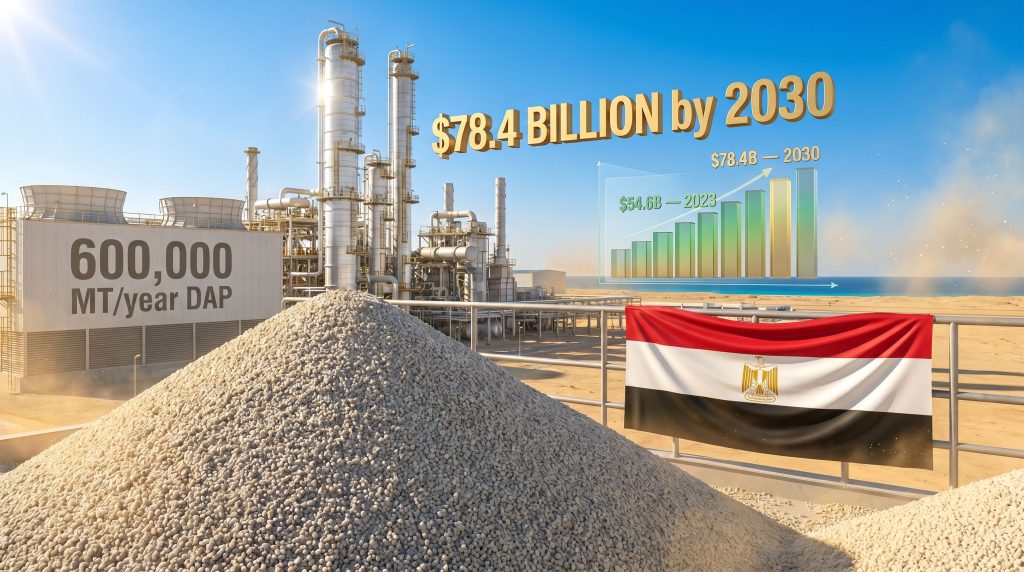
The Ain Sokhna facility anchored by Misr Phosphate is the most immediately significant of these investments. Planned at 600,000 MT per year of DAP output, the plant is designed around an integrated production model incorporating 320,000 MT per year of phosphoric acid and 1.023 million MT per year of sulphuric acid manufacturing, with 1.25 million MT per year of phosphate rock feedstock to be sourced from Red Sea mining operations. Misr Phosphate holds a 15% equity stake in the project and is entitled to 20% of production output, a structure that blends state participation with private and international capital while keeping project risk distribution commercially viable.
The Abu Tartur phosphoric acid complex deserves particular attention from an industrial economics perspective. Investing USD 573 million to produce phosphoric acid on-site at an inland deposit fundamentally changes the economics of that reserve. Instead of bearing the cost of transporting low-value ore to coastal processing facilities, the project converts the ore into a higher-value intermediate product before it leaves the desert. Phosphoric acid is the essential feedstock for both DAP and MAP (monoammonium phosphate) production, meaning Abu Tartur's output would strengthen the supply chain for Egypt's broader fertiliser manufacturing ambitions. This approach mirrors principles seen in successful phosphate project development globally, where integrated processing transforms resource economics.
MOPCO's planned expansion focuses on nitrogen-based fertilisers rather than phosphate directly, but it matters for the overall sector picture. A 10% capacity increase targeting 2.2 million MT per year reinforces Egypt's position as a leading Arab urea producer and demonstrates that investment momentum extends across the fertiliser product spectrum, not solely in phosphate-derived compounds.
The Asia-Potash complex occupies a different category entirely. With an investment range reported between USD 1.6 billion and USD 10 billion and production ambitions spanning 2 to 10 million MT, this project, if fully realised, would represent the largest single foreign investment commitment in Egypt's minerals sector. The involvement of Chinese industrial capital introduces geopolitical dimensions worth monitoring. Chinese fertiliser manufacturers have historically operated under periods of export restriction when domestic agricultural needs are prioritised, creating episodic global supply gaps that benefit alternative producers. Egyptian capacity funded by Chinese capital could paradoxically serve to fill shortfalls that Chinese export policy itself creates.
Export Markets: Where Egyptian Phosphate Is Going
The Shifting Geography of Egyptian Fertiliser Trade
Brazil is the anchor export destination for Egyptian phosphate, which makes structural sense. Brazil is the world's largest net importer of fertilisers by volume, with a domestic agricultural sector of enormous scale that cannot be adequately supplied by local production. Egypt's Red Sea port access provides efficient routing to Brazilian Atlantic ports, and the two countries have established commercial relationships in phosphate trade spanning multiple decades.
Japan represents a different export profile: smaller in volume but higher in product specification requirements. Japanese buyers typically demand consistent quality grades and reliable supply contracts, making this market a useful indicator of whether Egyptian producers can meet internationally demanding quality benchmarks.
The most dynamic shift in Egypt's export geography, however, is occurring in Europe. European phosphate demand accelerated notably after Russia's invasion of Ukraine disrupted fertiliser supply chains and prompted importers across the continent to diversify their source countries. Egypt targets stronger global presence in these markets, with Egyptian phosphate exports to European buyers between January and October 2025 reaching 600,000 MT, surpassing the 433,000 MT shipped to Europe across the entirety of 2024. This trajectory, if sustained, points to Egypt capturing a structurally larger share of European phosphate imports rather than simply benefiting from a temporary supply disruption.
The De-Dusting Requirement: A Technical Barrier to European Market Access
European port terminals impose strict handling and environmental compliance requirements on bulk phosphate imports. Fine phosphate dust creates respiratory hazards for port workers and creates contamination risks for surrounding environments. To address these concerns, European terminal operators require phosphate rock to meet specific particle size and dust content specifications, generally achieved through a de-dusting treatment that binds fine particles to coarser granules using moisture or binding agents.
Egypt's initiative to produce 1 million MT per year of de-dusted phosphate rock by end of 2026 is a direct response to these requirements. This is not merely a technical adaptation; it is a market access strategy. Without complying with European dust standards, Egyptian exports would be restricted to terminals with less stringent requirements or face loading delays and surcharges. Meeting European port specifications opens the door to premium pricing tiers and long-term supply agreements with European agricultural distributors, transforming a logistical compliance requirement into a commercial differentiator.
Competitive Landscape: Egypt Within the Global Phosphate Hierarchy
How Egypt Stacks Up Against the World's Major Producers
| Country | Estimated Phosphate Reserves | Key Competitive Advantage | Primary Export Focus |
|---|---|---|---|
| Morocco | ~50 billion tonnes | OCP Group scale, global logistics | Europe, India, Brazil |
| China | ~3.2 billion tonnes | Domestic consumption priority | Limited, periodically restricted |
| Egypt | ~3+ billion tonnes | Red Sea access, downstream investment surge | Brazil, Japan, Europe (growing) |
| Tunisia | ~1 billion tonnes | Mediterranean proximity, EU relationships | Europe, Mediterranean |
| Jordan | ~1 billion tonnes | Middle East agricultural proximity | India, Southeast Asia |
Morocco's OCP Group is, by a considerable margin, the world's dominant phosphate exporter. Its reserve base of approximately 50 billion tonnes represents roughly 70% of global phosphate reserves, and OCP has invested heavily in integrated fertiliser production, logistics, and agricultural services across Africa. Egypt cannot realistically challenge Morocco's scale in the near term.
What Egypt can do, and is actively doing, is pursue a different competitive positioning. Egypt's Red Sea port access provides shipping route advantages that Morocco's Atlantic and Mediterranean ports cannot replicate for certain Asian and East African markets. Egypt's lower-cost processing economics, a function of domestic energy pricing and labour costs, also provide potential margin advantages versus Moroccan DAP in price-sensitive markets. Critically, Egypt's location positions it as a natural supplier to Sub-Saharan African agricultural markets that are expected to see some of the strongest fertiliser demand growth globally over the coming decade.
China's periodic export restrictions on fertilisers, including phosphate-derived products, have repeatedly demonstrated the fragility of global supply chains that rely too heavily on any single dominant supplier. Egypt's emerging production capacity could position it as a reliable alternative source during precisely those periods when Chinese product becomes unavailable.
The next major ASX story will hit our subscribers first
Structural Risks That Could Constrain Egypt's Ambitions
A Framework for Evaluating the Challenges Ahead
No assessment of Egypt phosphate fertiliser markets would be complete without acknowledging the structural risks that could slow or complicate the industrial transformation underway.
| Risk Category | Specific Challenge | Potential Impact |
|---|---|---|
| Energy Input Costs | Natural gas exposure for nitrogen-linked production | Margin compression during energy price spikes |
| Regional Competition | Morocco and OCP Group's scale advantages | Pricing pressure in overlapping export markets |
| Capital Execution | Multi-billion project financing complexity | Timeline delays, cost overruns |
| Currency Volatility | Egyptian pound fluctuations on USD-denominated inputs | Investment return uncertainty for foreign partners |
| Cadmium Compliance | European heavy metal thresholds in fertiliser imports | Ore selection and processing constraints |
The natural gas dependency is Egypt's most immediate structural vulnerability in fertiliser manufacturing. Nitrogen-based fertilisers, including urea produced by MOPCO and similar facilities, require natural gas as both a chemical feedstock and energy source. When global gas prices spike, as occurred dramatically following the 2022 European energy crisis, Egyptian production economics are squeezed even as fertiliser market prices may simultaneously be rising.
The currency dimension introduces additional complexity for projects involving USD-denominated capital equipment imports, international debt financing, and foreign partner agreements. Egyptian pound volatility affects the local currency equivalent of debt service costs and input procurement, creating unpredictability in project economics that foreign investors must price into their return expectations. Understanding phosphate project economics in other jurisdictions illustrates how currency and energy risks can materially reshape project viability.
Policy Architecture: How Egypt Is Structuring Its Sector Transformation
Regulatory Reforms and Institutional Commitments
Egypt's Petroleum Ministry has revised mining regulations to reduce the mandatory state joint-venture equity stake requirements that previously constrained private and foreign investment in the sector. Lower obligatory state equity participation reduces the capital burden on state entities while allowing private partners to hold majority economic positions, improving the risk-return profile for international investors considering large-scale commitments.
Cabinet-level engagement with the phosphate sector has been sustained and specific. Prime Minister Madbouli's direct involvement in chairing project review meetings signals that the phosphate and fertiliser manufacturing agenda is treated as a national economic priority. Cabinet Spokesman Ambassador Mohamed el-Homosani confirmed that discussions in recent ministerial reviews covered phosphate reserve volumes, current coarse ore production capacity, fertiliser plant operational status, and ongoing cooperative projects with both local and international specialised companies.
Egypt has also formalised bilateral mining and energy cooperation frameworks with regional partners including Turkey, establishing a model for knowledge transfer, technical assistance, and joint investment that could be extended to additional countries with complementary capabilities. The government's formal target of growing the mining sector's contribution to 6% of GDP from its current modest share provides the macroeconomic framing for these sectoral investments. Phosphate and its downstream fertiliser products represent the most immediately scalable pathway toward that target.
Furthermore, understanding cut-off grade economics remains essential for project developers assessing which Egyptian deposits are economically viable to advance, particularly as energy and processing costs evolve. Similarly, definitive feasibility studies will be critical gating documents before the largest capital commitments in Egypt's phosphate pipeline can proceed to construction.
Frequently Asked Questions: Egypt Phosphate Fertiliser Markets
What fertiliser products does Egypt currently produce and plan to expand?
Egypt's existing manufacturing base covers single superphosphate (SSP) and urea, with the planned expansion adding DAP (diammonium phosphate), MAP (monoammonium phosphate), and ultimately NPK compound blends. DAP and MAP are the highest-volume phosphate fertiliser products globally, used across grain, oilseed, and vegetable production systems. The Ain Sokhna facility is specifically designed around DAP production at industrial scale.
How does phosphate production affect Egypt's domestic food security?
Egypt's population has surpassed 100 million and continues to grow, placing ongoing pressure on domestic agricultural productivity and food import dependency. Domestically produced fertilisers provide Egyptian farmers with access to inputs at more stable and potentially lower prices than imported alternatives, while surplus production earns foreign currency that can fund other import requirements. The government's approach prioritises ensuring domestic supply adequacy before directing production toward export markets.
What is the environmental dimension of Egypt's phosphate mining expansion?
Phosphate mining and processing generates several categories of environmental challenge that are particularly relevant to European export market access. Phosphogypsum, the calcium sulphate waste product of phosphoric acid production, accumulates in large volumes and requires managed disposal. Water consumption in beneficiation processes is significant in regions where freshwater is already scarce. Meeting European Union fertiliser regulations, including cadmium content limits and traceability requirements, requires investment in monitoring and processing controls that smaller or less capitalised operations may struggle to sustain.
When will Egypt's major projects begin contributing to production?
Based on currently reported timelines, the Ain Sokhna DAP facility is scheduled to begin construction in Q2 2026, the Abu Tartur phosphoric acid complex is also targeting a 2026 construction commencement, and MOPCO's expansion is planned for completion across 2026 and 2027. Egypt's broader fertiliser ambitions suggest realistic first production contributions from the major new facilities would be expected in the 2027 to 2028 period, with ramp-up to full capacity extending beyond that.
Disclaimer: This article is intended for informational purposes only and does not constitute financial, investment, or professional advice. Projections, timelines, and investment figures referenced in this article are drawn from publicly reported sources and industry estimates, which carry inherent uncertainty. Readers should conduct independent due diligence before making investment or business decisions related to any sector or company discussed herein. Forecasts about market size, production capacity, and export volumes are speculative in nature and subject to change based on macroeconomic, regulatory, and operational factors.
Want to Identify the Next Major Mineral Discovery Before the Market Does?
Discovery Alert's proprietary Discovery IQ model delivers real-time ASX alerts on significant mineral discoveries — including phosphate and other critical commodities — instantly turning complex geological data into actionable investment insights for both short-term traders and long-term investors. Explore historic examples of major discovery returns or start your 14-day free trial today to position yourself ahead of the broader market.