May 11, 2026
When Diplomacy Moves Markets: Understanding Oil's Geopolitical Pricing Engine
Commodity markets have always had a complex relationship with geopolitical uncertainty, but crude oil occupies a unique position in this dynamic. Unlike gold or copper, oil's pricing is simultaneously shaped by physical supply realities, shipping logistics, and the real-time interpretation of political signals thousands of kilometres from where the barrels actually trade. The result is a market that can swing violently within hours, punishing traders who anchor too firmly to any single scenario.
This behavioural architecture is precisely what makes the current Middle East situation so consequential for global energy prices. Understanding why oil prices rise on Middle East peace prospects — and equally why they fall when those prospects fade — requires looking beyond the headline numbers to the structural mechanics underneath.
When big ASX news breaks, our subscribers know first
The Geopolitical Risk Premium: How Conflict Gets Priced Into Crude
Every barrel of crude traded on global benchmarks carries a base value derived from supply and demand fundamentals. However, during periods of regional conflict near critical export infrastructure, traders layer an additional premium on top of that base value, compensating for the probability that physical supply will be interrupted. This markup is known as the geopolitical risk premium, and its defining characteristic is volatility: it builds rapidly during escalation and collapses just as fast when diplomatic signals emerge.
The asymmetry of this mechanism is important. When peace talks surface, the market does not wait for a signed agreement before pricing out risk. Algorithmic trading systems and sentiment-driven participants react to headlines within seconds, triggering cascading sell orders that can remove several dollars per barrel from benchmark prices before the diplomatic situation has materially changed at all.
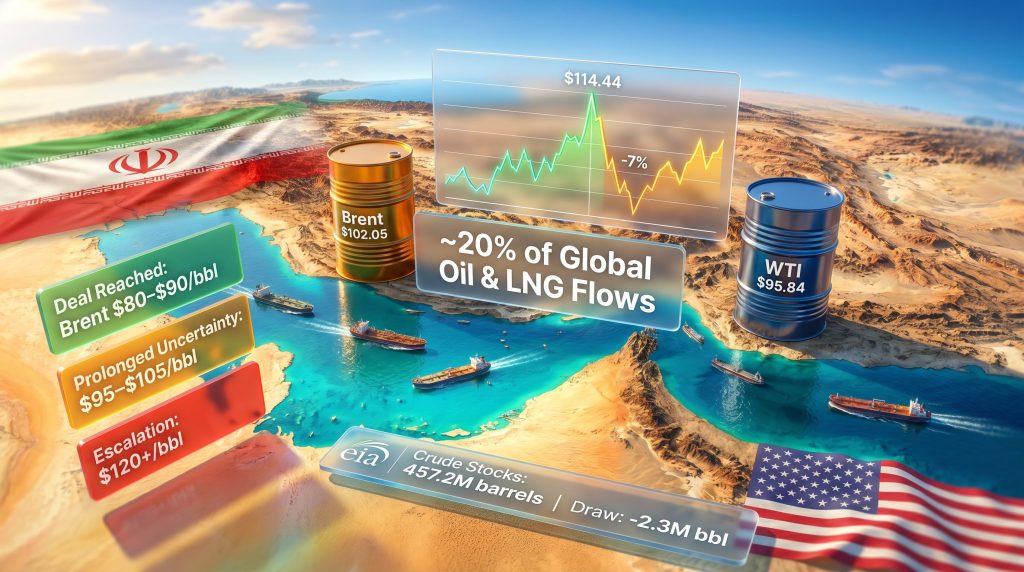
This is precisely what unfolded in early May 2026. Both Brent crude and WTI fell more than 7 percent in a single trading session as optimism around a possible end to the Middle East conflict spread through markets. The sell-off was sharp, reflexive, and ultimately partial: prices recovered meaningfully when US President Donald Trump indicated it was too soon for direct talks with Tehran, and an Iranian lawmaker publicly characterised the US proposal as aspirational rather than workable.
Why the Middle East Commands Such Outsized Market Influence
The region's structural importance to global energy flows cannot be overstated. The Strait of Hormuz, the narrow waterway separating Iran from the Arabian Peninsula, handles approximately 20 percent of the world's daily oil and LNG shipments. There is no viable alternative route of comparable capacity for Gulf producers. Any restriction to this chokepoint creates an immediate supply shock that reverberates across Asian refineries, European import terminals, and US energy pricing benchmarks simultaneously.
Historical precedent reinforces this sensitivity. The 1973 Arab oil embargo, the 1990 Gulf War, and the 2019 strikes on Saudi Aramco's Abqaiq facility each produced sharp, sustained crude price spikes. What distinguishes the current environment, furthermore, is the convergence of multiple simultaneous disruption sources — a dynamic that compresses the market's ability to absorb individual shocks through geographic diversification.
Current Market Conditions: Benchmarks Under Pressure
As of the morning session on 8 May 2026, oil prices rise on Middle East peace prospects had partially reversed the previous day's steep losses:
| Benchmark | Price | Session Move |
|---|---|---|
| Brent Crude | $102.05/barrel | +$0.78 (+0.8%) |
| WTI (West Texas Intermediate) | $95.84/barrel | +$0.76 (+0.8%) |
Source: Arab News/Reuters, 8 May 2026
The synchronised 0.8 percent gain across both benchmarks is itself a signal worth examining. When Brent and WTI move in near-identical proportions, it typically indicates that the price driver is macro or geopolitical in nature rather than regionally specific. Brent's geographic basis in the North Sea and WTI's basis in Cushing, Oklahoma, mean that their usual divergence reflects regional inventory and logistics conditions. When they converge, markets are telling traders something systemic is at work.
The $100 per barrel level has effectively become a psychological floor during this period. Despite multiple optimistic diplomatic signals from both Washington and Tehran, neither benchmark has sustained a break below this threshold for more than a single session, highlighting how deeply structural the underlying supply tightness has become.
The US-Iran Diplomatic Framework: What Is Actually on the Table
The framework under discussion involves a reported one-page memorandum that would formally end the conflict without necessarily resolving the longer-term structural disputes between Washington and Tehran. According to sources cited by the US media outlet Axios, the US expected Iranian responses on several key points within 48 hours, with analysts noting this represented the closest the two parties had come to agreement since hostilities began.
Pakistan's reported role as a back-channel mediator adds a layer of complexity to the process. A Pakistan mediation source confirmed that an agreement was considered close, though the mechanics of how such mediation translates into binding commitments remains unclear.
The complicating factor is that the proposed memorandum appears to leave unresolved several demands that Washington considers essential:
- Suspension of Iran's nuclear programme
- Constraints on Iran's missile capabilities
- Formal reopening of the Strait of Hormuz to commercial shipping
Iran's internal response to these demands has been resistant. A senior Iranian lawmaker publicly described the US proposal in terms suggesting it reflected American wishes rather than a realistic negotiating position, indicating the bar for a comprehensive agreement remains very high. Iran's foreign ministry, citing ISNA news agency, confirmed Tehran would formally convey its response through diplomatic channels.
The Trump-Xi Summit as a Secondary Market Catalyst
US President Donald Trump and Chinese President Xi Jinping are scheduled to meet the week following 8 May 2026. Energy markets are watching this summit closely, though not because US-China relations directly control Middle East diplomacy. China's position as the world's largest crude importer gives it a deep structural interest in Middle East stability. Any signal from the summit that the two largest economies are aligned — or misaligned — on Iran policy could shift the pace of negotiations considerably.
Hiroyuki Kikukawa, chief strategist of Nissan Securities Investment, has articulated a view that peace negotiations are likely to continue at least until the summit, with the outlook beyond that point remaining genuinely uncertain. His central scenario is that oil prices will remain elevated regardless of short-term diplomatic developments, reflecting the view that structural tightness — not geopolitical premiums alone — is sustaining current price levels. (Arab News/Reuters, 8 May 2026)
Scenario Analysis: Three Pathways for Crude in the Weeks Ahead
The market is effectively pricing across three distinct scenarios simultaneously, with each carrying materially different implications for Brent pricing:
| Scenario | Primary Trigger | Likely Brent Range | Commentary |
|---|---|---|---|
| Full deal + Strait reopening | Signed memorandum, verified Hormuz access restored | $80–$90/barrel | Rapid premium evaporation; supply normalisation takes weeks |
| Partial agreement / prolonged uncertainty | Framework agreed, implementation delayed | $95–$105/barrel | Current pricing range; elevated volatility persists |
| Escalation / infrastructure attacks | Talks collapse, new strikes on oil facilities | $120+/barrel | Tail risk; additional parabolic spike possible |
Scenario ranges are analyst projections and represent inherently uncertain forward-looking assessments. They should not be treated as investment advice.
Priyanka Sachdeva, senior market analyst at Phillip Nova, has described the dynamics in stark terms: if a formal deal materialises, oil prices could experience a rapid and steep decline as risk premiums disappear from the market. Conversely, any fresh signs of attacks on oil infrastructure or further escalation could equally trigger another sharp upward move in crude pricing. (Arab News/Reuters, 8 May 2026)
This captures the core tension defining the current market: the asymmetry between downside scenarios driven by peace and upside scenarios driven by escalation, with both possibilities remaining live simultaneously.
Why Peace Doesn't Produce Instant Supply Relief
One of the most important — and least widely understood — dynamics in this market is the distinction between a diplomatic breakthrough and actual supply normalisation. Even in the most optimistic scenario, a signed peace agreement would not immediately return Middle Eastern crude to global refiners. The physical supply chain involves a multi-step process:
- Diplomatic agreement reached and ceasefire formally declared
- Strait of Hormuz officially reopened to commercial shipping
- Tanker operators resume cargo bookings and vessels depart Gulf loading ports
- Transit time to Asian and European refineries: approximately 2 to 4 weeks depending on destination
- Refinery intake, processing, and distribution before refined products reach end consumers
This timeline means that even a breakthrough agreement in mid-May 2026 would not result in refinery deliveries before June at the earliest. In the meantime, oil companies and national refiners will continue drawing down storage inventories to meet peak summer demand — a seasonal dynamic that accelerates depletion regardless of diplomatic progress.
The next major ASX story will hit our subscribers first
US Crude Inventory Data: Reading Between the Lines
US crude inventories from the Energy Information Administration's most recent weekly data offer a nuanced picture of how supply disruptions are filtering through to inventory levels:
| Metric | Reported Figure | Analyst Expectation | Variance |
|---|---|---|---|
| Crude Stock Change | -2.3 million barrels | -3.3 million barrels | 1.0M bbl less drawn than expected |
| Total Crude Stocks | 457.2 million barrels | Below seasonal norms | Structural tightness persists |
Source: US Energy Information Administration (EIA), cited in Arab News/Reuters, 8 May 2026
The smaller-than-expected draw might superficially appear bullish for supply, but the interpretation requires care. A draw of 2.3 million barrels is still a meaningful weekly decline. The fact that the drawdown was less severe than anticipated may reflect emergency strategic reserve releases partially buffering commercial stock depletion, rather than any genuine easing of underlying supply pressure.
The Multi-Front Supply Shock: Russia, Iraq, and Iran Simultaneously
What distinguishes this energy crisis from previous geopolitical disruptions is the convergence of three separate supply headwinds operating concurrently. The Iran-related Strait of Hormuz restriction is the most visible, but it is compounding pre-existing tightness from two additional sources. The broader implications of crude oil geopolitics are, furthermore, playing out across all three fronts simultaneously:
- Russia: Export capacity has been materially reduced by Ukrainian strikes on energy infrastructure, limiting seaborne crude flows from a major global supplier
- Iraq: Production declines contributing to reduced OPEC+ aggregate output at a time when the cartel is already navigating complex production discipline dynamics
- Iran/Strait of Hormuz: Blockade restricting approximately 20% of global daily seaborne oil and LNG shipments
The International Energy Agency has characterised the current disruption as the largest supply shock of its kind — a designation that invites historical comparison. The 1973 Arab oil embargo removed roughly 5 million barrels per day from global supply and produced sustained price spikes measured in multiples rather than percentages. The Abqaiq facility attacks in 2019 temporarily removed approximately 5.7 million barrels per day of Saudi production capacity. The current disruption's distinction lies in its breadth across multiple geographic sources and its persistence over more than two months.
Market Psychology: Stuck Between Diplomacy and Disruption
Perhaps the most revealing insight about the current crude market is psychological rather than physical. Sachdeva's characterisation — that markets have remained stuck between diplomacy and disruption for more than two months, with investor sentiment shifting on headlines almost daily — captures a market operating without a stable directional anchor. (Arab News/Reuters, 8 May 2026)
This headline sensitivity creates specific risks for different market participants:
- Short-term traders face the risk of being caught on the wrong side of rapid premium evaporation or sudden escalation spikes
- Long-term investors must weigh whether current prices reflect structural tightness or inflated geopolitical premiums that will eventually compress
- Corporate hedgers (airlines, shipping companies, industrial manufacturers) face uncertainty in locking in future fuel costs at levels that may prove either too high or insufficient
The $100 per barrel threshold functions as both a psychological anchor and a market consensus point. Sustained trading near this level reflects a collective assessment that the conflict is real enough to maintain significant supply risk, but not so catastrophically unresolvable that prices should breach their historical extremes.
The Broader Implications: Inflation, Energy Security, and OPEC+ Dynamics
Sustained crude oil above $100 per barrel has transmission effects well beyond energy markets. Consumer fuel costs, transport and logistics pricing, and manufactured goods inflation all respond to elevated crude benchmarks with lags of weeks to months. Central banks in inflation-sensitive economies face an uncomfortable dynamic: supply-side inflation driven by geopolitical factors cannot be resolved through interest rate adjustments.
The potential oil price shock rippling through energy-importing nations — particularly across Asia and Europe — is, consequently, accelerating strategic decisions around reserve capacity, LNG supply diversification, and renewable energy infrastructure investment timelines. There is a well-established historical pattern: sustained high oil prices drive structural shifts in energy policy that outlast the immediate crisis. The 1970s embargo reshaped nuclear energy policy across Europe. The 2022 Russian supply disruption accelerated European LNG terminal buildout and renewable energy targets significantly ahead of prior schedules.
Within OPEC+, elevated prices create their own tensions. OPEC's market influence is being tested as high crude values incentivise member discipline by delivering strong fiscal revenues, but simultaneously attract non-OPEC production investment that can erode cartel pricing power over a 12 to 24 month horizon. US shale producers, Canadian oil sands operators, and Brazilian deepwater producers all respond to sustained price signals above $90 per barrel with expanded capital expenditure, creating a medium-term supply response that can unwind geopolitical premiums from the bottom up rather than from the top down.
How Trade War Dynamics Compound the Picture
It is also worth noting that the trade war oil markets relationship adds a further layer of complexity. Tariff-driven demand uncertainty from major economies can partially offset the upward pressure from supply disruptions, creating cross-currents that make directional price calls particularly difficult. However, in the current environment, supply-side factors are dominating demand-side concerns by a considerable margin.
Key Takeaways: What the Market Is Really Signalling
The current crude market's behaviour around oil prices rise on Middle East peace prospects reveals several structural realities that extend beyond any individual diplomatic session:
- Oil prices function as a real-time barometer of geopolitical risk, with sharp moves in both directions reflecting headline sensitivity rather than measured supply-demand analysis
- The $100 per barrel level has become a gravitational centre, with prices consistently returning near this threshold after both upward and downward extremes
- A formal peace agreement, even if achieved rapidly, would not produce immediate supply normalisation due to the physical logistics of resuming Gulf shipping routes and restoring refinery feedstock flows
- The convergence of disruptions from Iran, Russia, and Iraq means structural supply tightness would persist even if the Strait of Hormuz reopened tomorrow
- Three indicators deserve close monitoring: Iran's formal response to the US memorandum framework, the outcome of the Trump-Xi summit, and weekly inventory figures as a measure of how quickly strategic reserve buffers are being depleted
This article contains forward-looking analysis and scenario projections based on market conditions as of May 2026. Energy price forecasts involve inherent uncertainty and should not be construed as investment advice. Readers should consult qualified financial professionals before making energy-related investment decisions.
Want to Stay Ahead of the Next Major Resource Discovery Amid Volatile Markets?
When geopolitical shocks send commodity markets into freefall, timing is everything — Discovery Alert's proprietary Discovery IQ model delivers real-time alerts on significant ASX mineral discoveries, turning complex resource data into actionable insights so subscribers can act before the broader market catches on. Explore how historic discoveries have generated substantial returns on Discovery Alert's dedicated discoveries page, and begin your 14-day free trial today to secure a market-leading advantage.