August 24, 2026
The Infrastructure Behind Industrial Metals Trading: Why Physical Storage Shapes Global Markets
Commodity markets are often discussed through the lens of price movements, futures curves, and macroeconomic signals. But beneath the trading screens lies a physical infrastructure layer that determines whether financial markets can actually function. Approved storage facilities, warrant issuance systems, and certified logistics networks form the backbone of industrial metals trading globally. When that physical layer becomes constrained, the consequences ripple outward into financing costs, delivery mechanics, and ultimately price discovery itself.
Nowhere is this dynamic more visible right now than in Hong Kong, where the Hong Kong LME warehouses full situation has expanded at a pace that has outrun available physical capacity.
When big ASX news breaks, our subscribers know first
How Hong Kong Became a Strategic Node in Global LME Infrastructure
The LME, founded in 1877, operates the world's largest industrial metals trading centre and manages a global network of approximately 450 approved third-party warehouses distributed across the United States, Europe, and Asia. These facilities span established regional hubs including Malaysia and South Korea, where operational warehouse networks have served industrial and financial markets for years.
Hong Kong's integration into this system began in earnest following HKEX's acquisition of the LME in 2012, a transaction that embedded the exchange within one of Asia's most prominent financial centres. While HKEX subsequently introduced a range of commodity-linked products in Hong Kong, the physical warehouse network has emerged as the most commercially impactful initiative from that acquisition.
The strategic logic is straightforward: proximity to China's vast manufacturing and consumption base, access to one of the world's deepest financial markets, and the ability to connect physical metals flows with sophisticated financing and derivatives infrastructure all converge in Hong Kong in ways that are difficult to replicate elsewhere. Furthermore, China metals demand continues to underpin the case for regionally accessible, financially recognised storage solutions.
What Gets Stored and Why It Matters Beyond Simple Logistics
LME-approved warehouses in Hong Kong store a range of approved non-ferrous metals, including copper, aluminium, nickel, tin, zinc, lead, and aluminium alloy. These are not passive storage arrangements. Each approved facility operates within a regulated framework that gives stored metal a specific legal and financial status within the LME system.
Approved storage facilities function as collateral infrastructure for institutional financing, meaning physical capacity is a direct enabler of capital markets activity, not merely a logistics convenience.
When metal is deposited in an LME-approved warehouse, it can be issued as a warehouse warrant, which is a transferable document of title. These warrants serve multiple functions simultaneously:
- They allow metals to be traded on the LME's electronic platform as physically deliverable instruments
- They can be pledged as collateral to secure bank financing, creating a direct link between physical inventory and credit markets
- They facilitate physical delivery settlement for LME futures contracts, maintaining the integrity of the exchange's pricing benchmark function
This multi-layered functionality means that an approved warehouse is categorically different from general commercial storage. The capacity constraints now visible in Hong Kong are not simply a warehousing problem but a constraint on the market's financing and delivery infrastructure. In addition, base metal pricing delays can compound these constraints when storage bottlenecks coincide with periods of elevated market activity.
From Four Facilities to Fifteen: A Timeline of Rapid Expansion
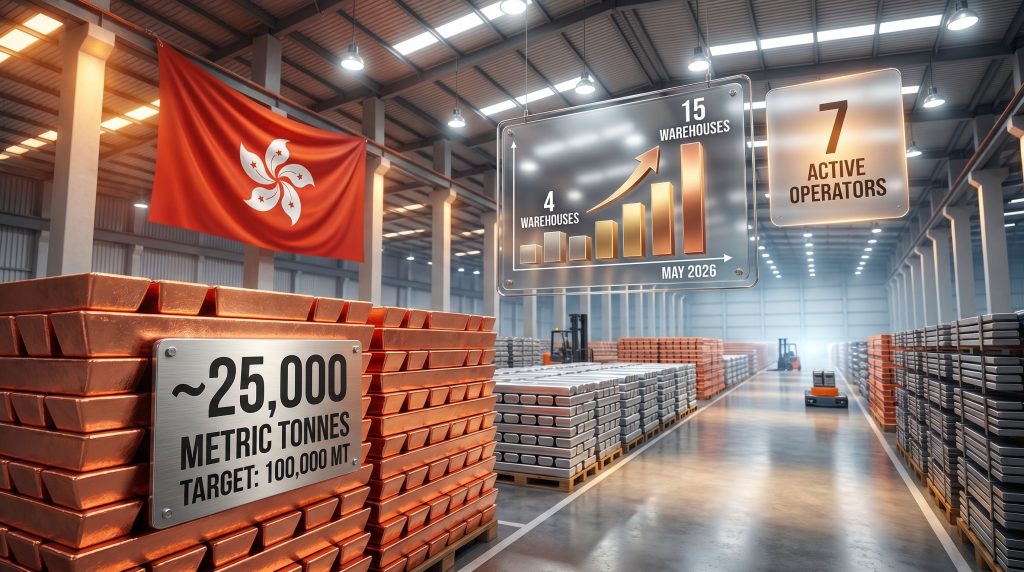
Hong Kong's LME warehouse program launched approximately one year before the May 2026 reporting period, beginning with just four approved facilities. The growth trajectory since that initial approval has been remarkable:
| Milestone | Detail |
|---|---|
| Program launch | Approximately May 2025 |
| Initial facility count | 4 warehouses |
| Current facility count | 15 warehouses |
| Active operators | 7 companies |
| Current stored volume | ~25,000 metric tonnes |
| Utilisation status | Near or at full capacity |
| Long-term capacity target | 100,000 metric tonnes |
The move from 4 to 15 facilities represents a 275% increase in approved warehouse count within roughly twelve months. That the network reached near-full utilisation at this scale within such a compressed timeframe signals genuine underlying demand, not speculative positioning by operators hoping demand would follow infrastructure.
Three broad forces have likely contributed to this acceleration. First, regional supply chain restructuring following years of geopolitical disruption has increased demand for regionally accessible, financially recognised storage. Second, metals financing activity linked to Chinese industrial demand creates consistent appetite for warrant-backed lending instruments. Third, the financial hub characteristics of Hong Kong, including deep banking networks and sophisticated counterparty infrastructure, make LME warrant financing structurally more attractive there than in locations with less developed financial ecosystems.
Understanding Why Full Capacity Is Both a Success Signal and a Structural Warning
LME Chief Executive Matthew Chamberlain has characterised the warehouse saturation as a situation that is genuinely positive in what it signals about demand but simultaneously difficult to resolve quickly. His framing captures a dynamic well understood in commodity infrastructure development: demand validation and supply constraints often arrive simultaneously, and the window between them can determine whether a hub achieves lasting significance or loses momentum to competitors.
In commodity infrastructure, capacity saturation is typically a lagging indicator of demand success, but it can quickly become a forward constraint on market growth if expansion timelines are mismanaged.
Comparing Hong Kong's situation against the broader LME network is instructive. Malaysia and South Korea operate as established Asian nodes within the ~450-warehouse global system, with utilisation patterns shaped by decades of operational history. Hong Kong's near-immediate saturation at launch reflects both the strength of pent-up regional demand and the relative scarcity of approved facilities in a market that was previously underserved by LME infrastructure.
The risk framing is equally important for market participants to understand. A hub that consistently cannot accommodate demand will see flows redirect. Traders requiring physical delivery settlement or financing collateral need reliable access to approved storage. If Hong Kong cannot expand capacity at a rate commensurate with demand growth, the logical alternative is to utilise established facilities in South Korea or Malaysia, potentially accelerating those hubs' competitive positioning at Hong Kong's expense.
The Hidden Complexity of Expanding LME-Approved Storage
A critical distinction shapes the expansion challenge: physical storage capacity and LME-certified storage eligibility are not the same thing. Hong Kong has substantial general commercial warehousing, but not all facilities can simply be converted into LME-approved storage. The approval process involves operator qualification requirements, facility standards, governance protocols, and regulatory coordination between the LME and relevant authorities.
The specific bottlenecks constraining faster expansion include:
- Land scarcity: Hong Kong's high-density urban geography limits the availability of industrial land suited to large-scale metals warehousing at commercially viable costs
- Regulatory approval timelines: Each new facility requires formal approval through LME processes, which involve assessment of operator qualifications and facility standards rather than simple administrative registration
- Operator qualification requirements: Not every logistics operator meets the standards required for LME certification, limiting the pool of eligible expansion candidates to established, qualified market participants
This combination means that even where physical space theoretically exists, converting it to productive LME-approved capacity involves a non-trivial timeline. Matthew Chamberlain's acknowledgment that the problem is not easily solved reflects these structural realities rather than a lack of intent to expand.
The next major ASX story will hit our subscribers first
What the Expansion Pipeline Looks Like Through 2026 and Beyond
The near-term expansion trajectory targets approval of one to two additional warehouses within 2026, representing incremental rather than transformational capacity relief in the short term. The more significant strategic ambition is reaching 100,000 metric tonnes of approved storage capacity, which would represent a fourfold increase over current stored volumes.
Achieving that scale would not merely represent more storage. It would structurally reposition Hong Kong within the global LME network as a significant physical delivery and financing hub, rather than an emerging one. The implications for derivatives market liquidity, warrant issuance volumes, and metals financing activity in the region would be substantial. Consequently, LME trading volumes across the region are likely to reflect these structural shifts as capacity expands.
| Metric | Hong Kong (Current) | Malaysia | South Korea |
|---|---|---|---|
| LME Approval Status | Active (from 2025) | Established | Established |
| Current Facility Count | 15 | Part of ~450 global network | Part of ~450 global network |
| Current Utilisation | Near/at full capacity | Operational | Operational |
| Strategic Positioning | Financial hub integration | Manufacturing proximity | Industrial demand base |
| Long-Term Capacity Target | 100,000 tonnes | Not publicly specified | Not publicly specified |
The coordination required to achieve this scale involves both LME and HKEX leadership, reflecting the joint institutional interest both organisations have in Hong Kong's development as a commodities centre. HKEX's 2012 acquisition of the LME created an alignment of incentives that makes Hong Kong warehouse expansion a strategic priority rather than a peripheral operational matter.
How Capacity Constraints Affect Traders, End Users, and Financing Markets
For metals traders and commercial end users operating in Asia, the practical implications of constrained approved storage are concrete and immediate. When LME-certified warehouse capacity becomes scarce, several market mechanics are affected:
- Warrant issuance slows, reducing the volume of physically backed instruments available for trading and collateral purposes
- Financing costs may increase as competition for scarce warrant-backed collateral intensifies among borrowers seeking metals-secured credit facilities
- Physical delivery premiums can widen as available delivery points become congested, adding basis risk for participants hedging with LME futures contracts
- Counterparty flexibility is reduced as operators with approved storage gain pricing leverage over users with limited alternatives
The scenario in which Hong Kong LME warehouses full through late 2026 while demand continues to grow is not a remote tail risk. It is the current trajectory absent accelerated approvals. The competitive response from South Korea and Malaysia would likely be organic rather than deliberate, simply reflecting that available capacity attracts volume. However, copper market trends and broader non-ferrous metals demand suggest that regional appetite for certified storage will remain robust regardless of how competitive dynamics evolve.
Frequently Asked Questions: Hong Kong LME Warehouses
What is an LME-approved warehouse and how does it differ from regular storage?
An LME-approved warehouse is a certified third-party facility that meets the exchange's technical and operational standards. Metal stored in these facilities can be issued as warehouse warrants, which are legally recognised instruments used for trading and bank-secured financing. General commercial storage does not provide this warrant issuance capability or financial recognition within the LME system.
Why are Hong Kong's LME warehouses currently full?
The network reached near or at full capacity because demand for approved storage, driven by metals financing activity, physical delivery requirements, and regional supply chain needs, grew faster than the available pool of certified facilities could accommodate. The program launched with four facilities approximately one year before May 2026 and expanded to fifteen, but utilisation kept pace with each expansion phase.
How many tonnes of metal can Hong Kong's LME warehouses currently hold?
Current stored volumes sit at approximately 25,000 metric tonnes across fifteen facilities operated by seven companies. The long-term capacity target for the network is 100,000 metric tonnes.
What metals are eligible for storage in Hong Kong's LME network?
The approved commodities include copper, aluminium, nickel, tin, zinc, lead, and aluminium alloy, covering the primary non-ferrous metals traded on the LME's global platform.
When will new LME warehouse capacity be available in Hong Kong?
One to two additional warehouses are targeted for approval within 2026. However, structural constraints including land availability, regulatory approval timelines, and operator qualification requirements mean expansion is measured rather than rapid.
Does full warehouse capacity affect metal prices in Asia?
Capacity constraints can affect regional physical premiums, warrant availability, and financing costs, all of which feed into the total cost of holding or transacting in physical metals. Direct price effects on LME benchmark prices are indirect, but basis differentials and regional spot premiums can be influenced by storage infrastructure conditions. Furthermore, commodities trading volatility during periods of constrained storage can amplify these effects across regional markets.
What the Saturation Story Reveals About Hong Kong's Commodities Ambitions
The fact that fifteen Hong Kong LME warehouses are full within roughly twelve months of the program's launch is, in isolation, a compelling endorsement of the city's relevance to regional metals markets. It confirms that demand exists, that operators have committed capital to the market, and that the financial infrastructure surrounding LME warrant financing is attractive enough to drive utilisation to capacity almost immediately.
The more nuanced reading is that demand has outpaced infrastructure planning, and the path to 100,000 metric tonnes of approved storage will require resolving genuine structural constraints, not just approving more applications. Land availability, regulatory approval velocity, and operator qualification pipelines all need to scale in parallel for the long-term ambition to materialise.
Hong Kong's ability to establish itself as a structurally significant node in global non-ferrous metals logistics, rather than simply an interesting emerging hub, depends on how efficiently the gap between current capacity and long-term targets is closed. The competitive alternatives in Asia are established, operational, and capable of absorbing redirected flows if Hong Kong's expansion timeline extends beyond what the market's demand trajectory can accommodate.
The LME's characterisation of this as a positive problem is accurate. But in commodity infrastructure, positive problems left unresolved for too long have a reliable tendency to become competitive disadvantages. Indeed, the Hong Kong LME warehouses full scenario represents precisely the kind of inflection point that determines whether an emerging hub consolidates its position or cedes ground to more established competitors.
This article is intended for informational purposes only and does not constitute financial or investment advice. Figures and capacity projections reflect publicly reported data as of the original publication period and may be subject to change as market conditions evolve.
Want to Stay Ahead of the Next Major Metals Discovery?
While physical infrastructure constraints reshape industrial metals markets across Asia, Discovery Alert's proprietary Discovery IQ model scans ASX announcements in real time, instantly identifying significant mineral discoveries across copper, nickel, aluminium, and beyond — converting complex data into clear, actionable investment insights. Explore how historic mineral discoveries have generated exceptional returns, then begin your 14-day free trial at Discovery Alert to position yourself ahead of the broader market.