August 5, 2026
When the World's Most Critical Shipping Lane Stops Working
Energy markets are built on assumptions of continuity. Refiners, traders, and governments plan around predictable flows, stable transit corridors, and the quiet assumption that the infrastructure underpinning global oil supply will function tomorrow the same as it did today. The Aramco East-West Pipeline and Strait of Hormuz disruption has long tested that assumption, but the events of early 2026 pushed it to a breaking point that even veteran energy analysts had not fully priced into their scenario models.
What unfolded was not simply a regional conflict. It was a live demonstration of how geographic concentration in energy export infrastructure creates systemic exposure for the entire global economy, and how a single company's pre-positioned bypass capacity can become one of the most consequential assets on the planet. Indeed, understanding crude oil volatility trends is essential context for appreciating just how unprecedented this situation became.
When big ASX news breaks, our subscribers know first
Why the Strait of Hormuz Remains the World's Most Dangerous Oil Chokepoint
The Scale of Exposure Is Almost Impossible to Overstate
Under normal operating conditions, approximately 20 to 21 million barrels per day (MMbpd) of crude oil and petroleum products transit the Strait of Hormuz, representing roughly one-fifth of total global petroleum supply, according to figures consistently documented by the U.S. Energy Information Administration (EIA). The waterway connects the Persian Gulf to the Gulf of Oman and the Arabian Sea, serving as the exclusive maritime export corridor for Saudi Arabia, Iraq, Kuwait, the UAE, Qatar, and Iran.
The physical geography makes this vulnerability almost structurally unavoidable. At its narrowest point, the strait measures approximately 33 nautical miles wide, with internationally designated shipping lanes on each side extending only about 2 nautical miles in width. The northern shoreline belongs to Iran. The southern shore is Omani territory. Any power capable of projecting force along the Iranian coastline can, in practical terms, threaten the economic viability of transiting that lane without physically sealing it shut.
This is the mechanism that separates the current crisis from all previous Hormuz episodes. Furthermore, the IEA's dedicated Strait of Hormuz security analysis underscores just how central this chokepoint remains to global energy security planning.
How the 2026 Crisis Differs From Historical Precedents
The Tanker War of the 1980s, spanning the full duration of the Iraq-Iran War from 1980 to 1988, resulted in approximately 543 commercial vessels being attacked, damaged, or sunk. Crude prices in nominal terms roughly tripled during the period. Yet the underlying production base and most shipping lanes remained functional throughout. The threat was targeted harassment: dangerous, but manageable.
The 2019 Gulf of Oman incidents, in which Iranian Revolutionary Guard Corps (IRGC) forces seized British-flagged tankers and targeted Norwegian-flagged vessels, represented a more recent version of the same playbook: demonstrate capability, create uncertainty, then allow diplomatic processes to normalise conditions. Insurance surcharges spiked and then retreated.
The conflict environment of 2026 is categorically different. The combination of drone and missile strikes on commercial vessels, electronic warfare interfering with navigation systems, active U.S.-Iran naval confrontations, and U.S. strikes on Iranian port infrastructure at Jask means the threat calculus has moved from targeted harassment to something approaching operational paralysis. Maritime advisory bodies including the U.S. Maritime Administration (MARAD) and the United Kingdom Maritime Trade Operations (UKMTO) have issued repeated navigational warnings, with hundreds of vessels anchored or rerouted as operators absorb prohibitive war-risk insurance costs.
War-risk insurance premiums for Hormuz-route transits have historically surged from baseline rates of around 0.05% to 0.10% of vessel value to peaks of 1% to 2% during major geopolitical escalations. At these levels, many operators find the voyage economically unviable, effectively suppressing tanker traffic without requiring Iran to enforce a formal naval blockade.
This is the dynamic that distinguishes the current disruption from a conventional chokepoint crisis: the threat perception itself is sufficient to achieve near-equivalent economic disruption to an actual blockade. Formal closure is not required when operator avoidance produces the same outcome. These oil market disruption risks have been building for some time, and the 2026 crisis represents their most severe expression yet.
What Is the Aramco East-West Pipeline and Why Does It Matter Now?
Infrastructure Profile: Capacity, Route, and Strategic Architecture
The Aramco East-West Pipeline, formally designated as the Petroline, stretches approximately 1,200 kilometres across the Arabian Peninsula. Its origin sits in Saudi Arabia's Eastern Province, home to the Ghawar and Safaniyah fields that collectively represent some of the highest-producing oil reservoirs on earth. Its western terminus is the Red Sea port of Yanbu, a deep-water facility capable of loading Very Large Crude Carriers (VLCCs) directly, with total crude storage capacity exceeding 10 million barrels.
The pipeline was originally commissioned in 1981, conceived specifically as an export route that could function independently of Persian Gulf shipping during the Iraq-Iran War. Its very existence is a product of geopolitical risk planning.
| Attribute | Detail |
|---|---|
| Total Length | ~1,200 km |
| Maximum Throughput Capacity | 7 MMbpd |
| Export Terminal | Yanbu, Red Sea Coast |
| Hormuz Bypass Function | Eliminates Persian Gulf transit dependency |
| Operational Status (Q1 2026) | Ramped to full 7 MMbpd capacity |
| Pipeline Diameter | ~48-50 inches (main trunk) |
| Transport Cost Advantage | ~$0.50-$1.00/bbl vs. $1.50-$3.00/bbl by tanker |
During Q1 2026, Saudi Aramco activated the Petroline to its maximum rated throughput, rerouting crude volumes away from Gulf shipping lanes and through Yanbu for Red Sea export. CEO Amin H. Nasser confirmed in Aramco's Q1 2026 earnings release that the East-West Pipeline had reached 7.0 million barrels per day and described it as a critical supply artery that provided measurable relief to customers unable to access normal Hormuz-route shipping channels.
The Drone Strike Incident: Conflict Targets the Bypass Route
A drone strike attributed to Iranian-linked forces struck a key pumping station along the East-West Pipeline, triggering fires at the facility and halting oil flow. The timing was particularly significant: the attack occurred within hours of a U.S.-brokered two-week ceasefire announcement, illustrating the gap between diplomatic signalling and operational reality on the ground.
No casualties were reported. Saudi Aramco subsequently restored full pipeline capacity, returning the Petroline to its 7 MMbpd throughput.
The strategic logic behind targeting the pipeline is straightforward: if adversarial actors can neutralise the primary bypass route, they amplify Iran's Hormuz leverage. Every barrel that cannot exit via Yanbu must either be stored onshore, wait for Hormuz conditions to improve, or be sold at a steep discount. The attack demonstrated that the East-West Pipeline is not just an energy asset in this conflict — it is a strategic military target.
A 1,200-kilometre pipeline traversing the Arabian Peninsula contains multiple exposed pumping stations and metering facilities. While most of the trunk line is buried, these surface infrastructure points represent potential targets in any sustained aerial campaign against Saudi export capacity.
How Did Saudi Aramco Perform Financially Under These Conditions?
Q1 2026 Earnings: Quantifying Resilience
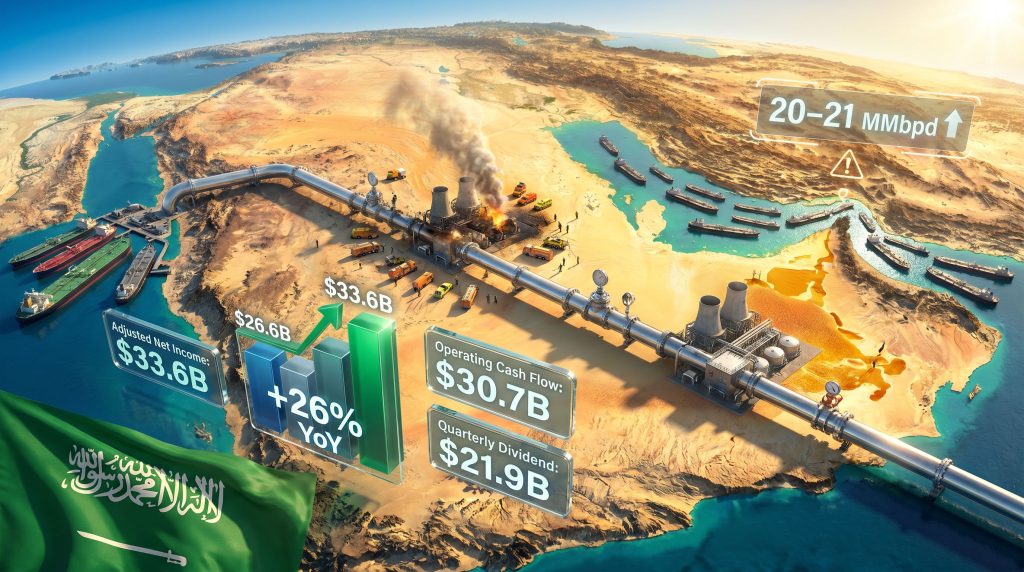
Saudi Aramco's Q1 2026 financial results delivered a result that would be extraordinary in peacetime. Against the backdrop of active conflict, drone strikes on its own infrastructure, and the largest Hormuz disruption in modern history, the company posted a 26% year-over-year increase in adjusted net income. The geopolitical oil price pressures driving this outcome were both severe and, for Aramco, ultimately advantageous given its bypass infrastructure.
| Financial Metric | Q1 2026 | Q1 2025 | Change |
|---|---|---|---|
| Adjusted Net Income | $33.6 billion | $26.6 billion | +26% YoY |
| Quarterly Dividend | $21.9 billion | ~$21.2 billion | +3.5% YoY |
| Operating Cash Flow | $30.7 billion | Not disclosed | N/A |
| Free Cash Flow | $18.6 billion | Not disclosed | N/A |
| Capital Expenditure | $12.1 billion | Not disclosed | N/A |
| Working Capital Build | $15.8 billion | Not disclosed | N/A |
| Gearing Ratio (end March 2026) | 4.8% | 3.8% (end 2025) | +100 bps |
The profit surge reflects two converging forces: elevated crude prices driven by Hormuz supply anxiety, and Aramco's operational capacity to sustain export volumes through the Petroline while most Gulf competitors faced severe route constraints.
Reading Between the Numbers
Free cash flow of $18.6 billion was partially compressed by a $15.8 billion working capital build. This figure deserves attention because it signals the logistical and financial complexity of operating a crisis-period rerouting strategy at scale. Repositioning inventory, restructuring offtake agreements, and absorbing the additional pipeline transport costs all leave a mark on working capital, even when top-line earnings are strong.
The gearing ratio increase from 3.8% to 4.8% similarly reflects the balance sheet cost of infrastructure mobilisation. Aramco committed $12.1 billion in capital expenditure in a single quarter, signalling that the company views crisis conditions as an accelerant for long-term infrastructure investment rather than a reason for caution.
A 26% profit surge during an active geopolitical conflict is a rare outcome in energy markets. It reflects a confluence of price tailwinds and operational preparedness that most national oil companies cannot replicate. Aramco's pre-positioned infrastructure created asymmetric upside during a crisis that severely constrained competitors' supply chains.
What Are the Broader Global Energy Security Implications?
The Stockpile Buffer Is Not Infinite
Global strategic petroleum reserves (SPR) and commercial inventories provide a finite buffer against sustained supply disruption. The mathematics of drawdown are sobering: under a complete Hormuz closure scenario, consuming nations would face a potential supply shortfall of 9 to 10 MMbpd even after accounting for all available bypass infrastructure operating at full capacity. This gap cannot be bridged by releasing strategic reserves indefinitely.
Industry executives have publicly flagged the severity of this exposure. Chevron's CEO has cautioned that infrastructure damage and the collapse of shipping confidence could persist well beyond any formal ceasefire, given the structural impact on insurance markets and operator risk appetite. ADNOC leadership has separately raised the possibility of global fuel shortages if Hormuz remains effectively closed for an extended duration.
The Nations Most Exposed
The consuming nations with the greatest Hormuz dependency face the most acute supply security risk. These include:
-
China: The world's largest crude importer, with Gulf suppliers accounting for roughly 40% of import volumes. Chinese shipments reportedly slumped during the disruption period.
-
Japan and South Korea: Both nations import the vast majority of their crude from Gulf producers and maintain strategic reserves sufficient to cover approximately 90 to 180 days of consumption under drawdown scenarios.
-
India: A rapidly growing importer with significant exposure to Gulf crude, though India has accelerated diversification efforts in recent years including expanded imports from Russia and Africa.
The Insurance Premium Spiral and Shipping Economics
War-risk insurance surcharges represent the primary economic disruption mechanism in the current crisis. When premiums surge to 1% to 2% of vessel value for Hormuz-route transits, many operators find the voyage economically unviable. For a VLCC with an insured value of approximately $100 million, this translates to a single-voyage insurance cost of $1 million to $2 million, imposed on top of fuel, crew, and charter costs.
The knock-on effect is tanker fleet utilisation rates approaching or exceeding 90% as rerouted vessels spend additional days in transit via alternative pathways. The Petroline and Red Sea route adds significant distance for some destinations, while routes around the Arabian Peninsula add 5 to 15 additional sailing days compared to direct Hormuz transit. This fleet compression reduces the effective global supply of available tanker capacity and pushes freight rates higher across all oil trade routes.
The UAE's OPEC Departure: A Structural Realignment Signal
Reports of the UAE withdrawing from OPEC during this period carry implications that extend beyond a single organisational exit. The UAE has for several years sought higher production quotas within the OPEC structure, and the OPEC market influence dynamic, combined with the current conflict environment and the UAE's own partial bypass capability through the Abu Dhabi Crude Oil Pipeline (ADCOP), may have accelerated a decision that was already structurally motivated. Consequently, this development suggests the geopolitical architecture underpinning Gulf oil production is undergoing a more fundamental reconfiguration than any single conflict episode would typically produce.
Alternative Export Infrastructure: A Global Comparative Analysis
How the Bypass Routes Stack Up
The critical insight that the Aramco East-West Pipeline and Strait of Hormuz disruption highlights is the asymmetry between what bypass infrastructure exists and what volume it can realistically absorb. Even at maximum combined capacity, all existing bypass routes fall well short of replacing Hormuz-route volumes.
| Route / Infrastructure | Capacity | Operator / Region | Hormuz Bypass? |
|---|---|---|---|
| Aramco East-West Pipeline (Petroline) | 7.0 MMbpd | Saudi Arabia | Yes, Red Sea exit via Yanbu |
| Abu Dhabi Crude Oil Pipeline (ADCOP) | ~1.5 MMbpd | UAE / ADNOC | Yes, Fujairah, Gulf of Oman |
| Sumed Pipeline (Egypt) | ~2.5 MMbpd | Egypt / Arab states | Partial, Suez Canal alternative |
| Iraq-Turkey Pipeline (Kirkuk-Ceyhan) | ~0.45 MMbpd | Iraq / Turkey | Yes, Mediterranean exit |
| Strait of Hormuz (sea lane) | ~20-21 MMbpd | International waters | N/A, the chokepoint itself |
The combined maximum throughput of all bypass pipelines totals approximately 11 to 11.5 MMbpd under ideal conditions. Against the 20 to 21 MMbpd that normally transits Hormuz, this leaves a structural gap of 9 to 10 MMbpd with no viable alternative routing under current infrastructure. Crucially, the Petroline solves Saudi Arabia's own export problem. It provides no relief for Iraq's roughly 3.5 MMbpd of Hormuz-dependent exports, nor for Kuwait, Qatar, or Iranian crude flows.
The Iraq-Turkey pipeline's 0.45 MMbpd capacity is also frequently disrupted by militant attacks and technical failures, making it unreliable as a crisis-period backstop. The Sumed pipeline in Egypt represents a partial solution for crude moving through the Suez Canal, but its capacity is constrained and it does not eliminate Gulf-origin supply risk.
The next major ASX story will hit our subscribers first
What Does This Crisis Reveal About Long-Term Energy Infrastructure Strategy?
Infrastructure Redundancy as a Revenue Enabler
Aramco's Q1 2026 performance provides a compelling financial case study for a principle that energy security planners have advocated for decades: physical redundancy in export pathways is not an operational cost centre, it is a crisis-period revenue enabler.
The company's pre-positioning of domestic and international storage capacity, combined with contingency logistics planning and the decades-long investment in the Petroline, allowed it to maintain supply continuity to customers during a period when competitors faced severe route constraints and inventory dislocations.
Capital expenditure of $12.1 billion in a single quarter signals that Aramco is accelerating infrastructure investment, not reducing it, in response to the conflict environment. This is consistent with the company's long-term strategy articulated in multiple investor presentations: that investment in infrastructure resilience and production capacity creates compounding optionality during geopolitical volatility.
The Nuclear Dimension: Why Resolution Is Structurally Difficult
Underlying the conflict is an unresolved Iranian nuclear programme that has resisted diplomatic containment across multiple decades and multiple U.S. administrations. U.S. naval operations, including reported strikes on Iranian port infrastructure at Jask, combined with ongoing Iranian missile and drone campaigns against commercial shipping and Saudi pipeline infrastructure, indicate that the conflict has escalated beyond a conventional maritime dispute into a multi-domain confrontation with no straightforward off-ramp.
Industry executives have warned that even after any formal cessation of hostilities, the structural damage to shipping confidence and insurance market pricing could persist for an extended period. Energy markets would be prudent to treat the current elevated geopolitical risk premium on Gulf crude not as a temporary spike but as a new structural baseline until verifiable de-escalation occurs.
Dual-Track Energy Strategy: Transition and Conventional Redundancy
The Hormuz crisis has reinvigorated policy debates in consuming nations around strategic reserve adequacy and supply diversification. Nations most exposed to Gulf crude dependency face a strategic imperative that is increasingly described by analysts as unavoidable: simultaneously accelerating both conventional supply chain redundancy and an energy transition strategy that reduces long-term hydrocarbon import dependency.
These are not competing priorities but complementary ones. Renewable energy development reduces long-term hydrocarbon import dependency. Strategic reserve expansion and pipeline diversification reduce near-term disruption vulnerability. Both are now policy imperatives for governments watching Hormuz-route traffic collapse in real time.
Frequently Asked Questions: Aramco East-West Pipeline and Strait of Hormuz Disruption
What is the maximum capacity of the Aramco East-West Pipeline?
The East-West Pipeline, also known as the Petroline, has a maximum throughput capacity of 7 million barrels per day (MMbpd). During Q1 2026, Saudi Aramco ramped the pipeline to this full capacity to sustain crude exports via the Red Sea port of Yanbu, bypassing constrained Hormuz-route shipping.
How much oil normally passes through the Strait of Hormuz each day?
Under normal operating conditions, approximately 20 to 21 million barrels per day of crude oil and petroleum products transit the Strait of Hormuz, representing roughly 20% of total global oil supply as documented by the U.S. Energy Information Administration.
Was the Aramco East-West Pipeline targeted during the Hormuz crisis?
A drone strike attributed to Iranian-linked forces struck a pumping station on the East-West Pipeline, causing temporary fires and interrupting oil flow. The attack occurred shortly after a U.S.-brokered ceasefire announcement. No casualties were reported, and Saudi Aramco subsequently restored full pipeline capacity.
How did Aramco's finances hold up under crisis conditions?
Saudi Aramco reported adjusted net income of $33.6 billion in Q1 2026, a 26% increase compared to $26.6 billion in Q1 2025. The company maintained its quarterly dividend at $21.9 billion (up 3.5% year-over-year) and generated $30.7 billion in operating cash flow. For further detail on these results, Aramco's Q1 2026 profit figures have been widely covered in financial media.
Can bypass pipelines replace Hormuz if it is fully closed?
No. The combined maximum capacity of all existing bypass routes totals approximately 11 to 11.5 MMbpd, against the 20 to 21 MMbpd that normally transits Hormuz. A sustained full closure would leave an estimated 9 to 10 MMbpd of Gulf crude with no viable alternative routing on current infrastructure.
Which countries are most exposed to a Hormuz disruption?
The nations with the greatest vulnerability include China (the world's largest crude importer, sourcing approximately 40% of imports from Gulf producers), Japan, South Korea, and India. All maintain strategic reserves, but the duration of any sustained disruption would ultimately determine whether those buffers are adequate.
Key Takeaways: Structural Lessons From the Hormuz-Petroline Crisis
-
Infrastructure redundancy creates asymmetric upside during crises: Aramco's 26% profit surge validates decades of pipeline investment as a revenue-enabling asset rather than a contingency cost.
-
The Strait of Hormuz remains irreplaceable at scale: No combination of existing bypass routes can substitute for the 20 to 21 MMbpd normally transiting Hormuz, leaving a structural supply gap of 9 to 10 MMbpd under full closure scenarios.
-
Fear functions as effectively as force: War-risk insurance surcharges and operator avoidance can suppress tanker traffic without requiring physical enforcement of a blockade.
-
Bypass infrastructure is itself a conflict target: The drone strike on the Petroline pumping station demonstrates that adversarial actors will seek to neutralise alternative export routes precisely because their strategic value is so high.
-
The risk premium on Gulf crude is likely structural, not temporary: With the Iranian nuclear programme unresolved and active military operations ongoing, energy markets face a sustained period of elevated geopolitical risk pricing on Hormuz-dependent supply.
-
Consuming nations face a dual investment imperative: Both conventional supply chain redundancy and long-term energy transition investment are now simultaneous policy necessities, not sequential ones.
Disclaimer: This article contains forward-looking statements, financial projections, and geopolitical scenario analysis. Readers should not construe any of this content as investment advice. Energy market conditions, geopolitical developments, and corporate financial results are subject to rapid and material change. Historical data cited reflects publicly available sources; figures attributed to Q1 2026 are sourced from World Oil's May 9, 2026 reporting and have not been independently verified against Aramco's formal financial filings.
Want to Position Yourself Ahead of the Next Major Resource Discovery?
While geopolitical disruptions reshape global energy markets, Discovery Alert's proprietary Discovery IQ model delivers real-time alerts on significant ASX mineral discoveries — instantly translating complex resource data into actionable opportunities for investors at every experience level. Explore Discovery Alert's dedicated discoveries page to understand how historic ASX discoveries have generated substantial returns, and begin your 14-day free trial today to secure a market-leading edge before the broader market catches on.