August 14, 2026
The Geography of Vulnerability: Understanding the World's Most Exposed Energy Corridor
Iran responds to U.S. peace proposal Strait of Hormuz tensions represent one of the most consequential geopolitical developments of 2026. Every few decades, a single geopolitical event forces the world to confront a structural weakness it has spent years quietly ignoring. The disruption playing out across the Strait of Hormuz is one such moment. It is not simply a conflict between two nations over military posture or nuclear ambiguity. It is a live demonstration of what happens when roughly one-fifth of the planet's combined oil and liquefied natural gas supply flows through a waterway narrow enough that opposing coastlines are visible from a ship's deck.
The strait, at its narrowest point approximately 33 kilometres wide, separates the Persian Gulf from the Gulf of Oman. Its significance to global energy infrastructure cannot be overstated. Before hostilities escalated in late February 2026, the waterway served as the primary maritime export corridor for crude oil and LNG produced across Kuwait, Saudi Arabia, Iraq, the UAE, Qatar, and Iran itself. No single alternative route replicates its capacity, and the infrastructure gaps that make diversification difficult have been decades in the making.
Understanding why Hormuz remains irreplaceable requires examining what the alternatives actually offer. The East-West Pipeline across Saudi Arabia, the Habshan-Fujairah crude export route through the UAE, and overland pipeline corridors through Turkey and the Caucasus collectively provide meaningful but structurally limited bypass capacity. Saudi Aramco has redirected portions of its exports through Red Sea routes since the conflict began, and ADNOC has continued moving limited crude volumes through the strait itself as a partial confidence signal. However, these options do not come close to absorbing the full volume that passed through Hormuz before the conflict.
When big ASX news breaks, our subscribers know first
Iran Responds to U.S. Peace Proposal: What the Diplomatic Architecture Reveals
When Iran formally submitted its response to the latest U.S. peace proposal through Pakistani intermediaries on 9 May 2026, the move confirmed that diplomatic channels remain operational even as kinetic incidents persist across the Gulf. Iran's state-run IRNA news agency acknowledged the submission without disclosing its content, and Tehran has not publicly indicated whether it intends to accept the terms outlined by Washington.
The structure of the U.S. proposal reflects a deliberate sequencing strategy. Rather than bundling the nuclear file with the immediate maritime access question, Washington separated the two issues into distinct negotiating tracks:
- Track One (near-term): Iran restores shipping access through Hormuz in exchange for the U.S. easing its blockade on Iranian ports within a 30-day window
- Track Two (longer-term): A broader framework offering sanctions relief and the release of frozen Iranian financial assets in exchange for a moratorium on nuclear enrichment activity
- Bridge mechanism: An interim memorandum of understanding structure designed to operationalise the shipping arrangement before comprehensive geopolitical resolution is achieved
U.S. Energy Secretary Chris Wright publicly signalled that restoring open transit through Hormuz may take precedence over resolving the nuclear dimension immediately. This sequencing acknowledges a hard political reality: the energy market consequences of prolonged strait disruption create their own diplomatic urgency, separate from the longer geopolitical confrontation over Iran's nuclear programme. Furthermore, the oil price shock that has reverberated through global markets reinforces the urgency of any diplomatic breakthrough.
Tehran's Strategic Calculus
Iran's negotiating position reflects a layered set of considerations that extend well beyond the strait itself. Tehran has indicated it is prioritising a full cessation of hostilities across all active conflict fronts, including Lebanon, before engaging on nuclear-related conditions. President Masoud Pezeshkian has framed the negotiation publicly as a sovereign engagement rather than a capitulation, a positioning that serves both his domestic political base and his management of hardliner opposition within the Iranian political system.
Senior Iranian advisers have framed control over Hormuz as a strategic asset of exceptional leverage, drawing comparisons in deterrence value to a nuclear capability itself. This framing carries important implications for how Iran will time and calibrate any concessions. Tehran's foreign ministry has also explicitly rejected externally imposed deadlines, signalling that it intends to control the pace of any resolution regardless of market pressure from outside.
"The separation of the shipping access question from the nuclear file is a deliberate diplomatic architecture, not an oversight. It creates a potential path to near-term energy market relief that neither side has to publicly frame as a strategic compromise."
Oil Price Dynamics and the Anatomy of a Geopolitical Risk Premium
Energy markets in May 2026 are not responding to supply fundamentals alone. They are responding to the perceived credibility of diplomatic signals, the reliability of ceasefire commitments, and the shipping risk premium embedded in insurance and freight rates for Gulf-region cargoes. The broader oil market disruption context has compounded these pressures considerably.
| Metric | Current Data Point |
|---|---|
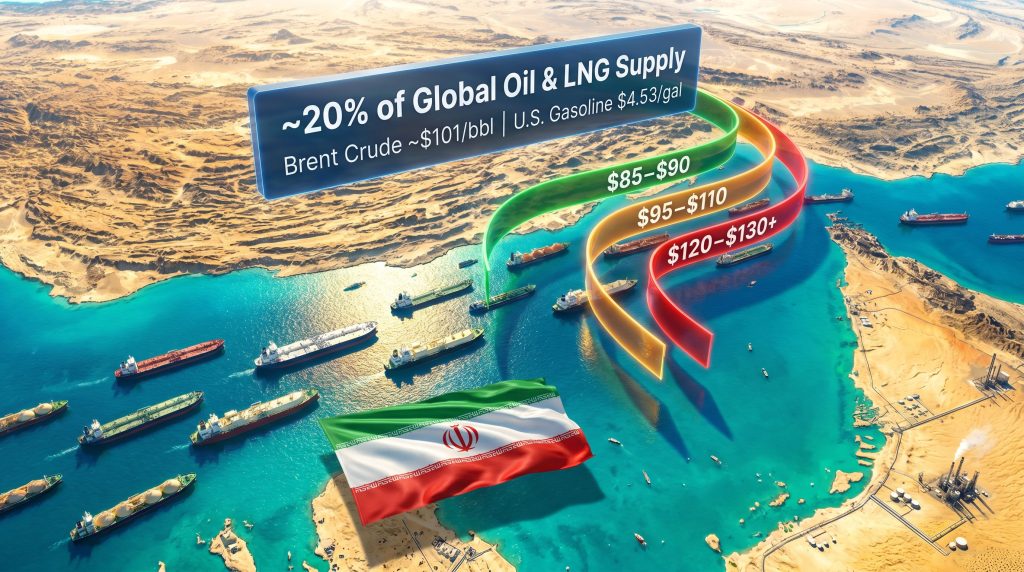
| Brent crude price (early May 2026) | ~$101 per barrel |
| Weekly price movement | Approximately -6% over the prior week |
| U.S. average retail gasoline price | $4.53 per gallon |
| Two-week gasoline price increase | +$0.25 per gallon |
| Conflict duration | Approximately 10 weeks from late February |
| Pre-conflict Hormuz throughput share | ~20% of global oil and LNG supply |
The roughly 6% weekly decline in Brent crude prices reflects how sensitively markets are tracking diplomatic developments. When credible signals emerge suggesting progress on the Iran responds to U.S. peace proposal dynamic, risk premiums compress rapidly. When incidents occur, they reassert with equal speed. This creates a volatility cycle driven primarily by information flow rather than physical supply changes.
What is particularly notable is the asymmetry in market response. Negative signals — such as drone strikes, naval warnings, or diplomatic breakdowns — tend to produce sharper and faster price spikes than positive signals produce price declines. This asymmetry reflects what traders call geopolitical risk convexity: markets price in worst-case scenarios faster than they price out uncertainty. Consequently, even partial diplomatic progress can have an outsised calming effect on prices, as recently observed with the crude oil price trends across global benchmarks.
The LNG Dimension: Qatar's First Post-Conflict Cargo
Ship-tracking data compiled by Bloomberg confirmed that Qatar exported its first LNG cargo through Hormuz since the conflict began, with the shipment heading to Pakistan. This single cargo movement carries significance well beyond its physical volume. It functions as a confidence signal from one of the world's largest LNG exporters that the corridor remains operationally viable, even at elevated risk premiums. The broader LNG supply outlook for 2025 and beyond had already signalled vulnerabilities that this disruption has now dramatically amplified.
Qatar's dual role in the current situation is worth noting. It is simultaneously one of the parties most economically exposed to prolonged Hormuz disruption and one of the most active diplomatic intermediaries. Qatar's Prime Minister met with senior U.S. officials, including the Middle East envoy, Secretary of State, and Vice President, in a meeting that underscored the country's unique positioning at the intersection of energy economics and regional diplomacy.
Pakistan's involvement as LNG recipient and diplomatic back-channel is similarly layered. A nation facing its own energy import pressures has strong structural incentives to facilitate a resolution that restores shipping access as quickly as possible.
Why Market Normalisation Will Take Longer Than Diplomacy
One of the least-discussed aspects of the Hormuz crisis is the distinction between the moment of formal diplomatic resolution and the point at which energy markets actually normalise. Saudi Aramco CEO Amin Nasser made this point explicitly, warning that even an immediate reopening of the strait would require several months before supply chains return to normal functioning. Some assessments extend the disruption effects into 2027.
This lag is structural, not speculative. It reflects several independent recovery timelines that operate in parallel:
- Tanker repositioning: Vessels that have been rerouted around the Cape of Good Hope or held in waiting positions cannot immediately return to Gulf-region routes. Fleet repositioning takes weeks to months depending on vessel type and contract obligations.
- Insurance premium recalibration: Marine war risk insurance premiums spiked significantly when the conflict began. Even after a formal ceasefire, underwriters require an extended period of incident-free operation before premiums return to pre-conflict levels.
- Buyer confidence restoration: Importers who pivoted to alternative suppliers or signed emergency spot contracts during the disruption period do not immediately revert to Gulf-source supply chains. Contract unwinding introduces its own timeline.
- Port congestion clearance: The backlog of cargo delayed during constrained shipping periods creates congestion at destination ports, which takes additional weeks to clear.
- Price discovery stabilisation: Spot market pricing remains elevated until physical supply and demand fundamentals reassert themselves over the geopolitical risk premium.
"Even after the political agreement is reached, the energy market will continue operating under disruption-era conditions for a significant period. The formal reopening of the strait is the beginning of recovery, not the end of the crisis."
The Ceasefire That Isn't: Ongoing Security Incidents and the Managed Instability Phase
Despite the April 8 ceasefire declaration, the security environment across the Gulf region has not stabilised. A drone strike set a cargo vessel ablaze near Qatar in the days following the ceasefire. Both the UAE and Kuwait reported successfully intercepting hostile drone systems. Iran accused U.S. forces of violating ceasefire terms through continued strikes on ports within the strait region. U.S. military forces had, during the active conflict phase, redirected 58 vessels and disabled 4 during the blockade enforcement period.
Iran's warning to the United Kingdom and France regarding their naval presence is particularly significant from an escalation management perspective. The explicit threat that increased UK and French naval activity in Hormuz would trigger a decisive and immediate military response places European nations in a difficult position. Their energy import dependency creates pressure to support diplomatic de-escalation, while their broader security commitments create pressure to maintain naval presence.
This pattern of continued incidents post-ceasefire is consistent with what conflict analysts describe as a managed instability phase: neither side has fully committed to de-escalation, but both retain sufficient incentives to avoid returning to full-scale hostilities. In practice, this means energy markets will continue operating under elevated risk conditions even if a formal diplomatic agreement on the Iran responds to U.S. peace proposal framework is reached. Analysts tracking tanker movements through the strait have noted that commercial shipping confidence remains fragile despite the ceasefire declaration.
Three Scenarios for Hormuz: Mapping the Range of Outcomes
The trajectory of Strait of Hormuz tensions from this point forward is genuinely uncertain. Three broad scenarios frame the range of plausible outcomes, each with distinct implications for energy markets and geopolitical stability.
Scenario A: Interim Agreement Reached Within 30 Days
Shipping lanes are partially restored under monitored conditions following a successful interim memorandum of understanding. Brent crude retraces toward the $85 to $90 per barrel range as the geopolitical risk premium compresses. Nuclear negotiations proceed on a separate, slower diplomatic track. Market normalisation remains delayed by 3 to 6 months due to the structural shipping recovery timelines described above.
Scenario B: Negotiations Stall, Managed Disruption Continues
Selective cargo movements continue at elevated risk premiums without a formal agreement. Oil prices remain range-bound between $95 and $110 per barrel. LNG spot markets face sustained tightness through the third quarter of 2026. Alternative routing through Red Sea pipeline corridors and Cape of Good Hope shipping absorbs partial volume but at materially higher cost.
Scenario C: Renewed Escalation or Formal Strait Closure
A breakdown in negotiations or a significant new security incident triggers renewed escalation. A formal Hormuz closure affecting approximately 20% of global oil and LNG flows produces an acute supply shock. Brent crude tests the $120 to $130-plus per barrel range in the near term. International Energy Agency strategic reserve releases are activated. Long-term structural investment in alternative routing infrastructure, LNG terminal capacity, and strategic reserve expansion accelerates significantly.
The next major ASX story will hit our subscribers first
The Long Shadow: What Hormuz Means for the Future of Energy Security
The 2026 Hormuz crisis will almost certainly accelerate a set of structural shifts in global energy security planning that were already underway but moving slowly. Governments and corporations across Asia, Europe, and North America are now receiving a live demonstration of what single-point-of-failure dependency looks like in practice.
Several longer-term consequences are already becoming visible:
- Strategic reserve expansion: Multiple importing nations are reassessing their strategic petroleum reserve targets in light of the extended disruption timeline
- Alternative infrastructure investment: Pipeline corridors, LNG regasification terminal capacity, and offshore floating storage are all receiving renewed investment attention
- Supply chain diversification: Long-term LNG and crude oil purchase agreements are being renegotiated with diversification clauses that reduce dependency on single-corridor sources
- Energy transition investment as risk mitigation: The crisis is reinforcing the argument that domestic renewable energy deployment reduces exposure to maritime chokepoint disruptions, adding a new dimension to the traditional economic and environmental rationale for clean energy
For Gulf Cooperation Council states, the crisis is also reshaping internal strategic calculations. Saudi Arabia and the UAE are both reassessing their own export infrastructure resilience and their positioning within a region where the security architecture is demonstrably fragile.
Disclaimer: This article is intended for informational and educational purposes only. It does not constitute financial, investment, or trading advice. Market data, price forecasts, and scenario projections involve inherent uncertainty and should not be relied upon as predictions of future outcomes. Readers should consult qualified financial and geopolitical risk advisers before making any investment decisions based on the information presented here.
Frequently Asked Questions: Iran, the U.S. Peace Proposal, and Hormuz Tensions
What did Iran submit in response to the U.S. peace proposal?
Iran formally submitted a response through Pakistani intermediaries, with IRNA confirming the submission without disclosing its content. Tehran indicated it is prioritising a full cessation of hostilities across all active conflict fronts before engaging nuclear-related terms.
Why is the Strait of Hormuz so critical to global energy supply?
The strait functions as the primary maritime export corridor for Gulf-region oil and LNG producers. Before the 2026 conflict, approximately 20% of global oil and LNG volumes transited this waterway daily, making it the world's highest-concentration energy chokepoint with no structurally equivalent alternative.
What are the core terms of the U.S. proposal to Iran?
The proposal includes a phased easing of the U.S. blockade on Iranian ports in exchange for restored shipping access through Hormuz, alongside a broader framework offering sanctions relief and frozen asset releases contingent on a nuclear enrichment moratorium.
How have oil prices responded to the Hormuz disruption?
Brent crude settled near $101 per barrel in early May 2026 after falling approximately 6% in the prior week, while U.S. retail gasoline averaged $4.53 per gallon, reflecting a sustained geopolitical risk premium embedded in energy markets since hostilities began.
When could the Strait of Hormuz fully reopen to normal shipping?
Even under an optimistic diplomatic resolution scenario, industry assessments suggest full market normalisation could take several months following any formal reopening, with some projections extending disruption effects into 2027 due to tanker repositioning, insurance recalibration, and buyer confidence recovery timelines.
What roles are Pakistan and Qatar playing in the negotiations?
Pakistan has served as a direct diplomatic back-channel between Washington and Tehran, while Qatar has engaged U.S. officials at the highest levels in its capacity as both a regional diplomatic host and a major LNG exporter with direct economic exposure to the disruption.
Want to Stay Ahead of the Next Major Resource Discovery Triggered by Energy Market Shifts?
Discovery Alert's proprietary Discovery IQ model delivers real-time alerts on significant ASX mineral discoveries the moment they hit the market, transforming complex geological and commodity data into actionable investment insights — precisely the kind of edge that matters when geopolitical shocks like the Hormuz crisis reshape global resource demand overnight. Explore how historic mineral discoveries have generated substantial returns and begin your 14-day free trial to position yourself ahead of the broader market.