August 2, 2026
The Arterial Valve of Global Energy: Understanding Why the Strait of Hormuz Controls Oil Prices
Every major oil price crisis in modern history traces back to a single, recurring vulnerability: the concentration of global energy flows through a small number of maritime corridors. When those corridors function normally, markets remain stable. When they are threatened or closed, the consequences of oil prices and Strait of Hormuz closure radiate outward with extraordinary speed, touching everything from refinery gate prices in South Korea to household fuel bills in Germany. No chokepoint demonstrates this dynamic more starkly than the Strait of Hormuz, and the events of early 2026 have reinforced that lesson with considerable force.
When big ASX news breaks, our subscribers know first
What Makes the Strait of Hormuz So Difficult to Replace?
The strait sits at the mouth of the Persian Gulf, connecting that body of water to the Gulf of Oman and, beyond it, the broader Arabian Sea. Its physical dimensions are deceptively modest. At its narrowest point, the passage measures roughly 33 kilometres across, with two navigable shipping lanes of approximately 3 kilometres each. Yet through those lanes flows an estimated 20% of global crude oil supply, equivalent to somewhere between 17 and 21 million barrels per day under normal operating conditions, according to U.S. Energy Information Administration data.
The producer nations that depend on this corridor include Saudi Arabia, Iraq, Kuwait, the United Arab Emirates, and Iran itself. No alternative pipeline network exists at sufficient scale to absorb a full closure. The East-West Pipeline in Saudi Arabia and the Abu Dhabi Crude Oil Pipeline together offer partial bypass capacity, but their combined throughput falls well short of the volumes that ordinarily transit the strait each day. Rerouting around the Arabian Peninsula also adds substantial distance, cost, and transit time.
Furthermore, beyond crude oil, the strait carries liquefied natural gas exports from Qatar, the world's largest LNG exporter by volume. This means a sustained disruption does not merely tighten crude markets — it simultaneously constrains global LNG supply, amplifying energy security risks for importing nations that have been shifting toward gas as a transition fuel.
The Strait of Hormuz is not simply a shipping lane. It functions as the pressure valve of the entire global oil system, and when that valve is forced shut, every energy-dependent economy feels the consequences within days, not weeks.
The Escalation Sequence: How the Strait Was Effectively Closed
The current disruption did not emerge without warning. Diplomatic tensions between Washington and Tehran deteriorated over approximately a ten-week period before the strait was effectively closed to normal commercial traffic. The sequence of events matters because it reveals how quickly a geopolitical standoff can translate into a structural supply emergency.
| Milestone | Approximate Timeframe | Market Impact |
|---|---|---|
| US-Iran diplomatic breakdown accelerates | Approximately 10 weeks prior to May 2026 | Precautionary risk premium added to crude |
| Iran restricts Strait of Hormuz transit | Weeks 1–2 of closure | Global supply disruption formally begins |
| US naval convoy attempts; Iranian countermeasures activated | Weeks 3–6 | Physical shipping rerouted; insurance costs spike |
| Attacks on UAE energy infrastructure near Fujairah | Mid-closure period | GCC regional stability concerns emerge |
| US peace proposal formally rejected by Tehran | May 11, 2026 | Markets spike; diplomatic resolution timeline extends |
| Trump-Xi Beijing meeting confirmed for May 14, 2026 | May 11, 2026 | Geopolitical pivot point identified by markets |
Iran's stated rationale for the closure centred on its characterisation of US naval activity as coercive, with President Masoud Pezeshkian conveying to regional partners including Pakistan that Tehran would not participate in negotiations conducted under duress. Iran subsequently cancelled formal peace discussions following renewed incidents involving merchant vessels, hardening the diplomatic deadlock.
Washington responded by framing its military strikes against Iranian facilities as defensive in nature. The United States also launched what was described as a merchant vessel escort initiative, though this programme was suspended after Gulf Cooperation Council members declined to provide necessary basing access, constraining US operational flexibility in the region.
As of May 11, 2026, President Trump publicly described Iran's response to a US-drafted peace proposal as unacceptable, extinguishing near-term hopes for a rapid resolution and triggering the latest upward move in oil prices, as reported by Reuters via ET EnergyWorld.
Oil Prices and the Strait of Hormuz Closure: What the Numbers Show
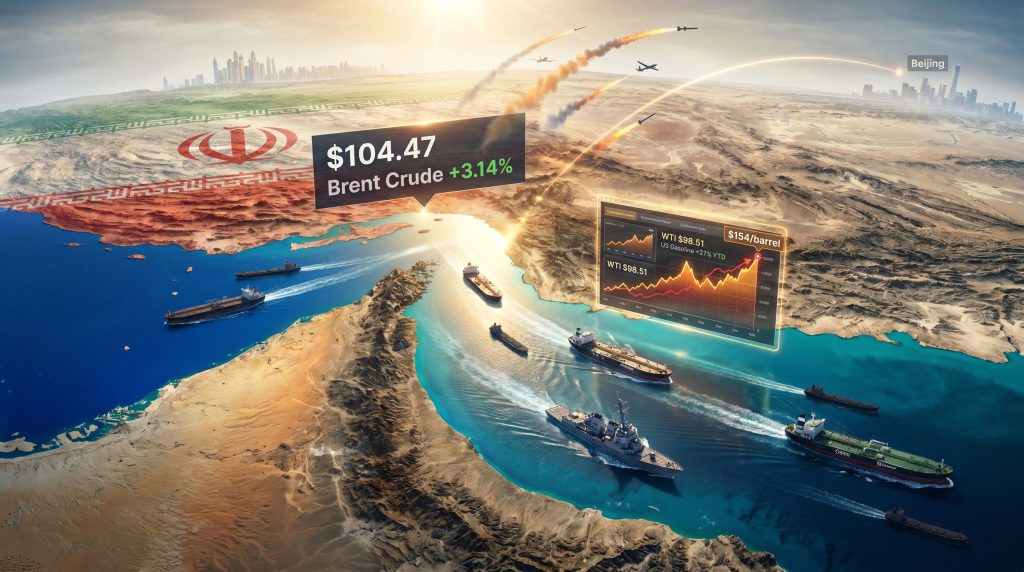
The market reaction to the failed peace proposal was swift and significant. Brent crude futures climbed $3.18 per barrel, or 3.14%, to $104.47 per barrel in a single trading session following Trump's statement. West Texas Intermediate advanced $3.09 per barrel, or 3.24%, to reach $98.51, extending gains that had already accumulated across the previous Friday session. These figures were confirmed by Reuters reporting published on ET EnergyWorld on May 11, 2026.
| Benchmark | Price (May 11, 2026) | Single-Session Change |
|---|---|---|
| Brent Crude Futures | $104.47/barrel | +$3.18 (+3.14%) |
| WTI Crude | $98.51/barrel | +$3.09 (+3.24%) |
| US Retail Gasoline (AAA avg.) | $4.02–$4.10/gallon | +27% year-to-date |
The scale of cumulative supply loss is equally striking. Saudi Aramco CEO Amin Nasser stated publicly that global markets have lost approximately 1 billion barrels of oil over the two-month conflict period. Energy markets are consequently expected to require considerable time to restabilise, even after flows eventually resume, due to the extent of inventory drawdowns and logistical dislocation that has accumulated.
Analyst projections carry a sobering message for the months ahead. If the closure extends to the 12-week mark, price models suggest Dated Brent crude could approach $154 per barrel, driven by an estimated supply shortfall of 5.3 million barrels per day for the quarter. This represents more than a simple price forecast; it signals the threshold at which demand destruction, recessionary pressure, and policy intervention would become unavoidable responses.
This unfolding oil price shock bears comparison to historical precedents, where prolonged chokepoint disruptions consistently triggered cascading economic consequences well beyond energy markets alone.
Disclaimer: Price projections and supply deficit estimates represent analyst modelling scenarios, not guaranteed outcomes. Energy markets are subject to rapid revision based on geopolitical developments, policy responses, and demand-side changes that cannot be predicted with certainty.
Dark Shipping, SPR Drawdowns, and the Mechanics of Market Adaptation
Global commodity markets rarely remain passive in the face of supply shocks. Several adaptive mechanisms have emerged since the strait's effective closure, each carrying its own set of trade-offs.
Dark shipping has become one of the more operationally significant responses. Kpler shipping data, as reported by Reuters, confirmed that at least two crude-laden tankers transited the Strait of Hormuz in the most recent week with their AIS transponders deactivated, deliberately removing themselves from satellite tracking systems to reduce targeting risk. This practice, while not new, has become considerably more prevalent as the conflict has intensified.
The implications extend beyond the vessels themselves:
- Insurance underwriters face heightened difficulty pricing risk on voyages they cannot monitor in real time
- Commodity traders lose the ability to track cargo positions and delivery timelines with precision
- Regulators and port authorities receive incomplete information about vessel movements and cargo manifests
- The broader practice introduces systemic opacity into a market that typically values transparency for price discovery
Strategic Petroleum Reserve drawdowns represent the other primary buffer mechanism. Major importing economies have been releasing reserves to partially offset the supply shortfall, though this response is finite by definition. Critically, analysts have noted that no meaningful demand destruction has yet materialised at the macroeconomic level, despite elevated prices. This removes one of the natural self-correcting mechanisms that markets would ordinarily rely upon to bring supply and demand back into balance.
The shock is also propagating through supply chains that are less visible than crude oil headlines. Petrochemical feedstock availability has tightened, fertiliser input costs are rising, and energy-intensive manufacturing sectors across Asia and Europe face compounding pressure from elevated crude and natural gas pricing simultaneously. According to UNCTAD analysis of Hormuz disruptions, the downstream trade consequences of a prolonged strait closure extend well beyond commodity markets into broader development outcomes for importing nations.
The Geopolitical Triangle: US, China, and Iran
The diplomatic calculus surrounding the Hormuz crisis has come to centre on a three-way dynamic between Washington, Beijing, and Tehran. It is a dynamic shaped by commercial interests as much as strategic posturing, and one that is further complicated by the ongoing US-China trade war and its influence on both parties' willingness to cooperate on energy diplomacy.
China is Iran's largest crude oil customer. Throughout the extended sanctions period, Beijing has purchased Iranian barrels at significant discounts relative to international benchmarks, creating a commercial dependency that gives China meaningful leverage over Tehran's economic calculus. IG market analyst Tony Sycamore noted that market focus had shifted entirely toward Trump's China visit, with participants hoping that Beijing could be persuaded to use its influence over Iran to advance a comprehensive ceasefire, as reported by Reuters via ET EnergyWorld.
The comparison to Beijing's 2023 role in facilitating the Saudi Arabia-Iran normalisation agreement is instructive. That initiative demonstrated that China is willing to deploy its economic relationships as diplomatic instruments when it perceives strategic benefit. Whether the same calculation applies in 2026, given the direct involvement of US military forces and the broader geopolitical stakes, remains the central uncertainty.
The structural deadlock between Washington and Tehran has a circular quality that makes unilateral resolution difficult:
- Iran insists on the withdrawal of US naval forces as a precondition for negotiations
- Washington refuses to withdraw without a verified ceasefire in place
- No ceasefire framework exists without prior negotiations
- Neither party accepts the other's sequencing demand
This circularity is precisely the kind of impasse that third-party mediation is best positioned to break. Beijing's unique commercial leverage over Tehran, combined with its interest in stable energy supply for its own economy, creates at least a structural incentive for intervention.
The next major ASX story will hit our subscribers first
Three Scenarios and Their Price Implications
| Scenario | Key Trigger | Brent Price Outlook |
|---|---|---|
| Rapid Resolution | Beijing brokers ceasefire; strait reopens within two weeks | Correction toward $85–$90/barrel |
| Prolonged Stalemate | Talks fail; closure extends beyond 12 weeks | Escalation toward $130–$154/barrel |
| Kinetic Escalation | Direct US-Iran military confrontation widens in scope | Potential spike above $160/barrel; recession risk elevated |
These scenarios are illustrative projections based on available analyst commentary and historical precedent. They do not constitute investment advice and should not be treated as predictions of actual market outcomes.
Which Economies Face the Highest Exposure?
The distributional impact of the oil prices and Strait of Hormuz closure is not uniform. Nations with high dependence on Persian Gulf crude face disproportionate vulnerability, particularly those with limited domestic production and constrained ability to rapidly diversify import sources.
| Economy | Estimated Hormuz Import Dependency | Primary Vulnerability |
|---|---|---|
| Japan | Approximately 85% | Manufacturing and power generation |
| South Korea | Approximately 70% | Petrochemical refining capacity |
| India | Approximately 60% | Fuel subsidies and current account |
| China | Approximately 40% | Industrial output and infrastructure |
| United States | Indirect (domestic producer) | Gasoline inflation and consumer sentiment |
| Europe | Moderate | LNG substitution cost and supply diversity |
Historical precedent offers context for the recessionary risk embedded in these exposure levels. The 1973 Arab Oil Embargo and the 1979 Iranian Revolution both demonstrated that sustained energy chokepoint disruptions can produce GDP contractions of one to three percentage points in major importing economies. At projected price levels near $154 per barrel, the erosion of consumer disposable income would represent a significant effective tax increase on households across multiple continents.
Central banks would face a particularly difficult policy environment under this scenario. Raising interest rates to suppress energy-driven inflation risks compressing growth that is already fragile, recreating the stagflationary dynamic that defined the 1970s. Consequently, this oil market disruption represents not merely a commodity pricing event but a potential systemic economic stress test for multiple major economies simultaneously.
Can an Energy Transition Buffer the Shock?
A question worth examining is whether accelerating adoption of electric vehicles and renewable energy infrastructure provides any meaningful near-term cushion. The historical pattern suggests that sustained oil price spikes do accelerate structural shifts toward alternative energy, as the economic case for substitution strengthens at higher crude prices.
However, a critical lag exists between price signal and infrastructure deployment. The 12 to 24 months typically required to translate investment decisions into operational capacity means that the transition cannot meaningfully buffer a supply shock playing out over weeks or months. Short-term policy responses — including emergency LNG procurement, coal-to-power switching where permitted, and demand rationing programmes — represent more realistic near-term mechanisms for importing nations. Furthermore, as CSIS analysis of the strait's strategic dimensions highlights, the geography of the chokepoint creates structural dependencies that energy transition timelines simply cannot dissolve quickly enough to matter in the current crisis.
Frequently Asked Questions: Oil Prices and Strait of Hormuz Closure
What percentage of world oil passes through the Strait of Hormuz?
Approximately 20% of global crude oil supply transits the strait under normal conditions, equivalent to 17–21 million barrels per day according to U.S. Energy Information Administration data.
How high could oil prices go if the closure continues?
Analyst projections suggest Dated Brent could approach $154 per barrel if the disruption extends to 12 weeks, driven by an estimated demand shortfall of 5.3 million barrels per day. A broader military escalation scenario could push prices above $160 per barrel.
Why can't oil simply be rerouted around the strait?
Limited pipeline alternatives exist, but their combined capacity is insufficient to replace Hormuz transit volumes. Rerouting via the Arabian Peninsula also adds cost and transit time that the market cannot readily absorb at current scale.
How long has the strait been disrupted in 2026?
As of May 11, 2026, the strait has been effectively closed or severely disrupted for approximately ten weeks, placing it among the most prolonged chokepoint disruptions in modern energy history.
How are some tankers still moving through?
Some vessels have been transiting with AIS tracking transponders deactivated, a practice known as dark shipping, to reduce Iranian targeting risk. Kpler shipping data confirmed at least two such transits in the most recent week, as reported by Reuters via ET EnergyWorld.
What role does China play in potential resolution?
China is Iran's largest crude oil buyer and holds meaningful economic leverage over Tehran. Diplomatic efforts have consequently focused on whether Beijing will deploy that leverage to broker a ceasefire, particularly in the context of President Trump's scheduled Beijing visit in May 2026.
Want to Stay Ahead of the Next Major Commodity Disruption?
When geopolitical shocks like the Strait of Hormuz closure send energy markets into turmoil, the investors best positioned are those who act on timely intelligence — Discovery Alert's proprietary Discovery IQ model delivers real-time alerts on significant ASX mineral discoveries, helping subscribers identify actionable opportunities in commodities before the broader market reacts. Explore historic examples of major discovery returns and begin your 14-day free trial today to secure a market-leading edge during periods of heightened global volatility.