July 26, 2026
The Arithmetic of a Chokepoint: Understanding the Hormuz Supply Collapse
Energy markets are built on the assumption of redundancy. Pipelines have backup routes, refineries maintain buffer inventories, and traders operate with contingency contracts. Yet there is one geographic feature in the global oil supply chain for which no meaningful redundancy exists: a narrow channel of water between Iran and the Oman peninsula through which, under normal conditions, roughly one in every five barrels of oil consumed globally must pass.
The Strait of Hormuz has long occupied a unique position in energy security analysis, more discussed in theoretical frameworks than experienced as an operational crisis. Since March 2026, that theoretical vulnerability has become a daily operational reality for the world's two largest Gulf crude exporters. The ways in which Saudi Aramco and ADNOC are managing Aramco and ADNOC Hormuz crude exports under conflict conditions reveals both the ingenuity of energy infrastructure adaptation and its hard structural limits.
When big ASX news breaks, our subscribers know first
Why the Strait Cannot Simply Be Bypassed
The fundamental problem is not that Gulf producers lack creativity. It is that decades of infrastructure investment were designed around the assumption of reliable Hormuz transit, not its absence. Furthermore, the commodity market volatility generated by this disruption has compounded the challenge for producers attempting to plan around an uncertain security environment.
Under pre-conflict conditions, tanker-tracking data compiled by Bloomberg indicated that approximately 13.6 million barrels per day (MMbpd) of non-Iranian crude was transiting the strait in the two months before March 2026. That single corridor represented a staggering share of seaborne oil supply, and its disruption has created an arithmetic gap that no combination of currently available infrastructure can fully bridge.
Both Saudi Arabia and the UAE constructed bypass systems over the preceding two decades precisely because planners understood the theoretical concentration risk. Saudi Aramco's East-West Pipeline, which connects Eastern Province production fields to the Red Sea export terminal at Yanbu, represents the most significant of these investments. ADNOC developed the Abu Dhabi Crude Oil Pipeline (ADCOP), a roughly 380-kilometre overland route terminating at the port of Fujairah on the Gulf of Oman.
The critical flaw in both systems is capacity. Bypass infrastructure was sized to supplement Hormuz transit, not replace it. When the strait effectively closed to normal operations in early March 2026, producers discovered that their backup systems could absorb only a fraction of the export volumes they were capable of generating.
"The Strait of Hormuz is not merely a transit corridor. It is the load-bearing structural element of Gulf export economics, and every bypass solution that exists was designed to carry supplementary weight, not the full load."
How Severe Is the Current Export Disruption?
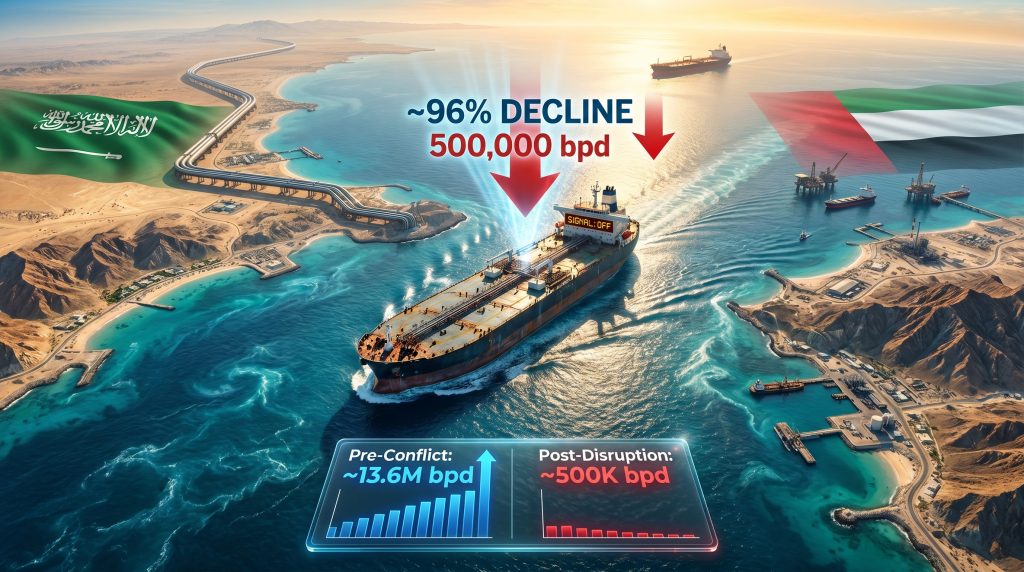
The scale of the flow collapse is difficult to overstate. According to tanker-tracking data reported by Bloomberg and published by World Oil on 8 May 2026, non-Iranian crude exports moving through Hormuz have averaged approximately 500,000 bpd since early March 2026, compared to roughly 13.6 MMbpd in the preceding two-month period. That represents a decline of approximately 96% in measurable throughput.
| Metric | Pre-Conflict Baseline | Post-Disruption Level | Change |
|---|---|---|---|
| Non-Iranian crude via Hormuz | ~13.6 MMbpd | ~500,000 bpd | ~96% decline |
| ADNOC crude production | ~3.4 MMbpd | ~1.5–1.7 MMbpd | >50% decline |
| Yanbu (Red Sea) exports | ~770,000 bpd | ~3.66–4 MMbpd | ~5x increase |
| Fujairah port exports | ~2.2 MMbpd | ~790,000 bpd | ~64% decline |
| Estimated global supply gap | Baseline | 10+ MMbpd | Critical |
However, the 500,000 bpd figure requires important qualification. A critical insight from industry participants with direct market exposure is that actual vessel movements through or near the strait exceed what satellite-based tracking systems are recording. The reason is methodological: most transits since the conflict escalated have been occurring with Automatic Identification System (AIS) transponders deliberately switched off.
Mercuria Energy Group's chief executive Marco Dunand indicated that the real volume of tankers transiting Hormuz is higher than publicly available tracking data would suggest, as reported by Bloomberg. Consequently, all flow estimates derived from tracking databases carry a systematic downward bias of unknown magnitude.
What the Tracking Data Gap Means for Market Analysis
This visibility problem has meaningful implications for how traders, refiners, and policymakers are interpreting the supply shock. When a substantial proportion of vessel movements become invisible to public monitoring systems, the following distortions enter market pricing:
- Spot price signals may overestimate supply scarcity if hidden transits are delivering more volume than visible data implies
- Strategic reserve release decisions made on the basis of tracking data may be miscalibrated relative to actual available supply
- Refinery procurement teams face genuine uncertainty about whether contracted volumes will arrive, regardless of whether vessels are technically in transit
- Insurance underwriters and freight rate benchmarks cannot accurately price risk without knowing actual transit frequency
The market volatility impact of these distortions extends well beyond the Gulf region, affecting energy pricing benchmarks across global markets.
Saudi Aramco's Export Strategy: The Yanbu Pivot
Aramco's primary operational response to Hormuz disruption has been a dramatic acceleration of throughput through its East-West Pipeline and the Red Sea port of Yanbu. The scale of this shift is significant: Yanbu export volumes grew from approximately 770,000 bpd in January and February 2026 to nearly 4 MMbpd by late March 2026, with throughput sustaining at approximately 3.66–4 MMbpd through mid-May 2026.
This represents a roughly five-fold increase in Red Sea export activity within weeks, a logistical achievement that reflects both the urgency of the supply pressure and the latent capacity within the East-West Pipeline system. In addition, Aramco has moved oil flows to the Red Sea as Hormuz operations have ground to a near halt, reinforcing the scale of this strategic pivot.
Yet the mathematics of the Yanbu pivot reveal its fundamental limitation. Aramco's sustainable production capacity is approximately 12.2 MMbpd. Even with the East-West Pipeline operating near its estimated 5 MMbpd export ceiling, the structural gap between production capability and available export route capacity remains approximately 7–8 MMbpd.
When Storage Becomes the Hard Ceiling
The consequence of this arithmetic is a qualitatively different type of production constraint than global oil markets have previously experienced at scale. With Hormuz flows near zero and Yanbu approaching utilisation limits, storage facilities at Eastern Province terminals face overflow risk. This has forced Aramco to reduce output at major producing fields, not as a strategic production management decision, but as an operationally necessary response to finite tank capacity.
"This distinction matters enormously for supply modelling. Voluntary OPEC quota reductions follow predictable patterns with clear reversal timelines. Forced shut-ins driven by storage constraints are harder to predict, slower to reverse, and more sensitive to the speed with which export routes reopen."
The production curtailment dynamic also creates a secondary complication: fields that are shut in unexpectedly can suffer reservoir pressure changes and wellbore integrity challenges that complicate rapid restart. A disruption that runs long enough could extend its effective duration beyond the point at which the security environment normalises, simply because physical reservoir management takes time to restore.
ADNOC's Structural Problem: When There Is No Alternative Route
If Aramco's situation is difficult, ADNOC's is structurally more severe. The critical difference between the two producers lies in the geography of their production assets. The majority of UAE crude production originates from offshore fields, primarily in the shallow waters of the Arabian Gulf, for which no alternative export route exists.
ADNOC's overland bypass option, the Abu Dhabi Crude Oil Pipeline to Fujairah, connects onshore production to a non-Hormuz port, but offshore production cannot be redirected overland. The result is that ADNOC's production decline of more than 50%, from approximately 3.4 MMbpd to an estimated 1.5–1.7 MMbpd, reflects the direct elimination of production volumes that cannot be rerouted by any available means.
AIS-Dark Operations and Ship-to-Ship Transfer Logistics
Despite these constraints, ADNOC has continued attempting to move limited crude volumes through unconventional operational arrangements. Bloomberg reporting confirmed by World Oil detailed a documented operational sequence involving the supertanker Basrah Energy, which loaded crude from the Zirku Island offshore terminal in the UAE, transited the strait with its AIS transponder disabled, and then completed a ship-to-ship (STS) cargo transfer in Omani waters before the cargo proceeded toward Asian buyers.
Separately, the tanker Fujairah Energy was observed holding position offshore Abu Dhabi after receiving crude through STS operations while awaiting a viable transit window. These STS arrangements reflect a specific operational logic:
- Load cargo at an offshore UAE terminal with relatively low exposure to Hormuz threats
- Transit the strait with transponders off, minimising electronic signature during the highest-threat passage
- Transfer cargo to a different vessel in lower-risk Omani waters
- Continue onward delivery on the receiving vessel, which has not transited the strait and carries no conflict-zone history for this voyage
The layered risk mitigation embedded in this approach is sophisticated, but it is also operationally costly, time-intensive, and dependent on coordination between vessel operators, cargo owners, and receiving buyers across multiple jurisdictions.
The Near-Elimination of UAE LNG Exports
The disruption to UAE liquefied natural gas exports has been even more complete than the crude picture. Under pre-conflict conditions, approximately three loaded LNG carriers were transiting the Strait of Hormuz daily from UAE terminals, representing a monthly throughput of roughly 90 shipments. However, since the conflict began in early March 2026, only two confirmed LNG shipments have successfully completed strait transits.
| Period | LNG Carriers Per Day | Monthly Equivalent |
|---|---|---|
| Pre-conflict baseline | ~3 per day | ~90 per month |
| March to May 2026 | ~0.02 per day | ~2 total across 3 months |
This near-complete collapse in LNG export activity has significant downstream consequences for Asian energy buyers. The broader LNG supply outlook for the region was already under pressure before this disruption, and the additional strain from the Hormuz closure has intensified procurement challenges considerably. Unlike crude oil, LNG markets are characterised by long-term contractual relationships and destination-specific infrastructure, making rapid substitution both expensive and logistically constrained.
Tanker Operators and Commodity Traders: A Market Split Into Two Camps
The security environment has produced a sharp bifurcation in the behaviour of shipping market participants. The tanker operator community has effectively divided into two distinct groups with fundamentally different risk tolerances and commercial strategies.
The first group has exited the region entirely. These operators are prioritising vessel safety and crew welfare over revenue generation, absorbing the commercial cost of route avoidance as a deliberate business decision. For many shipowners, the combination of drone strike risk, escalating war-risk insurance premiums, and potential vessel total loss represents an unacceptable risk-reward calculation regardless of available freight rates.
The second group remains operational in Gulf waters and is commanding dramatically elevated charter rates to compensate for the full stack of additional costs:
- Hull and cargo war-risk insurance surcharges, which have increased substantially since March 2026
- Crew hazard pay and specialist manning premiums for operating in a conflict zone
- Vessel positioning costs associated with reduced route optionality after a conflict-zone transit
- Flag state and classification society compliance costs for vessels operating in designated high-risk areas
Greek tanker operator Dynacom Tankers Management and commodity trading house Mercuria Energy Group are among the firms that have maintained active operations in the region despite the elevated security environment, as confirmed by Bloomberg reporting. These participants have accepted the risk premium economics as commercially viable at current charter rate levels.
The next major ASX story will hit our subscribers first
Global Market Consequences: A Gap That Infrastructure Cannot Close
The combined effect of forced production curtailments at Aramco, offshore production shut-ins at ADNOC, and the near-elimination of normal Hormuz transit volumes has created an estimated deficit of more than 10 MMbpd against pre-conflict global supply levels. Available bypass mechanisms, primarily Yanbu at approximately 4 MMbpd of realised throughput, can offset roughly 40% of this deficit. The remaining 6–7 MMbpd gap has no near-term infrastructure solution.
To contextualise the scale of this disruption, a supply shortfall of 10 MMbpd represents approximately 10% of total global oil demand. Historical episodes that approached or exceeded this magnitude, including the 1973 Arab oil embargo (~4 MMbpd removed) and the early stages of the 1990 Gulf War, produced significant macroeconomic dislocations including recessions in major consuming economies.
The oil price impacts of such a sustained supply shortfall are considerable, and the oil price rally dynamics already visible in global markets suggest that financial participants are beginning to price in a prolonged disruption scenario. The current situation differs from historical precedents in several important respects. Global oil demand is higher in absolute terms. Strategic petroleum reserve (SPR) holdings in major consuming nations, while substantial, were built for shorter-duration disruptions.
Asian economies, which are now the primary destination market for Gulf crude, have limited domestic production capacity and less SPR coverage relative to import dependency than Western consumers had in the 1970s. The duration of the disruption therefore remains the single most consequential variable for global economic outcomes.
Disclaimer: The analysis of price dynamics, economic consequences, and market outcomes contained in this article represents a synthesis of available data and analytical frameworks. Energy market conditions are subject to rapid change, and no forward-looking assessment should be interpreted as a prediction of specific price or economic outcomes.
FAQ: Aramco and ADNOC Hormuz Crude Exports
What is the current export rate through the Strait of Hormuz?
Tanker-tracking data reported by Bloomberg indicates that non-Iranian crude exports through the strait averaged approximately 500,000 bpd from early March 2026, compared to roughly 13.6 MMbpd in the two preceding months. However, given that most transits are occurring with AIS transponders disabled, actual volumes are likely higher than visible tracking data reflects, though remain far below pre-conflict norms.
How is Saudi Aramco compensating for restricted Hormuz access?
Aramco has substantially increased throughput on its East-West Pipeline to the Red Sea port of Yanbu, with export volumes growing from approximately 770,000 bpd to nearly 4 MMbpd. However, with sustainable production capacity around 12.2 MMbpd and Yanbu's ceiling near 5 MMbpd, the route cannot fully substitute for Hormuz access, and production curtailments have become operationally necessary to prevent storage overflow.
Why is ADNOC's situation more structurally severe than Aramco's?
The majority of UAE crude production originates from offshore fields that have no alternative export pathway. Unlike Saudi Arabia's East-West Pipeline, there is no equivalent overland bypass for offshore UAE production. This means production losses translate almost directly into global supply losses without any rerouting possibility.
What are AIS-dark tanker transits and why do they matter?
AIS transponder suppression involves deliberately disabling the electronic identification system that vessels are required to broadcast under normal maritime conditions. Operators in conflict zones use this tactic to reduce their detectability to hostile surveillance systems. Consequently, publicly available tracking data systematically undercounts actual vessel movements, introducing material uncertainty into all flow estimates.
Which firms are still operating in Gulf waters?
Tanker operator Dynacom Tankers Management and commodity trading firm Mercuria Energy Group have been identified as among the firms continuing to move cargoes through the region, as reported by Bloomberg. These operators are commanding elevated charter rates and accepting enhanced war-risk insurance costs as the price of continued operations.
What is the estimated global oil supply gap from the Hormuz disruption?
The combined disruption to Gulf production and exports has created an estimated deficit of more than 10 MMbpd against pre-conflict supply levels. Available bypass capacity, primarily Yanbu, offsets approximately 4 MMbpd of this deficit, leaving a gap of roughly 6–7 MMbpd with no near-term infrastructure solution.
Want to Know Which ASX Resources Companies Could Benefit From Global Energy Disruptions?
Discovery Alert's proprietary Discovery IQ model scans ASX announcements in real time, instantly identifying significant mineral discoveries and actionable investment opportunities — including those in energy commodities facing extraordinary supply pressure. Explore how historic discoveries have generated substantial returns and begin your 14-day free trial at Discovery Alert to position yourself ahead of the broader market.