
July 28, 2026
When Chokepoints Become Crisis Points: Understanding the Hormuz Supply Shock
Energy markets have always operated on a razor-thin margin between sufficiency and scarcity. The physical infrastructure that moves crude oil around the world, specifically the narrow maritime passages that connect producing regions to consuming ones, represents one of the most consequential and underappreciated vulnerabilities in the modern global economy. When those passages are disrupted, the consequences ripple through inventory buffers, freight markets, refinery schedules, and ultimately into the cost of fuel paid by households and industries on every continent.
The Aramco CEO warns 1bn barrels lost will slow oil market recovery, and the current Strait of Hormuz crisis is not merely a geopolitical headline. It is a systemic stress test of the global oil supply architecture, and by most assessments, the system is failing that test in ways that will take considerably longer to resolve than markets may currently anticipate.
When big ASX news breaks, our subscribers know first
The Strait of Hormuz: Why No Alternative Can Replace It
The Strait of Hormuz connects the Persian Gulf to the Gulf of Oman, functioning as the singular exit point for the crude production of Saudi Arabia, Iraq, the United Arab Emirates, Kuwait, and Iran. Roughly one-fifth of all oil traded globally moves through this narrow waterway on any given day, a concentration of energy flows that has no parallel anywhere on earth.
What makes the strait genuinely irreplaceable is not just its volume throughput but the absence of viable substitutes capable of absorbing equivalent quantities at equivalent speed. Alternative routing options exist in limited form, but each imposes additional transit time, elevated cost, and in some cases its own geopolitical exposure. The strait is structurally embedded into the global energy supply chain in ways that decades of infrastructure planning have not adequately addressed.
Iran's restriction of Strait of Hormuz shipping traffic, which emerged from the broader regional conflict involving the US and Israel, has created precisely the kind of acute bottleneck that energy security planners have warned about for years without sufficient urgency. Tanker traffic through the waterway has been severely curtailed. Freight rates have climbed sharply in response to elevated geopolitical risk premiums. Furthermore, the cascading effect has moved downstream into refinery intake schedules across Asia, Europe, and beyond.
"Chokepoint disruptions do not simply reduce supply in the short term. They restructure trade flows, elevate freight costs, and introduce lasting volatility into pricing benchmarks that can persist long after physical routes reopen."
The 1 Billion Barrel Warning: What Does This Number Actually Represent?
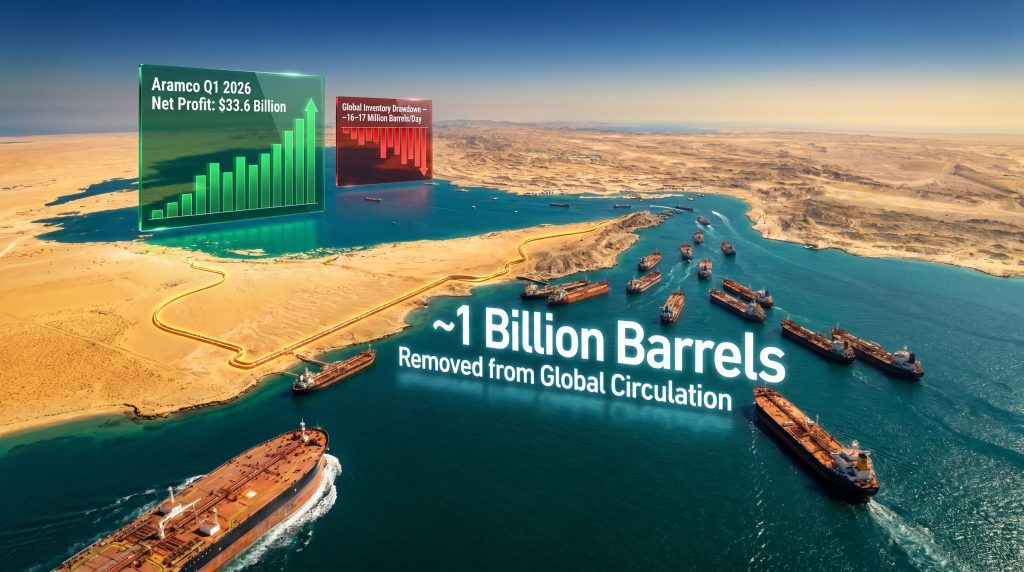
Saudi Aramco's President and CEO, Amin Nasser, stated publicly on 10 May 2026 that the world has lost approximately one billion barrels of oil over the preceding two months as a direct consequence of shipping disruptions through the Strait of Hormuz. This figure has circulated widely, but its full implications deserve more careful examination than the headline typically receives.
To put the scale in context:
| Metric | Estimated Figure |
|---|---|
| Barrels effectively removed from global circulation | ~1 billion barrels |
| Disruption timeframe | Approximately 2 months |
| Implied average daily supply impact | ~16 to 17 million barrels per day |
| Global daily oil consumption (approximate) | ~103 million barrels per day |
The billion-barrel figure does not represent crude that was destroyed or permanently lost from the ground. It represents oil that could not be shipped, was diverted at substantially elevated cost, or was effectively withheld from consuming markets during the disruption window. The distinction matters, but it offers less comfort than it might appear to.
Even crude that was merely delayed rather than destroyed has consequences. Refineries that did not receive scheduled deliveries drew down stored inventories to maintain throughput. Commercial stockpiles that were already running below seasonal averages prior to the disruption were depleted further. Strategic petroleum reserves held by governments were tapped to compensate for the shortfall. All of these buffers now require replenishment, and replenishment takes time.
Nasser made this point with notable directness, stating that reopening shipping routes is fundamentally different from normalising a market that has been deprived of approximately one billion barrels of oil. This distinction is critical and frequently misunderstood by markets that tend to interpret physical route reopening as the endpoint of a supply crisis rather than merely the beginning of a recovery process.
Why Recovery Takes Quarters, Not Weeks
The mechanics of oil market recovery following a major supply disruption are less intuitive than they appear. Several reinforcing factors extend the normalisation timeline well beyond the period of physical disruption:
- Inventory rebuilding lag: Strategic and commercial stockpiles drawn down during the crisis cannot be replenished at the same rate they were depleted. Supply must run above demand for an extended period to restore buffer levels.
- Freight market inertia: Elevated shipping rates, rerouting contracts, and tanker availability constraints do not normalise instantaneously when a waterway reopens. Charter market dynamics reflect longer-term risk assessments.
- Refinery scheduling disruptions: Refineries that adjusted their crude sourcing, processing schedules, or product slates during the disruption require time to return to optimal configurations.
- Buyer confidence effects: Long-term supply contract renegotiations, spot market risk premiums, and insurance cost adjustments all create pricing inertia that persists beyond physical normalisation.
- Speculative positioning: Financial market participants who positioned for elevated prices during the disruption unwind those positions over time, contributing to price volatility even as physical markets stabilise.
Structural Fragility: The Underinvestment Problem That Predates the Crisis
One of the most important insights Nasser offered alongside the billion-barrel warning was that years of underinvestment in upstream oil production have compounded the strain on already-low global inventories. This framing is significant because it positions the current crisis not as an isolated geopolitical shock but as the collision of a geopolitical trigger with a structurally weakened supply system.
Global upstream capital expenditure contracted sharply during the 2014 to 2016 oil price collapse and again during the COVID-19 period spanning 2020 and 2021. Beyond these cyclical pullbacks, the accelerating narrative around energy transition encouraged institutional capital to reduce exposure to conventional oil and gas exploration, compressing the pipeline of new production capacity coming online in the mid-2020s.
The consequence was predictable in retrospect: entering 2026, global spare production capacity was structurally thin. There was limited buffer available to absorb a demand surge, let alone a supply disruption of this magnitude. Commercial crude inventories in OECD nations had already been trending below five-year seasonal averages before the Hormuz blockade began. The crisis did not create a structural deficit. It collided with one that already existed.
"The current supply crisis reflects the intersection of a geopolitical shock with a structurally under-resourced global oil supply system, a combination that energy economists had flagged as an increasingly probable risk scenario as underinvestment in conventional production accelerated through the early 2020s."
This pre-existing fragility amplifies the price response to supply shocks. When inventory buffers are thin, even moderate supply disruptions produce outsized price movements because the market lacks the cushion to absorb variance. One billion barrels removed from a well-stocked market would be painful. One billion barrels removed from an already-depleted market is categorically more severe.
Aramco's East-West Pipeline: The Bypass That Cannot Fully Substitute
Saudi Aramco has responded to the Hormuz disruption by activating its East-West Pipeline, known as the Petroline, which Nasser described as a critical lifeline in managing the global supply crisis. This infrastructure runs approximately 1,200 kilometres across the Arabian Peninsula, connecting Eastern Province oil fields to the Red Sea export terminal at Yanbu.
The strategic value of this asset is considerable. With a reported throughput capacity of approximately five million barrels per day, the East-West Pipeline provides meaningful alternative export capability at a time when the primary routing is effectively closed. However, important limitations apply:
| Route | Approximate Capacity | Current Risk Profile |
|---|---|---|
| Strait of Hormuz (pre-disruption) | ~20 million bpd global transit | Currently disrupted by blockade |
| Aramco East-West Pipeline | ~5 million bpd | Operational, Red Sea exposure |
| Other regional alternative routes | Variable and limited | Elevated geopolitical risk |
The pipeline capacity, while significant, cannot fully substitute for the total volume that ordinarily transits Hormuz from all Persian Gulf producers combined. Furthermore, Red Sea routing introduces its own geopolitical risk exposure. Insurance premiums for Red Sea transit, tanker availability at Yanbu, and the security environment along this alternative corridor all constrain practical throughput below theoretical capacity.
What the East-West Pipeline represents, in strategic terms, is partial mitigation rather than a complete solution. It demonstrates the value of infrastructure redundancy whilst simultaneously illustrating why no single alternative can absorb the full consequence of Hormuz disruption.
Aramco's Q1 2026 Results: The Financial Arithmetic of Supply Crisis
Saudi Aramco reported a jump of approximately 25 to 26 percent in net profit for the first quarter of 2026, with earnings reaching approximately $33.6 billion. The company declared a dividend of approximately $21.9 billion for the quarter. These figures represent the direct financial translation of supply constraint into producer revenue.
This divergence reflects a structural feature of how oil supply crises distribute costs and benefits across the global economy:
- Producing nations and integrated majors capture windfall revenues during periods of elevated prices driven by supply constraint.
- Asian importing nations, which collectively represent the world's largest demand bloc for Persian Gulf crude, absorb higher energy costs that compress industrial margins and elevate domestic fuel prices.
- Refinery operators in price-exposed markets face margin compression as crude input costs rise faster than product prices can adjust.
- Shipping companies and tanker operators capture elevated charter rates during the disruption period, representing a transfer of value from cargo owners to vessel operators.
Nasser's reaffirmation that Asia remains a key priority for Aramco despite the current routing disruptions reflects an awareness that this asymmetric financial outcome carries long-term strategic implications. If sustained elevated prices accelerate demand destruction or energy diversification in Asian markets, the long-term revenue outlook for Gulf producers becomes more complicated even as near-term profitability reaches record levels.
The next major ASX story will hit our subscribers first
Asia's Disproportionate Exposure: The World's Largest Import Bloc at Risk
Asia accounts for the majority of global seaborne crude oil imports. China, India, Japan, South Korea, and Southeast Asian nations collectively represent the world's largest concentration of oil demand, and the overwhelming majority of Persian Gulf crude destined for these markets ordinarily transits the Strait of Hormuz. Consequently, Asian refiners carry a disproportionate share of the exposure created by the current blockade.
The practical consequences across the region include higher freight costs for crude sourced through alternative routes, compressed refinery margins, elevated domestic fuel prices across manufacturing-intensive economies, and currency and trade balance pressures in nations with large crude import bills denominated in US dollars.
The crisis is, however, accelerating strategic conversations about long-term energy security architecture across the region. These discussions include diversification of crude import sources, expansion of strategic petroleum reserve capacity, acceleration of domestic renewable energy deployment, and bilateral energy security agreements with Gulf producers that incorporate infrastructure redundancy provisions.
Scenario Analysis: How Long Before Markets Normalise?
The duration of market disruption is ultimately a function of geopolitical resolution rather than logistical adaptation. According to reporting by the Economic Times, even the most effective alternative routing strategies cannot fully substitute for restored Hormuz traffic at scale. This reality frames three distinct recovery scenarios:
| Scenario | Timeline to Market Normalisation | Key Determining Variable |
|---|---|---|
| Rapid Hormuz Reopening | 3 to 6 months | Speed of diplomatic resolution |
| Prolonged Disruption | 12 to 24 months | Duration of blockade |
| Escalation and Broader Conflict | Indefinite | Geopolitical resolution pathway |
Scenario One: Rapid Reopening (3 to 6 Month Recovery)
If Strait of Hormuz shipping resumes within weeks, the inventory rebuilding process could be substantially complete within three to six months under conditions of stable demand. Price volatility would likely persist through the rebuilding phase before gradually normalising as stockpiles recover and freight markets stabilise.
Scenario Two: Prolonged Disruption (12 to 24 Month Stress)
If the blockade extends through the second quarter of 2026 and beyond, the structural inventory deficit deepens materially. Alternative routing costs become embedded in global freight benchmarks. Demand destruction begins to appear in price-sensitive Asian markets as elevated costs compress economic activity.
Scenario Three: Escalation
Further escalation involving additional regional actors could extend disruption timelines indefinitely. In this scenario, market normalisation becomes contingent on geopolitical resolution. Coordinated strategic petroleum reserve releases by International Energy Agency member nations would likely be deployed, but SPR capacity is finite and represents a bridge rather than a solution.
Will the Crisis Trigger a New Upstream Investment Cycle?
Historical precedent suggests that sustained supply deficits and elevated prices eventually catalyse new upstream investment cycles. If crude prices remain elevated through the current disruption and recovery period, a renewed push for upstream capital expenditure becomes increasingly probable, particularly in politically stable producing regions.
The most likely destinations for new investment flows include:
- Gulf Cooperation Council producers including Saudi Arabia, the UAE, and Kuwait, which combine existing infrastructure, low production costs, and demonstrated capacity expansion capability.
- US shale operators, which retain the ability to respond relatively quickly to sustained price signals, albeit at higher breakeven costs than Gulf producers.
- West African deepwater producers in Nigeria, Angola, and Senegal, offering supply routes entirely independent of Hormuz exposure.
- Brazil's pre-salt formations, where Petrobras-led deepwater production represents a significant and growing non-OPEC, non-Hormuz supply source expanding steadily through the early 2020s.
The irony of the current moment is that the underinvestment narrative that contributed to supply fragility may now be partially reversed by the very crisis that underinvestment helped amplify. Capital follows price signals, and sustained elevated prices are among the most powerful investment incentives the industry knows.
Frequently Asked Questions
What caused the loss of 1 billion barrels of oil from global markets?
The figure represents crude that was effectively removed from global circulation over approximately two months due to Iran's blockade of the Strait of Hormuz, which emerged from the broader regional conflict involving the US and Israel. Tanker traffic through the waterway was severely curtailed, preventing crude from reaching consuming markets at normal volumes. Aramco CEO Amin Nasser confirmed this figure publicly on 10 May 2026.
Why won't markets recover quickly once shipping routes reopen?
Physical route reopening restores access but does not restore depleted inventories. Commercial and strategic stockpiles drawn down during the disruption require months of above-average supply to rebuild. Freight markets, refinery scheduling, and buyer confidence also take time to normalise, creating a recovery lag that extends well beyond the physical disruption window.
How is Saudi Aramco managing the Strait of Hormuz disruption?
Aramco has activated its East-West Pipeline, routing crude across the Arabian Peninsula to the Red Sea port of Yanbu, bypassing the Strait of Hormuz entirely. While this provides meaningful bypass capacity, it cannot fully substitute for the total volume ordinarily exported through Hormuz from all Persian Gulf producers combined.
Which countries face the greatest risk from the Hormuz disruption?
Asian nations, particularly China, India, Japan, and South Korea, carry the greatest exposure as the world's largest importers of Persian Gulf crude. The overwhelming majority of that crude ordinarily transits Hormuz, creating a routing dependency that leaves Asian refiners disproportionately affected by higher costs, reduced supply availability, and compressed margins.
What does the warning about 1bn barrels lost signal for oil prices?
The Aramco CEO warns 1bn barrels lost framing signals that price normalisation will not follow automatically from route reopening. Supply deficits of this scale, combined with pre-existing low inventory levels and years of upstream underinvestment, create conditions for sustained price elevation through the inventory rebuilding phase. Markets pricing in a rapid return to pre-crisis levels may be underestimating the structural nature of the current shortfall.
Key Takeaways
- Approximately one billion barrels of oil were effectively removed from global circulation over a two-month period due to Iran's blockade of the Strait of Hormuz, representing a supply shock of historic proportions confirmed by Aramco CEO Amin Nasser.
- The Aramco CEO warns 1bn barrels lost will slow oil market recovery, and the company's own experience validates this warning: even with the East-West Pipeline bypass operational, the scale of the deficit exceeds what alternative infrastructure can fully absorb.
- Market normalisation requires inventory rebuilding, freight market stabilisation, and restored buyer confidence, a process measured in quarters rather than weeks regardless of how quickly physical routes reopen.
- Years of underinvestment in upstream production, compounded by ESG-driven capital reallocation away from conventional exploration, had already thinned global spare capacity and inventory buffers before the crisis began, amplifying its impact.
- Saudi Aramco's Q1 2026 net profit reached approximately $33.6 billion, reflecting a 25 to 26 percent increase on the prior year and illustrating the financial asymmetry that supply crises create between producers and consumers.
- Asia faces the greatest near-term vulnerability, whilst the crisis is likely to accelerate long-term energy security investments across importing nations, including supply diversification, strategic reserve expansion, and renewable energy deployment.
- The duration of disruption will ultimately be determined more by geopolitical resolution than by any logistical or infrastructure workaround, and sustained elevated prices may paradoxically catalyse the new upstream investment cycle the global supply system urgently needs.
This article is based on publicly available information including reporting by Arab News and Asharq Al-Awsat dated 10 May 2026. Certain statistics relating to global oil consumption, spare capacity levels, and OECD inventory trends are drawn from industry-standard estimates and may be subject to revision as updated data becomes available. Nothing in this article constitutes financial advice. Scenario projections are analytical frameworks, not predictions, and actual market outcomes will depend on geopolitical, economic, and operational factors that remain subject to significant uncertainty.
Want to Know Which ASX Mining Companies Could Benefit From Rising Energy and Commodity Prices?
Discovery Alert's proprietary Discovery IQ model delivers real-time alerts on significant ASX mineral discoveries the moment they are announced, turning complex market data into actionable investment insights for both short-term traders and long-term investors. Explore how major mineral discoveries have historically generated substantial returns by visiting Discovery Alert's dedicated discoveries page, or begin your 14-day free trial at Discovery Alert to position yourself ahead of the market.