August 4, 2026
When Geography Becomes Destiny: How Chokepoint Warfare Reshapes the Economics of Oil Supermajors
The relationship between physical geography and financial performance has never been more starkly illustrated than in the current operating environment facing the world's largest crude oil producer. When a single waterway carrying roughly one-fifth of global oil supply becomes a contested warzone, every assumption about production capacity, export architecture, and revenue predictability is stress-tested simultaneously. The resulting financial picture is, counterintuitively, not one of collapse — it is one of adapted resilience, price-amplified earnings, and infrastructure that was built for exactly this kind of emergency.
Understanding how Aramco profit up, export capacity unmoved can coexist with a dramatic production curtailment requires moving beyond headline numbers and into the structural mechanics of how a vertically integrated national oil company actually generates and protects value under geopolitical duress. Furthermore, the broader context of geopolitical trade tensions reshaping energy flows globally makes this case study particularly instructive.
When big ASX news breaks, our subscribers know first
The Price-Volume Trade-Off: Why Fewer Barrels Can Still Mean More Revenue
The financial architecture of a state-controlled national oil company differs fundamentally from an independent producer. NOCs like Saudi Aramco carry exceptionally low lifting costs — widely estimated at well below $5 per barrel for conventional Saudi Arabian crude — meaning that even at sharply reduced production volumes, per-barrel margins remain substantial when prices are elevated.
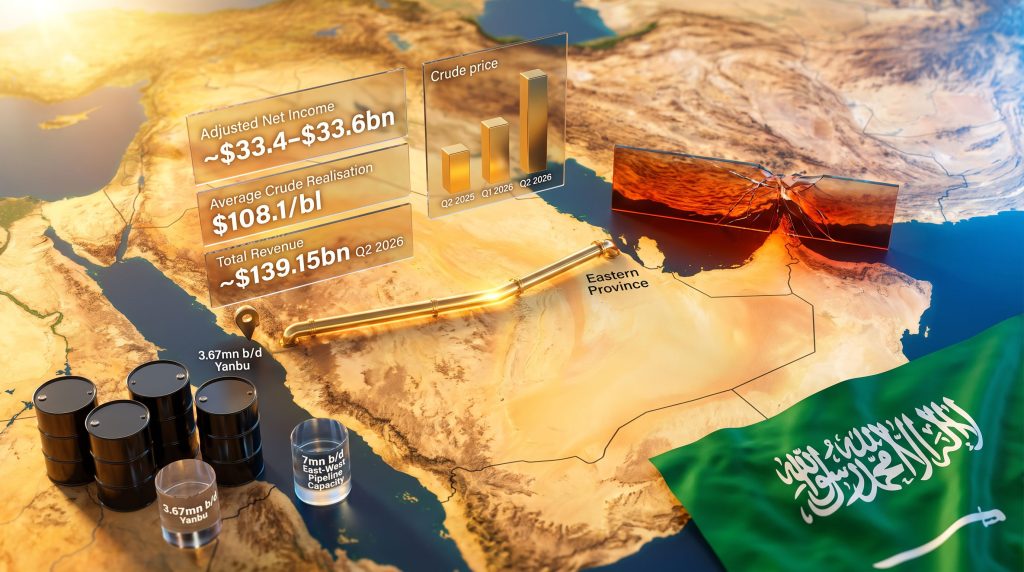
The numbers from Q2 2026 illustrate this dynamic with unusual clarity:
| Financial Indicator | Q2 2025 | Q1 2026 | Q2 2026 |
|---|---|---|---|
| Adjusted Net Income | ~$25.2bn | ~$33.8bn | ~$33.4–$33.6bn |
| Total Revenue | ~$108.6bn | ~$124.6bn | ~$139.15bn |
| Average Crude Realisation | ~$66.7/bl | ~$76.9/bl | ~$108.1/bl |
| Total Hydrocarbons Output | ~12.780mn boe/d | ~12.614mn boe/d | ~9.463mn boe/d |
| Liquids Production | ~10.48mn b/d | ~10.56mn b/d | ~7.57mn b/d |
| Gas Production | ~11.85bn ft³/d | ~10.51bn ft³/d | ~9.92bn ft³/d |
| Base Dividend (Q2) | N/A | N/A | ~$21.9bn |
The data reveals something that many investors initially find difficult to reconcile: total revenues climbed to approximately $139.15 billion in Q2 2026, up from $108.6 billion in the corresponding prior-year period, despite liquids output falling by roughly 28% over the same timeframe. Adjusted net income reached approximately $33.4–$33.6 billion, exceeding the median analyst consensus of $31.59 billion by roughly $1.8 billion and representing a year-on-year increase of approximately 25–26%.
The mechanism is straightforward but powerful: Aramco's average crude realisation climbed from $66.7 per barrel in Q2 2025 to $108.1 per barrel in Q2 2026, a 62% increase in price per unit that more than absorbed the financial drag of producing and exporting significantly fewer barrels. This is the mathematical core of the paradox.
Key insight: For producers with ultra-low extraction costs, a sufficiently large price increase per barrel can generate greater total revenue from fewer barrels than from high volume at lower prices. At approximately $108/bl, the price windfall effectively monetised scarcity that Aramco itself could not control.
Rerouting Around a Closed Strait: The East-West Pipeline's Strategic Moment
How Saudi Arabia's Export Architecture Was Redrawn Overnight
Before the US-Iran conflict commenced on 28 February 2026, the Strait of Hormuz served as the dominant corridor for Saudi crude exports. The effective closure of this passage triggered by the conflict forced an immediate and consequential rerouting of export flows — a logistical challenge that Saudi Arabia was, due to decades of infrastructure investment, better positioned to absorb than most of its Gulf neighbours. The oil price geopolitical factors at play here are among the most consequential seen in decades.
The asset that made this possible is the East-West Pipeline, a piece of infrastructure whose strategic value is difficult to overstate in the current environment. Its key attributes:
- Maximum throughput capacity: 7 million barrels per day
- Route: Connects Saudi Arabia's hydrocarbon-producing Eastern Province directly to the Red Sea port of Yanbu
- Strategic function: Bypasses the Strait of Hormuz entirely, providing a Hormuz-independent export corridor
- Status: Pre-existing infrastructure, not a conflict-era construction project
This distinction matters considerably. The pipeline's capacity represents a rerouting of existing export flows, not a structural addition to Saudi Arabia's long-term export capability. The total ceiling on exports effectively shifted from being constrained by Hormuz transit capacity to being constrained by the pipeline's 7 million b/d throughput limit. For context, pre-conflict Saudi crude output was approximately 10.88 million b/d in February 2026 — the last month of normal operations before the war began.
The Houthi Variable and Multi-Route Export Management
Redirecting exports through Yanbu introduced a second layer of geopolitical risk. Houthi maritime threats targeting Saudi trade routes through the Red Sea created genuine uncertainty about the sustainability of this bypass corridor. According to vessel-tracking data compiled by Kpler, Saudi crude exports from Yanbu fell by approximately 470,000 b/d month-on-month to 3.67 million b/d in July 2026, with growing volumes being redirected northward toward Egypt rather than south through the contested Bab el-Mandeb strait.
Aramco's response was to activate a multi-route export management strategy drawing on all available pathways simultaneously:
- Bab el-Mandeb transit — continued use of the southern Red Sea exit despite Houthi activity
- Egypt's Suez Canal — northward routing for volumes destined for European and Atlantic Basin markets
- The Sumed pipeline — a 2.5 million b/d connection linking Egypt's Ain Sukhna port on the Red Sea to Mediterranean export terminals, providing a Suez Canal bypass option for very large crude carriers (VLCCs) that cannot transit the canal fully laden
Aramco's chief executive Amin Nasser stated publicly that the Houthi disruption had no material impact on the company's overall export capability, characterising the multi-route approach as sufficient to maintain commercial supply commitments. This assessment is consistent with the revenue data — export disruptions were real but not financially catastrophic at prevailing price levels.
Production Capacity: Temporarily Curtailed, Structurally Intact
The Critical Distinction Between Logistical and Technical Damage
One of the most consequential pieces of information embedded in Aramco's Q2 2026 results is the clarification by management that the company's production infrastructure has not been materially degraded. The curtailment of output from approximately 10.88 million b/d in February 2026 to 7.57 million b/d in liquids terms during Q2 2026 is a logistical and geopolitical constraint, not a technical one.
Aramco's leadership indicated that the company could restore crude production to pre-conflict levels within days of a Hormuz reopening, and could reach its 12 million b/d maximum sustainable capacity (MSC) within approximately three weeks. This is a meaningful signal: it implies that the underground reservoirs, wellheads, gathering systems, and processing facilities required to sustain 12 million b/d of production remain operational and undamaged.
Although Aramco confirmed that certain facilities were targeted in attacks during both Q2 2026 and July 2026, management characterised the financial and operational impact as non-material. The company stated that any conflict-related damage costs would be absorbed within its existing 2026 capital expenditure envelope of $50–55 billion — without requiring supplementary financing or project deferrals.
Three Scenarios for the Production Recovery Pathway
Scenario 1 — Rapid Normalisation: A swift Hormuz reopening following diplomatic resolution would allow Aramco to restore production to approximately 10.88 million b/d within days and to full 12 million b/d MSC within three weeks. Revenue implications would depend heavily on the pace of crude price normalisation; a rapid de-escalation could compress the price premium faster than production volumes recover.
Scenario 2 — Prolonged Conflict and Sustained Rerouting: Continued reliance on the East-West Pipeline caps physical export capacity well below pre-conflict levels. At sustained crude prices above approximately $90/bl, Aramco's current earnings trajectory would remain financially viable even at reduced volumes. However, the 7 million b/d pipeline ceiling would constrain revenue growth regardless of demand.
Scenario 3 — Infrastructure Escalation: The most adverse scenario involves significant physical damage to production or export infrastructure. Management's current posture suggests this is not considered a near-term base case, given continued advancement of major field development projects including the 600,000 b/d Zuluf development (targeted for 2026 online date) and the 50,000 b/d Dammam Phase 2 project (targeted 2027).
Strategic signal: The continued advancement of long-cycle capital projects during an active conflict is perhaps the clearest indication of Aramco's management assessment: the disruption is viewed as temporary, and long-term capacity expansion remains the strategic priority.
OPEC+ Quotas, CPC Disruption, and the Compounding Supply Squeeze
When Paper Commitments Diverge from Physical Reality
The OPEC+ core group of seven producers — Saudi Arabia, Russia, Iraq, Kuwait, Kazakhstan, Algeria, and Oman — agreed to raise collective production targets by a further 188,000 b/d from September 2026. This completed, at least nominally, the phased unwinding of the 1.65 million b/d voluntary production cuts first announced in 2023. In this context, OPEC's market influence remains a critical factor shaping how these paper quotas translate into real-world price outcomes.
The practical reality is that this quota increase carries almost no near-term physical supply implications. Mideast Gulf disruptions have suppressed actual output across multiple producing nations well below their theoretical quotas, meaning the paper increase does not translate into additional barrels reaching consuming markets. OPEC demand forecasts have consequently been subject to significant revision as the conflict persists.
Simultaneously, a geographically separate but compounding disruption has been affecting Caspian crude flows. Drone attacks targeting tankers at the Caspian Pipeline Consortium (CPC) terminal on Russia's Black Sea coast have materially disrupted loadings of CPC Blend crude since mid-July 2026. Kazakhstan's energy ministry denied reports of a complete CPC shutdown but acknowledged the disruption. At least eight tankers have been targeted since mid-July.
The simultaneous constraint on both Persian Gulf light crude (via Hormuz) and Caspian light sour crude (via the CPC terminal) has had an outsized effect on global light sour crude availability — a grade specification that many sophisticated refineries are specifically configured to process. This dual disruption has contributed meaningfully to the price premium that underpins Aramco's Q2 revenue outperformance.
The Diplomatic Variable: How Peace Talks Move Oil Prices
Price Sensitivity to De-Escalation Signals
The market's reaction to even tentative diplomatic signals illustrates the magnitude of the geopolitical risk premium currently embedded in crude prices. On 3 August 2026, following President Trump's announcement of cancelled military strikes and a claim that negotiations with Iran were resuming, WTI futures fell by more than 5%, declining approximately $4.33/bl to $80.34/bl, while Brent dropped approximately $4.16/bl to $83.77/bl.
This single-session move was triggered by signals of potential de-escalation, not by any confirmed reopening of the Strait of Hormuz. Iran's foreign ministry specifically denied holding direct talks with the US, noting instead that bilateral discussions with Oman were focused on establishing a safe shipping corridor — and explicitly clarifying that even those discussions would not independently lead to a strait reopening.
Iran's stated position links any Hormuz reopening to the cessation of what it characterises as US violations of the interim agreement that briefly allowed transits in mid-June 2026. This creates an inverse relationship between diplomatic progress and Aramco's per-barrel revenue realisation. A scenario in which meaningful diplomatic resolution is reached rapidly would simultaneously reduce the crude price premium that has driven Aramco's earnings outperformance, while production ramp-up would lag by days to weeks.
The next major ASX story will hit our subscribers first
The Oilfield Services Recovery Signal
The broader oil services industry has already begun positioning for a post-conflict rebound in Middle East activity. Major services companies including SLB and Halliburton have identified the region as a primary source of production growth once geopolitical conditions permit resumed operations. Industry analysts have noted that the labour forces in affected Middle East countries remain localised, equipment has not been materially damaged, and readiness to resume operations is high pending operational clearance.
SLB has indicated that final investment decisions for long-cycle projects are projected to increase by approximately 30% in 2026, with Africa leading the near-term growth trajectory and the Middle East positioned as a significant secondary driver of upstream capital expenditure growth in 2027. This forward-looking investment posture reinforces the view that the current disruption is understood by the industry as cyclical rather than structural. Saudi Arabia's resource strategy, moreover, extends well beyond hydrocarbons, adding further long-term resilience to the kingdom's economic positioning.
Frequently Asked Questions
Why did Aramco's profits rise despite producing significantly less oil?
Higher crude realisation prices more than offset lower production volumes. Average per-barrel pricing rose from approximately $66.7/bl in Q2 2025 to $108.1/bl in Q2 2026, a 62% increase that drove total revenues to approximately $139.15 billion despite the production shortfall. This is the defining characteristic of the Aramco profit up, export capacity unmoved dynamic.
What is the East-West Pipeline and why does it matter now?
The East-West Pipeline is a 7 million b/d capacity infrastructure asset connecting Saudi Arabia's Eastern Province to the Red Sea port of Yanbu. It bypasses the Strait of Hormuz entirely and has become Aramco's primary crude export corridor since the effective closure of the strait following the onset of the US-Iran conflict in February 2026.
Has Aramco permanently lost export or production capacity due to the conflict?
Management assessments indicate the production infrastructure is largely intact. Aramco's leadership stated the company could restore output to pre-conflict levels within days of a Hormuz reopening and reach its 12 million b/d maximum sustainable capacity within approximately three weeks.
What major projects is Aramco still advancing despite the conflict?
Two major field developments remain on schedule:
- Zuluf field development — approximately 600,000 b/d of capacity targeted for 2026
- Dammam Phase 2 — approximately 50,000 b/d of capacity targeted for 2027
What happens to Aramco's earnings if crude prices normalise rapidly?
This represents the primary financial risk in a rapid de-escalation scenario. If diplomatic resolution compresses the crude price premium faster than production volumes recover, there would be a transitional period in which both volume and price headwinds coexist. The duration and severity of this window would depend on the pace of Hormuz reopening logistics and OPEC+ coordination on production restoration.
Resilience by Design: The Infrastructure Dividend
The performance of the East-West Pipeline during this crisis is a case study in the long-term value of export redundancy investment. Built decades ago as part of Saudi Arabia's strategic infrastructure programme, the pipeline was not constructed for the 2026 conflict — it was constructed for exactly this category of conflict. The fact that it is now demonstrating its strategic value does not make the outcome lucky; it makes the original investment decision prescient.
What is genuinely outside Aramco's control, however, is the crude price environment. The financial resilience observed in Q2 2026 is substantially a function of elevated prices driven by a geopolitical premium that Aramco neither created nor can sustain indefinitely. Strip out the price windfall, and the volume reduction would tell a very different earnings story.
This is the fundamental tension embedded in the Aramco profit up, export capacity unmoved narrative: the company's operational adaptability is real and demonstrated, but its financial outperformance during this period is as much a product of market scarcity as it is of management competence. Investors and market analysts tracking Aramco's trajectory should treat these two sources of earnings resilience as analytically distinct — because when the geopolitical premium eventually compresses, only one of them will remain.
This article contains forward-looking statements, scenario projections, and financial analysis based on publicly reported figures and market data. Readers should note that geopolitical situations are inherently unpredictable, and actual outcomes regarding oil prices, production restoration timelines, and diplomatic developments may differ materially from scenarios discussed herein. Nothing in this article constitutes investment advice.
For additional context on global crude market dynamics and Strait of Hormuz disruption scenarios, Argus Media publishes commodity-specific pricing data and geopolitical market analysis for energy professionals. In addition, the U.S. Energy Information Administration provides comprehensive data on global petroleum markets, supply disruptions, and price trend analysis.
Want to Identify the Next Major Resource Discovery Before the Market Does?
When geopolitical disruptions reshape global commodity flows overnight, as the Hormuz crisis has demonstrated, being positioned ahead of the market is everything — Discovery Alert's proprietary Discovery IQ model scans ASX announcements in real time, delivering instant alerts on significant mineral discoveries across more than 30 commodities, so subscribers can act on actionable opportunities the moment they emerge. Explore historic discoveries and their extraordinary returns, then begin your 14-day free trial to ensure you are never the last to know when the next major find is announced.